50 years later, the bell still tolls for the Edmund Fitzgerald
It won’t be a surprise when SiriusXM radio DJ Phlash Phelps begins his Nov. 10 show with Gordon Lightfoot’s haunting ballad “The Wreck of the Edmund Fitzgerald.”
Nov. 10 …
Edmund Fitzgerald programs at Capital Area District Libraries
Ric Mixter, shipwreck historian
Monday, Oct. 6, 6:30-7:30 p.m., Leslie branch
Wednesday, Oct. 8, 2-3 p.m., Aurelius branch; 6-7 p.m., South Lansing branch
Michael Fornes, storytelling/musical program
Monday, Oct. 13, 6-7 p.m., Okemos branch
CADL plans programs At three branches For Great Lakes freighter
It won’t be a surprise when SiriusXM radio DJ Phlash Phelps begins his Nov. 10 show with Gordon Lightfoot’s haunting ballad “The Wreck of the Edmund Fitzgerald.”
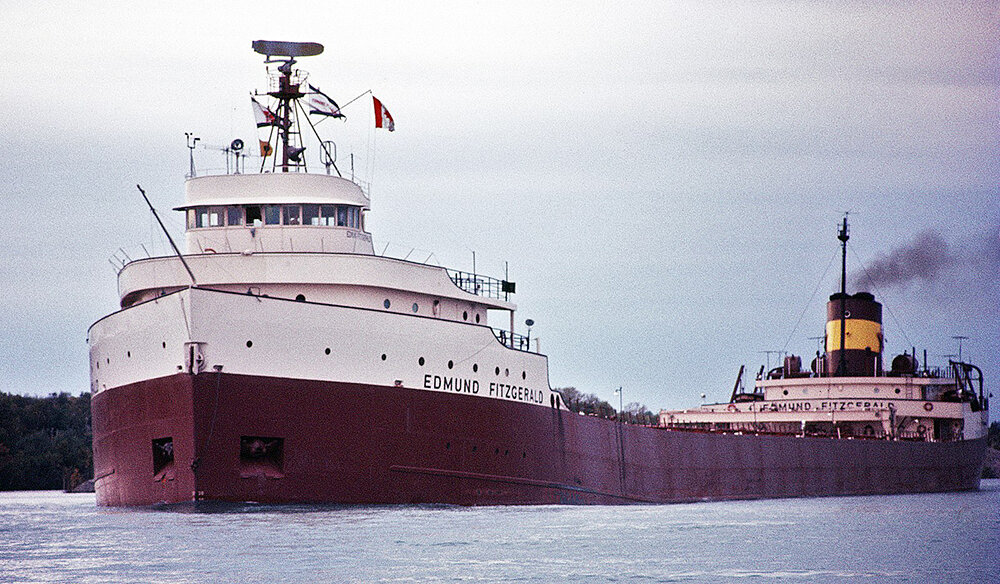
Nov. 10 is the 50th anniversary of the freighter’s sinking in Lake Superior, which resulted in the tragic loss of 29 sailors.
The 703-foot-long Great Lakes ship was hauling taconite from Wisconsin to Zug Island near Detroit when a ferocious storm sent it to the bottom. A controversial hearing on the sinking’s cause was unable to come up with an answer. It’s still debated.
Over the decades, exploratory dives using submersibles and robots have raised many more questions. The Edmund Fitzgerald sits in two pieces, 170 feet apart, approximately 17 miles off the shore in Canadian waters.
This year, the Great Lakes Shipwreck Museum at Whitefish Point will hold a special anniversary commemoration. The maritime museum displays the ship’s original bell, which will be rung 29 times, once for each lost crew member, in a tradition that began the day after the shipwreck. Surviving family members are expected to attend a private ceremony following a public one.
As it does annually on Nov. 10, the Mariners’ Church in Detroit will ring its bell 30 times — the additional time for all Great Lakes sailors lost at sea.
On May 23, 2023, the church bell rang 30 times to honor Lightfoot, who died that month.
Mariners’ Church was founded in 1842 as a place where Great Lakes sailors could pray while stopping in Detroit.
The Edmund Fitzgerald was not the deadliest Great Lakes shipwreck. That distinction goes to a passenger ship that sank in Lake Michigan in 1860, killing 300. The Fitzgerald’s sinking is the most famous, though. That’s due to Lightfoot’s 1976 ballad.
Locally, in landlocked Lansing, Capital Area District Libraries will host two programs on the Edmund Fitzgerald.
Ric Mixter, a noted shipwreck historian and documentarian who produced a DVD called “The Edmund Fitzgerald Investigations,” will appear at three CADL branches this month.
Mixter, of Wixom, explored the Edmund Fitzgerald site in a submersible in 1994. In his lectures, he shows a video of the ship resting on the lake bottom.
Mixter said he used to dive for wrecks, but age and technology have changed that approach. “As I get older, I’m happy to throw a robot over the side to search wrecks,” he said.
He noted that his lectures are factual and not based on the “ghosts and gold” themes that have become popular around Great Lakes wrecks. He said a lot of information on the Edmund Fitzgerald’s sinking is fiction, “some perpetuated by Lightfoot’s song.”
In a separate program, Michael Fornes will step into Lightfoot’s shoes, recreating how the song was written, its inspiration and the lyrics’ meaning.
Fornes has written books on the Mackinac Bridge, Grand Hotel and U.S. Coast Guard Cutter Mackinaw in addition to a career as a journalist and professional tour guide. He was also a professional hockey broadcaster for more than two decades. “I’m a hockey guy,” he said.
The focus of the tribute show, which Fornes has been doing for 17 years, “is an honest effort to keep Gord’s music alive.”
“Lightfoot felt a real connection to the Great Lakes,” Fornes said, citing Lightfoot’s participation in the Port Huron to Mackinac Race. Among the songs Fornes features are “Early Morning Rain,” “If You Could Read My Mind,” “Sit Down Young Stranger” and, of course, “The Wreck of the Edmund Fitzgerald.”