
The poet and the drain commissioner
No one likes to take a pop quiz after reading something, so let’s get it over with now.
Which of the following two statements was made by Lansing’s poet laureate, and which was made …
“We Are Water” poetry contest
Friday, Aug. 15-Oct. 17
Contest guidelines:
Open to residents of Clinton, Ingham and Eaton counties, age 10 and older.
Participants can submit up to three poems, each with no more than 25 lines.
Five winners will receive a 0 cash award. The winning poems will be featured on signs along the walking paths in the Tollgate Wetlands, 1101 N. Fairview Ave., Lansing.
For specific prompts and helpful hints to get the juices flowing, see the contest website: ruelainestokes.com/wearewater
Poems must be submitted individually by Oct. 17 to PoetryPathway71@gmail.com. Participants should include their name in the subject line, along with the title of the poem.
Emails should include two copies of the poem (each in a Microsoft Word document): one with the participant’s full name, age, address, phone number and email address, and one without any identifying information.
Two streams converge in ‘We Are Water’ poetry contest
No one likes to take a pop quiz after reading something, so let’s get it over with now.
Which of the following two statements was made by Lansing’s poet laureate, and which was made by the Ingham County drain commissioner?
A: “Poetry is a form of art, and it’s also a form of communication.”
B: “The water rushes over crushed limestone, which helps remove the acidity.”
Of course, it’s a trick question. Pat Lindemann, Ingham County’s ecologically conscious drain commissioner, is also a poet (and a painter and a musician), so, of course, he said “A.” Ruelaine Stokes, now in her second year as Lansing poet laureate, is not a drain commissioner, but she’s starting to sound like one.
At the end of July, Stokes learned she was one of 23 poets laureate across the nation to receive a $50,000 fellowship from the Academy of American Poets to mount a community project. Hers will literally take local poetry down the drain.
The tri-county “We Are Water” poetry contest will place five poems on durable plaques in the Tollgate Wetlands, Lindemann’s eco-friendly stormwater management mini-paradise on the city’s near east side.
With future support, Lindemann and Stokes hope to add poetry to two more of the region’s stormwater management showpieces, the Groesbeck Drain on the north side of town and the newly completed Montgomery Drain next to the Frandor Shopping Center.
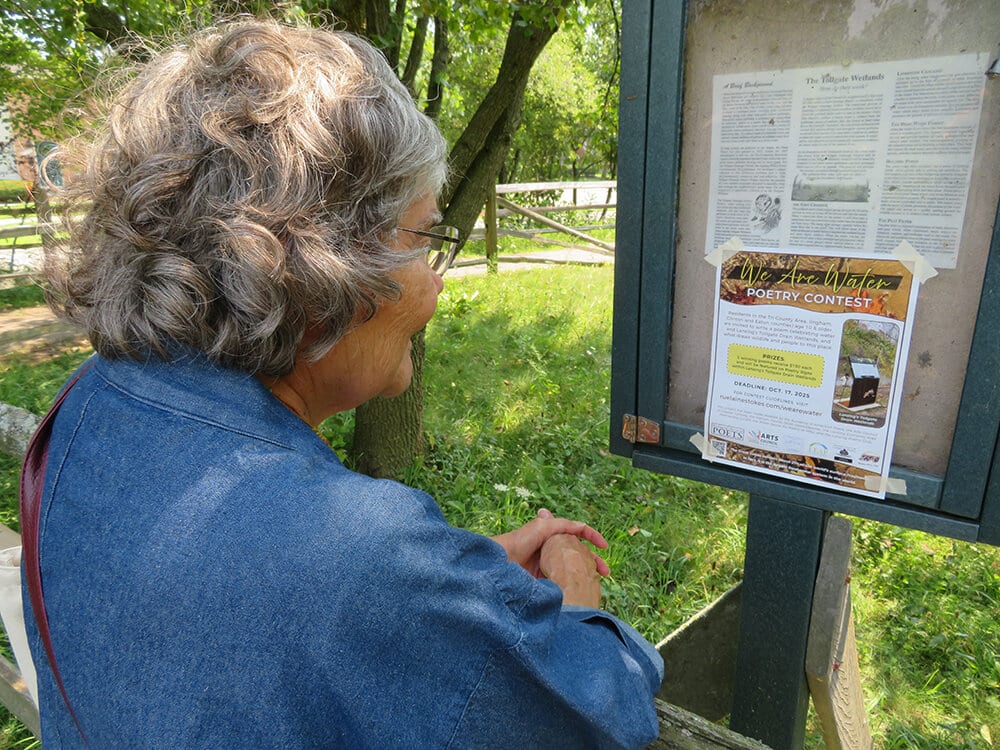
Enshrining verses contributed by the community amid the wildflowers, turtle beds and holding ponds of Lindemann’s nature-mimicking drains is a pleasant enough prospect.
But this confluence of poetry and stormwater management says much more about its two principal movers, and about the quality of life in greater Lansing.
How did these streams get crossed?
‘Who doesn’t like tardigrades?’
On a summer afternoon in 2024, Stokes paid a casual visit to the Tollgate Wetlands.
Goldfinches swarmed over thistles. Bullfrogs grunted from the shallows. Right away, she knew this was no ordinary piece of infrastructure.
Stokes has been a vigorous voice in the Lansing poetry scene for decades, organizing hundreds of events and taking part in many more. When she became Lansing’s poet laureate in 2024, she looked for more ways to bring poetry into people’s lives.
She first envisioned putting poetry in city parks or along the Lansing River Trail. A fellow poet told her about sturdy informational signs at Tollgate that might suit her purpose.
It was supposed to be a prosaic fact-finding visit, but the moment Stokes heard the trickling of water along the limestone cascade and beheld the foliage and wildlife in the southernmost treatment pond, her course was diverted.
“Tollgate is a piece of paradise right here in the city of Lansing,” she said. “It’s right next to Oakland Avenue, one of our major roadways, and there are busy streets on both sides. Yet as you come in, you hear the sound of rushing water, the music of leaves fluttering in the wind, and you come into a peaceful place of ponds, wildlife and beautiful vegetation. I just fell in love with it.”
Instead of inspecting the signs for design and durability, she found herself reading them.
She learned how stormwater is routed through a system of three holding ponds, oxygenated by a series of cascades and lined with natural filters (peat, clay and other materials) that clean the water.
By sending overflow into a similar set of ponds and filters at the nearby Groesbeck Golf Course, Tollgate can handle a 500-year flood without putting any water in the Red Cedar River, according to Lindemann.
“As I started to read the signs, I realized the wetland has this very important and serious purpose,” Stokes said. “I’d never really thought about stormwater management before. I didn’t think about why one place flooded and another didn’t, or how the bad water became good water, and this was a revelation to me.”
Stokes contacted Lindemann’s office to inquire about the signs, but Lindemann did more than refer her to a sign-making company. He invited her to another signature drain project, the Montgomery Drain, a massive undertaking 30 years in the making and only completed last fall.
The verdant, rolling hills of the drain area are tucked bizarrely next to the butt end of the Frandor Shopping Center and serve a square mile of densely packed strip malls, retail businesses and highways.
Stokes and Lindemann walked the paths and beheld the enormous grand cascade on the north end of the drain.
“He explained how the water circulates, how the different natural elements work to remove pollution, how it’s all connected,” Stokes said.
From the ponds behind the Red Cedar Development, the water is pumped to the north end of Ranney Park, where it travels over a spectacular, fizzy cascade that injects more oxygen into it.
The cascade is the drain’s showstopper. Lit dramatically at night, it’s a Cinerama spectacle, anchored by two huge curtains of corrugated limestone. The folds increase the surface area of the water exposed to the limestone.
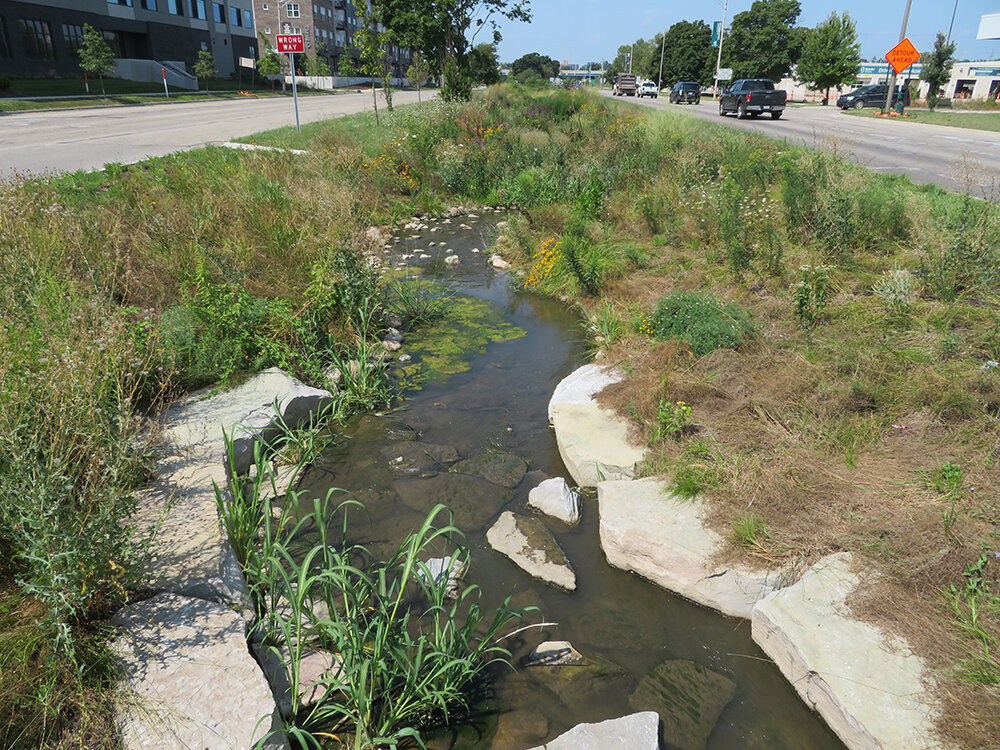
In between, from the great cascade southward to Michigan Avenue, are a series of Tollgate-style holding ponds and natural filters.
“This watershed produces 50,000 to 75,000 pounds of pollutants each year,” Lindemann said. “In this facility, I can handle 100,000 pounds of pollutants in a year.”
Lindemann made use of the Michigan Avenue meridian to route the water into rain gardens and pump it over cascades that will later be topped with sculptures.
Lindemann told Stokes that there’s a lot of phosphorus in the Montgomery Drain stormwater, so phosphorus-eating algae, and the organisms that eat them, are VIP guests.
These include tardigrades, or water bears, microscopic organisms that eat all kinds of junk.
Tardigrades are a hot item these days. You can get plush tardigrades, tardigrade nightlights, tardigrade PJs. They mob the Montgomery Drain in the millions.
Lindemann said he “checks on them” now and then using his own microscope, but he didn’t go into detail. (Do they need reassurance?)
Odds are, the “We Are Water” poetry contest will produce at least one paean to tardigrades. The question is, dactylic pentameter or free verse?
“Who doesn’t like tardigrades?” Stokes said. “They eat pollution.”
Lindemann told Stokes of his plans to make art a part of the Montgomery Drain project. Pedestals are already in place for dozens of sculptures to be installed throughout the drain, funded by a nonprofit organization, Art in the Wild, that was co-founded by Lindemann and his ex-wife, Melody Angel.
“Poetry is a form of art, and it’s also a form of communication,” Lindemann said. (But you know that already from the opening quiz.) “If I can preach clean water through art and poetry and have it paid for by somebody other than the taxpayer, then hah — bingo.”
He suggested that Stokes center the public poetry project on clean water.
Stokes said she was thinking the same thing but was waiting for him to bring up the idea.
“I thought it would be presumptuous of me to suggest that,” Stokes said. “But when he did, I thought, ‘Great.’ It was tremendously exciting that the drain commissioner understood how art and social spaces can work together, the way art can add dimension to people’s experience of our common space.”
Lindemann and Stokes hope that future grants will allow them to extend the poetry from Tollgate to the Montgomery and Groesbeck drains.
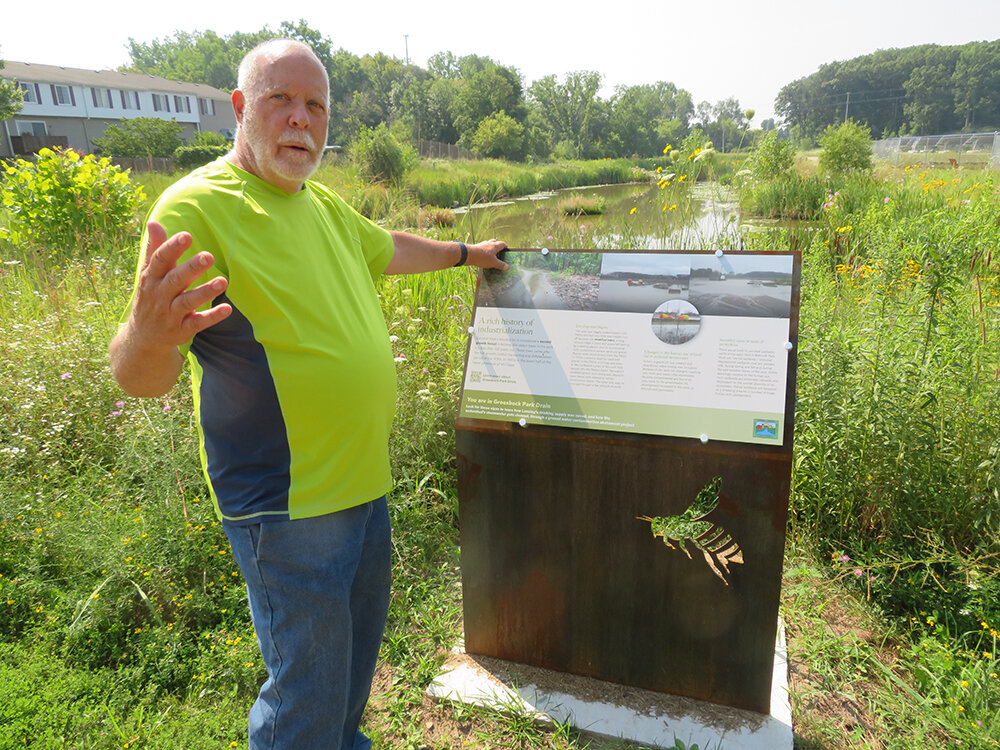
“Her poetry contest poems will go on signs just like this. One could go right here,” Lindemann said, pointing to an informational sign explaining the workings of the filtration pond. The steel stand, made of naturally oxidizing “weathering steel,” is etched with the silhouette of a bee. The stands are bolted to thick concrete pedestals, ready to weather any flood nature can throw at them.
“The base is permanent, but the sign can be removed and replaced,” he said.
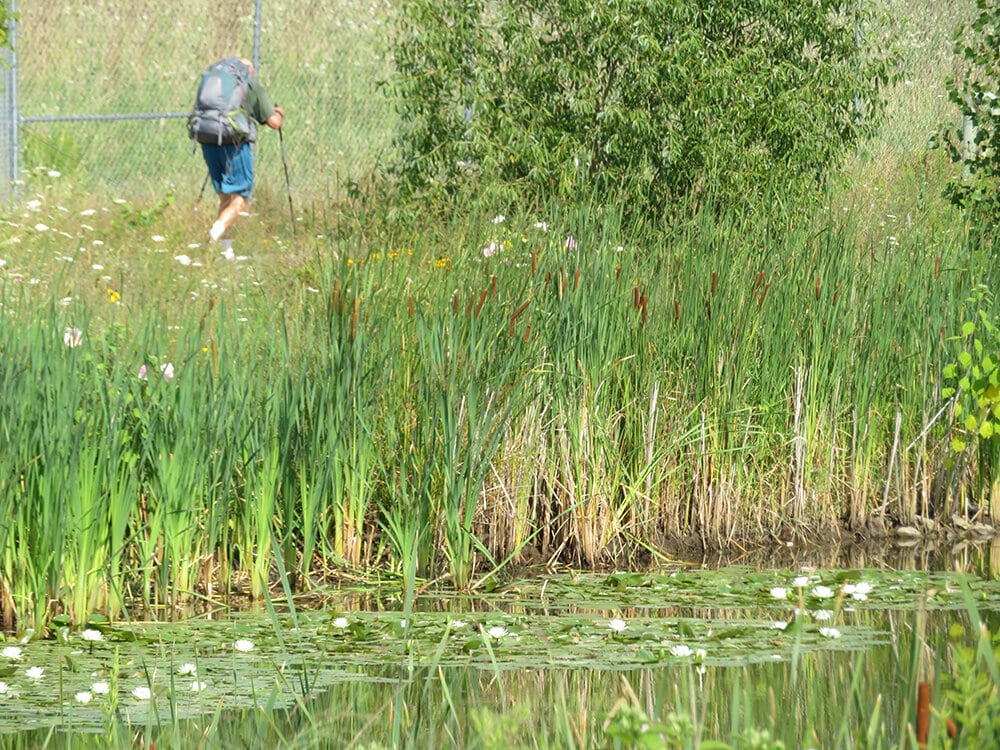
“They’re beautiful and incredibly sturdy,” Stokes said. “The base should last about 100 years, and the plate should last about 20.”
At first, Stokes thought of displaying poems by famous poets that rhapsodize about the importance of water, but she decided against it.
“There’s so much to be gained by involving the community in writing,” she said.
Stokes loves to discover local gems and share her excitement with others. In 2023, she and one of her predecessors as poet laureate, Laura Apol, created a contest called “My Secret Lansing,” inviting local poets to write about a person or place they love. The contest gave birth to a published collection of 86 poems and 55 prose entries.
“Because of that, I had a model in my mind of how to create a contest, and that makes it easier to do it a second time,” Stokes said.
The finished poems will be the end result of a process Stokes hopes will change peoples’ lives.
“I suggest people spend time walking around Tollgate, notebook in hand, and just record what they experience,” she said.
To quicken the creative juices, the contest website offers several prompts and hints for aspiring poets, courtesy of Stokes and Toby Altman. Altman is an assistant professor in MSU’s Residential College for the Arts and Humanities and director of RCAH’s Center for Poetry, a supporter of the “We Are Water” project.
“I grew up in the country as a little kid, running around outdoors in southern California, and I lived close to nature,” Stokes said. “But as I grew up and moved into the city, I became more of a bookish kid. I’m not a nature expert at all. This is giving me an opportunity to learn. Now I’m excited about tardigrades.”
Collateral repair
Water imagery, in the form of rain, rivers, dew and ice, saturates Stokes’ autobiographical verse. Often, she identifies intimately with the life-giving fluid. Her poem “Nowhere so safe” reads: “Endlessly, clear water/in the creek runs/over stones./Which are you, my dear?/Which am I?”
In her poem “Talking with the Angel,” a child is advised by a watchful angel to carve the ice from “a frozen fountain of regret” and warm it in her hands: “The ice will become water./Water will quench your thirst.”
Lindemann identifies with water in his own way.
Standing in the middle of the Montgomery Drain, he swept his arm in the direction of Frandor and Lansing’s east side.
“This is a hundred-year floodplain,” he said. “It’s going to flood. I can’t stop that, so I’m partnering with the water. I’m doing what the water wants to do naturally.”
“I think we’re kindred spirits,” Stokes said. “People talk about ‘left brain, right brain,’ but it’s more complex than that. We both have the part that’s fact-based and practical, as well as the part that makes big connections, that can see possibilities in situations not everyone can see.”
They also agree on the power of local action. Arts funding and support for environmentally conscious infrastructure may be in free fall at the national level, but both are alive and kicking in Greater Lansing, thanks to people like Stokes and Lindemann.
“There’s a Chinese proverb,” Stokes said. “‘The emperor may change, but the shape of the well remains the same.’ What we do on the local level is tremendously important. The fundamental ways we engage with one another, with the environment, are up to us.”
When Lindemann was a kid, he played in the wooded thickets of Bancroft Park on Lansing’s north side and skated on a frozen pond at the south end of the park.
Now, the park is part of the Groesbeck Drain, a three-stage system that filters polluted stormwater in an industrial area of north Lansing.
The hills of Bancroft Park are crowned by a towering second-growth forest that instantly takes the visitor away from their industrial surroundings. Viewpoints look out on the toy-like carts and fairways of Groesbeck Golf Course, which Lindemann has all but converted into a final treatment system for the drain.
“I’ve never met two watersheds that are the same,” Lindemann said.
While the Tollgate Drain is designed to control flooding and scour stormwater before it goes into the Red Cedar River, and the Montgomery Drain protects the river from an onslaught of tons of pollutants caused by urban overdevelopment, the Groesbeck Drain shields the groundwater below from decades of accumulated pollution.
Hidden stone and concrete dams, valves and pipes keep the stormwater from collecting in a sunken pond below the golf course, where it used to accumulate near a contaminated ash pit.
Before the drain was built, polluted stormwater and runoff from upstream soaked the groundwater area and made its way into the aquifer that supplies the city of Lansing with most of its drinking water.
The drain works in three stages, beginning with Tollgate-style filtering ponds and incorporating the city-owned Bancroft Park and adjoining Groesbeck Golf Course.
This area sits on the last remaining section of the Mason Esker, a remarkable underground layer of sand, gravel and stones deposited by glaciers.
Lindemann straightened his stance in his tracksuit and sandals, as if he were hunting mastodons in the Cenozoic Era.
“Right where we’re standing, there were two to two-and-a-half miles of ice, straight up,” he said.
Wherever the ice cracked, the meltwater deposited tons of gravel and sand scoured from the earth by the slow movement of the glacier, forming the esker.
Gravity obligingly sorted the deposits into clay, sand, gravel, pebbles and stones, creating a one-stop shop for decades of industrial use.
“This is the only remaining portion of the esker, which is roughly 22 miles long and goes all the way to Mason,” Lindemann said.
Cement factories, highway engineers and the builders of the Eckert Power Station all used portions of the esker to build the Lansing of today, but there was a price.
Thanks to the Groesbeck Drain and surrounding infrastructure, stormwater no longer sinks 300 feet into the ground, where a two-mile-long plume of pollution still awaits cleanup. The pollution includes industrial products from as far back as World War I, including waste from the Motor Wheel plant and decades of accumulated fly ash from the Lansing Board of Water and Light’s coal-burning plants.
The holding ponds filter the water using natural methods, à la Tollgate, with a second stage of filtering ponds on the neighboring golf course. (The water also irrigates the golf course.)
When more than half an inch of rain falls, a 3-foot-wide pipe brings the excess clean water all the way to the Grand River in Old Town.
“This whole system is designed to stop pollution from entering the groundwater,” Lindemann said.
The ambitious project brought with it the opposite of collateral damage. Might as well call it collateral repair. The forested part of Bancroft Park, once a cluttered and forgotten city park, is now a place of refuge for strollers, hikers and office cubicle refugees.
Even the humble holding ponds of the Groesbeck Drain teem with birds, bees, butterflies and wildflowers. The ponds are ringed by 700 young trees, including poplars, locusts and Lindemann’s favorite, the majestic pin oak.
Lindemann estimates he’s planted 4,000 trees this year in 30 drains throughout the county, most of them provided at no cost by local nonprofit environmental groups.
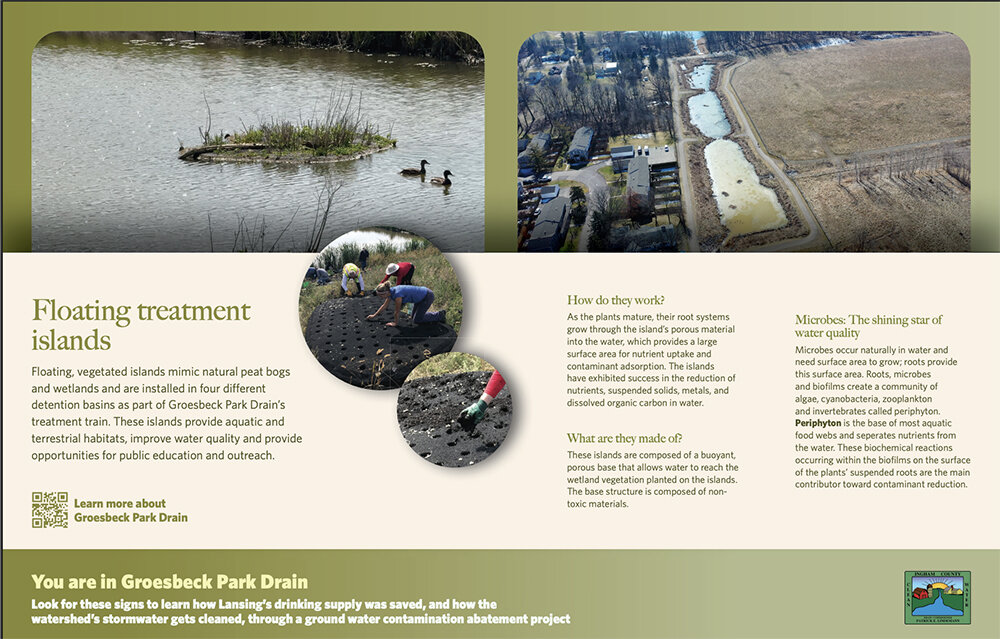
The plants not only surround the ponds but also form a cleansing thatch attached to several artificial floating islands. The roots hang in the water and help to remove pollutants.
“They’re scouring pads, just like in your kitchen,” Lindemann said.
Aerial photos of the ponds show the water changing color, from a murky brown to green, as it moves past the islands.
Lindemann paused to look at a low area in the brush.
“Look, some deer lay down and took a nap here.”
In their prime
As Lindemann and Stokes sang their duet about the life-giving magic of water, one note was conspicuously missing: the last one.
Lindemann is 77, and Stokes is 81. Both of them have achieved the goals of a lifetime.
After decades of nurturing the spoken-word scene she helped to create, Stokes published her first collection in 2020, was named Lansing’s poet laureate last year and has now earned a nationally prestigious grant most poets can only dream of.
“It’s amazing. It’s my life’s dream,” she said. “The grant is for $50,000. $15,000 is to be used for the community poetry project, and the other $35,000 is to support my development as a writer, which, to me, is astounding. I just can’t believe it.”
Last year, Lindemann put the capstone on the Montgomery Drain, the latest in a series of signature drain projects, from Towar Gardens to the Groesbeck Drain and the Tollgate Wetlands.
They’re both entitled to legacy talk, yet neither of them mentioned the word.
Retirement didn’t come up, either.
Lindemann was re-elected as drain commissioner just last year and has four years left in his term. He’s got half a dozen major projects on his planning board, beginning with a plan to stabilize the flood-prone Urbandale neighborhood on Lansing’s east side.
After a scary 2020 bout of chronic lymphocytic leukemia, a form of blood cancer, he just had his latest six-month checkup and is still cancer-free.
“I’ll be drain commissioner when I’m 100,” he said with typically earnest hyperbole.
Stokes is more reticent about personal matters, but she’s just as indefatigable.
“It’s amazing how the doctors keep us going,” she said during a recent visit to Tollgate, but her dry smile clipped off that line of talk.
She had neither the time nor the inclination to waste a second gabbing about her health in the sun-dappled wetland, with ducks and hawks and butterflies and turtles and wildflowers and dragonflies to marvel at.
She did, however, have a bag of ideas on how to bring poetry into the community, beginning with the “We Are Water” project. And projects don’t even begin to define her approach to life. With each day, she looks at the world with ever-widening eyes.
As she marveled over the natural wonders of Tollgate, an inquisitive duck waddled out from the lily pads and approached her bench. The morning sun danced on his green and gray feathers, illuminating each precious drop of water as it rolled down his back.
Stokes leaned forward and pitched her voice to a resonant whisper for an audience of one.
“Hello, hello, hello.”
Related Articles

A roundup of recent Lansing-area music news
From Big Sur releases new album, Starfarm’s Whitney Who has a new group and Displaced Manor finds a new home
Ten touchstones in local LGBTQ+ history
In 1971, gay activists in East Lansing demanded protections in the city government’s hiring process from their City Council. They came, they fought, and they won: East Lansing’s early 1972 civil rights ordinance was the first of its kind in the country.