Saving old Lansing
In July, a single word was changed on the Richard and Deborah Glaister House’s Wikipedia page: “is” was replaced with “was.”
The building had been listed on the …
What buildings are most at risk? Here are 10
In July, a single word was changed on the Richard and Deborah Glaister House’s Wikipedia page: “is” was replaced with “was.”
The building had been listed on the National Register of Historic Places in 2017, but it had no local historic designation. That meant there was nothing to prevent its demolition. It was demolished by its final owner, the City Rescue Mission of Lansing, to make room for a rainwater retention pond.
The Glaister House was one of 10 historic structures on a 2022 list of “at-risk” historic structures compiled by Historical Society of Greater Lansing President Bill Castanier and longtime preservation activist Dale Schrader, then president of Preservation Lansing. The list, published in City Pulse, also singled out the historic Eastern High School building as endangered. Castanier and Schrader’s concerns were proven right when both buildings came down this year.
This year, they have released another list of at-risk structures, published once again in City Pulse, with the intent of encouraging preservation conversations before it’s too late.
“Part of what Dale and I were talking about and looking at, was what policies allow a structure to fall into disrepair,” Castanier said.
Referring to the Glaister House specifically and historic buildings in general, he added, “You leave a house empty for 10 years, it’s going to fall apart. It doesn’t take much, frankly — it’s kind of surprising to watch how fast buildings deteriorate.”
“Is there a policy the city needs to embrace to take a look at these structures earlier on, or do we not care and just let them fall into disrepair until the point where they have to be torn down?” he mused. “I don’t think that’s a good strategy, but it appears to be the current strategy.”
The list runs the gauntlet from highly endangered properties like St. Lawrence Hospital, which Castanier and Schrader are worried will soon be demolished by University of Michigan Health-Sparrow following its demolition of Eastern, to in-use properties they are worried will not be kept up. They are not presented in any particular order, with each at-risk for its own reasons. While Schrader stressed that no property is ever “too far gone” — As Ford Motor Co. proved in saving Detroit’s Central Station and local nonprofit developer Capital Area Housing Partnership did in turning Lansing’s old Walter French Junior High School into apartments. But even five years without maintenance can skyrocket rehabilitation costs.
Mary Toshach, a local preservationist who has served on the Lansing Historic District Commission and is the most recent president of the inactive Preservation Lansing, said historic commercial districts like Old Town should be watched especially closely.
“Even though Old Town and downtown and all those buildings are listed on the National Register, those commercial districts don’t have any local designation that protects them,” she said.
Toshach said the lack of local historic district designation is particularly concerning because developers in other cities are putting increasing pressure on city governments to retract those designations.
“That’s becoming an issue in Ann Arbor, where they’re trying to re-designate areas because developers want to buy up properties and build high-rises,” she said.
Schrader called it “hard to believe” that Old Town is not a local historic district.
“If it was, they’d have to have a plan for demolition,” he said. “It’s possible that the Historic District Commission would approve them tearing something down, but right now, it’s just wide open.”
There are two Old Town properties on this list: the Kilbourne-Mead house at 1214 Center St. and the Preuss Building in 308 E. Cesar E. Chavez Ave. The latter, which is in dire condition, is on the city’s “make safe or demolish” list. In its current state, it is highly unlikely that the building could receive a local historic designation. Schrader said he hopes the list encour-
ages conversations around what properties might receive such a designation.
“They talked about doing it at Eastern, but it was kind of late in the game. It really should be talked about earlier,” he said.
While the list should be taken seriously, it is far from a harbinger of death for these properties. Two others that were included last time are the Moores Park Pool, which is being rehabilitated and is expected to open in summer 2026, and City Hall, which is expected to be converted to a hotel after its upcoming move.
Castanier said he’s hopeful the list can succeed in encouraging upkeep, especially considering a trend he has observed with younger people getting more interested in history.
“Last night, we had a walking tour of Cherry Hill, and there were a significant number of younger people,” he said last week. “Two young women stayed afterwards for a pretty extensive period of time talking about the buildings and how cool they were. It was kind of a surprise, but in a good way.”
- St. Lawrence Hospital
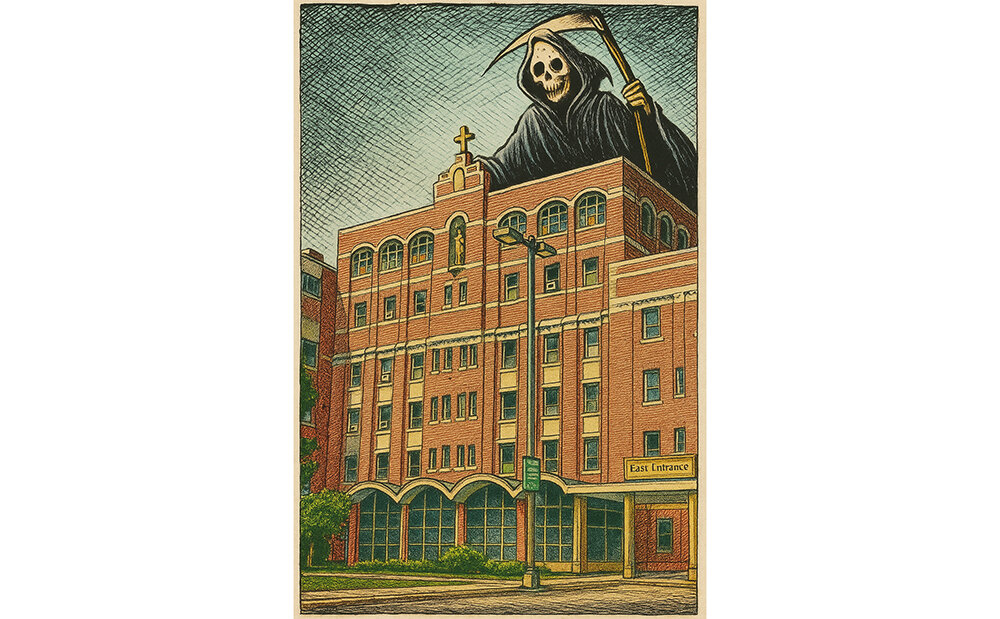
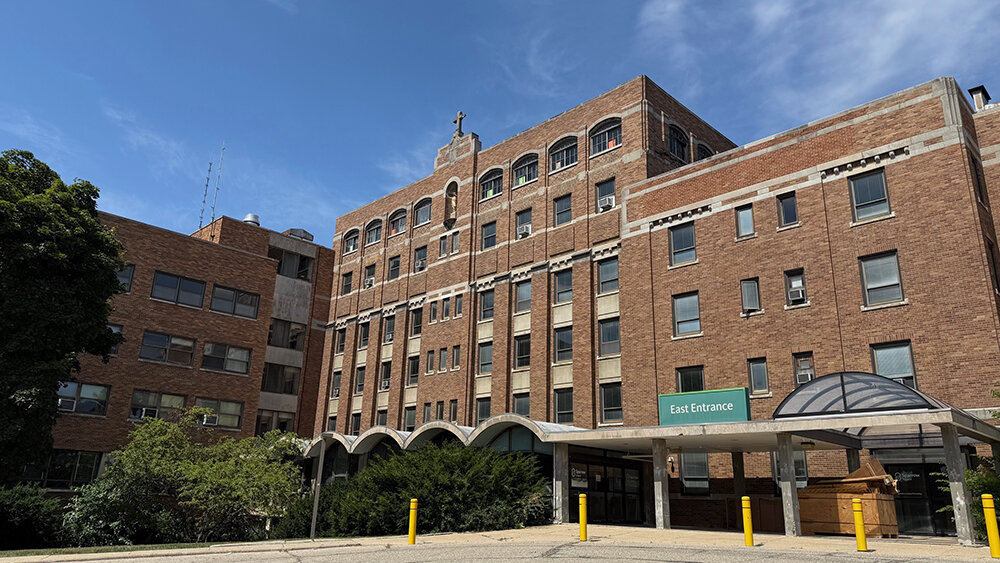
St. Lawrence Hospital was clearly designed to be a landmark. The brick-and-limestone edifice inspires awe in the same way a grand church might — an intentional choice, since the 1924 building was part of the “Collegiate Gothic” style that evoked a bygone era even then.
But the layered masonry and arched windows also evoke another familiar building: the historic Eastern High School, which was on the 2022 iteration of this list and which University of Michigan-Sparrow Health demolished this year. Even the copper dome on the building’s northeast side brings to mind Eastern’s iconic cupola. And, since UM-Sparrow also owns St. Lawrence Hospital, the outlook is grim.
“It’s almost inevitable that they’re going to take it down after what they did with Eastern,” Schrader said. “Sadly, I don’t think it has much of a chance.”
St. Lawrence Hospital, the second of its kind in Lansing, began operating in 1920 in a sanitarium on Willow Street, but it moved into the 125-bed facility thanks to a $100,000 donation from industrialist Lawrence Price.
UM-Sparrow spokesperson John Foren said in a statement that the health system “has not formalized any plans for the University of Michigan Health-Sparrow St. Lawrence campus but the location continues to play an important role as a home to behavioral health services, hospice, our sleep center and other services.”
But those services are mostly performed in a newer building next door. A sign on the historic hospital’s door reads, “Lab is CLOSED.”
Castanier said the neighborhood would lose not just “a piece of architectural history,” but “a sense of history and permanence” if the landmark is demolished.
2. Preuss Building
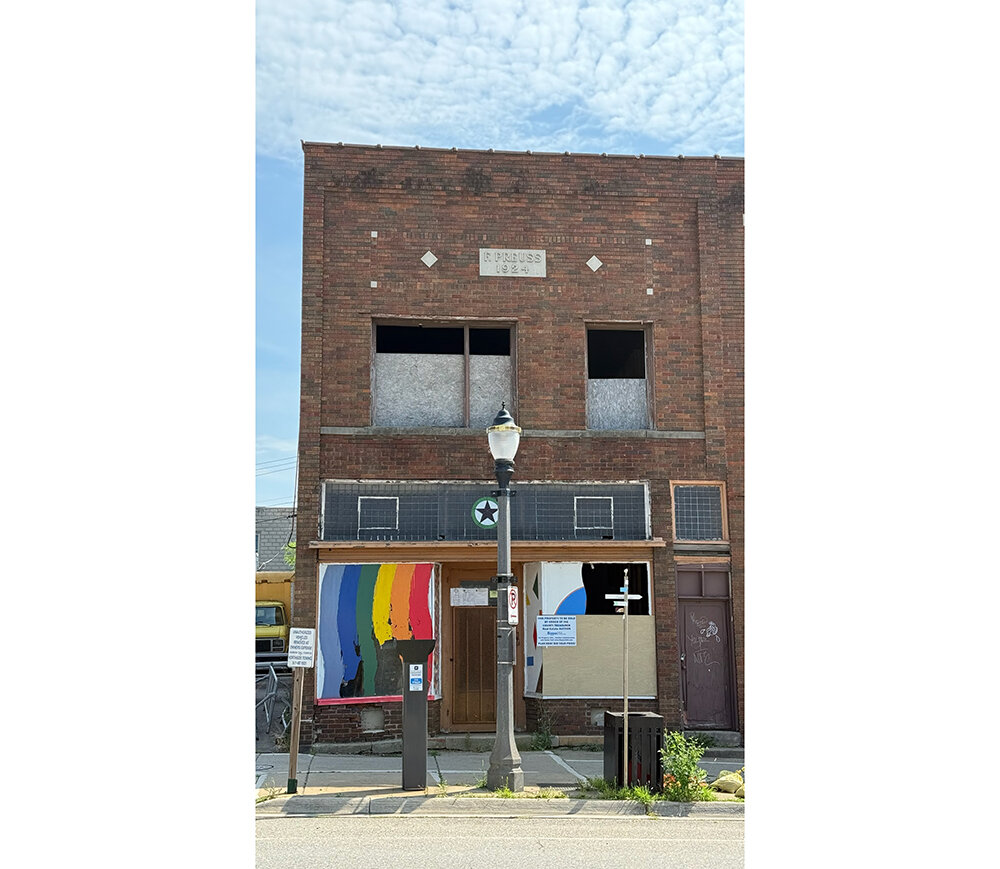
Constructed in 1875, Old Town’s Preuss Building gets its name from Frank Preuss, the German immigrant who extensively remodeled it in 1924. A stained-glass star remains of the Frank Preuss and Son Star Market, a meat and sausage market established the same year. Little else does.
The building is the eastern end-cap to a block of brick buildings that was described as “characteristic of the non-descript American commercial style which prevailed during the building boom that followed World War I” in the nomination form that led Old Town to be designated a national historic district in 1976. Since Old Town is not a local historic district, though, there is nothing to prevent the building’s demolition.
That demolition is likely. Years of neglect have left the property derelict, and it is now on the city’s “make safe or demolish” list. It appears in the Ingham County Land Bank’s auction next Tuesday (Aug. 26) following a foreclosure, and city spokesperson Scott Bean said in July that new owners would have to “immediately” submit construction documents and quickly begin work to avoid demolition.
Multiple Old Town residents attempted at one time or another to urge the building’s upkeep over decades of decline, including Frank Preuss’ grandson Rick, who owns Preuss Pets just down the street. None succeeded, and the property continued to deteriorate as it switched owners.
“What creates a situation that a building, which at one time was very usable and open to restoration, is put in a position where it has to be torn down?” Castanier asked.
3. Lansing Women’s Club
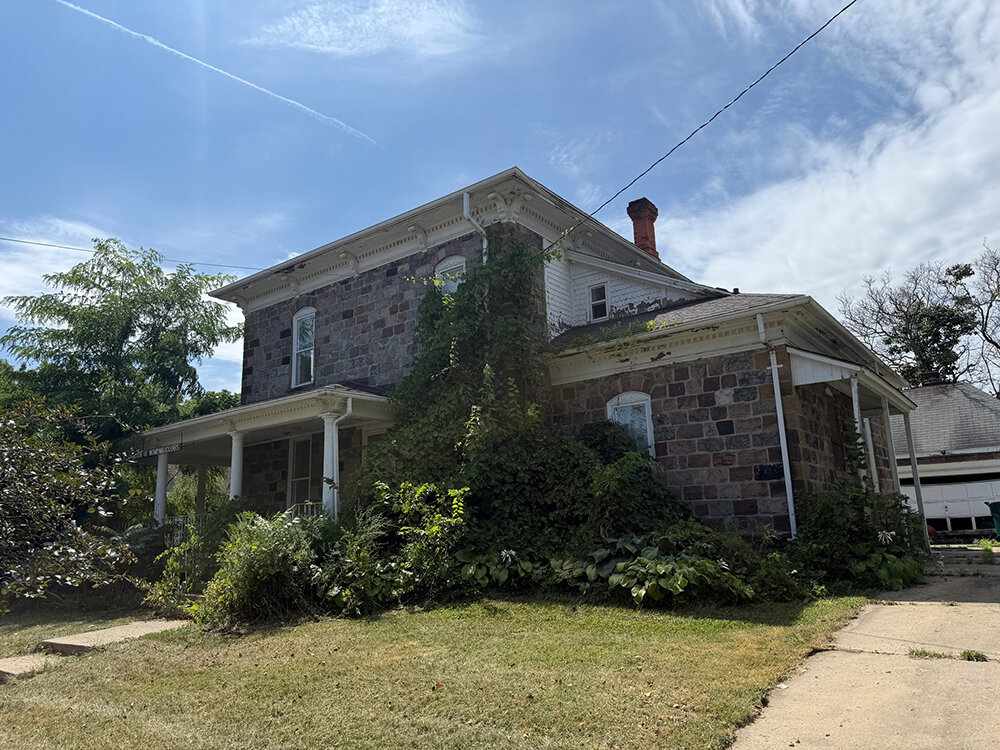
Passers-by are sure to be taken with the unique stonemasonry of this 1886 house, but 301 N. Butler Blvd. is equally significant for its history. The house was originally the 10-room home of Lansing pioneer Ulysses D. Ward, but earned its spot on the city’s African-American Heritage Trail through its role as a daycare center and meeting site for Black clubs during the Jim Crow era. It was purchased in 1992 by the Lansing Association of Women’s Clubs, a minority women’s club founded in 1945. The Eastside Community Action Center bought it in December.
The nonprofit uses the building as the office for its housing opportunity program, with plans to expand use of the building for other programming, Executive Director Stan Parker said.
“Right now we’re fighting against the city because we’re nonprofit and they don’t want to give us the tax exemption for the property,” Parker said.
While the building remains occupied, the need to maintain its upkeep is essential to the city’s African American history, Castanier said.
“It’s not been well-cared for the last half a decade or longer,” he said, “and it is very important to the concept of African American history in this city.”
4. Kilbourne-Mead house / 1214 Center St.
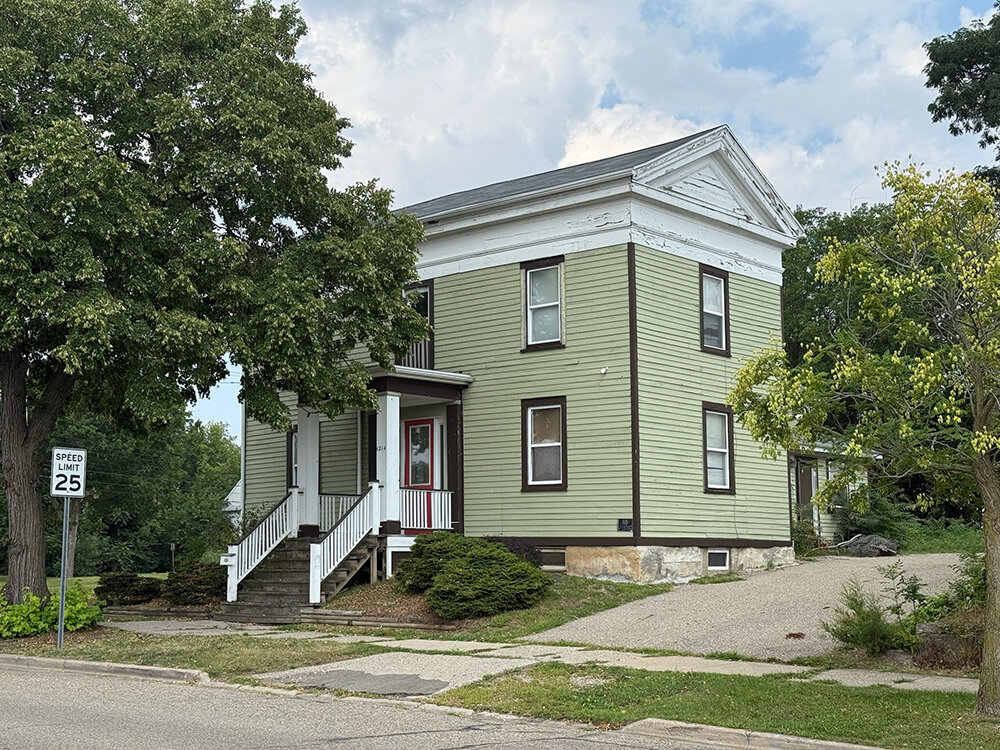
As Old Town expands eastward, new developments in the historic district are good for its economy — but worrying for its historic architecture. Since Old Town is not a local historic district, its historic structures have no protections. That includes the Kilbourne-Mead house at 1214 Center St. a pre-Civil War house that likely dates back to around Lansing’s designation as the state capital in 1848.
The house, along with other properties on Center Street, was purchased last year by Oldtown Center Street Holdings LLC, whose registered agent is local developer Eric Hanna. Hanna is the president of Michigan Community Capital, which renovated Temple Lofts in Old Town in 2022. But it’s unclear what the new owners’ intentions are for the property.. Hanna could not be reached for comment.
A 1992 newsletter by the Historical Society of Greater Lansing described the house as the first house of James I. Mead, one of Lansing’s original pioneers. Built in the Greek Revival style of the 1850s, the structure is relatively intact, Castanier said.
“It’s the oldest, or very close to the oldest, house in Lansing, and it’s in pretty decent shape,” he said. “So that’s got to be watched very carefully.”
5. Townhouse 617 Capitol Ave.
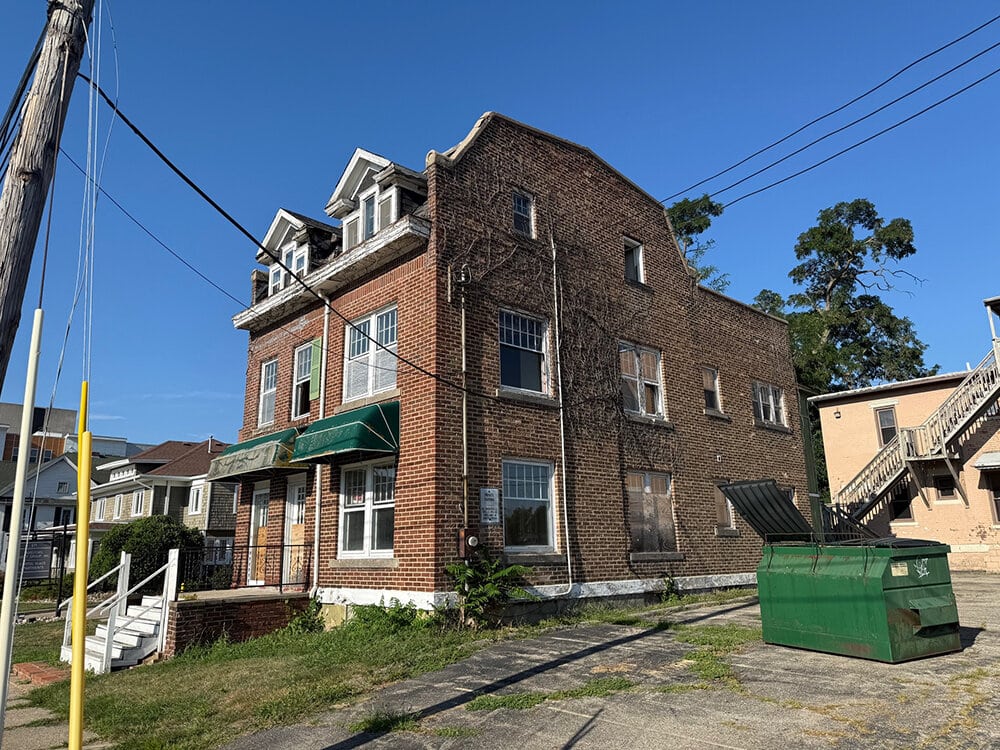
In 2016, developers announced plans to start work on “South Edge Lofts,” a luxury apartment project that would have incorporated the front side of this 1920 row house-style townhouse. They were supposed to break ground that spring, the Lansing State Journal reported.
But ground was never broken, and the development was quietly forgotten. A Google search for “South Edge Lofts,” in quotes, returns only seven results.
And the building’s condition has only continued to deteriorate.
“They’re looking worse and worse every year,” Schrader said. “It would take an awful lot of dedication from somebody to save them.”
The townhouse’s significance is owed less to its particular historic value — the Historical Society could not identify an architect, and its first occupant was an insurance underwriter, not a local historic figure — but to townhouses’ scarcity. Once a ubiquitous feature of any downtown, townhouses have declined in number in Lansing and across the country. Even this one’s neighbors fell decades ago, and it seems likely to follow suit soon enough.
The property has gone through many owners. Its most recent is 601 Block LLC, whose registered agent is local developer Brent Forsberg. Forsberg could not be reached for comment.
6. 900 Block of West Saginaw Street
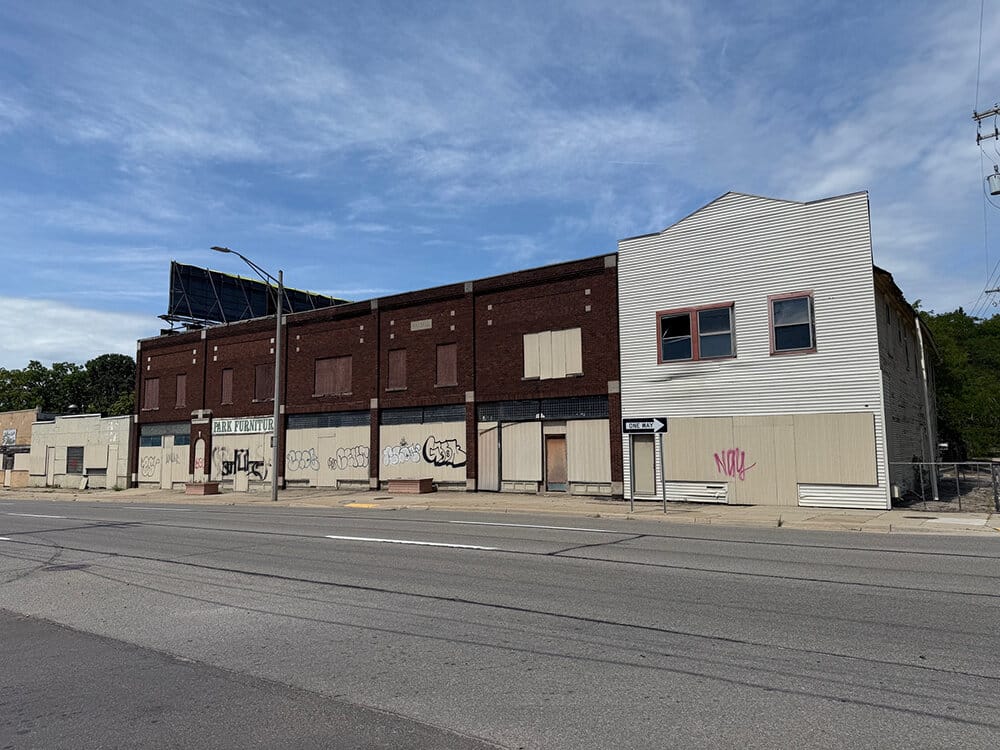
Once a vibrant commercial district, the 900 block of West Saginaw has been entirely vacant for years. A sign reading “Park Furniture” advertises the district’s most recent tenant, which was closed by the city in 2020 due to “imminent safety issues.”
On the property’s eastern end, above the liquor bottles littering the road, a gutter has fallen off a building’s roof and become tangled with the power lines. “Striking architecture,” according to Schrader, remains hidden beneath crumbling wood siding. From the front, the boarded windows and little square glass panes look a lot like Old Town’s Preuss Building — a bad omen, since that building is likely to be demolished soon.
But unlike the Preuss Building, there is a plan to save this district. The five former Parks Furniture buildings were purchased by local Re’Shane L. Lonzo in 2023, and she intends to preserve them.
Lonzo said she had watched the property deteriorate over the last three decades and felt an urge to preserve it because of the sense of community the historic buildings invoked among locals.
“Some of the residents remember walking to school 30, 40 years ago and buying fresh donuts here,” she said.
Lonzo is working on getting state and federal historic designations for tax benefits to help “close the financial gap,” after which she hopes to break ground on a project that will result in 11 affordable housing units on the second floor and space for businesses on the first. But if her development succeeds, it may struggle with an issue the original shopping district encountered: the chaotic four-lane highway it sits alongside.
Schrader said he believes Saginaw’s expansion from two lanes to four is “absolutely” a main reason behind the shopping center’s downfall.
“I wish they would close one lane and make parking or something, but I can’t imagine that ever happening,” he said.
7. Genesee Street School
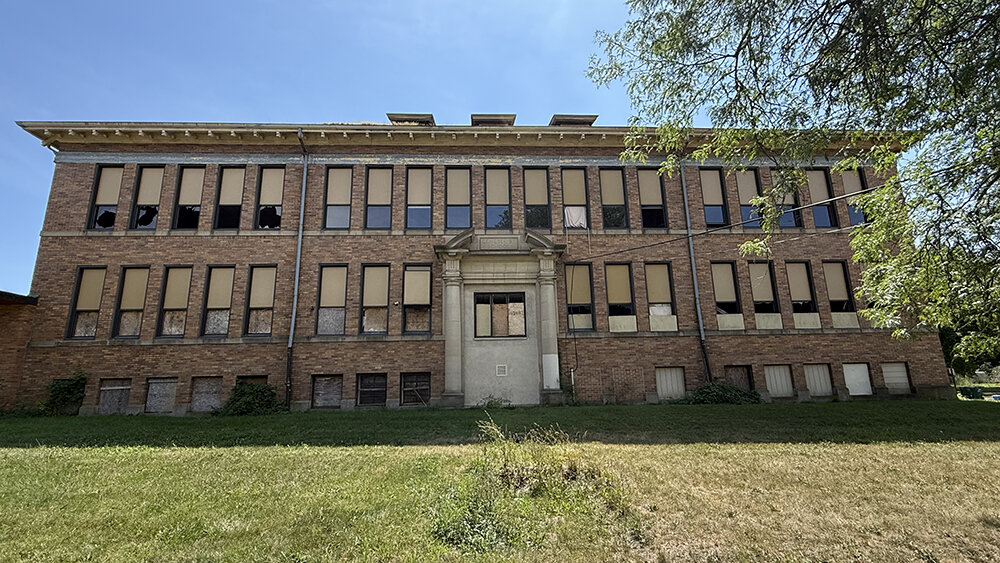
Open from 1912 to 1984, this former elementary school was designed by Edwyn Bowd of the Bowd–Munson Co., which designed many iconic local buildings, including the downtown Masonic Temple and the Lewis Cass Building. It is listed on the National Register of Historic Places.
But since appearing on the 2022 iteration of this list, the Genesee Street School’s condition has notably deteriorated. At the time, City Pulse reported that Lansing investor Julian Darden intended to convert the building into 30 lofts. A foreclosure hearing notice, standing out bright red amid the ashy scars of a fire on the building’s western facade, may indicate how that’s going. Darden could not be reached for comment, but Ingham County Treasurer Alan Fox confirmed payments have been made to keep the property out of foreclosure.
A potential buyer is seeking a Low-Income Housing Tax Credit and other financing, Fox added.
Castanier said the school was the most at-risk historic school building in Lansing “because it has been abandoned for quite some time.”
“It’s in the middle of a neighborhood, it’s a blight on that neighborhood and people are probably going to start agitating even more to have something happen to it,” he said.
8. Otto Junior High School
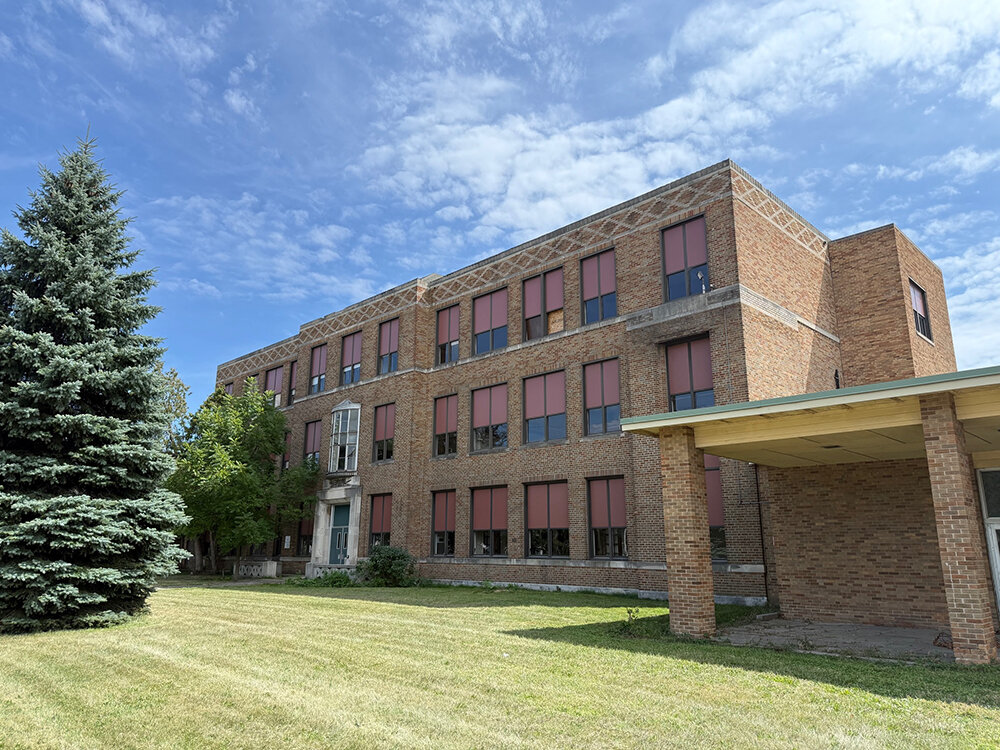
This building is so big that it costs around $30,000 a month just in utilities, said Derrick Knox, Jr., president of The Advancement Corp., which owns the building.
For his part, Knox has every intention of continuing and growing the community center operated in the building. He said the gym is leased out for basketball, volleyball and indoor soccer events, the computer labs have been redone and are in use, the auditorium and stage have been repaired and updated with new lighting and the kitchen has been redone with refrigerators and even grills.
But money remains an issue, he said.
“The renovation project is going to be a few years long, because we haven’t received any type of substantial capital for renovations, so we do what we can do, when we can do it,” he said. He added an EPA grant to add solar energy and cut costs was lost amid federal cuts.
The high maintenance cost is a problem, but Castanier said it becomes a greater one as the property value rises and makes selling a money-drain more enticing.
“It is a historic junior high school and a beautiful building,” he said, “but it is also a massive piece of property, and it sits on an even more massive piece of property. So, if Lansing continues to thrive, it is going to continue to become more valuable. That’s just the way it is.”
9. Downtown Masonic Temple
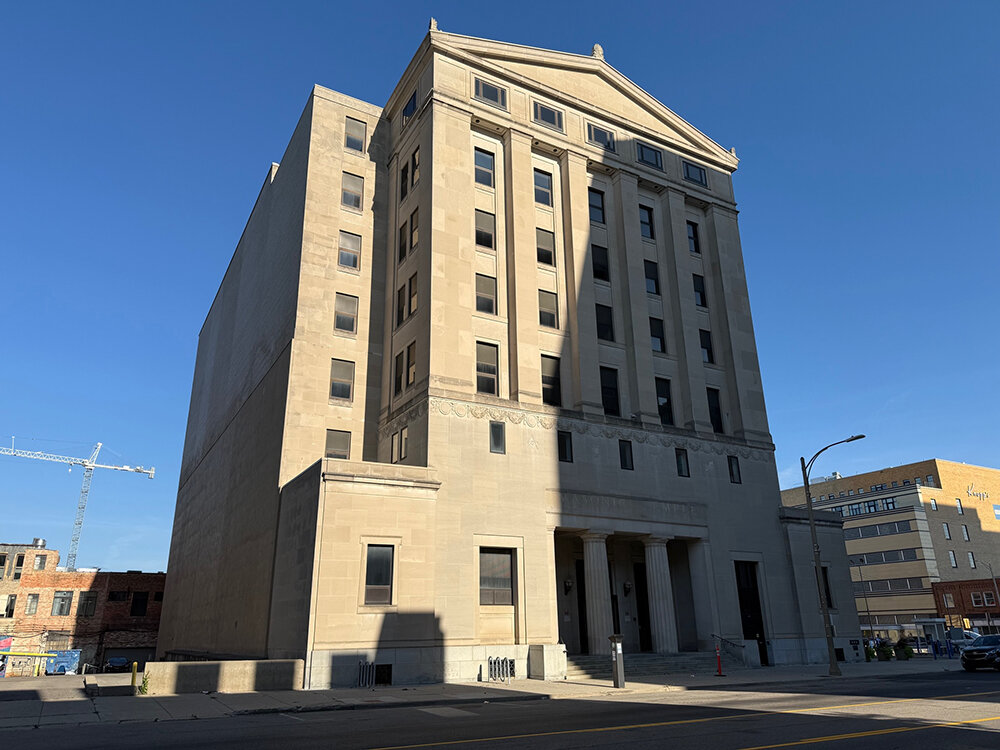
The reason this building made the list is simple, Castanier said: It’s empty.
“It’s empty, and it’s been empty for a number of years, and that is the first indication of a structure that could be at risk,” he said.
Like the Genesee Street School, Edwyn Bowd designed the temple. It was constructed in 1924, and in 1976 Cooley Law School purchased it and operated it until 2014. In 2021, Boji Group bought it.
Mayor Andy Schor wanted to buy it from Boji to move City Hall into the historic structure. That effort failed last year after City Council rejected it in an unexpected vote. The current City Hall, which was on the 2022 iteration of this list, will be converted into a hotel after the city completes construction of a new government headquarters at the corner of Grand and Lenawee Street. But there are no plans for the Masonic Temple.
“I was disappointed to see the City Council veto the plan,” Schrader said. “It looks like a real city hall should look, and now that it didn’t get that, I’m very worried about what’s going to happen with it.”
10. Washington Apartments, REO Town
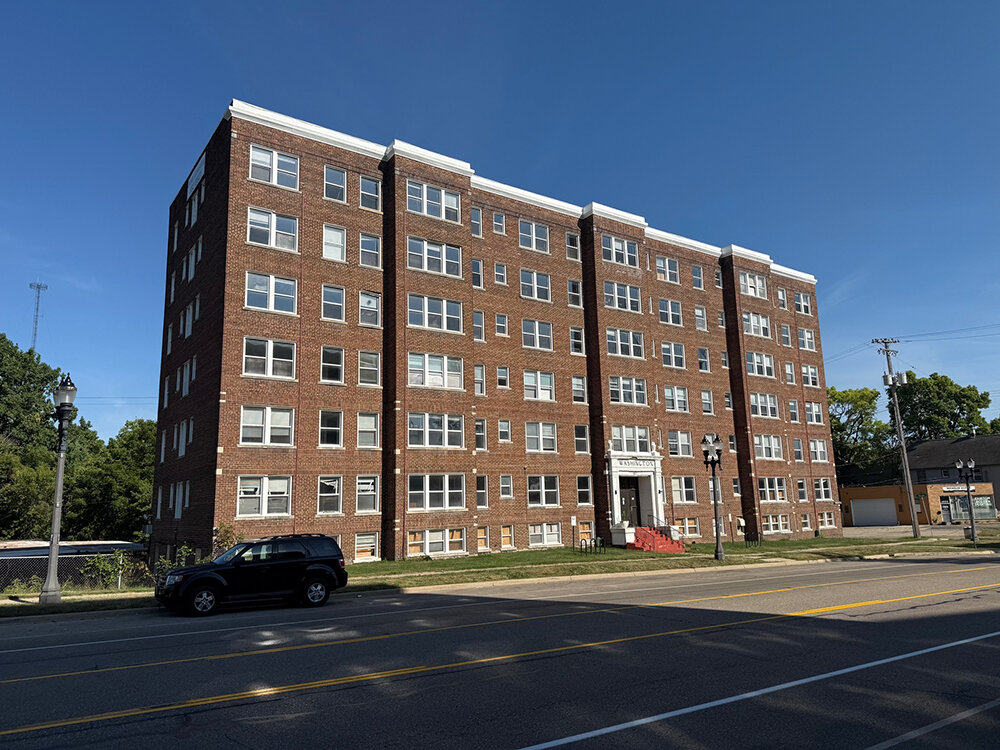
Constructed in 1922 as housing for Reo Motor Car Co. Plant workers, Washington Apartments was designed by Judson N. Churchill, who also designed the Walter French school. Despite changing hands several times, the building has been mostly unmodified. It has, however, been unoccupied since September 2019, when the city ordered it vacated because its ownership group did not have a valid rental certificate.
Last year, it was put on the National Register of Historic Places, leading City Pulse to report that it may soon get a facelift. So far, that hasn’t happened.
By the time it was vacated, the building was already known to be plagued by bedbugs and security concerns, leading the city to issue citations in 2012 and 2015.
Castanier said renovating the building was a logical step because of its location.
“It is on the entrance to REO town, which the city is trying to make extremely active again,” he said. “And it’s a destination now, so this is right on the entrance to that destination neighborhood.”
(Lawrence Cosentino contributed to this story.)