Double Hadidity
Each year, mid-Michigan art lovers and international observers wonder what direction the Michigan State University Broad Art Museum will take next.
The Broad’s mission is to display …
Curator tour: “unbecoming”
1-2 p.m. Sunday, Sept. 7
“unbecoming”
Through Dec. 14
10 a.m.-6 p.m. Wednesday-Sunday
MSU Broad Art Museum
547 E. Circle Drive, East Lansing
broadmuseum.msu.edu
Diana Al-Hadid exhibit grandly inhabits MSU Broad
Each year, mid-Michigan art lovers and international observers wonder what direction the Michigan State University Broad Art Museum will take next.
The Broad’s mission is to display contemporary art or reimagine older art, never to stand still.
As the Broad enters the second year of its search for a new director, one thing is certain: Wherever it’s going, it’s not going soft. Rich, multi-layered, challenging and even confrontational exhibits are still the norm. The museum has a gift shop, but there’s no gift-shop fodder on the walls.
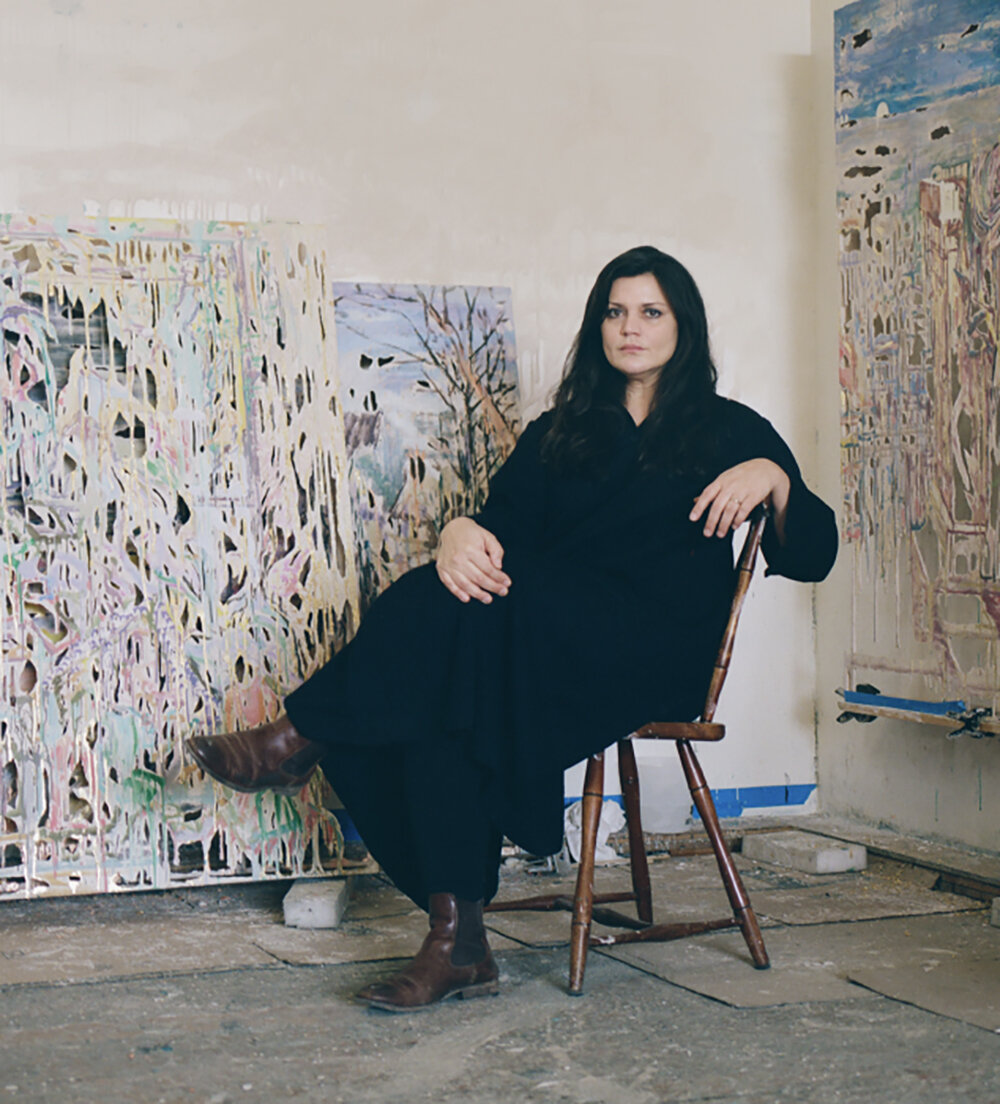
Walk into the Broad’s first-floor galleries this fall, and you’ll enter the melting, dripping world of Syrian-born, New York-based artist Diana Al-Hadid.
The art is fraught with questions about expectations for women’s behavior and the constant push to “become” the next thing (usually, whatever someone else wants).
It’s also a straight-up visual marvel, integrated deftly with the surrounding architecture of Zaha Hadid.
Entering the exhibit is like being drawn into a heretofore hidden, semi-transparent world, made manifest in tangible materials like mylar, paint and wood.
There’s a double meaning in the word “unbecoming,” the pointedly lowercase name of the exhibit.
It only begins with the surface, in assistant curator Rachel Winter’s view.
“The works feel like they’re fragile, falling apart — like they’re un-becoming,” Winter said.
But the word “unbecoming” is also used to criticize behavior, clothing, hairstyles or even opinions that some people, usually men, find objectionable.
That intriguing duality put a hook into Winter’s mind and heart as she worked with Al-Hadid to put the exhibit together.
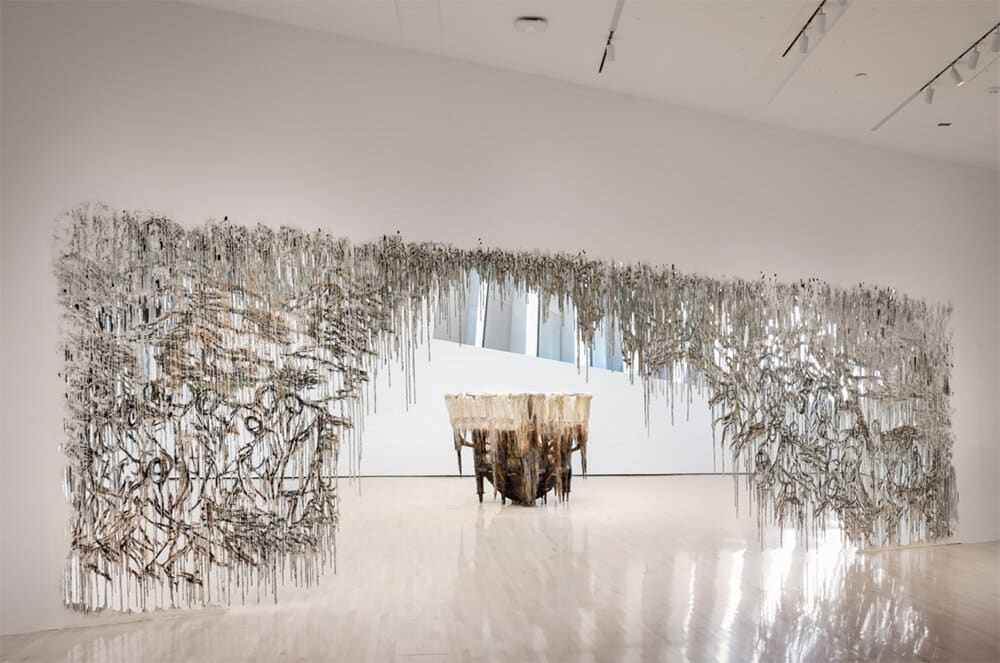
Al-Hadid’s disintegrating, porous work sponges up your deepest thoughts, inviting long and deep contemplation. But you don’t have to look that hard to see its most obvious characteristic — its size.
“Diana’s work is really big, and it really takes up space,” Winter said. “It’s very commanding and, in many ways, the opposite of what women are told to do, or even what women artists are told to do.”
(Winter will delve into the exhibit’s many meanings in a walkthrough on Sunday.)
The exhibit surveys about 20 years of Al-Hadid’s work, including paintings, sculptures and remarkable wall-hanging works with attributes of both. Four of the pieces are making their debut in this exhibit. A gallery of spectacular works on handmade paper offers a deeper dive into mythological and literary themes, from the Medusa myth to “The Arabian Nights.”
Resting at the center of the Broad’s biggest first-floor gallery is the earliest piece in the exhibit, a large sculpture from 2006 with the haunting title “Spun of the Limits of My Lonely Waltz.”
To create the sculpture, Al-Hadid painted the soles of her feet and waltzed around her studio, making impressions in a more or less quadrilateral layer of plaster. Building from this base, she erected an oozing, encrusted, Gothic tower of polystyrene, fiberglass and wooden furniture parts and turned the whole structure upside down.
Walk around to the side, and you can see that one side of the sculpture has been brutally blowtorched to create a blackened orifice.
The sculpture is taller than most humans, so the viewer has to climb the stairs to the second-floor balcony and look down upon it to see the footprints.
“August, After the Seventh Month” depicts Al-Hadid with her son, August, in a copper-tinged, dreamlike, three-dimensional landscape that blends the background of a Northern Renaissance painting with Al-Hadid’s home in upstate New York.
The portrait is not only huge; it’s pure magic, a stunning blend of numinous mystery and Midwestern frankness.
“She really outdid herself with this one,” Winter said. “I’m really proud that I was able to commission this work.” After a detour or two to other exhibits, the work will become part of the museum’s permanent collection.
Winter was already thinking about doing an exhibit of Al-Hadid’s work when she learned in early 2023 that the artist was giving a talk at the Cranbrook Art Museum in Bloomfield Hills.
Al-Hadid came to the Broad at Winter’s invitation and marveled at the angular architecture and the flood of natural lighting in the big first-floor gallery.
“Having an Al-Hadid show in a Hadid building is really exciting,” Winter said, relishing the rhyme. Double Hadidity aside, the building and the art are in stunning synchronization.
“Smokescreen” is an intricate, diaphanous curtain of wood, plaster and fiberglass made from 10 large panels, seamlessly fitted together.
The exhibition team at the Broad skillfully plastered the edges of the panels and matched the white color to the walls, so it’s impossible to tell where the art ends and the wall begins.
At a distance, the fine latticework of “Smokescreen” reveals ghostly figures and frames the big sculpture like a dramatically melting curtain.
Did I say there’s no gift-shop fodder here? I lied a little. A gorgeous new book keyed to this exhibit, with text by Winter, is winging its way from Europe and will be available by mid-fall.
Meanwhile, there’s plenty of food for the eyes and mind at the ever-changing Broad, with more on the way soon.
The museum is featuring the exhibits “Americans and the Holocaust: A Michigan Perspective” through Nov. 16; “Africa Past, Present and Future,” celebrating 65 years of the MSU African Studies Center, through Jan. 18; and a collection of clothing, furniture, appliances, jewelry and other objects designed by Zaha Hadid through August 2026.
“Jan Tichy: Darkness,” part of the Broad’s Signature Commission Series, will take over the big first-floor galleries from Jan. 24 to July 26. Tichy, a multimedia artist born in Prague and based in Chicago, will investigate the rhythms of sunlight and darkness in a site-specific, “multi-sensorial” installation. “Mekong Voices,” featuring art and traditional crafts from many of the 70 distinct cultures living along the Mekong River in Southeast Asia, will be on view from Sept. 14 to Feb. 22.