‘It all becomes one thing’
What’s cool about a chameleon? Rippling patterns and shifting colors; alert, all-seeing eyes; a paradox of vivid presence and artful blending.
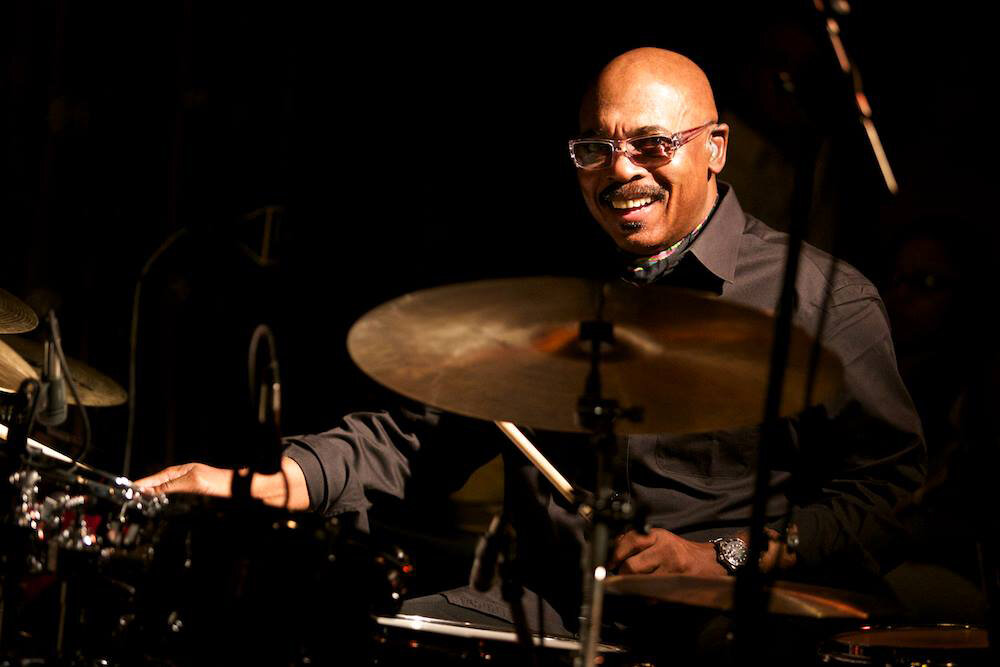
Legendary drummer Harvey Mason, 79, is among the …
MSU jazz orchestras
Harvey Mason, drums
3 p.m. Sunday, March 15
Wharton Center Pasant Theatre
750 E. Shaw Lane, East Lansing
(517) 353-5340
music.msu.edu
Drummer Harvey Mason brings lifetime of music to MSU jazz studies
What’s cool about a chameleon? Rippling patterns and shifting colors; alert, all-seeing eyes; a paradox of vivid presence and artful blending.
Legendary drummer Harvey Mason, 79, is among the most distinguished artists to join Michigan State University’s jazz studies students for a week of teaching, mentoring and rehearsing, culminating in a concert with the jazz orchestras on Sunday.
“Chameleon” is Mason’s musical sobriquet. It’s also the name of a famous track on keyboardist Herbie Hancock’s 1973 megahit “Head Hunters,” a groovy, electrified percolation that pushed jazz into the fusion era and became the biggest-selling jazz record of all time. (It was dethroned by George Benson’s Breezin’ in 1976.)
Mason is best known as the original Headhunters drummer, but he has accomplished much more. As the era’s ultimate session drummer, he’s played with an astonishing range of artists, from Duke Ellington and Frank Sinatra to Carole King, Björk, Carlos Santana, Beck, Beyoncé and the London Symphony Orchestra.
Does he have stories? Are you kidding?
One Saturday night in 1968, he was sitting at home in Boston when the phone rang.
The voice said, “Duke Ellington needs a drummer. You’d better get over there right away.”
Mason hustled two blocks to the Prudential Center, where the band was already playing without a drummer.
“I just walked onto the stage. People clapped. I thought they were clapping for me, but I had a black suit on, and everybody else was wearing a white suit.”
There was no music on the stand. Between tunes, Mason could hear trumpeter Cootie Williams, who was standing next to him, ask bassist Jeff Castleman, “What’s next?”
“I just sat down and started playing by ear,” Mason said. “Duke looked back at me and gave me a big wink and a thumbs up. It was a wonderful experience. After the concert, he thanked me and paid me.”
Mason may be the only human being to have played for both Lucille Ball (on her 1970s TV show) and James Brown. He’s an uncredited drummer on Brown’s 1974 live album, “Hell.”
“It was in the studio basement,” Mason recalled. “He was standing in the middle of the band, playing a little organ. I don’t know how we ended up playing that session, but it was a fun session.”
Being a go-to drummer for everybody, a true chameleon, takes skill, a wicked work ethic and a bit of luck.
Mason proudly calls himself “a product of public schools, a 50-cent set of sticks and a drum pad.” As a teenager, he performed at jazz clubs, bar mitzvahs, strip clubs and even played in a surf band.
It was fun, but he imagined himself as a lawyer, not a musician.
“I saw the way musicians were living,” he said. “It was a tough life.”
Then he read an article in DownBeat magazine about the lives of studio musicians, the often-unheralded pros who accompanied top pop and jazz artists and played for TV and movie soundtracks, commercials and stage musicals.
“I loved all kinds of music, so I thought it was perfect for me,” he said.
Nevertheless, he got degrees in both education and performance, just in case.
“I’m still covering my bets,” he said with a chuckle.
Take that with a grain of salt. Even before Mason finished his studies at the New England Conservatory of Music, his reputation spread like fire.
At a session for baritone saxophonist Gerry Mulligan, the drummer didn’t show up. Mason, hired as a percussionist, filled the chair ably, and pianist Dave Grusin hired him to play both drums and percussion.
Grusin’s ties to the movie world led to a parallel career for Mason.
His drumming can be heard in more than 200 movies, including “Shaft,” “Saturday Night Fever,” “Sleepless in Seattle” and both the “Star Trek” and “Star Wars” franchises — and that’s just the letter “s.”
When Hancock decided to swerve into the lane of electrified funk with “Head Hunters,” drummer Billy Hart recommended Mason, who was touring with Carole King in Japan. Mason met Hart as a teenager while playing in a jazz club in Atlantic City, and they became friends.
Hancock called Mason in Japan to pin him down. Mason recalled being hired after a “one-minute” audition.
“It just snowballs,” Mason said. “I’m very fortunate to be able to feel, adjust, adapt and play sensitively in a lot of different ways. That’s the key for me.”
To his surprise, Mason has also recorded 14 studio albums under his own name. Legendary record producer Clive Davis was so impressed with Mason that he signed the drummer to a six-album contract, including the hit albums “Marching in the Street” and “Funk in a Mason Jar.”
“I didn’t set out to do that,” Mason said. “I thought I would be anonymous.”
Adapting to so many diverse musical settings isn’t a question of switching gears.
“You build a tool kit. You build chops,” he said. “I don’t think about whether it’s one thing or another thing. The music just drives you into playing certain ways. You naturally adapt, and it all becomes one thing.”
Mason last worked with MSU students in 2017, but he’s been following the program and its many top-tier graduates in the interim.
“I run into MSU students frequently, from Japan to the United States,” Mason said. “They’re here, there and everywhere. It’s a great program.”
As a teenager, Mason met MSU drum instructor Randy Gelispie when Gelispie visited his hometown of Atlantic City.
“I was playing a club, and he watched me play several times,” Mason said. “We hung out and became lifelong friends.”
A big-band arrangement of “Chameleon,” the standout track from “Head Hunters,” is among several tunes Mason will rehearse and perform with the students this week.
“I enjoy being around the students and the questions they ask,” he said. “They bring a lot of energy to me. I try to inspire them and give them a real clear idea of what it’s like to become a session musician.”