Interlude of quietude
A lean, sinewy ensemble of some 60 musicians closed ranks to infuse Friday’s (March 27) Lansing Symphony Orchestra concert with a chamber-music level of intimacy.
The LSO has proved over and …
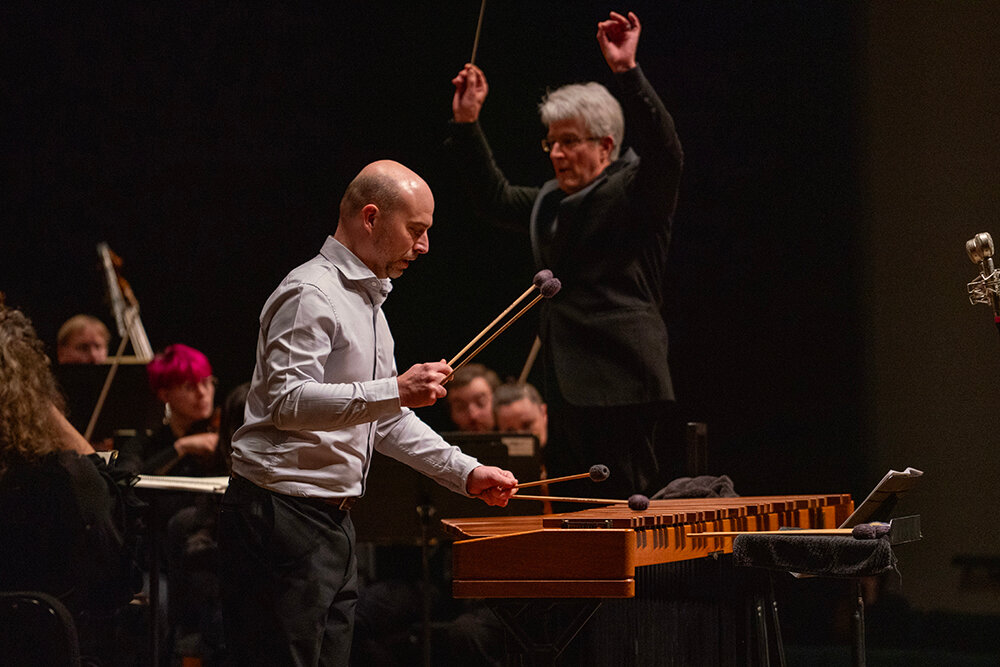
Matthew Beck plays marimba whisperer at LSO concert
A lean, sinewy ensemble of some 60 musicians closed ranks to infuse Friday’s (March 27) Lansing Symphony Orchestra concert with a chamber-music level of intimacy.
The LSO has proved over and over that it can blow you away. (Of course, it did it again Friday, but you had to wait for it.) This time, the musicians seemed mainly intent on demonstrating how softly they could play, how much tenderness and reverence they could conjure within the evanescent bubble of live performance.
The evening’s chief husher was an unlikely figure, principal percussionist Matthew Beck.
Beck seemed to relish his liberation from the noisy engine room of the ship, with its drums, bells, clackers and gongs, savoring his time on the airy upper deck, nearer to the angels.
Dancing through a lyrical marimba concerto by composer Kevin Puts, Beck wielded his four mallets with so much delicacy and restraint that he almost dared the audience to sit back or breathe too deeply.
The strings wafted a warm, luminous melody, and Beck sent low marimba vibrations outward in response.
The tune was unabashedly schmaltzy — it would not have been out of place in a movie about the return of a Labrador retriever who wandered 1,000 miles from home — but Beck’s intricate counterpoint gave it rippled, moody substance.
Usually, the star player in a concerto is a piano, a violin, a trumpet or some other high-end voice that drives the drama and mood. Beck’s marimba, by virtue of its hollow, low-end resonance, functioned more like a subsonic substrate, suddenly revealed to human perception through the chest as much as the ear.
The strings and woodwinds flowed above Beck like a sunlit stream, with the marimba’s pebbly pulsations glinting beneath. In a lovingly sculpted solo cadenza at the end of the first movement, Beck rose to the surface and danced like a water strider, bringing the hall to a complete hush.
By now, the orchestra was drawn fully into the marimba mood, trading downy, dark legato caresses with Beck’s gently drumming love taps.
When the idyll was spent, Beck summoned up an impressive volley of virtuoso runs, backed by stern chords in the brass, as if that beleaguered black Lab were making a last desperate run to the old back porch. Did he make it? The return of the schmaltzy melody from the beginning, followed by a pro forma bit of orchestral rejoicing, left no doubt.
The stage was already set for this interlude of quietude by an even quieter curtain raiser, Finnish composer Jean Sibelius’ “Valse Triste.” Among the countless things to thank Timothy Muffitt for after nearly 20 years as maestro is his willingness to jettison the table-pounding overtures of bygone days and draw the audience thoughtfully out of their everyday lives, into the world of music. The orchestra let the waltz’s sorrow and nostalgia sift down like snowflakes on a bleak and stony landscape, laying the groundwork for the intimate marimba echoes to follow.
Now, about that late-inning outburst.
There were, no doubt, many people in the audience who were thinking to themselves, “Do I really need to hear Beethoven’s Seventh Symphony again?”
I don’t read minds, but I’d bet a Sir Pizza Royal Feast that’s just the kind of challenge that turns mild-mannered maestro Muffitt into the Terminator.
And he terminated the concert, all right, with a Seventh that gathered up every “energy saver” credit earned from all that quiet music that came before and blew it all in one place.
Even the famous second-movement march, often played in a lugubrious, funereal mode, seemed to hurtle along with a purpose, as if to cheat time and escape whatever sorrowful event the music appears to mourn.
Muffitt would probably tell you he was just following Beethoven’s markings (allegretto), but there was some special sauce in there. The briskness and brio of the first three movements were surprising, but it was really a shocker when all forces went into full overdrive in the finale.
Some things are best experienced live. Food and sex come to mind. The sheer, bone-shaking joy of a Beethoven barnburner is right up there.
As he cued the various sections and assembled the instant architecture of the music before your eyes, Muffitt’s body seemed to teleport through time, like a film with frames missing. One split second, he was throwing a Molotov cocktail at the horns; the next, he was skewering the violins with his baton. How anyone could move so fast, and so much, while standing in the exact same spot is beyond me.
A strangely thinnish turnout on Friday could be chalked up to any number of things: the distractions of March Madness, the relative brevity of the program, the use of an in-house soloist or persistent late-winter blahs.
But those who attended were privy to a thoughtfully planned and well-played program. Maybe quietude doesn’t sell tickets, and people need a more momentous occasion to get their butts off the couch. Well, like it or not, they’ll get it at the season finale May 15, Muffitt’s final concert as music director.