
How long will the smoke be in mid-Michigan’s air?
The smoke and particulate concentrations in mid-Michigan’s air today are far worse than the 2023 and 2025 wildfire hazes and forecasters are expecting Friday to be almost the same as Thursday with smoke potentially lingering through the weekend.
Forecasting smoke can only be done about 48 hours in advance, according to state officials, who are expecting some improvements on Saturday.
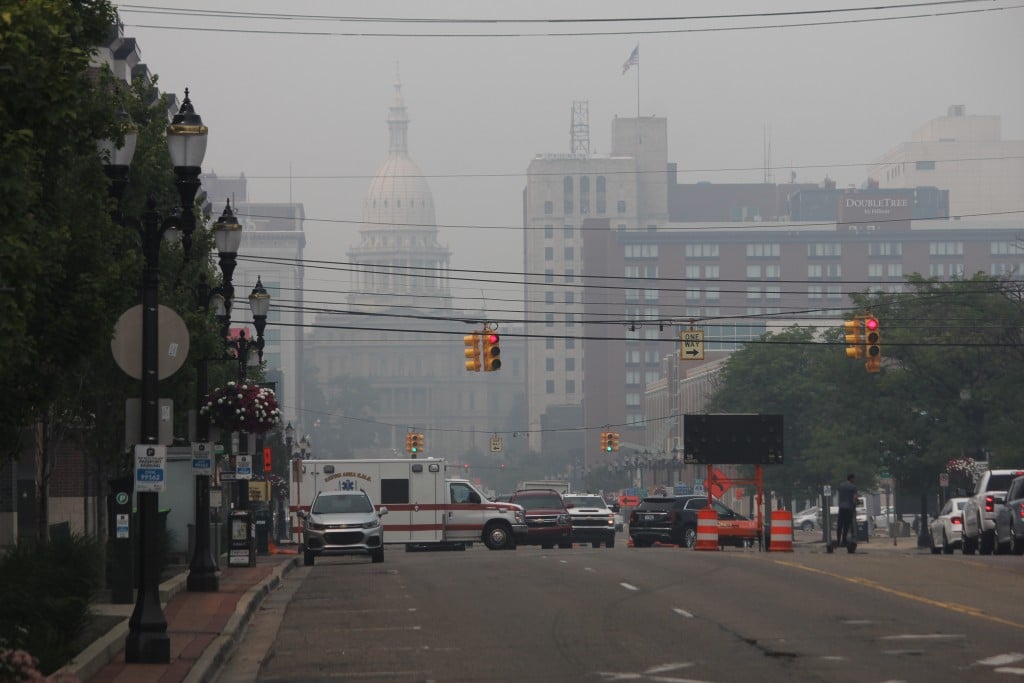
“But it is likely that smoke will linger and recirculate for a while,” according to the forecast from Michigan’s Department of Environment, Great Lakes and Energy.
The department has issued an Air Quality Alert for all of Michigan through Friday due to elevated levels of fine particulate, attributed to wildfire smoke linked to ongoing Canadian wildfires north of Minnesota.
Michigan officials are recommending people, if at all possible, avoid strenuous outdoor activities, especially for those with heart disease and respiratory illnesses such as asthma. For more information, please visit the EPA’s Air Now site for up-to-date air quality data: https://www.airnow.gov
The National Weather Service said there are increasing chances for showers and storms across northern Michigan late Friday evening into Friday night. The NWS station in Grand Rapids is warning of possible isolated strong to severe storms with damage potential from winds, large hail and heavy downpours.
According to EGLE, observed smoke concentrations are “unprecedented” and well beyond prior summer wildfire smoke hazes. The closeness of the wildfires, as well as the number and size, have been a major factor, according to EGLE.
” A front dropped through the region on Wednesday, trapping and dragging that smoke southward to complete the picture,” according to EGLE.
The smoke forecast for Michigan will continue to range from Very Unhealthy to Hazardous until further updates.
Rain on Saturday would help to knock down the smoke.
“In the meantime,” EGLE said, in a statement, people are advised “to avoid strenuous outdoor activities, especially those with heart disease and respiratory conditions like asthma. Watch for symptoms including wheezing, coughing, chest tightness, dizziness, or burning in nose, throat, and eyes. You can help reduce air pollution by limiting activities, such as outdoor burning. Keep windows closed overnight to prevent smoke from getting indoors and, if possible, run central air conditioning with MERV-13 or higher-rated filters.”