Lansing’s very own cryptid, revealed
Woldumar camp counselors spill the baked beans about the Hooga Hooga
In the golden July sunshine, with the smell of wildflowers filling the air and every blade of grass in sharp focus, Lansing’s 180-acre Woldumar Nature Center doesn’t feel like a place with a deep, dark secret.
But it has one.
The clueless adult hikers, joggers, birders and nature lovers who blithely trip along Woldumar’s 5 miles of wooded trails have no idea what lurks under their Keens and Merrells.
But the secret is well known to thousands of young campers, many of whom have gone on to become camp counselors and passed the secret on to the next generation.
They don’t volunteer the information unless they are asked. But when you ask them, their eyes flash with a faraway purple light.
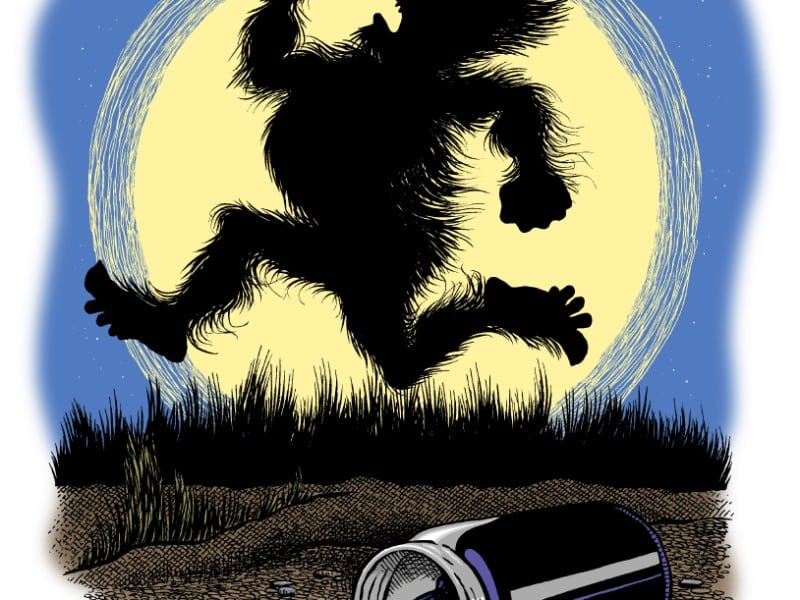
They will tell you that Woldumar is home to the Hooga Hooga, mysterious, hairy, secretive beings akin to Bigfoot that tunnel in unknown numbers under the nature center’s meadows, forests, streams and wetlands. Hooga Hoogas are only found at Woldumar — nowhere else in the world.
Just to be clear, Woldumar is a proper nonprofit nature center rooted in level-headed science. (The staff doesn’t even like it when you call it a park.) The counselors and naturalists are always ready to teach about the life cycles of painted turtles, great blue herons, maple-beech forests, native meadows and so on.
But it really lights them up to be the proud stewards of Lansing’s very own cryptid, as localized as the Loch Ness Monster and as much an emblem of the city as the state Capitol or the Oldsmobile.
And Hooga Hoogas not the only secret at Woldumar. The nature center itself is one of Lansing’s best kept secrets, a gorgeous swath of spacious meadow and rolling woodland that helps thousands of kids a year experience the joys of outdoor life and unravel the mysteries of nature.
It’s just that some of those mysteries are more mysterious than others.
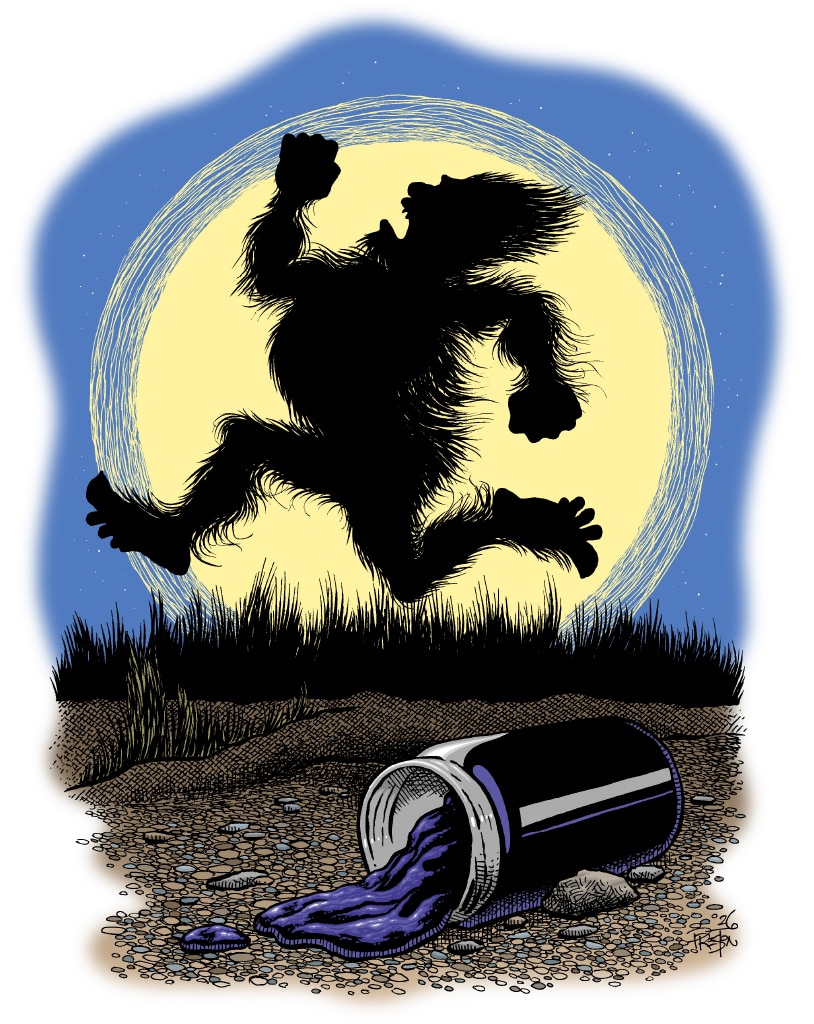
the rarely seen beasts are deathly averse to grape jelly. Illustration by Dennis Preston.
Under the surface
The theme of last week’s Camp Discovery at Woldumar, “under the surface,” was particularly appropriate.
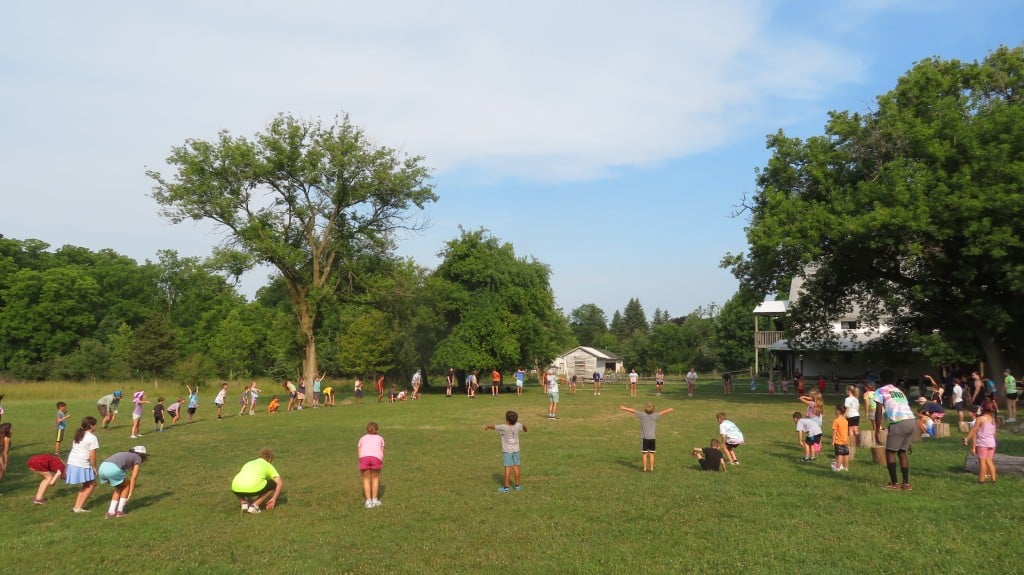
On the sunny, hot morning of July 14, about 80 kids gathered near the converted barns on the nature center’s lush grounds to prepare for another day of the weeklong camp. About 900 kids attend day camp at Woldumar during the 11 weeks it’s offered each summer.
Woldumar executive director Kevin Wernet put the combined number of students served by field trips from regional schools, educational programs and summer camps at 5,000 to 6,000 a year.
The day campers poked under logs, turned over rocks and took sample dips from the woodland pond, hunting for hidden organisms. Even before they set off into the woods, a few kids were bent to the ground, watching a mole burrow into the grass near the barn.
“He’s still down there, but let’s not bother him,” a counselor said.
It was all fun and educational, but there’s something much more charismatic and elusive “under the surface” at Woldumar.
Counselor Colum Shutler took a break from minding the kids to share the secret.
“They look like Bigfoot, covered in fur,” Shutler said. “It was a legend even before I started camping here. We never see them, because they can get from one spot to another by underground tunnels.” Shutler began camping at Woldumar 15 years ago, at age 5.
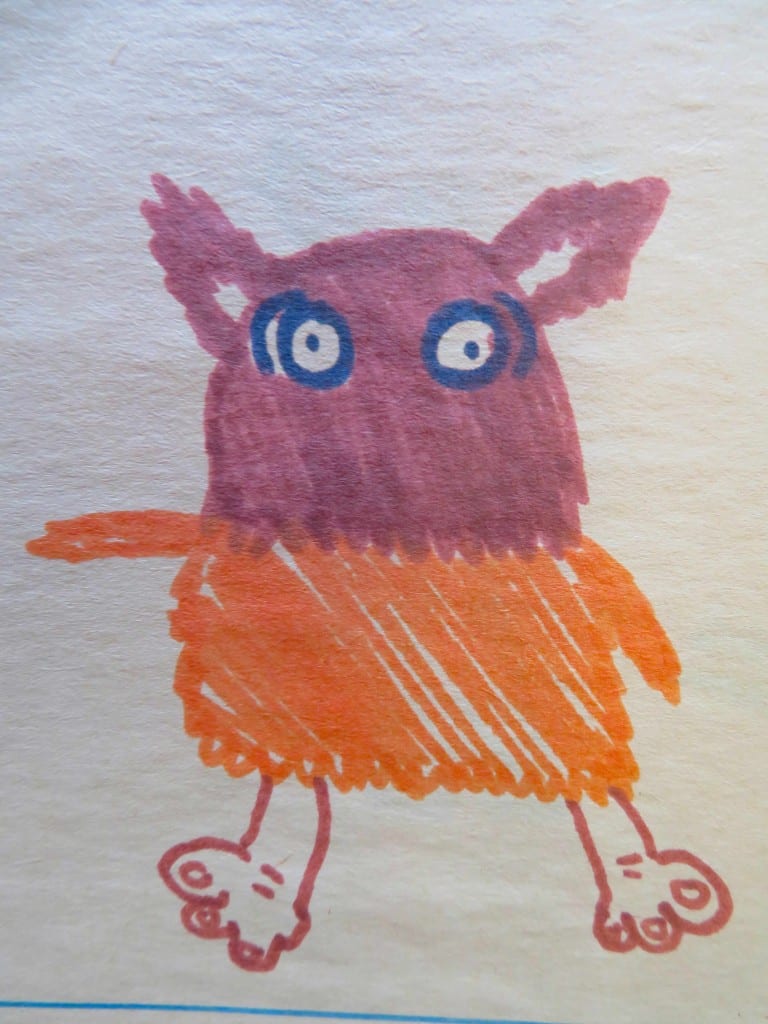
There’s a lot of doubtful and apocryphal Hooga Hooga lore, but some things are pretty much agreed upon.
They are 7 to 9 feet tall, and they have brown-black hair all over.
“You can repel them with grape jelly, which actually burns them on contact,” longtime camp counselor Patrick Reichel said. “You can also do a Hooga Hooga war dance, a sign of aggression. Fortunately for us, it looks a lot like the chicken dance, so it’s easy to teach.”
Reichel first attended camp at Woldumar at age 5 and “just never left.” He became a junior counselor in his teens and a senior counselor at 18. (He’s now 27.)
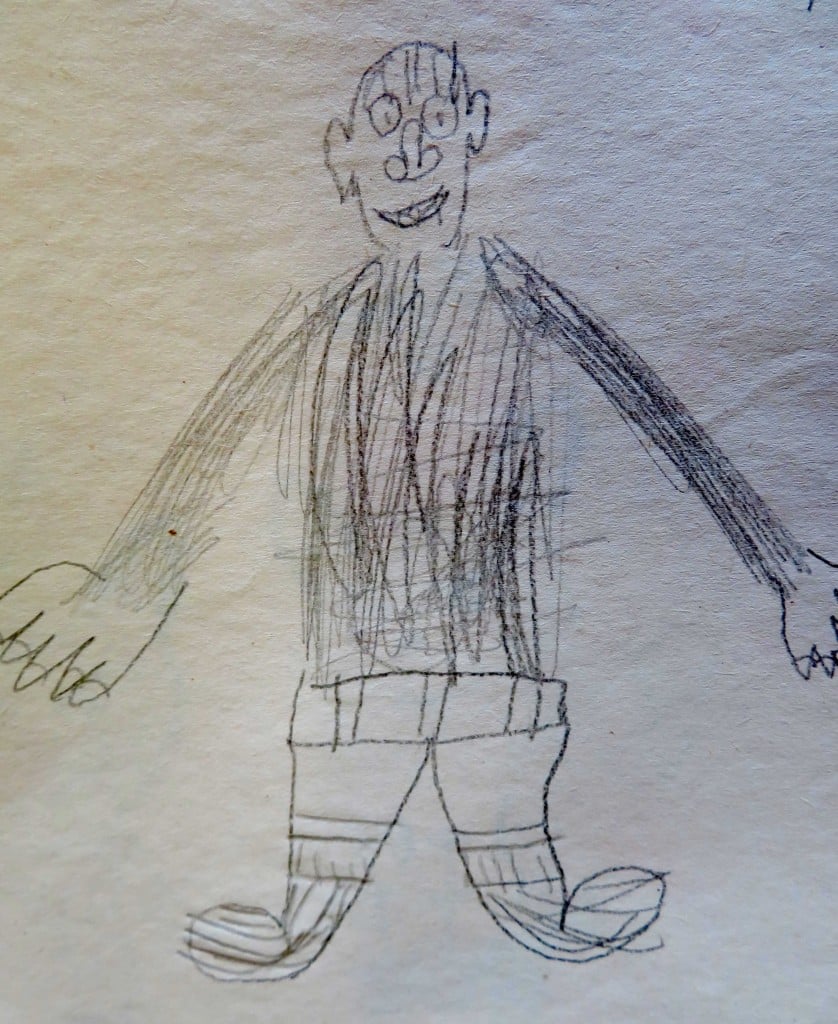
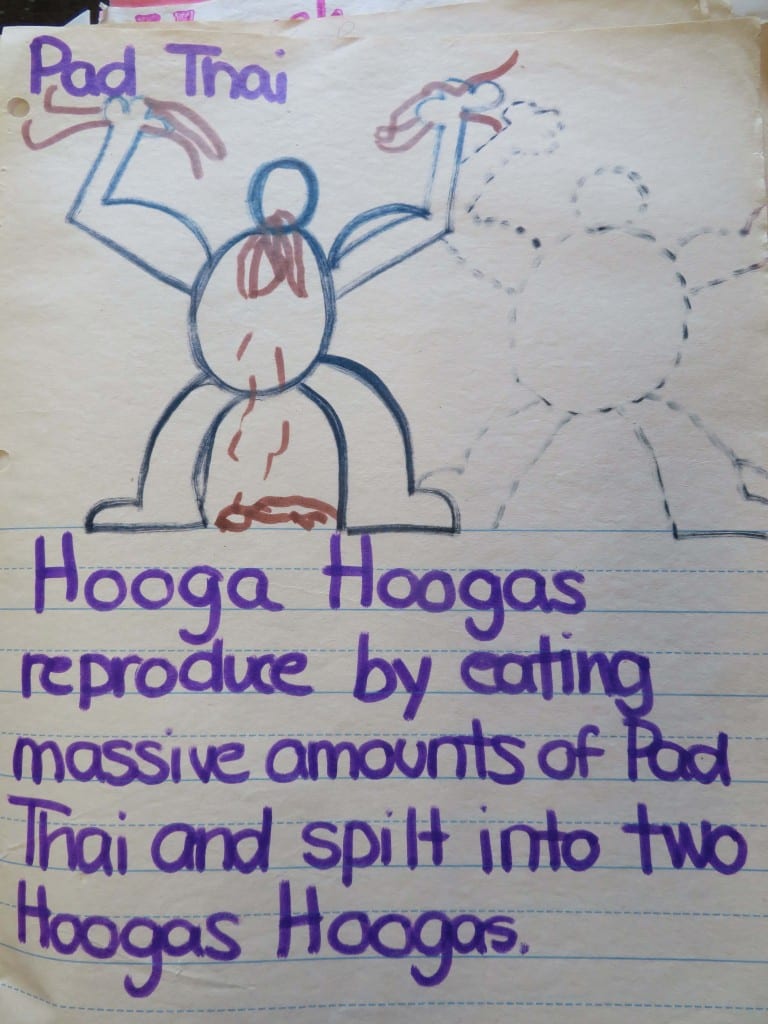
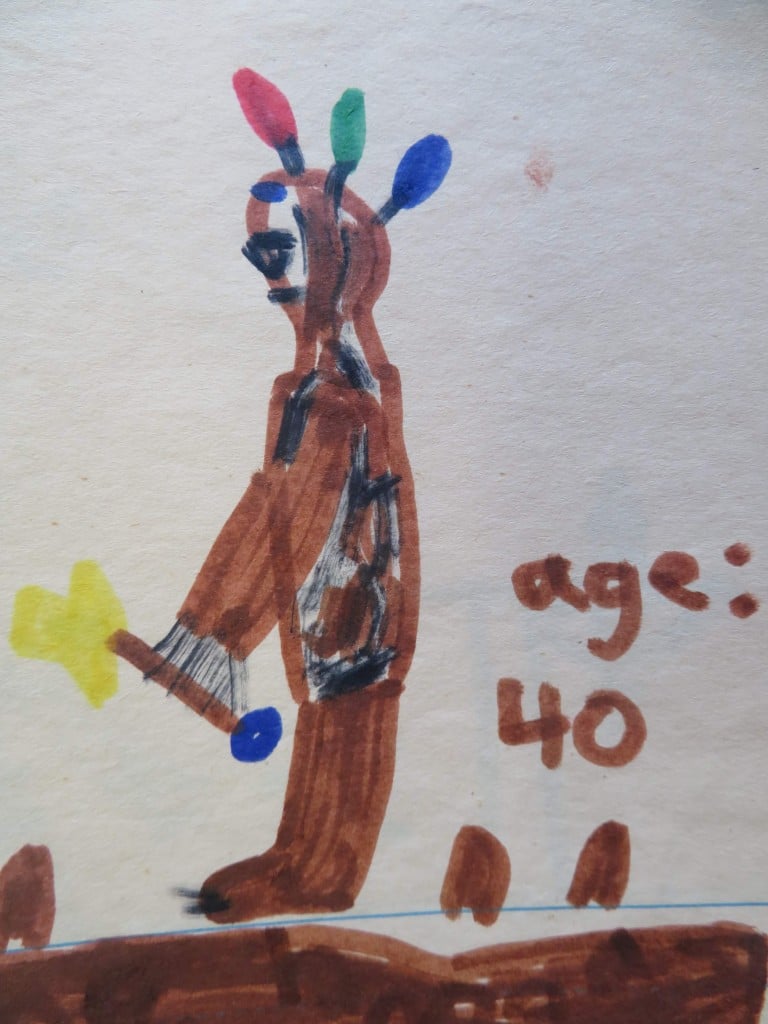
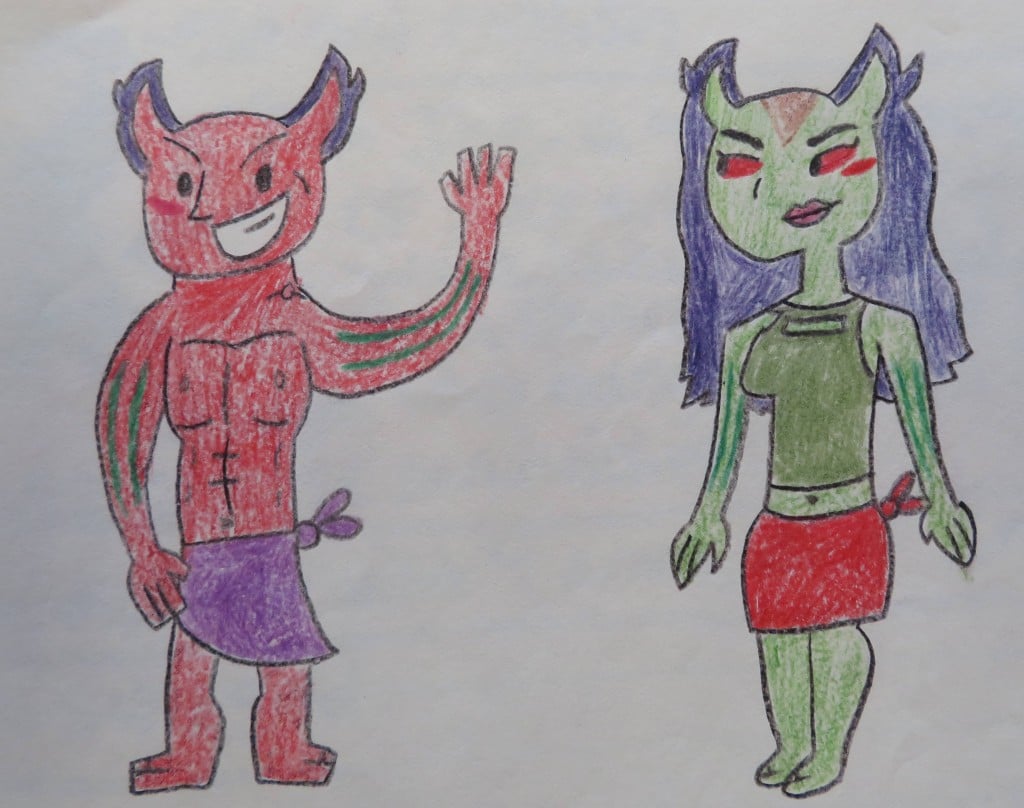
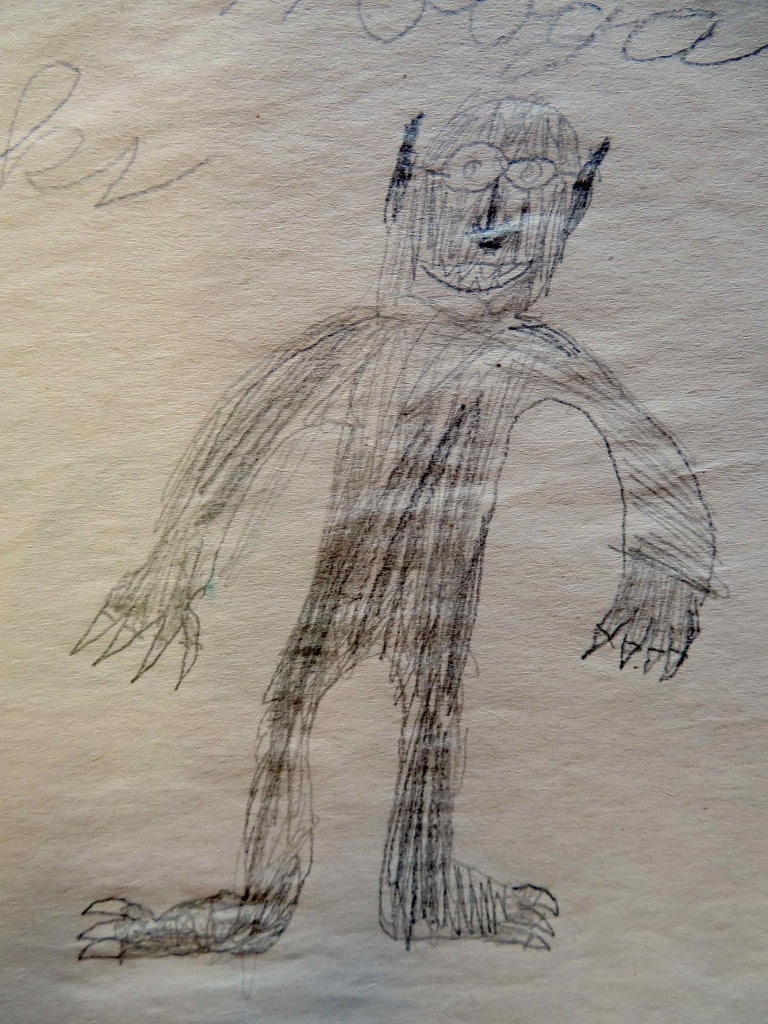
“In certain lighting conditions, the fur changes color,” Reichel said. “One of the colors you can perceive is purple. We’ve seen shades closer to orange. It varies from Hooga Hooga to Hooga Hooga.” Another counselor reported that they flat-out dyed their fur purple this summer.
They are said to be fond of pad Thai and cheese sandwiches.
“Allegedly, if a Hooga Hooga consumes a large amount of pad Thai, it will undergo mitosis and divide into two Hooga Hoogas,” Reichel said. “I only heard this once. It could be true, it could be just a story, or it could even be a Hooga Hooga pulling a joke on us.”
A joke? Does that mean they can communicate with humans? As a “Hoogameister,” or liaison to the creatures, Reichel helped set the terms of an agreement that made Hooga Hooga Island, a small bit of land in the Grand River, off limits to humans. He thinks they picked up English from eavesdropping on campers.
“The island has the only known entrance to a Hooga Hooga tunnel,” he said. “We didn’t want to disrupt their comings and goings.”
They appear to be sanitary creatures.
“Sometimes we’ll find animal scat in a large quantity and someone will say, ‘A Hooga Hooga left it,’ but only as a joke,” Reichel said. “I never saw any.”
The biggest animal native to Woldumar, the white-tailed deer, leaves modest, Milk Dud-sized droppings. If the pile is prodigious, a dog is the likely culprit.
Going vegan
These days, Woldumar counselors preach peaceful coexistence with the Hooga Hooga, but that wasn’t always the case.
When Reichel was a tyke, campers were told that Hooga Hoogas caught and ate unwary kids who strayed too far from their counselors.
“It was a modern fairy tale,” Reichel said. “You don’t go out into the woods alone.”
A hair-raising handmade booklet drawn by camp kids more than 20 years ago portrayed the creatures as smooth-skinned, angular demons and warned of nocturnal encounters “ending in blood.” Nervous camp staffers asked us not to reproduce any images from that early chronicle.
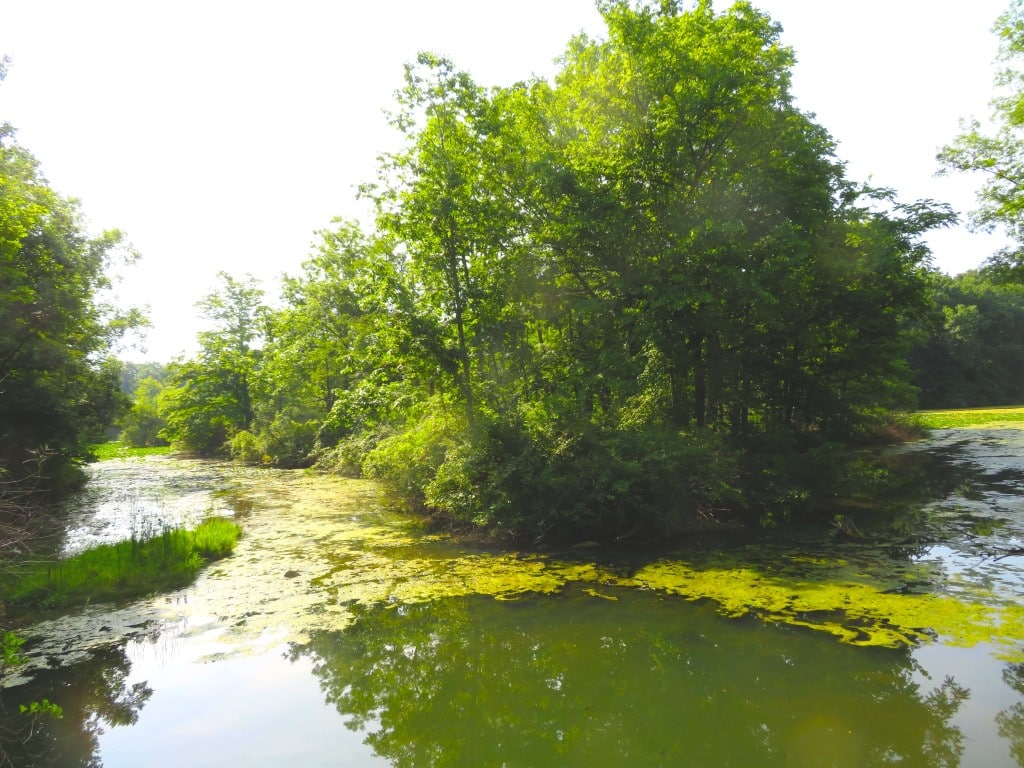
north side and the only known entrance to a Hooga Hooga tunnel. Photo by Lawrence Cosentino
For years, safe shelters built of sticks, shrubs and leaves, with names like “Bob’s Fort” of “Miguel’s Fort,” stood alongside paths as physical evidence of an ongoing war between the Hooga Hoogas and the staff of Woldumar.
Zeke Polken started camping at Woldumar in 2005, at 5 years old, and served as a counselor through his college years, until 2019.
“The whole thing was a cautionary tale to make campers stay with the groups,” Polken said.
What happened next is a little fuzzy.
Reichel said the Hooga Hoogas “evolved into vegetarians.”
“They no longer wanted to eat the children,” Polken said.
Shutler elaborated further.
“There was a time when they left and went on vacation for a few years,” he said. “They went to Florida. When they came back, we made a truce with them, and they decided to become vegan. Our part of the truce was to keep no grape jelly here at all, ever.”
In a remarkable stroke of luck, the Hooga Hoogas evolved from scary flesh eaters to shy vegetarians (vegans, even) at the same time kids’ summer camps shifted their emphasis from “fear and compliance” to “understanding and curiosity,” in the words of Woldumar development director Sam Inglot.
It was a serendipitous coincidence.
The mellowing of the Hooga Hoogas came as a relief to Woldumar executive director Kevin Wernet.
“Somewhere in the early to mid-2010s, we started to get feedback from parents,” Wernet said. “We’re a nature camp, and we want kids to be curious, to explore nature, observe science.”
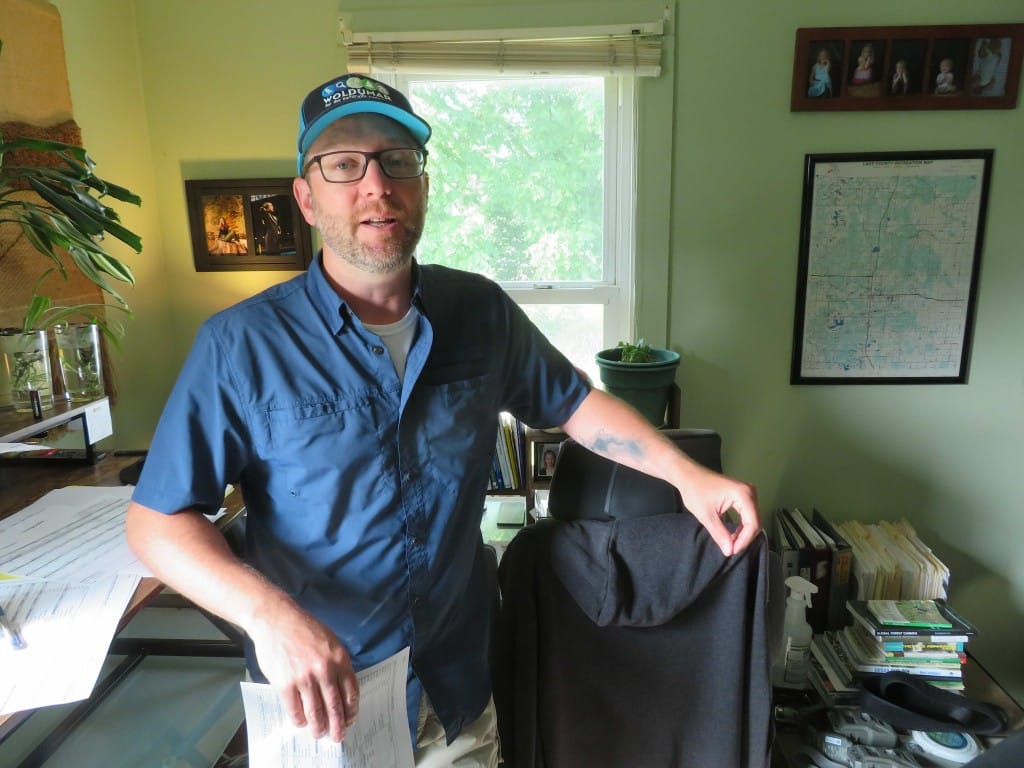
factor that sets Woldumar apart.” Photo by Lawrence Cosentino
Luckily, the Hooga Hoogas were evolving in the same direction.
“We kind of took a turn and made it a little more playful and used it as a mechanism to explore relationships in nature,” Wernet said.
The way Reichel tells the story, it sounds almost as if the whole thing is an elastic fable, altered to suit the spirit of the times, and not an amazing evolutionary convergence of human and Hooga Hooga culture.
“We recognized that the sensibilities of the times had changed,” Reichel said. “We realized it wasn’t the greatest thing to be telling kids that there was something in the forest that would eat you.”
“At a certain point, it turned into, ‘We can’t talk about this because the younger campers are freaking out about it,’” Polken said.
There’s another possible explanation for the change in tone from 1990s slasher movie to gee-whiz David Attenborough. Is it possible that the Hooga Hoogas were peaceful all along but misunderstood and feared by the campers and staff, as the unknown often is?
Wernet was intrigued by the hypothesis and instantly turned it into a teachable moment.
“If you look at the natural history of human-wildlife interactions, we see that with mountain lions, with wolves,” he said. If this were a 1950s sci-fi flick, he would have puffed thoughtfully on a pipe. “I won’t say the Hooga Hoogas are predators, but predators get a bad reputation with people who don’t dive deeper into natural systems.”
He added that nocturnal creatures like opossums, raccoons and bats also get “a bad rap.”
“Maybe there are some malevolent ones, but I don’t think the species as a whole is ill-intentioned.”
Rocky the rock
The tangle of Hooga Hooga legends has picked up a lot of fanciful and doubtful baggage over the years.
Polken, Reichel and Reichel’s twin sister, Callie, went so far as to compile a “Hooga Hooga Encyclopedia” from 2009 to 2011, with contributions from other young campers.
The scrapbook details the personalities of individual Hooga Hoogas and identifies some of their enemies, including the Triapothon, “half velociraptor and half praying mantis.”

Illustration by Dennis Preston.
A chubby woodchuck named Stu is celebrated as a dogged defender of the nature center, chasing Hooga Hoogas off in the night and returning to his cage in the visitor’s center by morning. (The visitor’s center at Woldumar no longer keeps caged animals.)
The keepers of the legend were entering their early teens, so it’s no surprise that they began to attribute adolescent concerns to the creatures, including unrequited crushes and body makeovers.
Only one dead, blood-covered camper is depicted in the scrapbook, a young kid stubbornly stuck in the old school.
There’s no telling what’s canon and what isn’t, but camp lore is a loose, baggy monster, more open-air open mic than fussy chronicle of Middle-earth. When excited kids are packed together into a summer camp, stories spring up like bioluminescent mushrooms.
“The curiosity and goofiness of camp is what makes it so cool,” Inglot said.
It goes on to this day. While gearing up for camp activities last week, a group of kids danced around a log, where an elaborate stick lodge had suddenly materialized at one end.
One of them held out a flat rock.
“It’s a home for Rocky the rock,” he grinned.
The week before, another group of kids banded together and called themselves the “sneaky avocados.”
“All week, you could hear the screams of the sneaky avocados,” Inglot said. Another group found 40 crayfish in the pond one day and called themselves the “crayfish empire.”
Last week, a brand-new legend sprang up at Woldumar when the kids dubbed taciturn counselor Ethan Kilgore “banana head.”
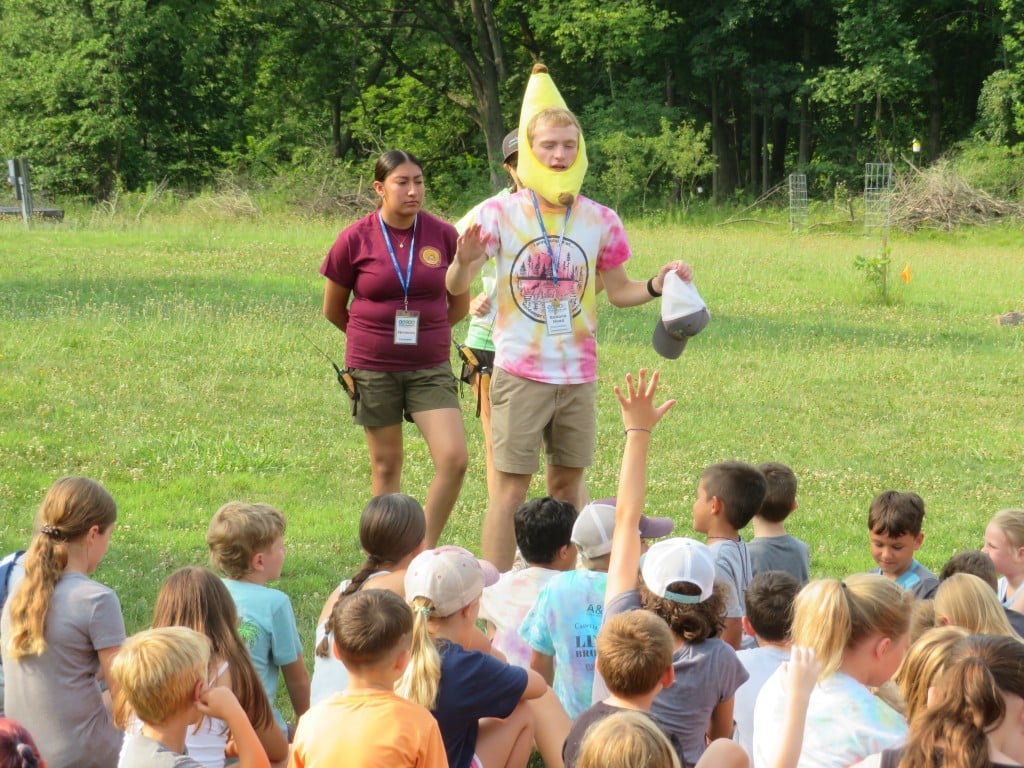
kids at the start of daily activities on July 14. Photo by Lawrence Costentino
Within a day or so, the counselors themselves were riffing on the “banana head” theme as they led the morning song:
“Banana head, banana head, where is banana head?”
Prior to his metamorphosis into banana head, Kilgore was notorious for his unsmiling, intense demeanor. The following morning, he showed up with a banana bandana on his head and was smiling.
“Who’s smiling all the time?” the kids chanted. “Banana head, banana head.”
Hooga Hoogas aren’t the only ones who can change their ways.
Peak Lansing
Hooga Hoogas embody many things at Woldumar, and one of them is the sheer fun and wonderment of being outdoors. You can hear the delight and love in Reichel’s voice when he talks about camping. He’s organized countless camp activities and served as a naturalist for many educational and outreach programs.
“My times at Woldumar are some of the best times I’ve ever had,” he said.
He’s come to know the nature center’s varied biomes — distinct areas with their own plants, animals, soil and even climate — like the back of his hand.
The grounds at Woldumar, like 90% of Michigan, were clear-cut in the logging boom from 1860 to 1910. The decimation of old-growth forest and conversion to farmland may have driven the Hooga Hoogas underground, but no one knows for sure.
Among Reichel’s favorite spots is a beech-maple forest informally called “the highlands” because of its rolling terrain. He loves to show campers one of the oldest stands of trees on the property and explain the stages of succession, or forest regrowth.
Since farming days nearly a century ago, Woldumar’s forests have regenerated into a diverse labyrinth of mixed beech and maple forest, showcasing species like the leafy pawpaw and a towering white pine plantation that’s often compared to a Gothic cathedral.
Inglot pointed out that the young forest still has a lot of understory — bushes, vines, shrubs and young trees that provide plenty of cover for secretive underground dwellers like the Hooga Hooga.
The forests at Woldumar have been a part of Reichel’s life since he was a little boy. He fondly recalls sunny afternoons at camp when counselors would section off a huge chunk of the nature center, divide the area in two and supervise a “tag”-style melee called “capture the flag.”
“We’d be running around through the woods, up and down the hills, weaving through the trees,” he said. “It was just an incredible experience.”
The furry, mysterious inhabitants living beneath Woldumar, and nowhere else in the world, also embody the nature center’s status as a local treasure — “peak Lansing,” in Inglot’s words.
The very land on which Woldumar sits was a working farm where the iconic Lansingite Ransom E. Olds built a home for his daughter Gladys Olds Anderson.
In the mid-1960s, Anderson made an agreement with the nonprofit nature center, which had no permanent home for its programs, to use the property, and she ceded it outright in the early 1970s. There’s no evidence that Anderson ceded the land as the result of a Hooga Hooga scare, but who knows? It’s not the kind of thing you put in a deed.
Woldumar is also unique in its status as the only private nonprofit nature center Lansing, according to Inglot.
“Memberships, grants and donations keep the lights on — although we don’t really have that many lights,” Inglot said. “But they keep the trails open and keep the programs running.” Event rentals are another key source of income.
Volunteers log about a thousand hours per year helping with events and activities, clearing brush and invasive species and generally keeping the place in top form. (The last of three summer creek cleanups is set for Aug. 15, and volunteers are always welcome.)
One of Woldumar’s most famous structures is a rustic cabin built in 1860 where Lansing’s most famous architect, Darius Moon, lived as a child. Moon went on to design the Turner-Dodge House, the historic Rogers-Carrier House at Lansing Community College and grand mansions for E.W. Sparrow and R.E. Olds.
“This place just oozes Lansing history, as well as being a cool summer camp,” Inglot said.
The Hooga Hooga are more than just hairy icing on the cake.
“It’s part of why Woldumar is such a unique and special place,” Polken said.
Polken is studying for a master’s degree in education. He credits the nature center for planting the seeds of his future career.
“I didn’t realize I wanted to work with kids until I started working with kids at Woldumar,” he said.
He plans to return to Woldumar Aug. 8 for the woodsy wedding of his one-time camp buddy and fellow “Hooga Hooga Encylopedia” contributor Callie Reichel. (Woldumar has a wooded amphitheater often used for weddings and a glittery dance venue, the R.E. Olds Anderson Rotary Barn.)
Once the place gets into your blood, it’s impossible to stay away for long.
“It’s a unique place I’ve known since I was a kid, the closest thing I have to a childhood home I can go back to,” Polken said. “The Hooga Hoogas help to bring out the kids’ sense of wonder and discovery. There just isn’t anywhere else like Woldumar.”