
David Hollister’s amazing run ends at 84
In the early eighties, State Rep. David Hollister was bitten by a bat while running in downtown Lansing. Not to be deterred by a few shots, he kept running.
What was he doing in 1993, right before being sworn in for his first term as Lansing mayor? He was running in his Tecumseh River neighborhood.
In 2000, Hollister was diagnosed with Parkinson’s disease and his running regimen evolved into a daily five-mile walk with his spouse Christine leading the way.
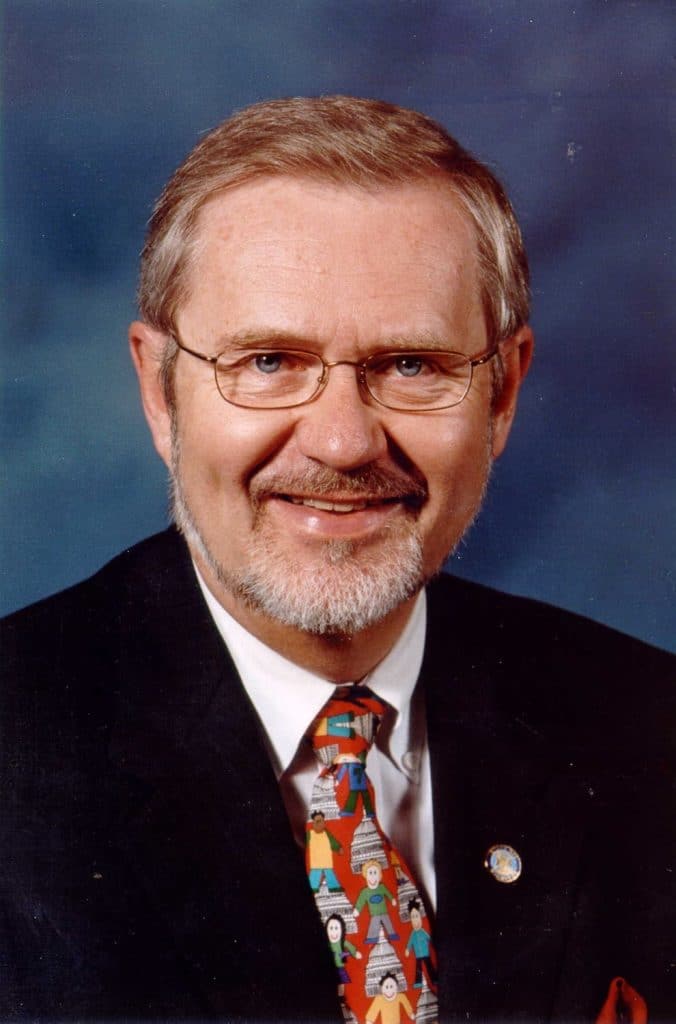
In the late 2000s, Parkinson’s forced him to transition to a high-tech walker, still running.
After his death at 84 on Sept. 22, he was remembered for his determination and his decades-long run as a public servant who could not be kept down.
He is remembered by friends, family and his wife, Christine, as someone who was a “giant,” “visionary,” “caring,” “tenacious,” and “strong-willed.”
Hollister was part of the World War II baby boom, born in Kalamazoo in 1942 and raised in a middle-class family in Battle Creek. He was the first in his family to attend college, and earned both a bachelor’s and master’s degree from MSU.
In April of 1965, Hollister learned that Dr. Martin Luther King Jr. would be speaking on campus at the MSU Auditorium. It was a fundraiser for an educational program in Mississippi. Hollister arrived late and had to sit in the balcony.
While leaving the event, he ran into King on a staircase landing.
It was a serendipitous, and fleetingly brief, meeting with King but that staircase moment would change the trajectory of both Hollister’s life and the future of Lansing.
Hollister had considered being a minister but instead, in the summer of 1966, he packed his bags and, with his young family, became a volunteer teacher with other MSU students at a Mississippi Freedom School in Holly Springs, Mississippi, a summer program at Rust College. At the time, Mississippi was a hotbed for voter registration efforts as well as racial violence. Freedom Schools, part of Freedom Summer, were established to help bridge the educational disparities between white and black children.
In an interview for Lansing City Pulse, Hollister recalled how “scared” everyone was. Just two years earlier, three Civil Rights activists had been killed in Mississippi.
After graduation, Hollister had taught in Durand but resigned over differences of opinion regarding teaching a segment on Black history. Moving to Lansing, he taught American history at Lansing Eastern High from 1967-1970.

His students loved him; one of his students, Sherri Randall, now lives in Northern Michigan and later became a teacher.
“He was an amazing teacher who taught living history,” she said.
In the 1967 school year, Hollister showed films of his Mississippi experience to the students and he organized rallies.
“He was fearless and believed that if you are going to teach you have to live it,” Randall said.
Hollister was also an anti-war activist and participated in marches and rallies. During one march to the Capitol, he was nearly run over by an errant driver, according to Richard Baker, a former Lansing Councilman who was just ahead of him. Hollister’s activism put him on the university’s infamous Red Squad list, which compiled intelligence dossiers of labor organizers and anti-war activists. Hollister considered it an honor to be included in such a list.
Hollister began his political career as an Ingham County commissioner, a post he held from 1968-1974. At the start, the board was decidedly in Republican control. By the time he left, it was in the hands of Democrats.
He kept his bell bottoms he wore to commission meetings; they still bear an upside-down American flag and a peace symbol sewn on the butt.
In 1974, he left the county commission after making a winning his run for the Michigan House of Representatives. In his 18-year stint in the House, he held several leadership roles, including chair of the powerful Social Services Committee, which oversaw services for Michigan’s poor.
As a State Representative, Hollister did not shy from controversial issues and proposed successful legislation for mandatory seatbelt use, which was considered an assault on citizen rights by many. Hollister also shepherded legislation covering open meetings and freedom of information.

Inspired by his grandfather’s “prolonged” death, he also introduced “right to die” legislation, which he counted as one of his most important accomplishments. Although controversial at the time, it led to the ability of patients to die with dignity and today’s hospice program can be traced to that monumental legislation. In an interview with Walt Sorg for the Michigan Political History group, Hollister details how his grandfather’s death inspired him.
Believing he accomplished everything he could in the House, he ran for Mayor of Lansing on a “good government” platform. At the time, Lansing was reeling from an early retirement scandal in which top officials got special treatment while voting on their own retirements with hefty cash payouts.
In his interview with Sorg, Hollister relayed how some business leaders reacted after his election as mayor: “Oh my god, we’ve elected a communist.”
One of the new mayor’s first and most notable achievements was to clean up the sin strip, which had plagued downtown with porno shops and peep shows for a couple of decades.
Hollister offered a visionary alternative: recruit a minor league baseball team and build a downtown baseball stadium in its place. The idea seemed outrageous to many Lansing residents.
But Hollister prevailed and was able to tear down the strip and replace it with a modern baseball stadium with the nameplate of the venerable Oldsmobile.
And when it came time to name the team and a mascot, a significant cadre of residents criticized the choice “Lugnuts,” calling it “stupid.”
Hollister in the Walt Sorg interview, admitted that the city got more letters about the naming than any other issue. Today, the Lugnut brand is revered in Lansing and the sin strip gave way to the new Stadium District.
However, Hollister’s most difficult challenge was looming on the horizon. In 1996, a visit from GM’s chief lobbyist left Hollister and the city reeling. It was one of those good news-bad news moments that would define Hollister’s public life.
He was told Lansing would get the new Alero line but in five years GM would pack up and leave Lansing, making 30,000 automotive jobs obsolete.
Not to be deterred, Hollister began searching for an answer. One of his first moves was to meet with David Cole, the preeminent automotive researcher and insider. At a private meeting at the Radisson in Lansing, Cole’s sage advice was to “go to Toledo” and see how they saved the Jeep plant there.
Hollister immediately led a bus tour of Lansing business and public officials to Toledo, where they began developing a strategy to Save GM.
Ray Tadgerson, who had worked with Hollister on the stadium project, said “the right people were on the bus,” including labor, local political leaders and business leaders.
The bus trip set in motion a regional effort, “Lansing Works! Keep GM.” In the company’s 100-year history, GM had never before reversed course on a decision to close a plant.
A plan, created by Tadgerson, showed how a modern automotive plant could be built on the old site.
The bid was audacious. And it worked.
As a result, the Lansing area has two GM plants today.
Hollister wrote a book about the effort, “Second Shift: The Inside Story of the Keep GM Movement,” and it led to a documentary movie.
In 2000, Hollister learned he had Parkinson’s. He wanted to confront and name his new nemesis, so his disease became personified as “Parky.”
His spouse Christine Hollister said, “Dave was always a competitive person. He fought Parkinsons by naming it and having it be his opponent.”
Like every other challenge in his life, Hollister didn’t let “Parky” define him.
He pasted motivational sketches of “Parky” around his home. He kept a daily 15,000-step walk and took up recreational boxing, sparring against the enemy lurking inside him. Sparring against time.
“He had ‘Parky’ at the foot of the bed and he would say I’m going to beat ‘Parky’ today,” his wife said. “‘Parky’ seldom won, until the end.”
Hollister’s professional career continued as mayor beyond the early diagnosis. In 2003, he resigned to become a cabinet member in the administration of Gov. Jennifer Granholm. In 2006, he would resign that post to head the newly formed Prima Civitas, a collaborative partnership with Michigan State University and East Lansing to promote economic growth.
Hollister kept his hand in local politics until near the end. Joan Bauer, a member of the Lansing Charter Commission and a former council member and state representative, said he provided input into the Charter rewrite and even wrote the preamble.
Hollister appeared in the City Council chambers and the City Hall that is named for him earlier this year, when he pushed for the changes.
For future generations, Hollister’s collected papers are at the MSU Archives and a transcript of his interview with Walt Sorg is online. A celebration of life event is still in the planning stages.