
Flight pioneer Harriet Quimby was ‘Fearless’
After covering multiple wars as an award-winning television correspondent for ABC and CBS, author Don Dahler engaged in a series of life-threatening adventures that taught him all too much about …
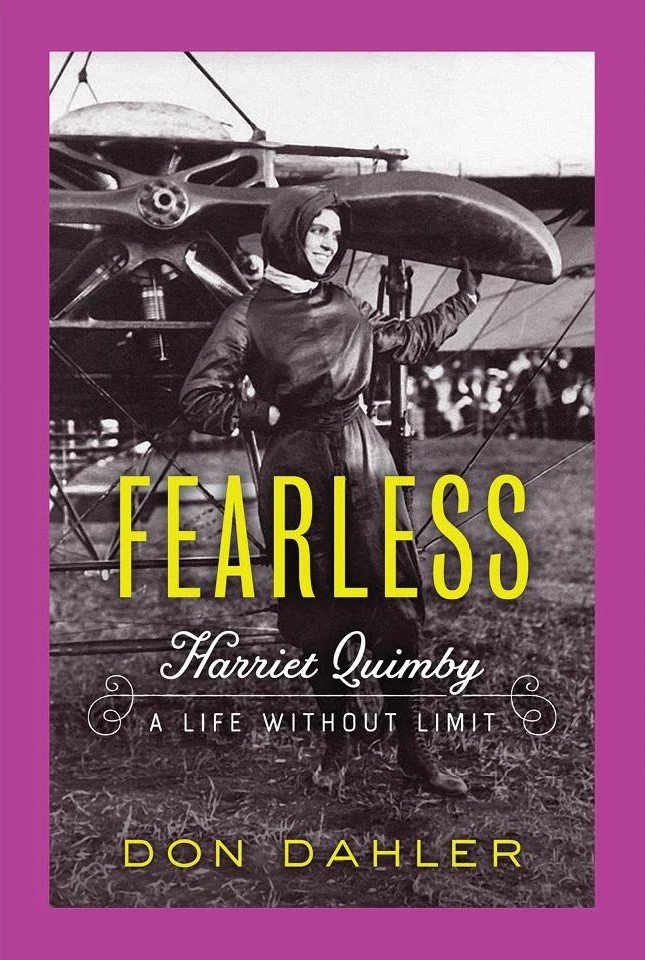
In his 336-page book, published last month, Dahler, an aviation buff who discovered Quimby while reading an early aviation magazine, tells the amazing rise of a young woman in — what was then — a man’s world.
New book details Michigan native’s extraordinary life
After covering multiple wars as an award-winning television correspondent for ABC and CBS, author Don Dahler engaged in a series of life-threatening adventures that taught him all too much about working a dangerous, yet rewarding profession.
Those adrenaline-pumping experiences no doubt helped inform his new book, which centers on another adventurer. In “Fearless: Harriet Quimby A Life Without Limit,” Dahler digs back over 100 years and recounts how Quimby, a Michigan native, became one of the most famous aviators in history. In 1912, she became the first woman to fly across the English Channel.
He writes in his new book: “In a time when human flight was still measured in minutes and dozens of lives were sacrificed annually for the advancement of aviation, Harriet’s was a journey almost as audacious and perilous as a trip to the moon would be 57 years later.”’
In his 336-page book, published last month, Dahler, an aviation buff who discovered Quimby while reading an early aviation magazine, tells the amazing rise of a young woman in — what was then — a man’s world.
Dahler traces Quimby’s life from her 1875 birth in the small Michigan farming town of Arcadia to her tragic death some 37 years later.
“When I found the obscure mention of her in an aviation industry magazine I was stunned,” Dahler said. “I never heard of her, and I went on a treasure hunt to learn more. I decided to write a screenplay, originally.”
The screenplay never went anywhere, and his boxes of research were packed away as he continued his career as a fiction writer and journalist — but Quimby was always on his mind.
Decades later, when he decided to take on the biography of Quimby, the New Jersey resident was meticulous with his research and sources.
He was worried he “was not going to do her justice,” he recalled. “I had never taken on a biography where every source has to be documented and you have to make it clear when using conjecture.”
But after utilizing search engines and online databases, he soon uncovered more than he ever knew about Quimby, including facts about her early days.
Quimby attended a one-room schoolhouse but soon moved to California with her family, who was looking to escape the hardscrabble life of Northern Michigan farming. Undaunted by her early life, Quimby soon became part of the San Francisco Bohemian scene and even appeared in a movie by the young director D.W. Griffiths.
It was in California she also began a career in journalism, ultimately moving to New York to become a writer for Leslie’s Illustrated Weekly, a national magazine. It was there her reputation soared.
“She did a lot of things,” he said. “She was one of the first women to write screenplays. She owned and operated an automobile, driving 100 miles an hour. She was a toughie.”
According to Dahler, it was her experiences driving fast that attracted her to flight. And, as the book details, when Quimby wanted something, she went after it with a passion.
By the time she talked someone into giving her flying lessons in 1911, manned flight was only a shade over a decade old. Dahler describes how Quimby was not to be deterred by the male-dominated field, and, in 1911, she became the first woman to become licensed by the Aero Club of America.
Given how dangerous early aviation was, Quimby took the responsibility seriously. As an example, the author cites the grim statistic that while she was earning her license 100 pilots died from flight accidents. As Quimby became comfortable flying, she made serious money at national and international air shows. She also used her platform with Leslie’s to write about her trailblazing adventures in the air.
With her stunning good looks, the former tomboy became the equivalent of today’s rock stars. When she readied herself for her flight across the English Channel in 1912, one of the last things she did was “touch up her makeup.” Quimby, who once performed on stage in San Francisco, intrinsically understood the importance of self-promotion, especially when it came to the flying outfit. She donned a non-traditional hooded one-piece plum-colored flight suit for her channel flight.
“She was 100% aware that day that what she was doing was historic,” Dahler said.
Even though the channel flight was perilous, given the high altitude, dense fog and unpredictable winds, Quimby flew into aviation history that day. Unfortunately, her historic flight, according to Dahler, was overshadowed by the sinking of the Titanic. Dahler said never showed her bitterness for being overlooked.
However, two months later at a Boston Airshow, she would fly into aviation history when a quirky two-seater plane she was flying plunged forward dumping them into a bog near Boston Harbor. She and a passenger were both killed.
According to Dahler, her death spurred the misogynistic attitude of the time and numerous publications ran editorials about “why women shouldn’t fly.”
Today, that ignorance is no longer attached to her reputation as a pioneer of flight. In 1991, the U.S. Postal Service issued a 50-cent airmail stamp to honor her. Beyond that, there are two historical markers honoring her time in Michigan, one in Coldwater and one at her childhood home in Acadia.
Related Articles

Rewarding resolutions that won’t require a major commitment of time
Much like money, time does not grow on trees. That reality is all too familiar to busy adults juggling multiple responsibilities at work, at home and other places where they spend their time. A time crunch can make it hard to commit …

‘Under the Radar’ TV guys publish 3rd book on Michigan sites
The title of their Emmy Award-winning television program may be “Under the Radar,” but the producers of the Michigan Travel and Tourism program are flying high.
They have …

A blast of Basie
Jazz vocalist Carmen Bradford can whisper, soar, groove and thunder her way into your soul. She makes it look easy, but it’s not.
“It’s a challenge to sing every night, to …