Artworks break free from behind bars
People who have never been inside a prison might imagine that life inside is a daily fight for physical survival, like it is on shows like “Oz” or “The Mayor of Kingstown.” To …
“Bridging walls [-] different worlds”
Through Dec. 12
Noon-4:30 p.m. Monday-Friday
Residential College of Arts and Humanities LookOut Gallery
Snyder Hall Second Floor
362 Bogue St., East Lansing
People who have never been inside a prison might imagine that life inside is a daily fight for physical survival, like it is on shows like “Oz” or “The Mayor of Kingstown.” To be sure, violence does happen in carceral settings, but the critical battles are often not physical; rather, they are mental, emotional and spiritual.
Entitled “Bridging walls [-] different worlds,” the current exhibit at the LookOut Gallery at Michigan State University’s Residential College of Arts and Humanities (RCAH) is an opportunity for the outsider, everyone outside of incarceration, to experience prison life through the art and poetry created by people incarcerated in Michigan.
The exhibit combines the outreach efforts of several organizations and builds another bridge, this one between state rivals MSU and the University of Michigan. The Prison Creative Arts Project (PCAP), housed within U-M’s Residential College and under the College of Literature, Science, and the Arts, began in 1990 with a single theatre workshop taught at a prison. PCAP itself is a bridge between two worlds, bringing college students and faculty into prisons for workshops in visual arts, writing, music and theatre.
PCAP also organizes the Annual Exhibition of Artists in Michigan Prisons, featuring hundreds of works by artists incarcerated within the Michigan Department of Corrections. Because of space limitations in prison cells, incarcerated artists are typically not allowed to keep their works for long. Most artists send their work home to family or friends or sometimes donate it to criminal justice reform non-profits for fundraisers. Some of the work is donated to PCAP. The work presented at the LookOut Gallery was curated by MSU faculty members Steve Baibak and David McCarthy, PCAP director Nora Krinitsky, PCAP exhibition and curatorial manager Emily Chase, three RCAH students and three U-M students.
The limitations imposed on incarcerated artists push their imagination and creativity. Many incarcerated artists begin their practice copying from photographs, and often they create photorealistic drawings. As with any artist, technical skill is only one aspect of creating art. Artists must develop a voice and message as their ideas mature, and incarcerated people have some serious messages to deliver. The RCAH exhibit is a perfect showcase for those messages, where important themes emerge.
One powerful theme is the fear associated with reentering society.
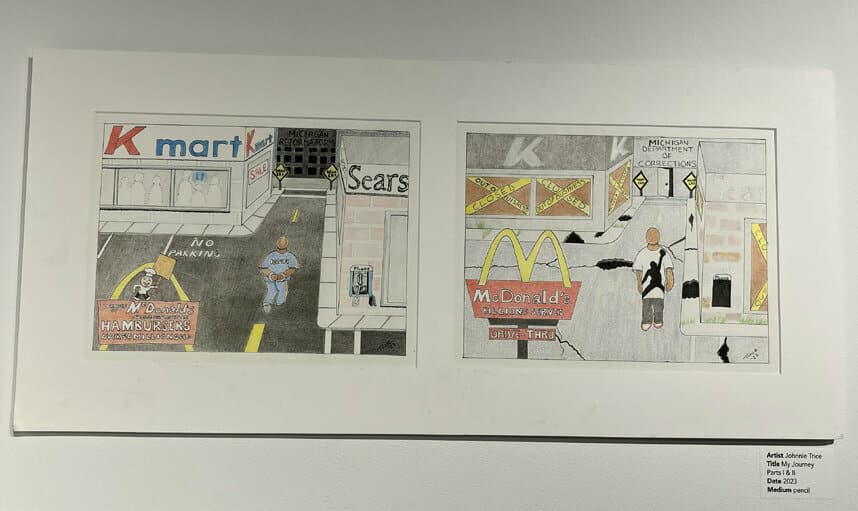
Those who have served long sentences are keenly aware that the world has changed incredibly, and they often feel woefully unprepared for the modern world. Artist Johnnie Trice’s piece “My Journey Parts I & II” shows a figure, presumably the artist, in a cityscape circa 1989, walking past a thriving K-Mart and Sears as he heads toward prison. The accompanying panel shows him exiting the prison, surrounded by empty storefronts covered in graffiti, with only the golden arches of McDonald’s to welcome him home. With businesses replaced by online shopping and pay phones replaced by cell phones, returning citizens are at a disadvantage when shopping and communicating without help from others.
Trice’s faceless figure is alone.
Baibak noticed another theme: the artist as superhero. “I feel like anything I say is just assuming, but I feel like superheroes save, maybe they’re saving themselves. Maybe they’re saving a version of themselves. Maybe they’re trying to get a message out, maybe it’s about goodness.”
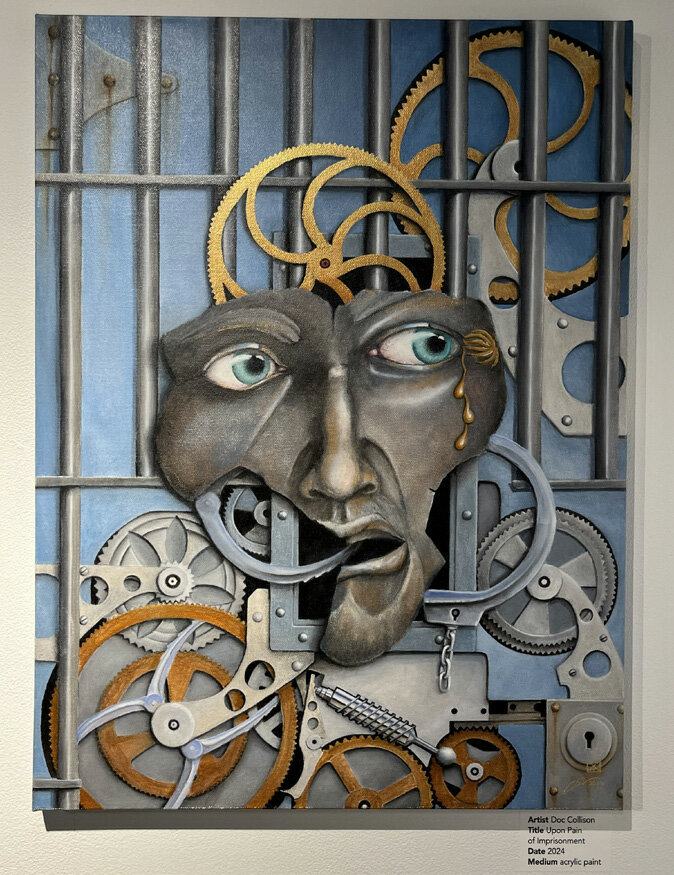
Perhaps the most prevalent theme is freedom, of escaping the prison environment or breaking the bonds of incarceration. These ideations don’t pose security risks, as these escapes are mental or emotional rather than physical. Images in this show vary from a painting showing three men in prison garb flying joyfully over the walls of a prison to a man in a brick tunnel walking toward a light, shedding his prison uniform as he strides forward.
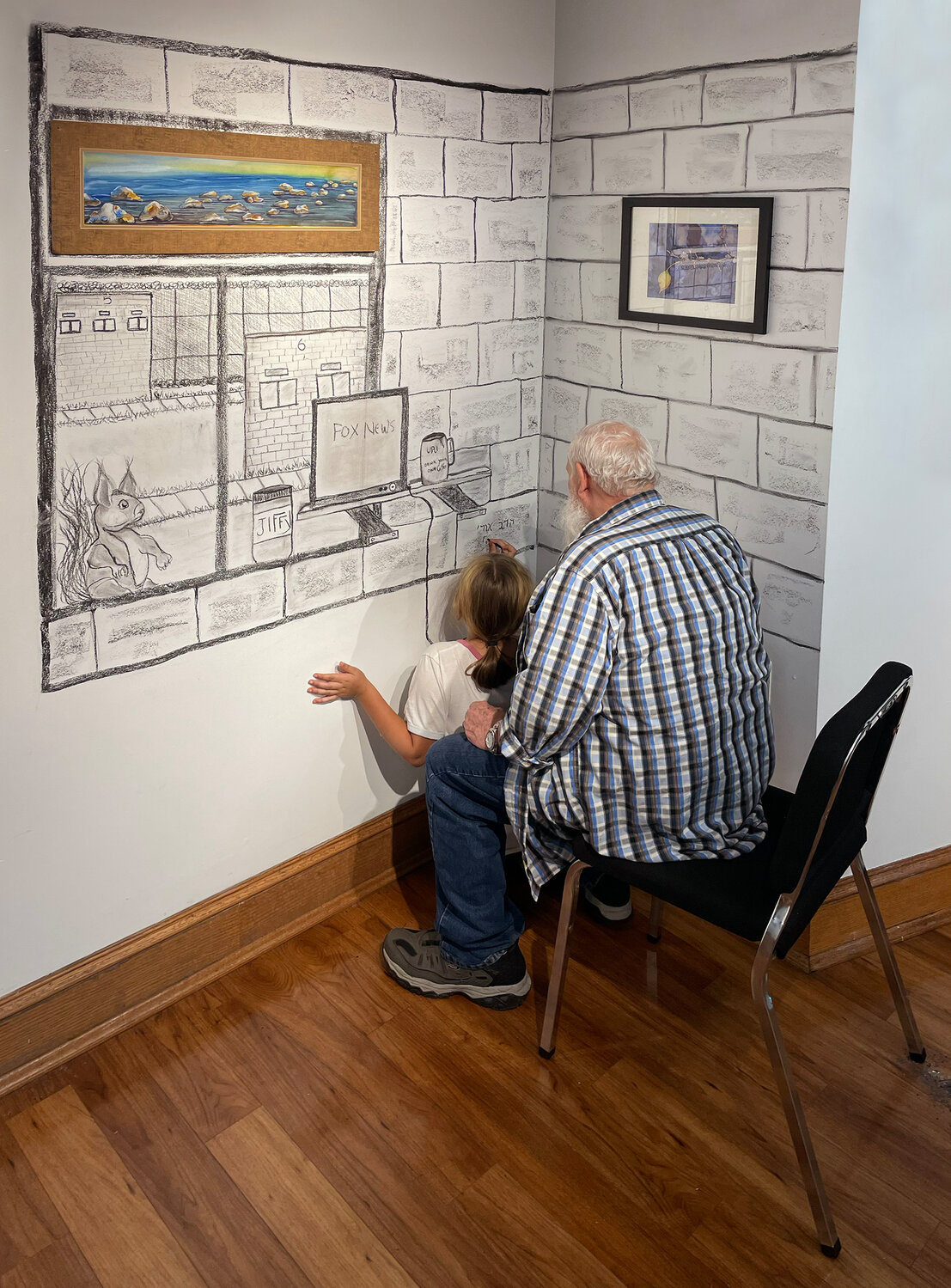
Participating artist Uri Scharfenstein said freedom is a common theme, and his installation “Cellblock Works” illustrates the practical application of art as a symbol of freedom. Scharfenstein has essentially framed two of his paintings with an almost life-sized charcoal recreation of his cell drawn on the walls of the gallery. A landscape watercolor is placed where he had it in his real cell, in a window partially blocking out his view of razor wire.
The idea to recreate the cell was Baibak’s idea.
“Steve said, ‘Your watercolor would be so much more impactful, and people would see what you saw, ’” Scharfenstein said.
The piece also shows Scharfenstein’s sense of humor. On the window ledge sits his “pet” squirrel and the jar of peanut butter he would feed it. His coffee mug sits on the ledge as well, marked “URI Drink Your Own Coffee,” a warning to his bunkie to leave his mug alone.
Scharfenstein has been home for six years, but still remembers keenly the value of art to incarcerated people.
“It takes you from chaos to peace,” he said, “It saves lives.”
Scharfenstein said all art saves, from the visual arts to music to theatre programs.
Other work highlighted in this exhibit includes poems.
Guillermo Delgado, an academic specialist at RCAH, has led creative workshops in carceral settings since 2014. Showcased in this exhibit are poems created by men incarcerated at the Handlon Correctional Facility in Ionia. The writers drafted odes to any number of subjects, and Delgado’s research assistant Elena Forman worked with the writers to design the broadsheets hanging in the gallery. The subject of these odes may seem mundane to outsiders, but to incarcerated people, items like headphones, keyboards and paint can offer freedom, escape and peace.
Delgado’s writers also participated in a poetry slam, with enlarged versions of their scripts on display. The slam poetry exudes a more visceral energy than the odes, together covering the spectrum from chaos to peace. Hanging next to the poems are the certificates of participation that the writers earned. This may seem a mundane addition to the exhibit, but it matters. Because incarcerated people are allowed so few possessions, a simple certificate is a powerful validation of achievement to those on the inside.
An exhibit in the hallway outside the LookOut Gallery is a bridge to another carceral world, the Ingham County Youth Center. Volunteer students from RCAH and the Creative Collaboration with Incarcerated Youth worked with incarcerated youth to create joyful, hopeful silhouettes. The volunteers brought in props such as hats and a giant foam hand, turned bright lights on the artists, and let them draw silhouettes of each other. The volunteers brought the papers back to campus to cut them out because no scissors are allowed in the facility.
“Scene in Silhouette, Seen in Silhouette” illustrates that in their most basic form, these youth look just like any kids.
Taken as a whole experience, the two exhibits remind us that while we live in different worlds, the desire to create is an essential part of what it means to be human. These works of art are proof positive that people on the inside are no less human than those on the outside.
They want to be seen, heard, understood and loved.
(Clarification: Some co-curators were left out of the original article. They are Prison Creative Arts Project director Nora Krinitsky, PCAP exhibition and curatorial manager Emily Chase, and their students Olivia Glinski, Iris Ruffing and Shravya Ghantasala.)