‘Bad Books’ tells both sides of all-too-common standoff
A mother shows up at the town’s public library to berate its librarian for recommending a particular book to her 15-year-old son, Jeremy.
Because she knows what’s best for him, …
“Bad Books”
Through May 31
2 p.m. Thursday, Saturday-Sunday
7:30 p.m. Friday-Saturday
Williamston Theatre
122 S. Putnam St., Williamston
(517) 655-7469
williamstontheatre.org
A mother shows up at the town’s public library to berate its librarian for recommending a particular book to her 15-year-old son, Jeremy.
Because she knows what’s best for him, the mother tries to convince the librarian to keep such books off the shelves, away from the eyes of children. If the librarian refuses, the mother is prepared to use her considerable social media influence in the community to organize a protest.
The librarian does not concede. Neither does the mother, who summons her supporters via cellphone video. The protest ensues, resulting in violence and damage and injury.
This is the story of “Bad Books,” by Sharyn Rothstein, making its Midwest regional premiere at Williamston Theatre.
As a reader and writer, I’m with the librarian. As a former 15-year-old, I know what it’s like to be curious about lots of stuff. At that age, I was hand-printing Dewey decimal numbers on the spines of books as a volunteer in my junior high library.
As a parent, I can understand the mother’s concerns about what her son and daughter are exposed to. My wife and I raised two sons and three daughters.
As I watched “Bad Books,” I observed revelations unfold in a library, a business office and a church parlor in unpleasant but sometimes humorous ways.
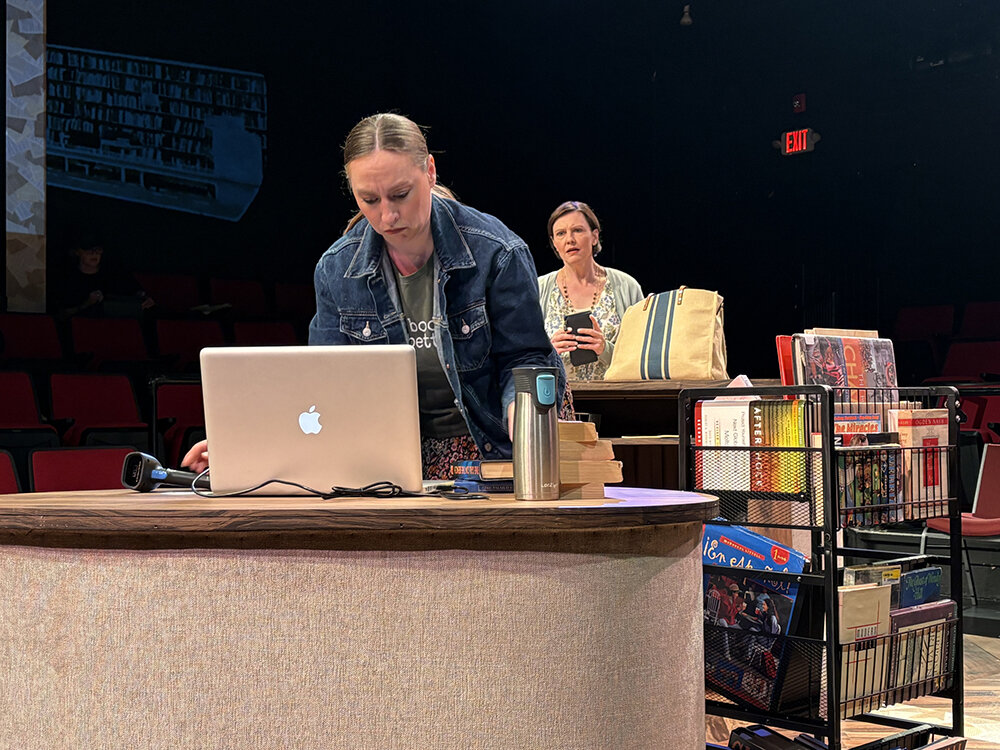
Welcoming us to the library is The Librarian — no name, just The Librarian — played by Alysia Kolascz of Detroit. She’s behind the desk when The Mother, played by Molly Garner of Saline, shows up to begin her screed.
As the effects of The Mother’s mission emerge — threat, violent protest and aftermath — Garner uses dialogue, body language and facial expressions to perfection. The big tote bag she carries is burdened with more than books, scarves and other so-called essentials. Likewise, her mind is burdened by something in her past.
The protest has consequences she never envisioned. These come in the second and third chapters.
Kolascz morphs into the role of The Manager in chapter two so effectively that it took a moment for me to recognize her. Her inflections and movements are different as she plays The Mother’s boss. Turns out The Manager isn’t as upset about The Mother’s protest as she is about something it reveals from The Mother’s past.
Kolascz’s mannerisms change again significantly in chapter three as she becomes The Editor, meeting The Mother in a church assembly room.
Hurt, meek and mild, The Editor is the mother of Jeremy’s girlfriend, and she’s fully aware of how the protest has made Jeremy an object of ridicule among students at his school. She says she’s developed an affection for Jeremy, who confided in her about a big secret his mother had tried to hide from him.
The two main characters end up at the library once again in the final chapter. There’s a hint of mutual understanding and empathy that isn’t there at the beginning.
I want to avoid giving away too much of the story, because I want you to feel the way I did as it unfolds so skillfully under the direction of Tony Caselli, the theater’s artistic director.
Enhancing Garner’s and Kolascz’s performances is the work of lighting designer Sam Schikora, sound designer Lucas Nunn, projection designer Will Myers, scenic designer Bartley H. Bauer, costume designer Ryan Scott Long and stage manager Jennifer Lowe. Flawless, to this casual observer.