‘Born into a gold mine’
One man’s music walks the earth. The other man’s music floats above it. One plucks rhythm and soul from strings and wood. The other makes machines cry.
Jazz bassist Rodney Whitaker and …
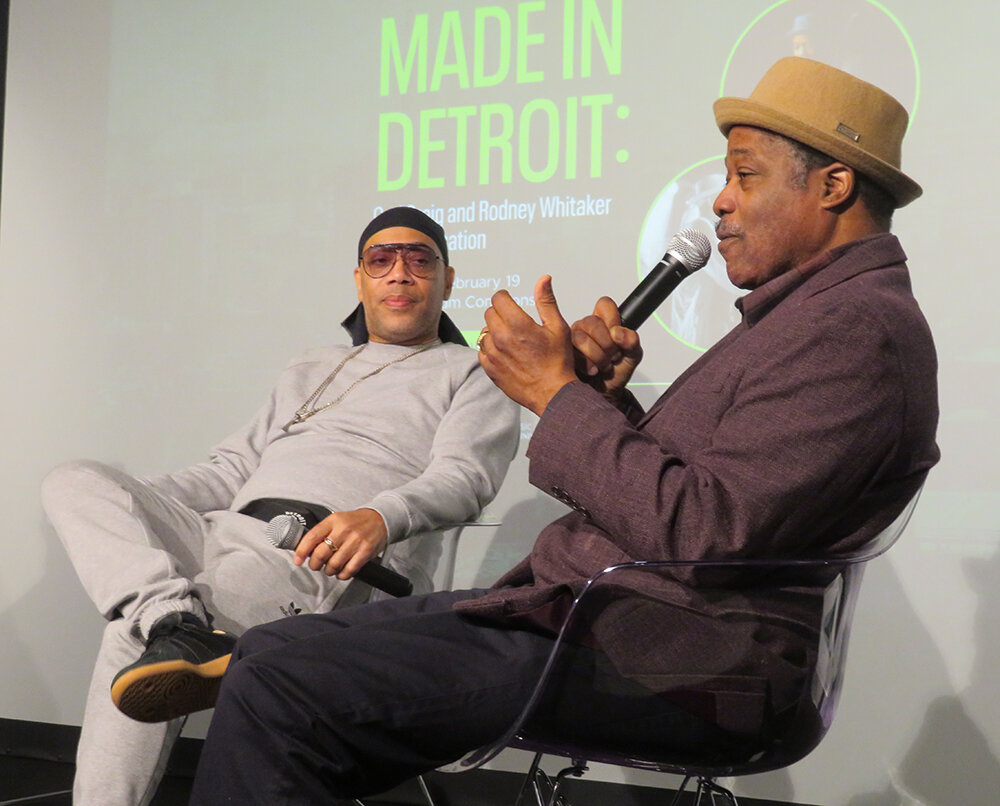
Carl Craig, Rodney Whitaker share memories of Detroit at MSU Museum
One man’s music walks the earth. The other man’s music floats above it. One plucks rhythm and soul from strings and wood. The other makes machines cry.
Jazz bassist Rodney Whitaker and techno pioneer Carl Craig inhabit different musical worlds, but they found plenty of common ground Thursday (Feb. 19) at the MSU Museum.
The discussion, a rare meeting of two internationally recognized musical giants, was the first public event of Craig’s January-through-April residency at MSU. Future events include a screening of “Desire: The Carl Craig Story” at the Capital City Film Festival and a mind-bending multimedia collaboration between Craig and MSU’s Facility for Rare Isotope Beams this fall.
Whitaker, director of jazz studies at MSU, couldn’t resist the chance to stroll over from the nearby Music Building and compare notes with a fellow legend.
The title of the talk, “Made in Detroit,” mapped out their common ground. Both artists grew up in the rich musical landscape of 1980s Detroit and would eventually shape that landscape in countless ways.
For both men, it’s mind and soul that drive the music. The hardware is secondary.
“The thing about techno that’s important to understand is that it’s not about using certain drum machines, certain synthesizers, the combination of those things,” Craig told MSU Museum curator Julian Chambliss in an April interview. “It’s about the mentality, the emotion that comes from it.”
Craig’s music melts the jagged edges of reality — including the blighted cityscapes he and Whitaker witnessed in Detroit as youth — into a pristine paradox of purple and pink, sorrow and hope, dusk and dawn.
“I felt the music I was making was my contribution to beautifying the city,” Craig said at Thursday’s event.
“There you go,” Whitaker agreed. “We both remember when the drugs came through the city. It devastated my neighborhood. We have to talk about that part. It put us in survival mode. Detroit people can survive anything. And the music was spiritual to us. It transported us to other places, and it made us dream.”
Craig grew up on the west side, Whitaker on the east side, but they were both enthralled by the music bursting from Detroit radio. A legendary Detroit DJ, The Electrifying Mojo, lived up to his name by blasting plugged-in funk, R&B and pop artists like Prince, Parliament-Funkadelic, the B-52s and Kraftwerk across lower Michigan in the 1980s, sending electrified vibes into the air.
Craig started out on acoustic instruments, but in 1982, he plugged in and never looked back.
“Once I got my hands on a synthesizer, it was all over,” he said.
It’s not surprising that Whitaker listened to jazz station WJZZ and DJ Ed Love’s jazz program on WDET. It was more of a revelation to learn that jazz is at the root of Craig’s music as well.
“I listened to WJZZ constantly. It was part of my being,” Craig said.
Both men expressed amazement at the abundance of great teachers, mentors and musicians who called Detroit home when they were growing up, from jazz to Motown, funk, hip-hop, techno and more.
“Growing up in Detroit was like a kid that’s born into a gold mine,” Craig said. “You take it for granted because it’s around you all the time.”
“We knew at a young age that Detroit was connected to musical excellence,” Whitaker said. “We were surrounded by people who changed the world.”
Detroit drummer, composer and bandleader Francisco Mora, a visiting professor at MSU in the 1990s, was a key influence on Craig’s distinctive, jazz-rooted brand of techno and played on Craig’s 1999 jazz-electronica album, “Programmed,” released under the alias Innerzone Orchestra.
Craig, Whitaker and Mora have recorded together, most notably on the irresistible “Bug in the Bass Bin” (also released under the Innerzone Orchestra moniker), a killer groove that oscillates with so much subatomic energy you wonder why Craig would bother with the FRIB.
In the jazz version of the track, available on YouTube, the acoustic and electric threads are so tightly wound you can’t even call it crossover music. How can you cross over when there is no gap?
“Francisco and Rodney sound like they’re both dancing around the original structure of it, and that makes it even more special,” Craig said. “Rodney killed it. He always does.”
“Collaborating with you felt like jazz,” Whitaker said.
It’s one thing to talk about breaking boundaries, but Craig was clearly pleased that he and Whitaker created something new together.
“I come from a background of programming synthesizers and drum machines and stuff,” Craig said. “I have some musical knowledge, but I’m not trying to play structured tunes, and you guys come from being able to play avant-garde, even. We just came together and made something phenomenal.”
“We’ve got to do it again,” Whitaker said, to a burst of applause from the audience.
Craig lamented that many people think of DJs as party and wedding hosts and don’t appreciate the deep artistry involved.
“Some of those guys are like John Coltrane,” Craig said. “It’s another level of an art form I can’t do in that way, but I have my own version of it that’s less performative and more meditative.”
Whitaker shared Craig’s high regard for virtuosic DJs of the 1980s, like Chuck D and Grandmaster Flash.
“I’ve never known anyone who knew more about every kind of music than Chuck D,” Whitaker said. “He grew up in the Bronx, similar to us in Detroit, where he had mentors who listened to jazz, R&B and all these different things. He wanted to be a musician, and there was no music in the schools, so he started working with turntables. It’s the same story in all these communities.”
Whitaker recalled that when he worked with other DJs, he felt like he was doing “their thing,” but working with Craig felt like a true collaboration.
“Carl is always open to trying things,” Whitaker said, turning to his colleague. “I think it’s because you grew up in Detroit. We didn’t think of jazz as bebop, avant-garde, whatever. We just played jazz. It was a color. It encompassed all these things.”