Chill winds and garlic bread
Despite the risk of turning off the old guard, new music peeks through the window fairly often at the Lansing Symphony Orchestra’s regular concerts, but it doesn’t usually break the window. …
Symphony flexes range in mix of old and new music
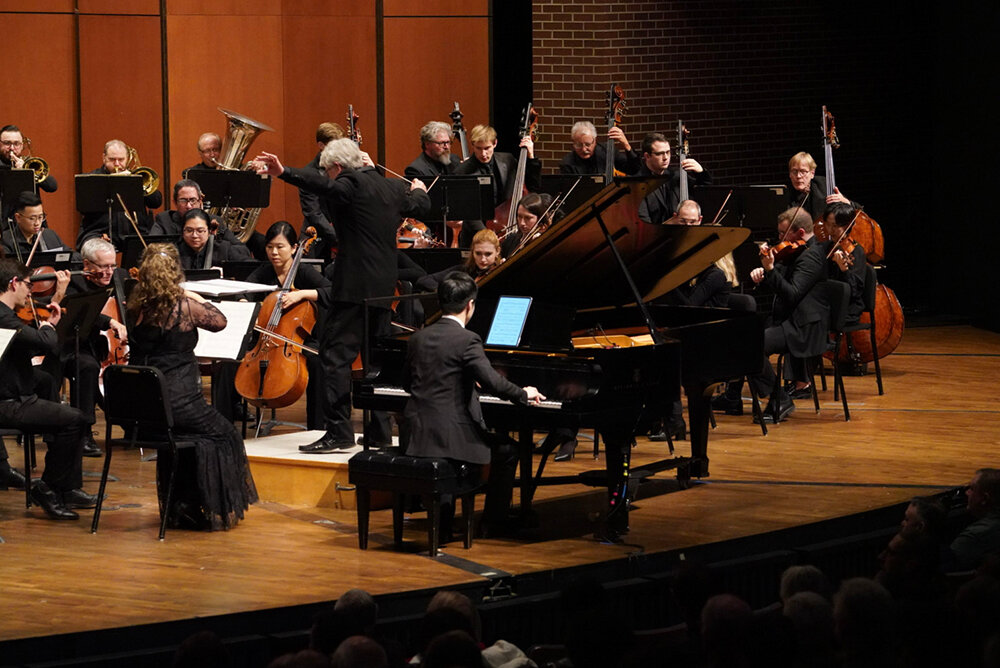
Despite the risk of turning off the old guard, new music peeks through the window fairly often at the Lansing Symphony Orchestra’s regular concerts, but it doesn’t usually break the window. Composer-in-residence Jared Miller’s “Shattered Night” concerto, a sonic alarm depicting the rise of fascism in 1930s Germany, did just that Friday evening.
The composer’s passion, inventiveness and craft — and the committed musicianship of maestro Timothy Muffitt and the orchestra — made every shock count. Miller’s broken windows let in some chill winds of reality that don’t often penetrate the concert hall.
In the concerto’s very first second, clangorous, ice-cold percussion dropped like a half ton of iron, heralding a sudden fall into a broken world. The music is not a literal depiction of Kristallnacht, or the Night of Broken Glass, but an emotional reflection on its horrors — with a traditional Jewish prayer at its heart.
Pianist Han Chen tiptoed up and down the scale, wrapping each twinkling note in a crystalline silence. Both pianist and orchestra made many such trips, moving slowly up and down the scale, like a searching soul pacing up and down an existential prison cell. A cloud of mournful seagull squawks came from God knows where. Miller was already reaching into his orchestral bag of tricks. (Later, he cobbled a virtual music box out of the percussion and strings.) Before long, his reverie was hijacked by the first in a series of overwhelming, frantic orchestral buildups. Shuddering timpani, vertiginous violins, elephantine trombone smears and swirling woodwind freakouts vacuumed Chen into a jagged nightmare. The musicians poured it on with such energy that they put the famous climax of The Beatles’ “A Day in the Life” in the shade.
Chen’s choice, as the central voice of the concerto, was to either fight the mounting chaos or succumb to it. But it really wasn’t a choice. He bifurcated himself like the little girl possessed by Satan in “The Exorcist,” glowing with simplicity and innocence one moment, vomiting bilious green horrors the next. The strings, in a desperate push to reclaim this shattered space, put every ounce of strength into the prayer at the heart of the piece, shielding Chen with a wall of humanity so he could resume his delicate search for peace. The music seemed headed for some kind of resolution, but the final fadeout was ambiguous — did it signify transcendence, survival or extermination?
It was a lot to take in, but Muffitt provided a touchstone in the tumult. In the final minutes, his shoulders shook as he deadlifted yearning string melodies out of the viscous murk, his arms bent, his usually ramrod-straight trunk bending to the storm and conjuring it at the same time. Far from trotting a victory lap, Muffitt is burning through his 20th and final year as Lansing Symphony maestro with a white-hot surge of passion and professionalism.
He exhibited three of his finest qualities Friday night. The first is a fierce and convincing commitment to new music, not just to “stretch” the audience, polish the orchestra’s bona fides or check a box only a few people will appreciate. He is clearly out to touch people with sounds, emotions and sensations they haven’t yet heard, to send them important signals from fellow human beings who happen to be alive.
The biggest work on Friday’s program, Brahms’ First Symphony, showcased Muffitt’s second big strength.
Not only does he devote the same energy, sweat and blood to new music as he does to the most hallowed classics, but he flips the equation and treats the classics as if they were written yesterday.
Muffitt loves nothing better than to launch into an expansive ocean of sound and escort you through its varied moods, taking the time to soak it all in but keeping the cords taut. If Brahms’ First were a novel, some folks would call it a “doorstop,” but in view of the rain of random input that bombards us all the time, the total immersion in something big and beautiful was a precious gift. Time and again, floor-to-ceiling chords sounded out like the biggest pipe organ you ever heard, from Kathryne Salo’s high piccolo all the way down to the delicious rumble of Phelan Young’s contrabassoon.
At the end of the second movement, the velvety orchestral curtains parted to give concertmaster Sonja Bosca-Harasim a gorgeous, lengthy soliloquy on violin. When she traded luminous licks with principal horn Corbin Wagner, the effect was pure rapture.
A third attribute Muffitt exhibited Friday is a side of him Lansing audiences seldom get to see. He loves to conduct opera, even though the closest he ever got in Lansing was directing “Carmina Burana,” and will likely do more of it after his Lansing Symphony gig is over. But that’s why we have overtures. A galloping, wake-up-the-village romp through Giuseppe Verdi’s “Nabucco” overture opened the evening like a buttery basket of garlic bread, dripping with over-the-top flavor and savor. We may never get a full banquet of opera from Muffitt in Lansing, but it’s better than nothing.