‘Da Vinci Notebooks’ probes the creative mind in cosmic LSO opener
Will the Lansing Symphony Orchestra’s 2025-‘26 season open Saturday evening with a bang or a whisper?
Both.
To kick off the final season of music director Timothy …
Lansing Symphony Orchestra: “The Planets”
With MSU choirs
7:30 p.m. Sat., Oct. 4
Wharton Center Cobb Great Hall
750 E. Shaw Lane, East Lansing
(517) 487-5001
lansingsymphony.org
Will the Lansing Symphony Orchestra’s 2025-‘26 season open Saturday evening with a bang or a whisper?
Both.
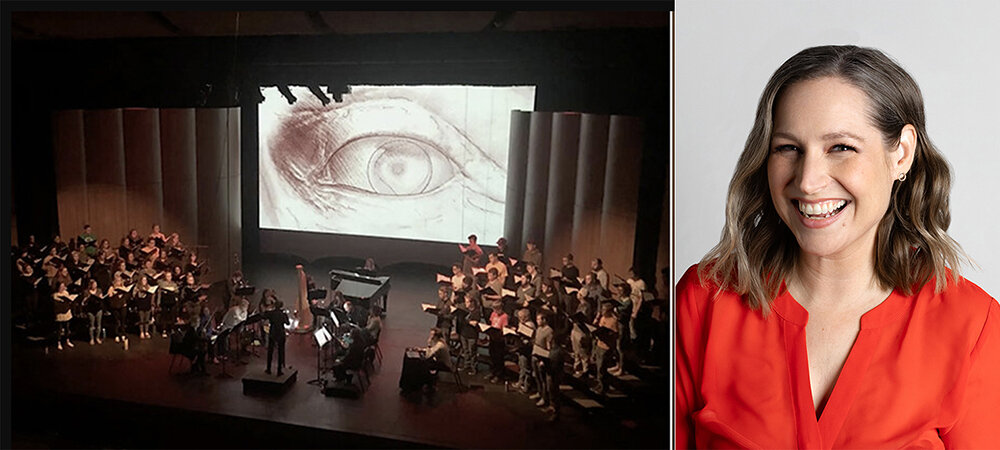
To kick off the final season of music director Timothy Muffitt’s 20-year run, the concert will begin with an expansive and fresh take on orchestral music: “The Notebooks of Leonardo da Vinci,” a 40-minute multimedia extravaganza by Minnesota-based composer Jocelyn Hagen.
“It’s on a huge scale, and it’s a portal into a different way of thinking about music,” Muffitt said.
Despite the potential for sensory overload, the music and projected images conjure an intimate inner world of curiosity and play. In the first minute, da Vinci’s signature right-to-left handwriting scratches its way across the screen, accompanied by a quiet, pretty flute melody. Everything stops for a few seconds when a word is crossed out in a messy blob of ink. The writing and music resume, gathering force as the ideas flow where they will.
“That beginning is about getting into a flow state,” Hagen said. “With the stops and starts, it’s a lot like meditation. It’s such a wonderful feeling when it’s really flowing.”
From that gentle beginning, Hagen’s sensory fantasia follows da Vinci’s fertile mind across the universe, from flying machines and the science of optics to the intricate tissues of dissected human bodies and the light of distant stars.
Muffitt jumped at the da Vinci project on the recommendation of MSU choral director Sandra Snow, who will add the university’s massed choral forces to Hagen’s immersive creation.
“From the first moment, I was just taken with it,” Muffitt said. “The text is all from da Vinci, and the projections are a beautifully collected collage of his work.”
Hagen was inspired to write the da Vinci piece after seeing the Codex Leicester, a collection of da Vinci’s writings, at the Minneapolis Institute of Art in 2015.
She was already looking for a new and effective way to combine visuals and orchestral music.
While filmmakers are almost too good at punching up movies with pounding orchestral music and aptly deployed (and licensed) pop songs, the classical world is still figuring out how best to utilize visual media.
As a composer, Hagen wanted the music to lead and the images to follow, not the other way around. The missing element, in her eyes, was the ability to sync it all up.
“I always loved music videos,” she said. “I grew up watching MTV and being fascinated with that. Then I heard about this technology, developed here in Minnesota, and I thought it would be really fun to use it on a large scale.”
At Wharton, a technician embedded in the orchestra will follow Muffitt like any other musician, speeding up or slowing down the images with the flow of the evening’s performance.
Da Vinci’s notebooks suited Hagen’s ideas almost too well. It wasn’t easy to wade through over 7,000 pages of notes, each more fascinating than the last, and boil it down to under an hour. She only knew that she wanted to create a musical event “so enticing that all kinds of people would want to see it.”
“Da Vinci’s work is timeless. People continue to be fascinated by his genius,” she said. “And, in the end, the music is just a lot of fun.”
“Notebooks” premiered in Minnesota in 2019, just before the pandemic shutdowns. Hagen took advantage of the hiatus to fine tune it, creating versions for chamber and full-size orchestras.
Since 2022, the work has taken on a life of its own, especially among college students and younger listeners. It has been performed more than 50 times across the country, as well as in Canada, Sweden, Croatia and England.
Last week, Hagen was thrilled to listen to a freshly pressed master recording by Tucson, Arizona-based ensemble True Concord Voices & Orchestra of “Notebooks” and another of her works, “Here I Am,” a 45-minute piece for orchestra, chorus and soloists marking the 100th anniversary of the ratification of the 19th Amendment. The CD will be out in March.
There are many moving parts to “Notebooks,” but beautiful melodies and pop energy are a key part of the work’s growing success.
“There are moments in ‘Notebooks’ where it gets kind of raucous, with big drum fills, and that’s part of my style,” Hagen said. “Pop music is a big part of who I’ve always been as a musician.”
In eighth grade, she realized she could listen to songs on the radio and play them by ear. Singer-songwriters Tori Amos (“such an incredible pianist”), Jewel and Alanis Morissette were among her favorites.
Growing up in North Dakota, Hagen played piano and gravitated to 20th-century composers like Sergei Rachmaninoff and Aaron Copland. (Her senior recital piece was Copland’s hyper-caffeinated “The Cat and the Mouse.”)
She wrote her own songs and her first piece of choral music in high school.
“I never met a composer in North Dakota,” she said. “All the musicians I knew were teachers, and I thought I’d be a music teacher.”
Nevertheless, she got into the flow of composing, writing art songs and choral pieces in college.
The cold carapace of 20th-century academic modernism was cracking.
“I’ve had some great composition teachers and some really horrible ones,” she said. “In some ways, you learn just as much from the horrible ones. That’s not what music means to me and not how I want it in my life.”
She was inspired by younger, genre-bending composers like Caroline Shaw, Sarah Kirkland Snider and Judd Greenstein.
“I never understood why you wouldn’t want to connect with audiences and musicians — all musicians, not just professional musicians,” she said. “I knew I wouldn’t be happy unless I pursued it, so I did.”
The second half of Saturday’s cosmic mind trip will be aptly filled by the only logical follow-up to da Vinci’s cosmic mindscape, Gustav Holst’s “The Planets.”
“With those spiritual and scientific threads connecting them, it just felt so right to put them together,” Muffitt said. An ethereal flotilla of female voices, drawn from the da Vinci chorus, will conveniently be on hand to wordlessly evoke the rings of Saturn.