
Deep Green data center: Where do things stand?
The steam stacks in downtown Lansing aren’t long for this world.
By the end of this year, the municipally-owned Board of Water and Light will be servicing some of its downtown customers with a …

Controversial proposal coincides with major BWL change
The steam stacks in downtown Lansing aren’t long for this world.
By the end of this year, the municipally-owned Board of Water and Light will be servicing some of its downtown customers with a closed-loop hot water system. The more-than-100-year-old steam system will be on its way out, and by the time the transition has been fully completed, the steam stack critters will be extinct.
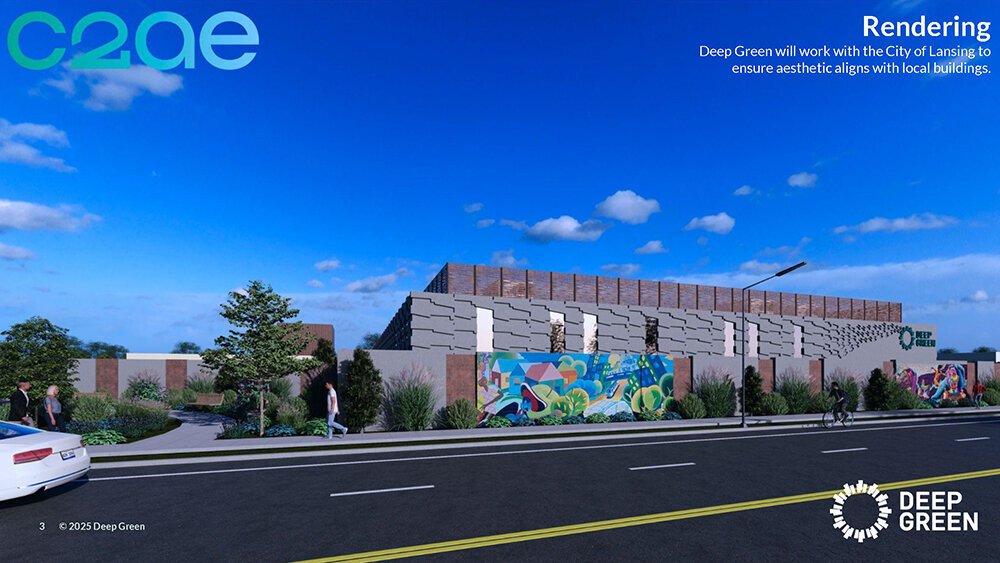
But the source of that new heat depends on the outcome of a major City Council decision next month: Whether or not to allow a 24-megawatt data center to be built on four parcels of land in the city’s stadium district.
UK-based data center builders Deep Green want to bring a European approach to the states with the proposed facility, capturing the heat generated by the server farm and donating it to the BWL, which would use it to help heat other businesses downtown.
Little has happened since the project was announced at a press conference on Nov. 3, but February could see the project sent off to the races or stopped in its tracks.
Deep Green needs City Council to approve two things: the sale of the land and a conditional rezoning request. Without the rezoning, the purchase would be useless, as the current location’s “downtown core” zoning forbids industrial development. The rezoning would be conditional on the land’s reuse as a data center, meaning other industrial uses would remain forbidden.
The rezoning approval would change four parcels at the intersection of Kalamazoo and S. Cedar streets from “downtown core” to “industrial,” contingent on its use as a data center. Without such approval, Deep Green would have no reason to buy the land.
The land is currently a parking lot and has drawn interest from earlier proposals. In 2008, a mixed-use development called Lansing Gateway was announced for the site. It would have included apartments and office space, and billed itself as a “green” development due to being LEED-certified and having a green roof. The proposal quietly disappeared during the Great Recession.
Residents can voice their opinions about the current project at a Feb. 9 City Council meeting, where Deep Green is scheduled to make a presentation. Before that, there is an open house with Deep Green this Saturday, Jan. 24, at the Lansing Center from 10 a.m.-noon.
The project will come before Council for an anticipated vote on Monday, Feb. 23.
City Pulse asked Deep Green, the BWL and Council President Peter Spadafore some unanswered questions about the project.
Revenues could benefit housing services
Last week, City Council President Peter Spadafore proposed that 10% of the revenues the city makes from new data centers, such as the Deep Green project, could be directed to a fund for housing services.
The BWL is municipally owned and pays a portion of yearly utility revenues to the city of Lansing. Spadafore said the estimated increase in that payment from Deep Green would be about $1 million, meaning an estimated $100,000 could go to a new Housing Support Fund under the ordinance.
The fund in question has not yet been created, and Spadafore said there is work to be done, both in defining what the funds could be used for and what constitutes a data center. He said he plans to wait and see how the Deep Green project goes before asking Council to vote on the matter, but that he intends the proposal to cover any future data centers in the city.
The proposal would impact new data centers, meaning revenues from the two existing Liquid Web data centers would not be impacted. Those centers have been in operation since the web hosting company launched in 1997 and total around 3 combined acres between two locations on Creyts and Canal roads.
Heat donation would decrease heating costs for downtown customers
Alongside paying for the infrastructure necessary to donate the data center’s heat to the city, Deep Green will be indirectly lowering downtown customers’ bills by doing so.
A spokesperson for the BWL said a heat donation would reduce the amount of fuel necessary to generate the heat, directly reducing the cost for customers.
But that also means that discount would disappear if future donated heat from the Deep Green site were no longer available. The rates, however, would likely stay lower than they are now, since a closed-loop hot water system would be cheaper to operate than the current steam system.
While the transition to hot water coincides with the data center’s timeline, Deep Green’s vice president for North America, Luke Gavin, said, the BWL will still pay for the upgrade from steam to hot water for most of the city. Deep Green’s work ends when the captured heat is available, at no cost, to the BWL.
“We have our site, and we design the data center to capture all the heat from the servers and any of the plant, and we deliver that heat up to a connection point on our site,” Gavin said, adding the process is identical to Deep Green’s existing centers in the UK. “And we basically say to the district energy operators, ‘That heat is there. If you want it, come and take it. It’s completely free.’”
Multi-tenant facility would likely lease space to Michigan State University
Unlike the massive, “hyperscale” data center causing controversy in Saline Township, the Deep Green center is not tied to any specific tech companies. The 250-acre Saline facility would be used entirely by tech behemoths Oracle and OpenAI. Meanwhile, Deep Green’s facility would likely not cater to or rely on any one specific business.
Because the data center has not been built yet, or even approved, there are no specific clients. At Deep Green’s currently-operating British facilities, universities are a typical early-stage client, Gavin said.
“Maybe their physics department is running an advanced model on something very complicated,” Gavin said. “That’s what uses a data center. It won’t necessarily be for student work, it would be research.”
Other clients who lease space from Deep Green already include a media business that uses the computing power for CGI effects in filmmaking as well as engineering firms doing complex operations such as aerodynamics simulations, Gavin said.
While the facility may be used to power AI technologies, it would not be used by big tech companies that can afford to build huge facilities at enormous scale. The tools more likely to be heating up Deep Green’s facility would be hyperspecific, he said, such as machine learning technology used for drug discovery in the pharmaceutical industry.
— LEO V. KAPLAN