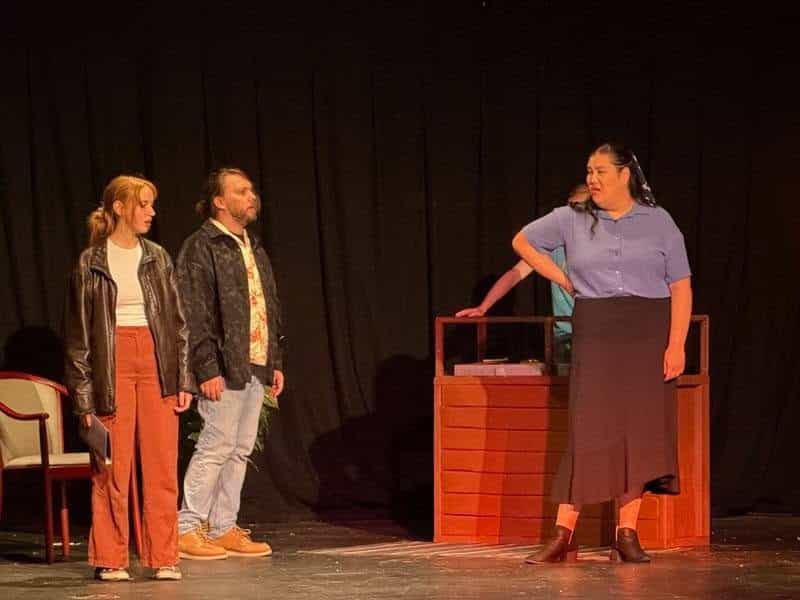
Despite slow start, ‘The Best We Could’ is an emotional gut punch
Don’t say you weren’t warned. In her debut, “The Best We Could (a family tragedy)” — being staged by Peppermint Creek Theatre Co. through Sunday — playwright Emily …
“The Best We Could (a family tragedy)”
Nov. 13-16
7 p.m. Thursday-Saturday
3 p.m. Saturday-Sunday
Stage One at Sycamore Creek Eastwood
2200 Lake Lansing Road, Lansing
(517) 927-3016
peppermintcreek.org
Don’t say you weren’t warned. In her debut, “The Best We Could (a family tragedy)” — being staged by Peppermint Creek Theatre Co. through Sunday — playwright Emily Feldman has crafted a timely, tragic story that, like many tragedies, one doesn’t see coming.
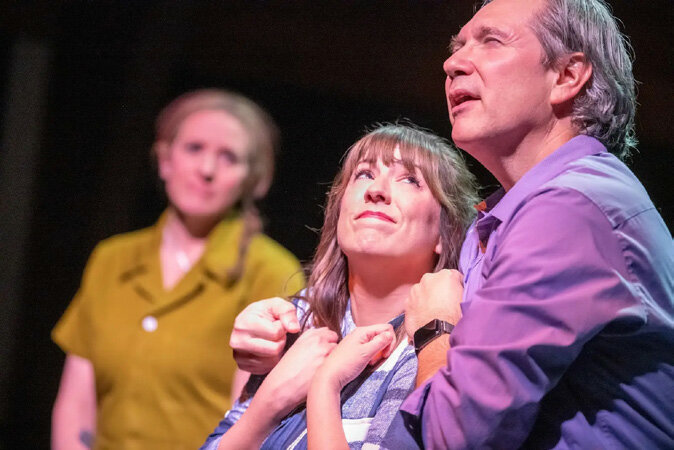
Lou has recently lost his job as a research scientist. Then his beloved dog dies. His wife, Peg (Amy Rickett), manipulates their daughter, Ella (Sarah Hayner), into taking a cross-country trip with Lou to pick up a rescue dog. Along the way, Lou reconnects with his best friend and former colleague, Marc (David Dunckel), whose company has an open position that Lou desperately needs.
In late middle age, Lou is struggling to find his place in the contemporary workplace and the modern world. Near the end of the road trip, he and Ella visit the family’s first home as he tries to find comfort in the past. His desperation to connect with better times plays out painfully as he chats up the disinterested owner of the home. This poignant scene will hit home for anyone who has driven past their old homestead, school, or any other place that holds warm memories of better days.
Ella is also somewhat lost, a millennial who hasn’t yet figured life out at age 36. She has quit most pursuits when they’ve become challenging, finally settling into a job as a chair yoga instructor. Her greatest achievement is creating an unpublished children’s book on the value of giving up.
Fair warning, the story is a slow burn. At a lean 90 minutes, the first hour sets up the characters and relationships, but it seems to meander. There are many funny moments as Lou tries to share his dad wisdom with Ella, but his enthusiasm for life becomes a bit cloying. Just when you start to wonder if this story is going anywhere, the first bombshell drops. From that point until the lights go down, the intensity escalates to the breathtaking finale.
As Maps, Shannon Bowen serves as a narrator, a stage director, a stagehand and an actor for several minor roles. Bowen is skilled at wrangling people and props flawlessly and is especially hilarious as the Zumba-obsessed Adele. In the very end, though, her role shifts to something dark. Not nefarious, not mean, not even judgmental, but unyielding as she directs the plot’s outcome with a cold finality.
As Lou, Magnuson’s goofy affectation seems like a bad case of overacting, but in the end, he commands the stage in a jaw-dropping moment of complete breakdown when, as Maps explains, “he can’t reconcile a challenge to his status.”
Hayner excels as Ella, at times an annoyed adult child, a loving child and, in the end, a desperate child. Her desperation becomes the audience’s desperation as all collectively wish for an outcome other than the one that is inevitable. To say more would spoil the drama.
“The Best We Could” addresses several key themes, including changing expectations of behavior between men and women across generations. The play offers no solutions for effectively resolving an uncomfortable situation; rather, it illustrates the collateral damage of a momentary lapse of judgment.