
Devil’s Day Tattoo to expand, seek OPRA tax abatement
The Devil’s Day Tattoo co-owners are planning to redevelop and restore the units right next door to their current spot: The former Baron’s Window Coverings building and neighboring …
Emerging developers ‘the opposite of a tight suit’
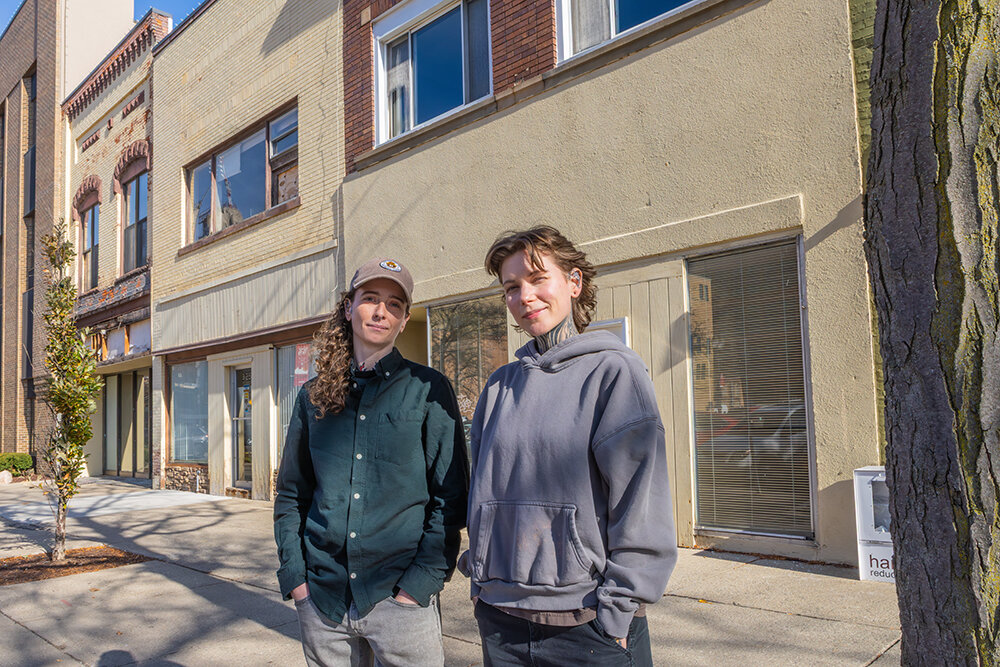
Val Magee and Ferg Ferguson hardly look like developers.
“We’re the opposite of a tight suit,” Magee said.
The Devil’s Day Tattoo co-owners are planning to redevelop and restore the units right next door to their current spot: The former Baron’s Window Coverings building and neighboring buildings, three units on South Washington Square, and the three units above them.
At Monday’s City Council meeting, council members unanimously approved setting a Dec. 8 public hearing to establish an Obsolete Property Rehabilitation Act (OPRA) District for the historic buildings, setting in motion a tax abatement process more commonly used by more tight-suited developers.
The abatement, which reduces owed taxes on the property for up to 12 years following qualifying development, will likely save between $300,000 to 500,000, Magee said.
It will help the tattoo artists do a $1 million or larger redevelopment project that could revitalize the buildings (all pictured). The tentative plan would allow Devil’s Day to move from the next-door space, with six artists, into a bigger space with room for 13. Next door would be a community center called the Bugpin, a tattoo reference, and next door to that would be a rentable retail space for a like-minded business. Upstairs, there would be room for up to five affordable housing units.
The tattoo artists said they will preserve the building’s history with the redevelopment, including uncovering the original 1880s brick walls and tin ceiling. They also purchased stained glass windows with giant roses from Jon Anthony Florist, a longtime Lansing business that is closing, and will feature them in the Bugpin.
In an interview two weeks ago, Mayor Andy Schor said tools like OPRA and brownfield redevelopment plans are open to everyone, but often difficult for small-scale developers to understand. Developers with money to hire consultants can often figure out how best to leverage them, he said.
So how did two tattoo artists who didn’t even know what OPRA was earlier this year end up using tax abatements and pro forma business plans?
The help came from the Lansing Economic Development Corporation, they said. And it came for free.
Schor said when the city held public meetings to determine how best to use COVID relief funds, the need to support emerging developers was a common thread. That led the city, county and LEDC to focus on outreach and support for emerging developers.
For the LEDC, those resources include programs like the Supporting Empowered Emerging Developers (SEED) Academy, a free class on real estate development currently recruiting for its second cohort. But they can also be as simple as networking events and presentations meant to help connect with emerging developers, who they work with on a case-by-case basis.
For Magee and Ferguson, weekly meetings with the LEDC’s development projects coordinator, Chelsea Dowler, have provided immeasurable help with the project.
“She has helped us get our pro forma down, helped pencil in our project to where it would make sense to qualify for certain things we didn’t even know were an option,” Magee said.
“She explains it in a way that’s actually easy to digest for people who don’t have any experience with that stuff,” Ferguson said, “because if you try to look things up on your own, they make it so difficult to understand.”
Dowler also connected Magee and Ferguson with an architect, Ken Jones, and facilitated conversations with others.
“It’s almost like they’re part of our team,” Magee said.
LEDC has access to tools and connections that can cost millions, she said, leveling the playing field for small-scale developers.
One key conversation was with the City Assessor’s office, which got Magee and Ferguson a key “functionally obsolete” designation, necessary for OPRA. The need for significant work in rehabilitating the historic building, including removing hazardous materials like asbestos from the future apartments, warranted the designation.
Magee said she and Ferguson had struck out with other avenues for help after starting out the project, including Downtown Lansing, Inc., which she said did not respond to them.
“We’ve had such bad luck with every other avenue we’ve gone down, which is really disheartening when you’re starting out,” she said.
But she said the LEDC jumped on board right away. Dowler and LEDC president and CEO Kris Klein gave Magee and Ferguson both the help they needed and the confidence to feel like they could do it, they said.
“There’s three big developers in town, and they always grab everything,” Magee said. “So I think that’s part of Chelsea and the EDC’s support — they want to see the small fish get something.”
Klein said planning for the Devil’s Day project included discussions of OPRA, the brownfield program and Lansing’s facade improvement program.
That list brings to mind a South Side project announced two weeks ago: 820 W. Miller. The blighted strip mall is being redeveloped by locals Melissa White and James Denning, the former of whom said help from the LEDC was instrumental in securing $1.3 million in financial assistance for the $3.8 million project.
Supporting local, emerging developers does more than just provide economic opportunity for a handful of local businesses, Klein said.
“A healthy economy takes all sorts of investment,” he said. “Looking at a downtown area, or really any dense commercial area, it’s important that you have as much local ownership as you can.
“Development sometimes carries a negative connotation, but it doesn’t have to.”
For Magee and Ferguson, local ownership means the community will be intrinsic to the project. Their focus on creating an inclusive space in the tattoo scene will filter into the community center, in which they plan to include a stage for events like open mic poetry nights and art nights.
It means a space for Lansing’s LGBTQ+ scene downtown that stays active after the “suit-and-ties” go home.
“We’re just trying to create a space for people like us,” Ferguson said. “And to show to other people that it is possible, and it’s accessible. You can be small and achieve things like the bigwigs do.”
Related Articles

Meet the local women leading Greater Lansing efforts to provide the ‘dignity of work’
No matter how successful Shara Trierweiler became in her years-long finance career, it never seemed to make being a mom to her two children, Philomena and Dominic, any easier. …
Rewind: News from the last 7 days
Rewind 6/3/26 The Michigan State Police have finished their investigation into the April 15 fatal police shooting of Isaiah Kirby by East Lansing officers.

Prayer Walk for Peace in Lansing brought faithful protesters to Capitol
Photo Gallery – Prayer Walk for Peace