
‘Dial M for Murder’ is a blast from the past
Seating can profoundly affect one’s perspective in theater in the round. For instance, I saw a “gotcha” blinking of eyes that made me and several others in my section chuckle on the opening …
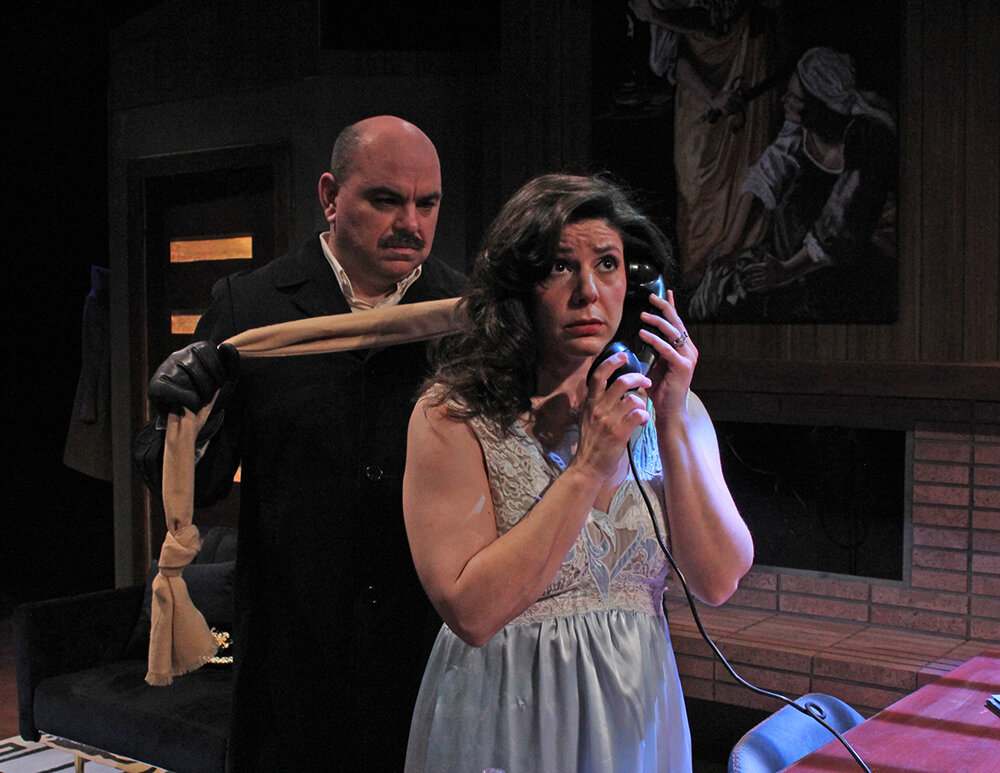
“Dial M for Murder”
Through March 8
2 p.m. Thursday, Saturday-Sunday
7:30 p.m. Friday-Saturday
Williamston Theatre
122 S. Putnam St., Williamston
(517) 655-7469
williamstontheatre.org
Seating can profoundly affect one’s perspective in theater in the round. For instance, I saw a “gotcha” blinking of eyes that made me and several others in my section chuckle on the opening night of “Dial M for Murder” at Williamston Theatre.
The eye blinker was Maxine Hadley, played by actress Yolanda Davis in a tension-filled update of the classic 1954 film. She was facing my section, speaking to Tony Wendice, played by Ryan Patrick Welsh, who had his back to us.
At that moment, her character had just seemingly spelled doom for Tony’s claims of innocence in a botched plot to kill his wife, Margot, so he could inherit her money. I didn’t get to see Tony’s facial response. Others could. I bet it was good.
This is one of many “gotchas” — and twists, turns, intonations, screams and shouts — all performed masterfully by what I consider an all-star cast. Stage and screen actress Jamie Elvey plays the role of Margot Wendice in her debut performance at Williamston.
The audience is omniscient, having witnessed confidential conversations, face to face and on the phone, among Maxine, Margot, Tony and Lesgate, an old acquaintance of Tony’s hired to do away with Margot while Tony and Maxine are away for a live radio interview at the BBC.
Lesgate, played by Williamston Theatre veteran Patrick Loos, follows Tony’s instructions, but Margot isn’t where she’s supposed to be in the scenario when the phone is to ring, providing an alibi for Tony and Maxine.
When Scotland Yard gets involved, you couldn’t ask for a better Inspector Hubbard than another Williamston returnee, Tobin Hissong, who plays a lawman who, perhaps purposely, perhaps not, jumps to all the wrong assumptions and conclusions.
Throughout the whole production, audience tension is building constantly, relieved briefly by gasps and nervous laughs prompted by dialogue or movements, depending on one’s perspective, such as Maxine’s blinking.
Updating a classic movie from the time of rotary telephones with wires plugged into wall sockets is virtually impossible. To make a call or answer the phone, one has to go to where it is. And this story is built around a telephone. It’s essential. So, here we were in London, back in 1952, with lines like “pick it up!” or “don’t pick it up!”
Where’s the update? The original play and movie had three central characters, two men and a woman. This version stars one man and two women. Hmm?
The play was adapted for the stage by Jeffrey Hatcher from Frederick Knott’s original. Kudos to returning director Jasmine Rivera, who was helped by lighting designer Harley Miah, costume designer Marley Boone, movement director Alexis Black, prop designer Michelle Raymond, stage manager Adam Kruger and sound designer Julia Garlotte. (Note: I wish the ringing had come from the phone itself.)