Dystopian ‘1984’ reflects life as we know it today
When Alex Vicknair moved to Lansing from Seattle in the mid- ‘90s, the local head shops were full of American, artisan-made glass. “I got here and went into In Flight to sell some glass, and they …
7 p.m. Friday, April 17-Saturday, April 18
Dart Auditorium
500 N. Capitol Ave., Lansing
(517) 483-1122
lcc.edu/showinfo
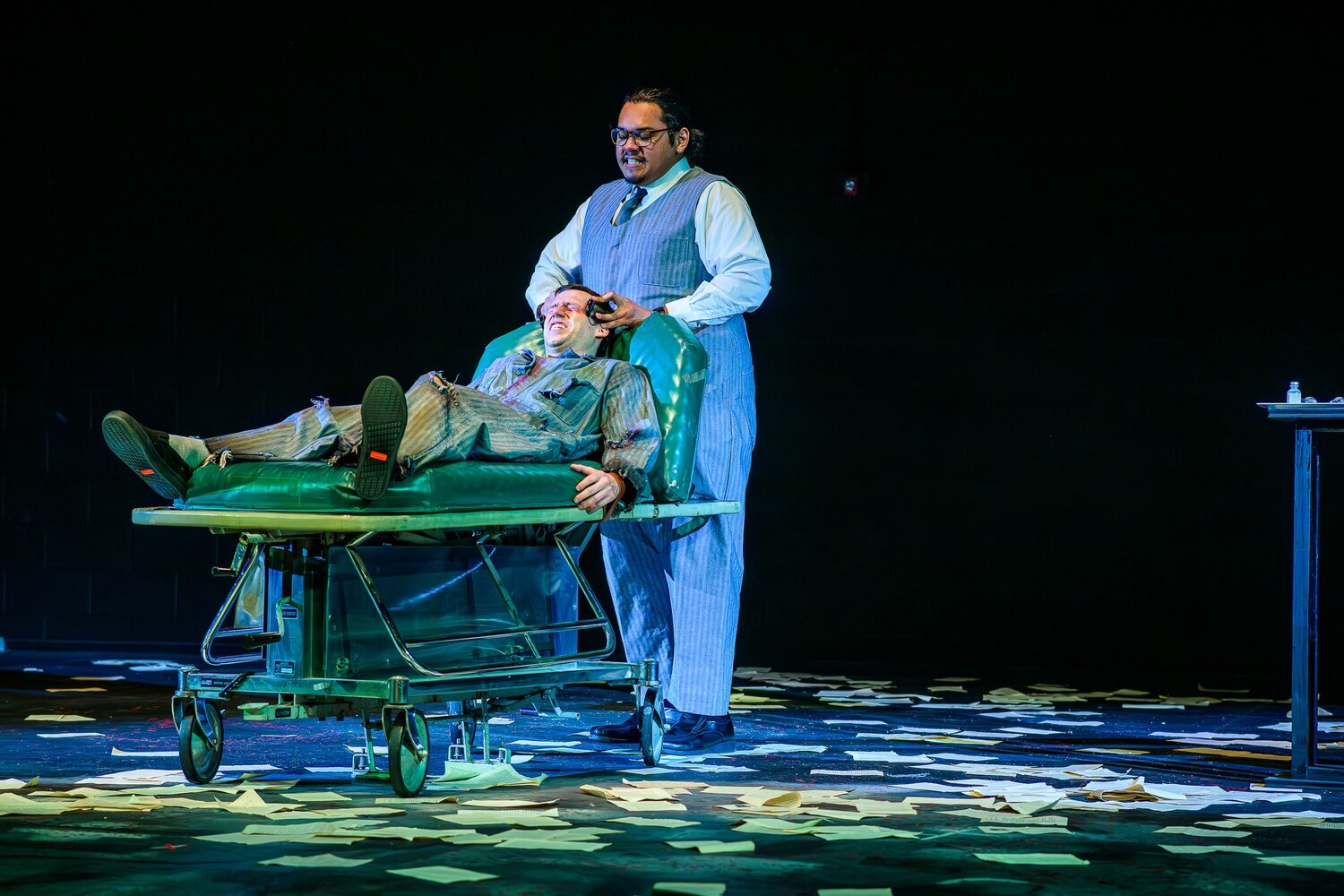
The slogans “war is peace,” “freedom is slavery” and “ignorance is strength” are projected on three overhead screens. The floor is a mottled, grey-black swirl speckled with dots of red, redolent of an uneven, drab prison floor. Book pages are strewn about, covering most of the stage. These are treated as disregarded rubbish that the actors walk over. A dissonant, not quite familiar tune evokes despair, anxiety and uncertainty. Several monochromatically clad actors sit in folding chairs, attempting to make themselves look small and unseen. Their eyes dart about as they track the movements of O’Brien, the sadistic torturer and “teacher” of the Inner Party.
George Orwell’s dystopian 1949 novel, “1984,” is about a future in which an overtly totalitarian regime called “Oceana” controls every aspect of human existence, children are encouraged to inform on their parents, and autonomy is met with death. This 2021 adaptation by Nick Hern, performed at Lansing Community College’s Dart Auditorium, encapsulates the last section of Orwell’s seminal novel. Set in the Ministry of Love’s torture chambers, the protagonist, Winston Smith (Jason Durr and Samuel Barrix), is forced to watch reenactments of his crimes against the state: his love for another human being, his independent thinking and his anti-party sentiment. Throughout the two-hour production, our protagonist is subjected to a “conversion therapy” of sorts that systematically destroys his identity. He is tortured, coerced and reconditioned.
Durr adeptly portrays the complexity of a man who will not be broken. While his physical presence seems to have become smaller and more frail during the seven years of his captivity, he watches the staged vignettes of himself with longing, embarrassment, pride, weariness and terror. Durr conveys to the audience that despite Winston’s ultimate capitulation, his is a mind that must remain free, down to the last flicker of recognition of his love for Julia.
Alternatively, O’Brien, an undercover agent of the “Thought Police” played by Raymon Torres, simmers with a quiet rage. O’Brien tortures Winston to cure his mind of the “false” notion that there is a past to be remembered. He explains that reality exists only in the human mind, and since the party controls everyone’s mind, it controls reality. As O’Brien, Torres reflects the odd juxtaposition of torturer and “savior” through his alternating bare-knuckled brutality and pleasant appreciation of the complexities of Winston’s mind.
Set against creepy, ponderous and oddly beautiful original music by recent LCC graduate Myka Spoelma, director Paige Tufford’s intelligent and instructive production of “1984” was an intentional choice for life as we know it in 2026. Like a roving eye, always watching the daily stream of information, we can’t help but recognize this cautionary tale of unchecked power, of the manipulation of history, of runaway AI’s evolving ability to rapidly dismantle systems, of forever wars with a rotating cast of “foes” from faraway places. This LCC production serves to remind its students and community members alike that authoritarianism must be disrupted and independent thought must be protected.