‘Every minute was a joy’
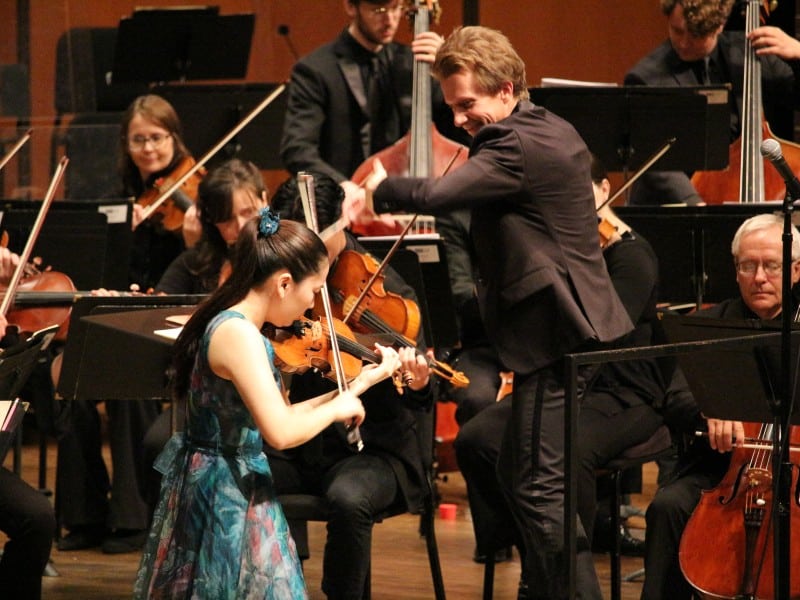
To lovers of classical music, Timothy Muffitt’s 20 years as music director of the Lansing Symphony Orchestra went by in a flash.
But not to him.
“There was no going by in a flash,” …
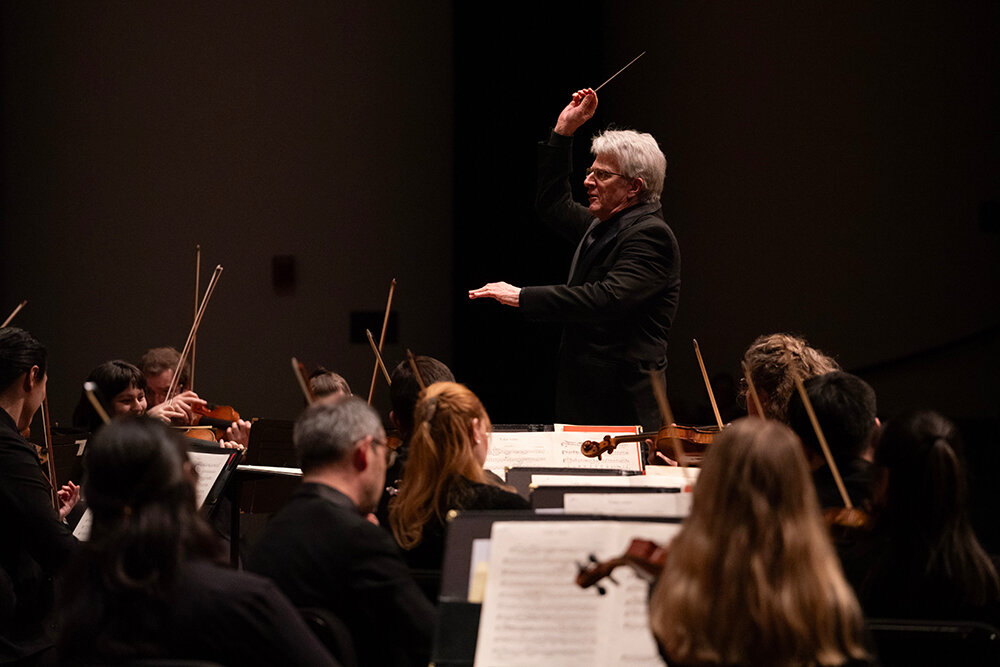
Timothy Muffitt looks back on 20 years as Lansing Symphony maestro
To lovers of classical music, Timothy Muffitt’s 20 years as music director of the Lansing Symphony Orchestra went by in a flash.
But not to him.
“There was no going by in a flash,” Muffitt said softly, settling onto a bench in the courtyard of The Peoples Church in East Lansing last week. “That’s not to say it wasn’t a blast, because it was. But it definitely feels like 20 years.”
That’s two 10-year cycles of the great symphonic classics — two Beethoven’s Ninths, two “Carmina Buranas,” two blasts of “The Planets,” even two rounds of Bartók’s thorny concerto for orchestra.
Muffitt has uncorked more fifths than a Boston bartender — the mighty fifth symphonies of Beethoven, Mahler, Shostakovich, Prokofiev, Tchaikovsky and Sibelius.
Reaching beyond the great works of the past, Muffitt deftly stirred dozens of significant new works, many of them world premieres, into a decades-spanning, ear-stretching cocktail of sounds.
He made a point of showcasing mid-Michigan’s rich pool of musical talent while drawing major guest stars who can write their own ticket in New York, Vienna and London.
In tandem with executive director Courtney Millbrook, he launched an innovative new music series, LSO at The Robin Theatre, and an ambitious composer-in-residence program that poked the ancient shoots of orchestral music into the bracing air of here and now.
The Muffitt years also gave the lie to the persistent idea that you have to be a self-obsessed jerk to get big things done.
The saga of his tenure in Lansing is both exciting and boring, because the drama is all in the music. Everyone who works with him, from rank-and-file musicians to the world-class stars he drew to Lansing, joined in the same choral fugue: “Tim is all about the music.” No one could recall a single tantrum, a humiliating callout, a wasted minute in rehearsal.
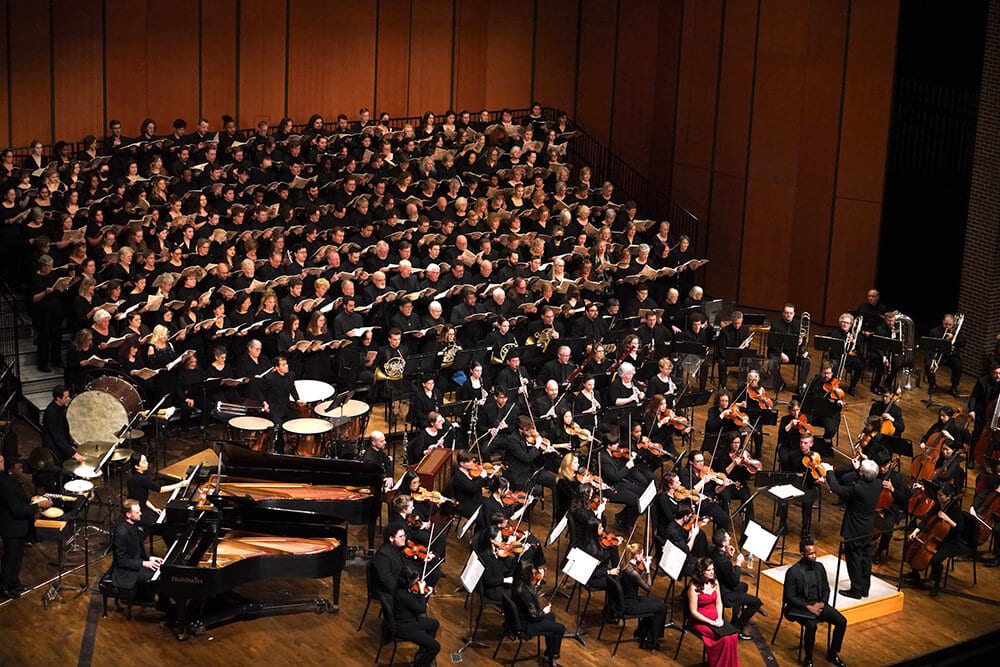
Popular movies about orchestra conductors roil with ego-driven conflict, scandal and confrontation. Sorry to disappoint, but Muffitt’s time in Lansing has been a wall-to-wall mutual lovefest.
Illustrious pianist (and Radiohead proponent) Christopher O’Riley, who soloed twice with the LSO, called Muffitt “the most warmhearted person I know.”
“With a lot of conductors, it’s all about themselves,” principal percussionist Matthew Beck said. “They have egos, and they want to make big gestures for board members, and that sort of thing. With Tim, the music comes first.”
Principal bassoonist Michael Kroth has been on board for the whole ride.
“It speaks to how the orchestra, the audience and the board feel about Tim that 20 years went by so fast,” Kroth said. “That’s a long stint for a conductor. That shows how well he did in this role, and it’s going to be sad to see him leave.”
“I love playing with the Lansing Symphony,” principal oboist Stephanie Shapiro said. “It’s a big, big joy in my life. I treasure the orchestra, I treasure Tim, I treasure the staff. It’s a place I really love to go to. My only complaint is that we just don’t have enough concerts.”
If you insist on adding drama to the story, take a stiff drink every time Muffitt drops the word “extraordinary.”
“It’s not hyperbole to say that every minute I spent with the orchestra was a joy, even when we were under pressure,” Muffitt said. “This orchestra has been, and continues to be, an extraordinary team of positive spirits that want to make it as great as they possibly can.”
‘Everybody bloomed’
In fall 2005, Muffitt led the Lansing Symphony in a galvanizing performance of Prokofiev’s rarely performed Fifth Symphony, a searing document of war, survival and hope for better times written in the cataclysmic year of 1944.
It was a bold choice for a try-out concert, but Muffitt was in no mood to play. As music director of Louisiana’s Baton Rouge Symphony, he was swept up in the aftermath of Hurricane Katrina, organizing relief concerts as his city doubled in size and the future of New Orleans hung by a thread.
This particular Fifth had never been uncorked in Lansing before. Muffitt seized the moment and drew a thundering performance from the orchestra that left many faces with a far-away, ravished expression last seen on their honeymoon.
“As soon as Tim got on the podium, it was clear that he was the choice,” Kroth said. “The audience felt it, and the orchestra felt the same way. There was a real excitement, and everybody kind of bloomed.”
Violinist Lauren Hansen, a 24-year veteran of the LSO, said Muffitt was “the perfect fit for this orchestra when he came.”
“It was pretty much unanimous from the symphony musicians,” Hansen said. “His personality, his musicality, the results he got from the orchestra were just amazing.”

From the start, there was some tough love in this lovefest. In rehearsals for his try-out concert, Muffitt took big chances for the sake of the music. Knowing that musician surveys would help decide his fate, he still couldn’t swallow the vinegary snarl of the violin section and respectfully read them the riot act.
Hansen was impressed.
“We were not sounding great,” she said. “He looks at the section and says, ‘Frankly, I expected more from you guys. It’s not acceptable. You have to go home and work on this.’ That took guts to do on his interview concert. But every single violin respected that.”
In the following months, Muffitt massaged the violins, a persistent trouble spot for years, into a plush and pliable magic carpet that took the orchestra on many a sweet ride.
“Our dynamics got so much better,” Hansen said. “His standards were so great, and everyone wanted to rise to that.”
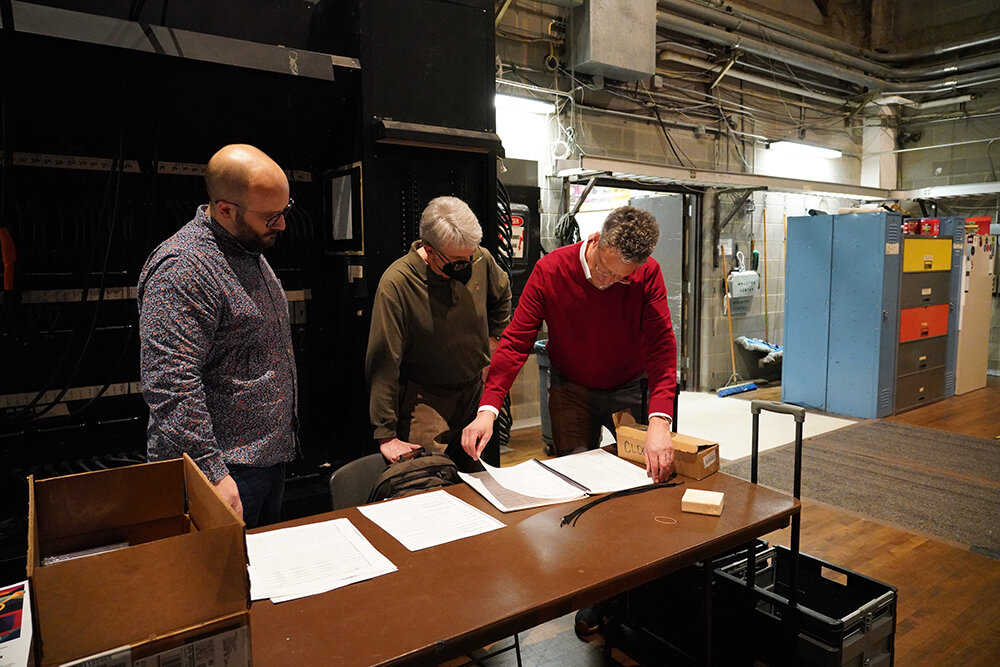
Kroth still has the orchestra surveys from eight weeks of try-out rehearsals and concerts in late 2005-‘06, a memento of his service on the search committee charged with finding a successor to 27-year maestro Gustav Meier.
Muffitt dominated every category, from communication of emotion to eye contact, baton technique and cueing, and scored more than double the other three candidates in the crucial category of knowledge of the score.
“He was clearly the winning candidate, and the orchestra was entirely behind him,” Kroth said. “That first season, it was new for everybody, and we did some terrific repertoire. It was an exciting time.”
Muffitt felt the chemistry, too. He didn’t envision staying in Lansing for 20 years, but he sensed a big opening.
“I remember thinking that the orchestra had an extraordinary potential for growth,” he said. “It had undergone considerable growth under Gustav Meier. I felt like if I were to come here, I would be inheriting an extraordinary situation.”
(Drinking game update: better make it half a shot per “extraordinary.”)
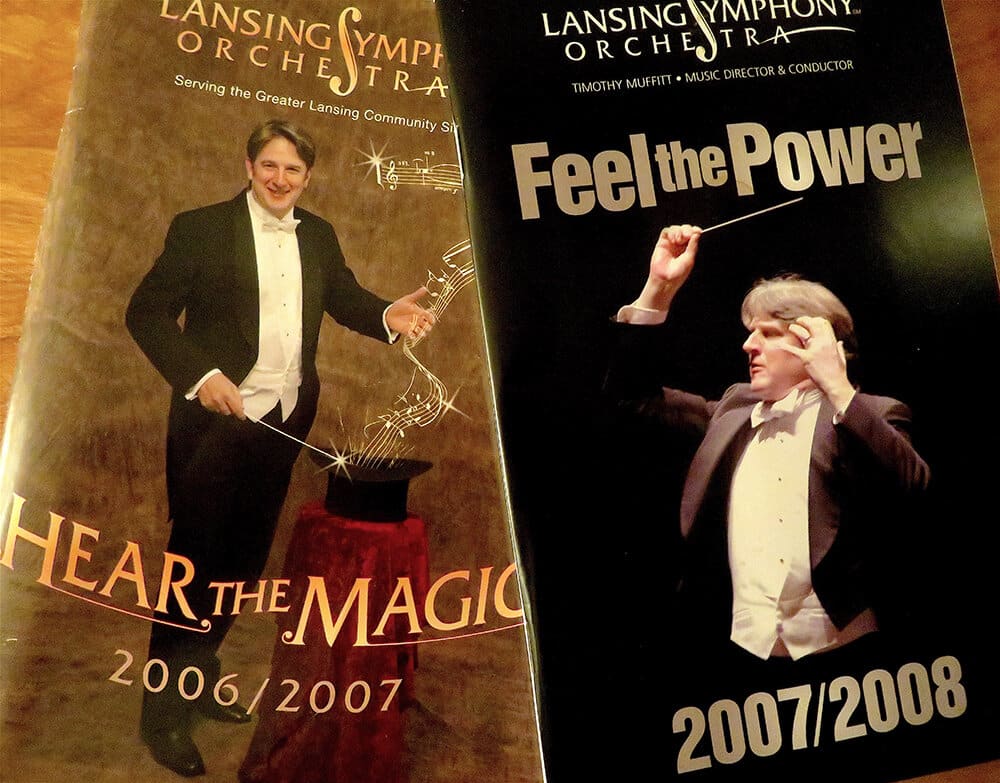
Things changed so fast that the orchestra’s PR people couldn’t keep up with the vibe shift. On the cringey cover of the LSO’s 2006-‘07 “Feel the Magic” season brochure, the newly minted maestro gamely posed as a magician pulling music out of a hat.
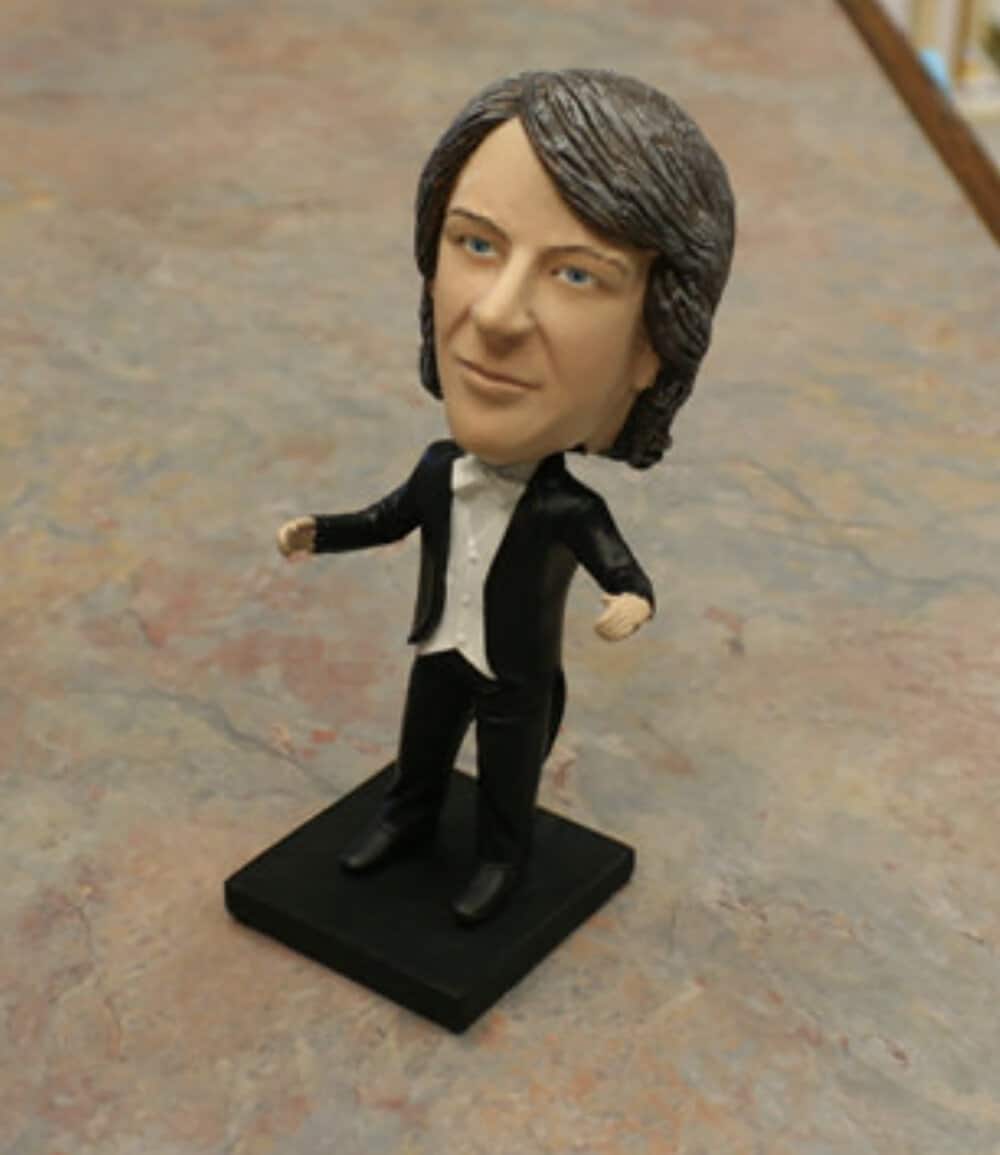
The next season, with Muffitt firmly in the driver’s seat, the gloves were off — literally. The cover photo captured Muffitt in all his grimacing, hair-flinging majesty, summoning up symphonic storms under a new slogan: “Feel the Power.”
Make it go ‘ping’
Some of Muffitt’s rehearsal tricks defied logical explanation. One piece of direction stuck in principal cellist Jinhyun Kim’s mind.
“Very often in rehearsal, when he wants a very pure sound, he says, ‘Make it go “Ping!”’ Somehow, that one word communicates everything immediately,” Kim said. “It’s very effective. I carry it with me and use it in my teaching. Ping!”
As soon as Muffitt came on board, he established a rapport with audiences, donors and the front office, but his relationship with the orchestra was the bedrock.
“One time in rehearsals, he referenced Bill Evans,” violist Madeline Warner said. “I was like, ‘the jazz guy?’ I can tell it’s about music, not about the big three old, dead composers. He has well-rounded musical tastes that bring so much to the rehearsal process.”
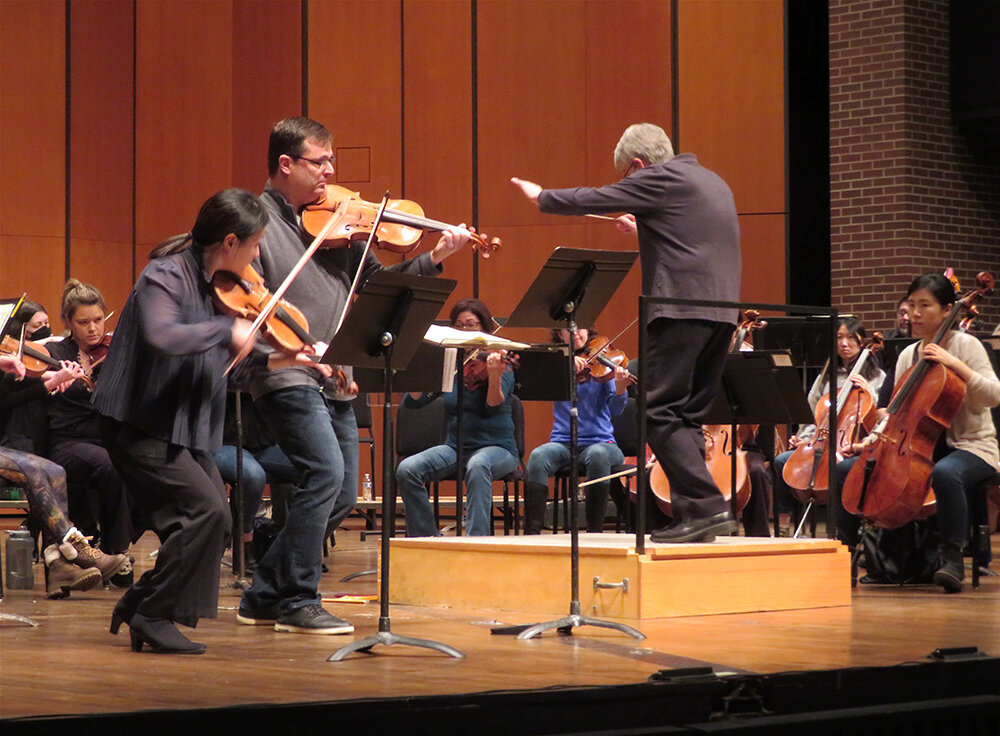
“Rehearsals are fun with him,” Hansen said. “He has a clear vision of what he wants, and he’s good at communicating that, whether it’s words, gestures, actions — sometimes he’ll dance on the podium to show what he wants.”
As they worked together on difficult, long and often unfamiliar scores with precious few rehearsals, the musicians came to consider him more of a colleague, a partner in music making, than a boss.
Warner boiled Muffitt’s bond with the musicians down to a small but meaningful gesture.
“The thing that stands out to me is that he knows all our names,” she said. “There’s, like, a hundred people up there, some of them he’s never seen before, and he learns all our names. I’ve worked with a lot of great conductors, and none of them did that.”
When Warner ran into Muffitt backstage before a rehearsal, she wasn’t sure how to address him.
“You try to be friendly, but there’s this whole hierarchy thing,” she said. “Do you call him maestro? But he was like, ‘Hi, Madeline,’ and I was so touched.”
The rolling thunder of principal timpanist Sarah Christianson is one of the orchestra’s many pleasures. When Christianson joined the orchestra in 2023, she was new to the community and knew almost no one in the orchestra. Muffitt made a point of approaching her after every concert with praise and encouragement.
“I don’t know any other conductors who have given me that much one-on-one attention and made me feel that welcome in their group,” she said.
As much as the musicians appreciate Muffitt’s warmth and approachability, his musicianship is what impresses them most. Kim said it’s rare for a conductor to perform so many of the biggest works in the repertoire without a score. Countless hundreds of pages of music, often for 70 to 80 musicians or more, are all in his head.
“It’s not just about memorization,” Kim said. “It really shows how deeply the music is internalized inside of him. That level of experience and dedication is really inspiring.”
The organized rigor of Muffitt’s rehearsal style gives the orchestra the confidence to express themselves with juicy spontaneity in performance.
“We’re not worried about how things are going to go,” Christianson said. “Tim irons out all of those details so we can really shine as musicians.”
Muffitt himself follows the philosophy of learning the book inside and out, then throwing it away.
“I’ve always felt I wanted to do everything, even the warhorses, as though I was doing the world premiere,” Muffitt said. “I would disregard what other people were doing. Didn’t listen to it. I would put out of my memory how I might have heard it, and that’s hard, because you’ve been listening to it since you were a teenager.”
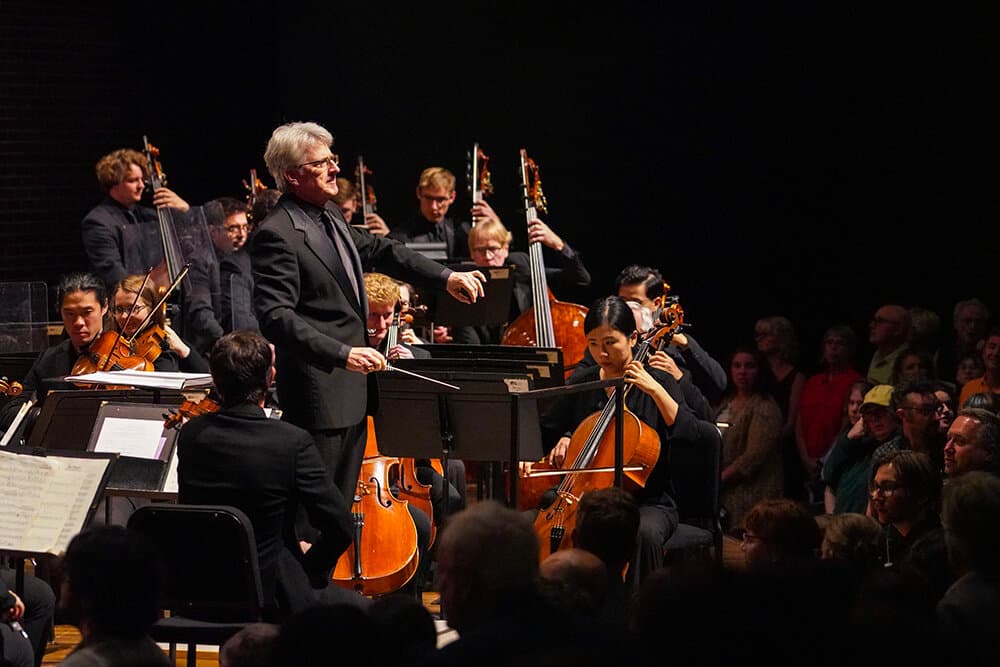
“Tim really comes alive in a different way during the performances,” Christianson said. “He has the freedom to do that because of the discipline he has in rehearsals.”
‘What’s a Korngold?’
With audiences in the palm of his hand and a rocket of a band on the launching pad, Muffitt felt ready to launch the LSO into new worlds. In 2008, he brought fiery young percussionist Lisa Pegher to rampage through a wild percussion concerto by Joseph Schwantner. Pegher would return twice in the following decade to energize LSO programs.
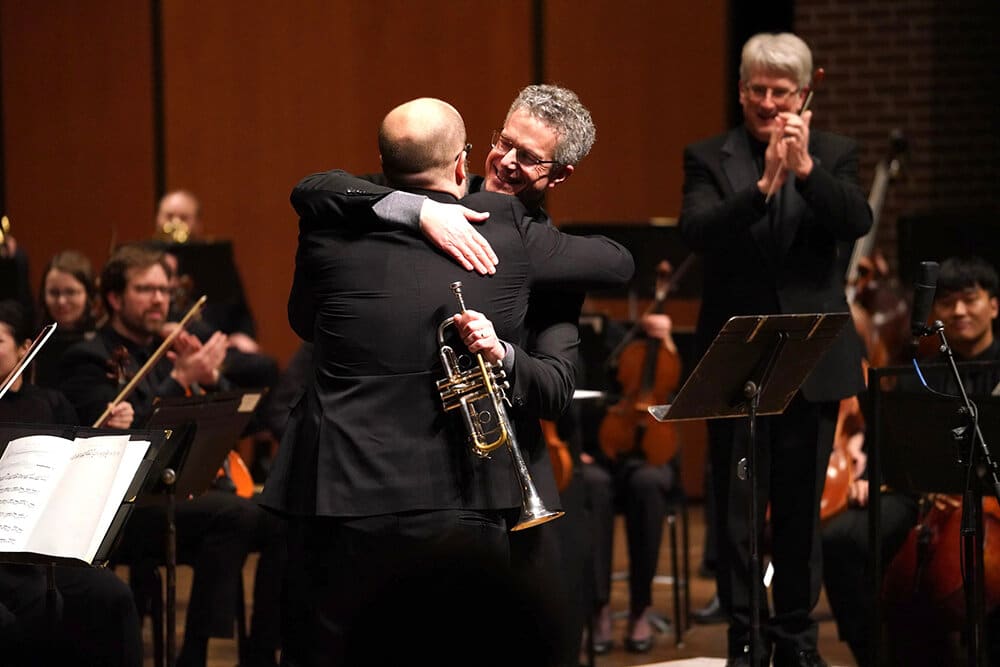
A blazing concerto for two trumpets by Stephen Paulus in March 2009 drew a riotous response and multiple curtain calls from the audience.
“That one stands out,” Muffitt said. “It was a major work, and we tackled it. I’ve always felt that mix is important. Music of our time is how we stay relevant.”
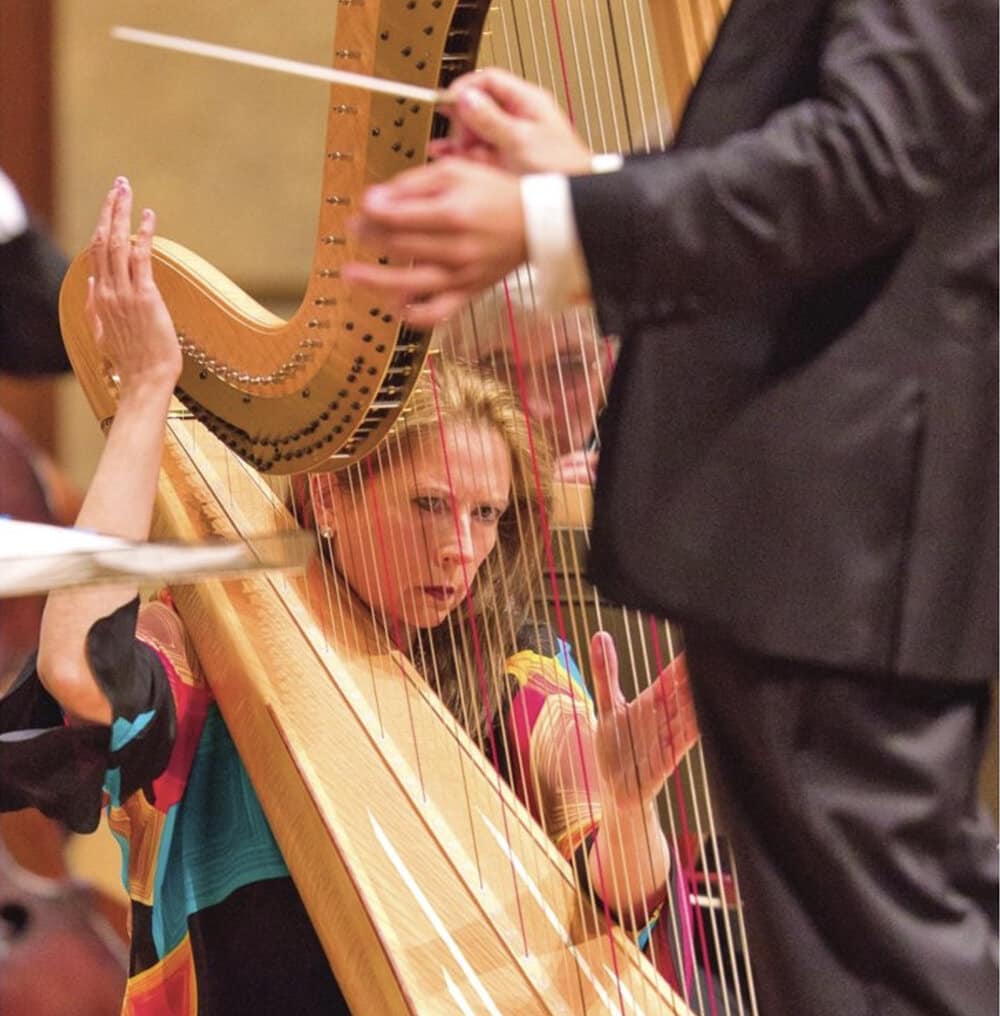
In 2011, Muffitt brought in Yolanda Kondonassis, arguably the world’s finest classical harpist, a give-no-quarter musical warrior who fought tooth and nail to expand her instrument’s genteel reputation and unleash its full range and impact.
Their electric performance of Alberto Ginastera’s spiky harp concerto, written in 1956, was a stunner.
“Oh my God, that was a career highlight,” Muffitt said. “That person, that instrument, that piece — that’s a force of nature right there.”
Impressed by the performance, Kondonassis asked the LSO to join a nationwide consortium of orchestras to commission a new harp concerto from the country’s most in-demand composer, Jennifer Higdon.
The orchestra melded with Kondonassis again, and the new concerto put another feather in Lansing’s cap.
“Tim is a blast,” Kondonassis said. “Jennifer’s music is very complex. You need to be able to look up for a split second and know where ‘one’ is, where ‘three’ is. You need a traffic cop at the podium in addition to a wonderful musician, and Tim is both.”
Mufftt and the orchestra were clearly on a roll. An orchestra with a budget just above $1 million a year, less than one-tenth that of Grand Rapids and one-thirtieth of Detroit’s, was punching way above its weight, drawing internationally acclaimed guest soloists and building a national reputation.

“As things continued to snowball with the new music, that just even gave us even greater momentum for all different kinds of things,” Muffitt said.
He took another chance by placing an epic 53-minute symphony written in 1952 by Erich Wolfgang Korngold at the center of a 2018 concert. It wasn’t exactly new by the calendar, but it’s likely that fewer than a handful, maybe zero, listeners in the hall that night had ever heard it.
“That was a risk in a lot of ways,” Muffitt said. “What’s a Korngold, right? It’s a major, massive symphony, and it’s immensely difficult. But I felt we could build on that trust and go there. That was another really great moment.”
Muffitt saw that the audience would let him take them to new places — a music director’s fondest dream.
The triennial suspense of whether Muffitt would renew his contract or ship his skills to a larger market began to recede.
“There was good reason to stick around for a few years,” Muffitt said. “It just all felt like a very good fit. I felt really good about how the orchestra was strengthening its relationship with the community. I wasn’t looking around. I was ready to settle in and see this through.”
‘Let’s try this seagull’
As the orchestra generated more excitement, major donors began to sprout up from an appreciative audience — supporters who would help Muffitt realize dreams that would otherwise have been out of reach.
Early in Muffitt’s tenure, Thomas Hofman and his wife, Wendy Granger Hofman, were sucked into the symphony’s orbit as concertgoers. Like much of the orchestra’s core audience, their kids were grown, and they found themselves with more time and energy to explore other sides of life.
“It started with the music,” Tom Hofman said. “We were hearing really dynamic and interesting programs, and Tim was at the center of that.”
As Hofman became more interested in the workings of the organization, he learned that ticket receipts only cover about a third of the orchestra’s budget. He ended up serving on the orchestra’s board of directors for 10 years and is currently its president.
“It was a natural progression from going to concerts, becoming informed and becoming patrons,” Hofman said.
To his surprise, Hofman loved some of the new pieces he heard.
“We didn’t come to these concerts thinking we wanted to hear something new,” he said. “He kind of worked his magic on us. We’d go to the car thinking, ‘Man, that really worked.’”
The newer music struck other listeners as a long-overdue course correction.
Sam Austin, a retired Michigan State University physics professor, and his wife, Mary, were longtime concertgoers, but they often went out of a sense of duty.

“In the time before Tim, we somehow found the LSO kind of boring, concentrating so much on the old masters,” Austin said. “That seemed strange to me. If I gave a lecture on Isaac Newton, nobody would come.”
After a few rounds of discussions with Muffitt and Millbrook, the Austins set up a 20-year endowment “to support the creation of new orchestral music, develop an understanding and enthusiasm for new music in our community and create a nurturing environment for composers.”
“We left it open-ended and trusted Tim and Courtney to work out the details,” Austin said.
Nationwide, the quality, accessibility, sincerity and variety of 21st-century classical music was winning over a new wave of listeners and overcoming old prejudices. Austin likes to wryly quote a friend of his who approached the LSO’s first composer in residence, Patrick Harlin, after one of his premieres with the orchestra and said, “You know, it wasn’t so bad.”
“You’ve got to have the music heard by people, so they get used to it,” Austin said.
“I wanted a composer in residence from Day 1, but it takes a major financial commitment to make sure it’s not cannibalizing something more important,” Muffitt said. “Sam and Mary have really taken a leadership role in wanting to explore the possibilities.”
Harlin created music that whisked listeners off to faraway places, from the Amazon basin to Earth’s orbit. His “Earthrise,” inspired by the famous photograph of the Earth rising over the horizon of the moon, got a standing ovation and even won the approval of the astronaut who took the photo, Bill Anders. (Anders saw the LSO performance on YouTube and commented that Harlin would “go far.”)
Jared Miller, the LSO’s second composer in residence, took his charge dead seriously, producing probing and innovative pieces like “Shattered Night,” depicting the rise of fascism in 1930s Germany. Muffitt’s final concert May 15 will feature a world premiere by Miller based on the peculiar logic and flow of dreams.

“They’re very different composers,” Muffitt said, “but they both embraced the role, not just writing music for us, but being involved in the orchestra and the community in a very powerful way.”
After more than 20 years with the LSO, violinist Lauren Hansen found herself working with living composers, working out new music in real time.
“It’s not something that’s been played for hundreds of years, and the composer is right there, so we get to figure out what’s going to work for this hall, for these musicians,” Hansen said. “It’s exciting. I spent the longest time making seagull noises on one of Jared’s pieces: ‘Nope, that’s not the right seagull. Let’s try this seagull.’”
LSO at The Robin, a series of chamber-style concerts highlighting new music, has become a staple among the folk, hip-hop, comedy, puppet shows and other eclectic offerings at the REO Town venue. The series is in its fifth year, and nearly all the concerts have sold out.
Karen Lewis, rector of St. Paul’s Episcopal Church, went to an LSO at The Robin concert three years ago and was so impressed that she became a donor to the series.
“It’s so intimate. You’re right there with the musicians,” Lewis said. “Two of the composers were there, and that was so cool. How often do you get to talk with the composers when they hear their music being played?”
“We found a lot of sweet spots with that,” Muffitt said. “It’s in a really cool venue, it goes about an hour with no intermission, it’s informal with a lot of personal interaction. We have these composers who maybe a week ago were in the Concertgebouw in Amsterdam, talking to that audience, and the next week they’re at our Robin Theatre in Lansing, talking to us.”
Muffitt credited the musicians, who often woodshed for weeks to perform difficult music they may not have another chance to play.
“It’s a labor of love to do those concerts, and it wouldn’t be a success without their commitment,” Muffitt said.
“None of the orchestras I play with in the area do stuff like that,” violist Madeline Warner said. “Once you’re out of music school, it’s rare that you get to do something that cool.”
In February, a string quartet drawn from the LSO, with Warner on viola, played an outstanding set of new music at The Robin, with a furious arrangement of Jimi Hendrix’s “Purple Haze” (made famous by the experimental Kronos Quartet) as a closing flourish.
Closing with Hendrix was Muffitt’s idea.
“He really wanted that,” Warner said. “He was like, ‘You can pick the music, but I want to hear “Purple Haze.”’”
‘Music has many powers’
After Muffitt’s May 15 swan song, he’ll resume his yearly summer job as artistic director of the Chautauqua Institution’s School for Music in western New York, but he’s ready for some down time.
He calls his other creative passion, photography, “a daily pursuit.” His subjects range from colorful portraits of people and places to rural scenes, nature studies, abstract compositions and delicate black-and-white imagery. Many of them can be seen on his website, under the tab “side hustle.”
“I can certainly see that expanding with more time on my hands,” he said.
So far, he has no plans to be a full-time maestro again. When he says the Lansing gig felt like 20 years, he means it.
“Being a music director is a high-pressure job, if you’re doing it right,” he said. “I’ll just have a little more space to still be a musician, still conduct, but have a little more breathing room. Elise and I have plans to travel and see things we haven’t seen, or haven’t seen together, and that will be a big part of it.”
Some things remain constant. Muffitt asserted without hesitation that the music still moves him as deeply as ever.
“Oh my God, yes,” he said. “I’m struck on a regular basis by the impact of even works I know inside out. They come on WKAR or whatever, and the same things inside me resonate.”
But music has never been a complacent armchair pleasure for Muffitt. When he unleashed Prokofiev’s Fifth Symphony in Lansing more than more than 20 years ago, he described it as “music that looks to a brighter future.” And if many things look bleak now, Muffitt pointed out that Prokofiev bottled his life-affirming message amid the global war, genocide, brutal dictators and furious firestorms of 1944.
“Music has many powers,” Muffitt said. “It brings us into a physical space together. It brings us into a spiritual place together. It brings us into a human experience together. And we could use more togetherness now, and more common appreciation.”
Next season, Muffitt will stay with the LSO as artistic advisor, guiding the chamber series, LSO at The Robin and other ongoing programs as the orchestra sifts through five candidates to succeed him as music director.
But his impact will reverberate well beyond the coming transitional year.
“His retirement is bittersweet,” principal cellist Jinhyun Kim said. “I’ve grown so much under him as a musician. It’s the kind of experience money can’t buy. We’ll miss him so much, musically and personally.”
“When you have the luxury of working with colleagues you respect and admire and love making music with, those moments, they’re not just static experiences,” principal oboist Stephanie Shapiro said. “They shape how you think and perform and be a musician in the future. So, his impact on me personally, and on the orchestra, will always be felt, and that’s a nice thing to be able to hold on to.”