
‘It’s not about the money, it’s about the principle’
The 1890 house at 1119 Seymour Ave. in Lansing has been red-tagged for so long that the tag is more pinkish-orange.
Following $150,000 in renovations and two and a half years of local …
(This story has been updated to report that Lansing City Council President Ryan Kost said he has already initiated an effort to amend the monitoring fee ordinance so that red-tagged property owners who are making progress on improvements are not penalized. Earlier, Kost said it would likely be next year, but Kost said he misspoke.)
The 1890 house at 1119 Seymour Ave. in Lansing has been red-tagged for so long that the tag is more pinkish-orange.
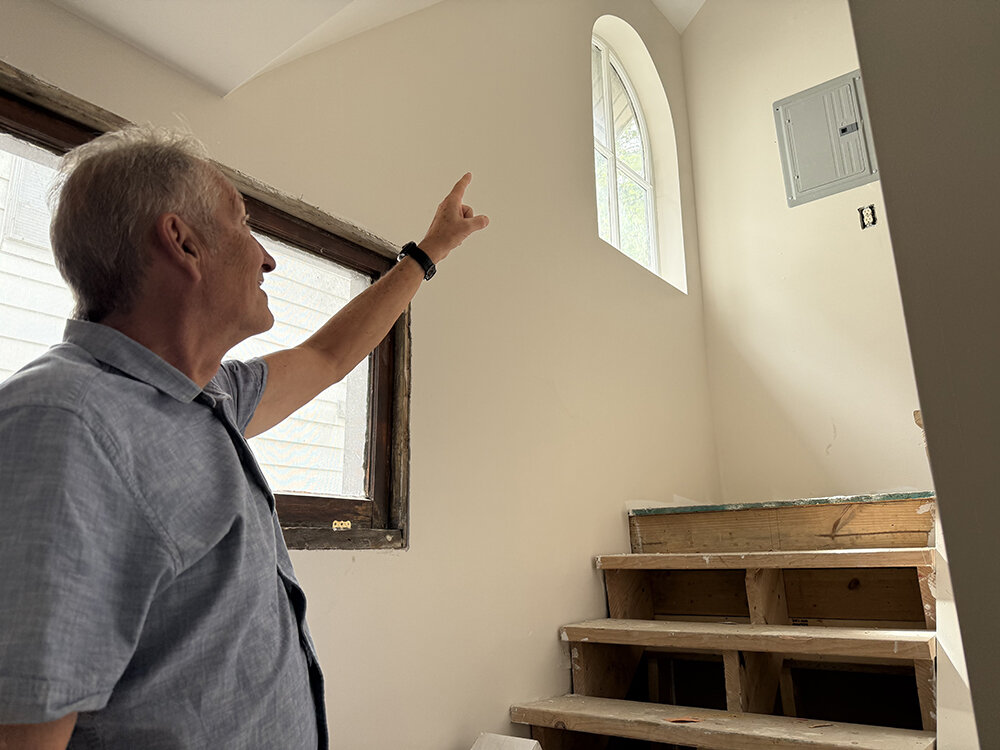
Following $150,000 in renovations and two and a half years of local preservationist Dale Schrader’s time, that sun-bleached tag is close to coming off. A hole in the roof that for five years leaked rainwater into the house has been replaced with a curved window Schrader salvaged from another house. What was once a tangle of trees and weeds has been replaced with a path made from bricks taken from the original Washington Avenue in nearby Old Town.
Schrader, the self-described “accidental landlord” who is known for rehabilitating and restoring the historic Pulver Brothers Filling Station in Old Town, thinks he’s doing the city a favor.
But the city isn’t thanking him — it’s charging him.
Per local ordinance, owners of a property that has been red-tagged more than 90 days must pay a $165 monthly “monitoring fee.” Rawley Van Fossen, the city’s economic development and planning director, said the fee is “not punitive.” Rather, it covers the cost of code enforcement officers to conduct a monthly check and “determine whether further decay or unsafe conditions have presented themselves that may cause the city to take additional action.”
Schrader, who said he has rehabilitated five red-tagged properties and has a proven track record, doesn’t see why the fee is necessary when the house is clearly being worked on. He disagrees with the assertion that the fee is not punitive.
“They call it a monitoring fee, but I think it’s just to penalize the owner and get them moving,” he said. “There are people that will buy a red-tagged property and just sit on it, so this fee is sort of an incentive for them to get moving.”
As for the monitoring efforts, he struggles to see why it would cost $165 per visit.
“They don’t really do anything,” he said. “They don’t call me and come in. They might just drive by and look at it.”
Van Fossen said 469 properties are subject to the fee, which would equate to over $77,000 monthly. He said the cost “covers the time of the driver to physically drive to the property, complete the inspection and enter that into the system” and other “physical costs to deliver that service.”
Van Fossen said that the ordinance necessitates the fee.
Mayor Andy Schor said that “years ago, the code staff would waive the monthly fee if they thought there was work being done on the house,” but the City Council had decided to require the fee no matter what.
“I’m open to looking at how we could allow people to repair houses without getting a fee, but it’s a Council discussion,” he said.
And while those discussions are a ways off, City Council President Ryan Kost is “looking at it,” he said Monday.
Kost said a change allowing property owners to apply for an extension after the initial 90-day period is one of several ideas he discussed with the city attorney Monday.
“Part of the built-in ordinance would be an opportunity for extension if the work is actually being done,” he said. “And when I say work, I don’t mean just putting a nail in the wall and walking away, because that was the problem before.”
Kost said today (Sept. 12) that he has already asked the city attorney to revise the ordinance “to give breaks on the fee to people who just bought or are making actual efforts to restore homes. ” He said he hoped the Council would approve the amendment by the end of the year.
For his part, Schrader said he can afford the fee, but he finds it insulting.
“It’s not even about the money to me,” he said. “It’s just about the principle.”