Justified overkill
Muffitt, LSO bring down the curtain with many
From the beginning, the Lansing Symphony Orchestra’s season finale was all about endings. The very first piece on Friday evening’s (May 15) program, Antonín Dvořák’s “Carnival Overture,” is packed with furious, finale-worthy hammer blows that don’t quit until the stubborn nail of resistance inside your brain is finally driven flush to the wood.
Your honor, the defense pleads justified overkill.
The biggest ending of all — the ominous yet positively charged thunderhead looming over everything — was, of course, the end of Timothy Muffitt’s 20-year tenure as music director.
With 90-plus musicians on stage, Muffitt and the crew ramped up the razzle-dazzle, as required at such a moment in the orchestra’s history, but didn’t skimp on seriousness, substance and surprise.
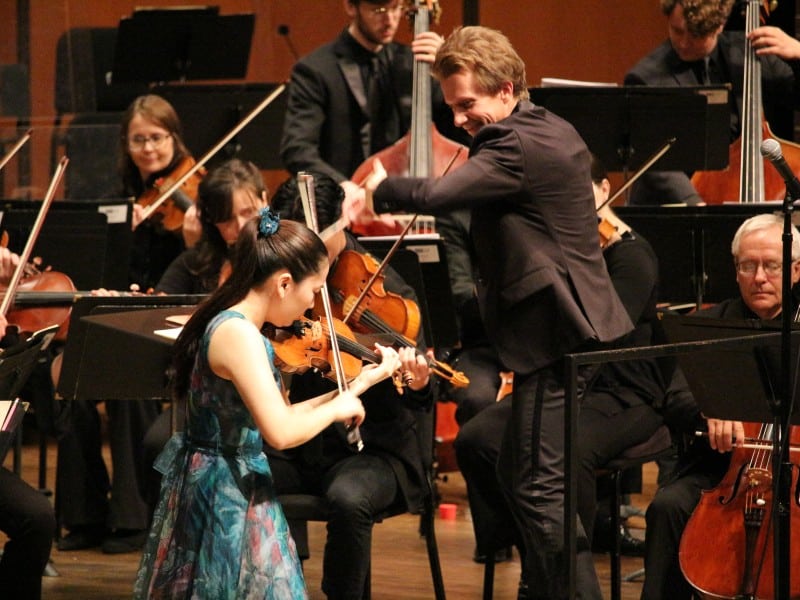
To meet the challenge of going out with a bang while staying true to his musical standards, Muffitt was careful to deliver a precise bludgeoning. The maestro deployed several extraordinary moves to keep the proceedings at the requisite pitch, as if to say, “And after 20 years, you thought you’d seen it all.” To keep the hyper-caffeinated overture from spinning into centrifugal chaos, his arm shot up and down like the escapement of a Rolex, first vertically then horizontally, almost faster than the eye could follow.
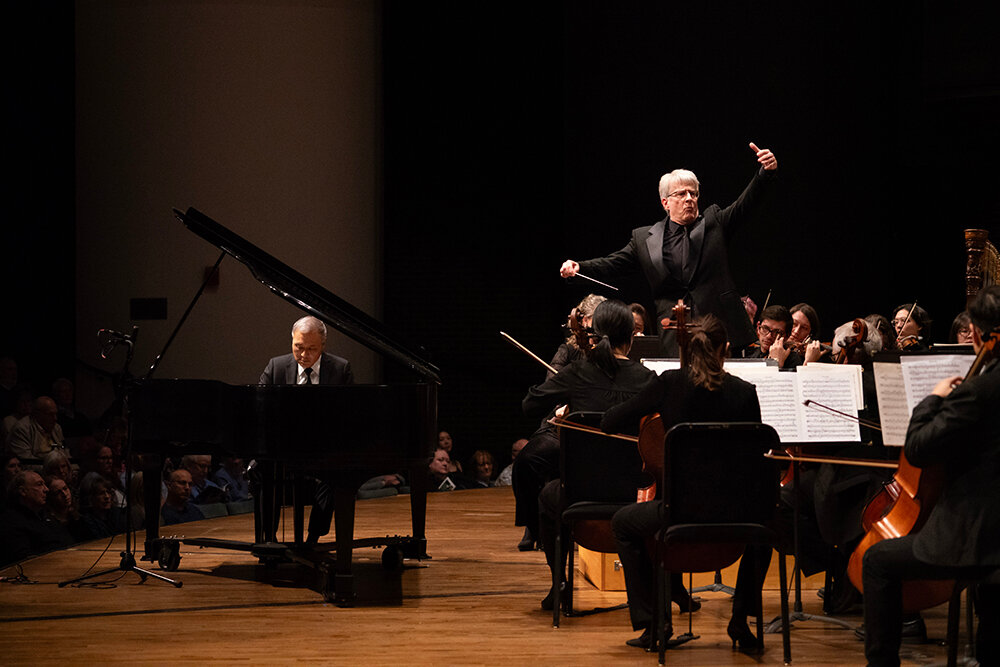
That precision came in handy when the latest in a series of deeply simpatico soloists, pianist Jon Nakamatsu, teamed up with Muffitt and the orchestra for a brisk, bravura performance of Rachmaninoff’s “Variations on a Theme by Paganini.”
Fused into one, trusting each other to navigate abrupt shifts of timing and mood by apparent telepathy, Nakamatsu and Muffitt charged through the variations like two horns on a bull. They refrained from milking more out of the material than necessary, even in the famous, swooning melody that pours out of the orchestra toward the end like a good sob after a bad party. They had their cry and moved on.
There was so much energy emanating from Nakamatsu, Muffitt, the musicians and the momentousness of the night itself that Rachmaninoff’s familiar showpiece not only felt fresh but almost experimental, especially when the strings “spiccato-ed” their bows off their instruments, along with taps from the snare drum, to make it feel like ants were dancing out the music on your arms.
Friday’s concert marked another end: the final work from three-year composer-in-residence Jared Miller. Written to order for a maximum-sized LSO, “House of Dreams” added some welcome weirdness, fun and food for thought to the familiar sounds that came before and after.
Principal bassist Ed Fedewa led the way with a lyrical solo melody drawn from the groaning depths of slumber, gradually picked up, layer by layer, by the cellos, violas, violins and brass. Miller is a mad master of adopting traditional orchestral techniques like the big, slow buildup and injecting them with insidious, chromosome-level mutations. About halfway through, the mists of dreamland parted to reveal pulsating threads of spectral colors in the strings, achieved by divvying them into complicated, ever-changing combinations.
The piece was punctuated throughout by relentless bass drum whacks, possibly suggesting the sleeper’s heartbeat, if the sleeper were a sperm whale or an apatosaurus. It was a lot of bass drum to take in, but it fit in with the evening’s spirit of justified overkill.
As passionately as Muffitt has made the case for beloved favorites like Haydn or Brahms over the years, he must have known they wouldn’t deliver the right kind of “wow” for a night of multiple climaxes. Respighi’s “Pines of Rome” hit all the notes. The splashy opening movement, with its joyous horn whoops and geysers of woodwinds, drenched the audience like a Cedar Point ride.
But there’s never a brainless bacchanal with Muffitt in charge. Melancholy meditations on the passage of time were also in order. The orchestra quietly conjured the cavernous echoes and shadowy ruins of the catacombs with a spacious luminosity that stirred goosebumps on many a neck. Principal trumpeter Neil Mueller snuck offstage to play a noble hymn that floated over the music like the moon, and the whole orchestra responded with massive, ancient-sounding chords that restored those ruins and retrieved a lost world from oblivion for a few fleeting seconds.
The serene interlude that followed, complete with pre-recorded nightingale songs and a vibrato-less, hyper-delicate solo by principal clarinetist Guy Yehuda, was only a setup for the cataclysm to come. Respighi’s imaginary march of the Roman legions increases in intensity from a distant thrumming to a fortissimo sonic supernova.
All night, the musicians of the orchestra played their guts out for the departing maestro, their torsos twirling in their seats with effort. Now it was time to build up to the final chords. As usual, Muffitt wasn’t interested in displaying moves for the sake of moves. He conducts like an embodiment of the music itself, which made him all the more watchable.
Nevertheless, Friday’s finale added one more memory to a 20-year-thick album. The need to synchronize an offstage contingent of horns, parked in the upper balcony, with the climactic chords produced by the musicians on stage drove him to thrust one arm out at 45 degrees toward the interior of the hall, like a samurai wielding a sword, while cueing the orchestra with his other arm, positioned at 90 degrees in the opposite direction, and looking both ways at once. I last saw this move when Toshiro Mifune fought the eight-tailed serpent in “The Three Treasures.” He danced around the dragon, cut off all of its heads, saved the village and took a bath in a barrel of sake. I hope the maestro found a roughly equivalent afterglow.