
Lawmakers push for public media funding in next state budget
LANSING – The loss of federal funding sent Michigan’s public broadcasters scrambling for a long-term funding solution.
Now, some lawmakers are pushing for state support.
Legislation …
LANSING – The loss of federal funding sent Michigan’s public broadcasters scrambling for a long-term funding solution.
Now, some lawmakers are pushing for state support.
Legislation introduced by Rep. Jason Morgan, D-Ann Arbor, would create a $13 million public media fund in the state budget, designated to support public television and radio stations.
Additional advocacy focuses on including money for public media in the next budget cycle as Gov. Gretchen Whitmer prepares to present her 2027 budget proposal to lawmakers on Feb 11.
“For folks who believe in supporting the continuation of public media, I think it’s essential that the state steps up and fills the void left by the federal government,” Morgan said.
In January, the Corporation for Public Broadcasting (CPB) – which distributed federal funds to NPR, PBS and over 1,500 locally managed public television and radio stations – announced that it would officially dissolve the organization.
The move follows the congressional decision last summer to sign off on President Trump’s request to defund NPR and PBS, rescinding $1.1 billion in previously allocated funds for the CPB and leaving public media outlets in Michigan and elsewhere in a lurch.
The executive order signed by President Donald Trump directed the CPB board to cease direct funding to NPR and PBS, stating, “No media outlet has a constitutional right to taxpayer subsidies, and the government is entitled to determine which categories of activities to subsidize.”
It further reads that the CPB “fails to abide” by “principles of impartiality” reflected in its governing statute, to the extent it subsidizes NPR and PBS.
Stations had those grants built into their budget because the money had already been approved, Michigan Association of Public Broadcasters’ president Molly Motherwell said.
Every grant was different, depending on factors like audience size and fundraising, but “we all had to make up that difference,” said Motherwell, also the general manager of WEMU in Ypsilanti.
While some public media outlets received increased donations to help keep them afloat this year, Morgan said that those contributions are not necessarily permanent because they were, in many cases, one-time gifts.
“This is where we have to, within the next year or two, contribute to public media and protect it at the state level if we’re going to ensure long-term sustainability,” Morgan said.
At Interlochen Public Radio (IPR) based in Grand Traverse County, annual grants from the CPB had provided between $250,000 and $300,000 for operations in recent years. In the fiscal year prior to the cuts, they amounted to 14% of IPR’s revenue.
“The generosity of our listeners has compensated for the loss of federal funds for now,” Executive Director Peter Payette said.
IPR’s annual fund drive started a week after the defunding vote in Congress, and donations amounted to three and a half times the station’s goal for the event, Payette said.
“That’s the thing we learned most – a lot of people care a lot about public radio in this country,” he said.
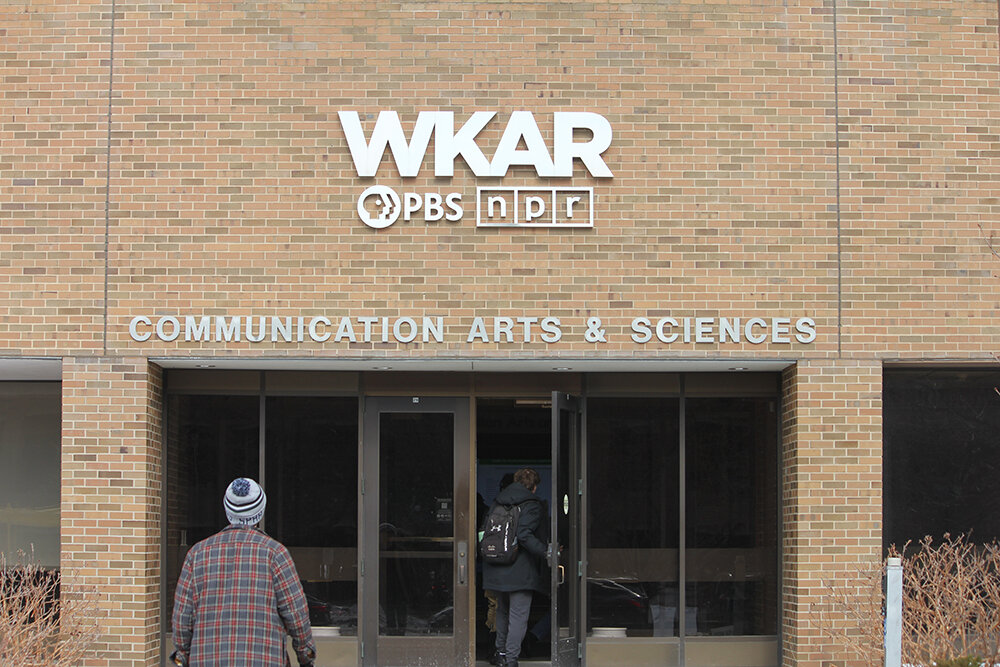
There were similar results at WKAR in East Lansing, where the loss of federal funding left a $1.6 million funding gap in its annual operating budget, according to General Manager Shawn Turner.
The station had made various moves in anticipation of the federal cuts last summer – including elimination of nine positions – but “after all of that, it still left us with about a $500,000 funding gap,” Turner said.
A fundraising campaign launched in response to ask community members to “close the gap” raised more money in the first couple of weeks after its launch than the five annual campaigns preceding it did in the same period.
“The response has been overwhelming,” Turner said, “The community has been very clear that they want to step in and help support WKAR.”
But regarding the sustainability of funding?
Motherwell said, “Nothing has been laid out in terms of a strategic plan for the industry.”
According to her, stations are working in groups with the networks NPR and PBS and the noncomMUSIC Alliance organization to come up with proposals about how to move forward.
As some stations relied on federal funding more than others, Motherwell said the group is looking at which stations were most drastically affected.
“For the northern stations, the more rural stations, this was more catastrophic for them than it maybe was for the more urban stations that have larger populations to draw from,” she said.
According to Payette, there may be ways for stations to collaborate to be more efficient if they overlap or offer redundant services.
“One of the realities that I hope changes is there’s not a great discussion going on now in Michigan among the public media entities about how we could do things differently,” he said.
Morgan’s bill, introduced to the House, is pending in the House Appropriations Committee.
Cosponsors include Reps. Jason Hoskins, D-Southfield; Erin Byrnes, D-Dearborn; Emily Dievendorf, D-Lansing; Carol Glanville, D-Walker, and Phil Skaggs, D-East Grand Rapids.
But the House is currently controlled by Republicans, who Morgan said “have not been super-supportive of protecting public media,” adding that he doesn’t know whether the bill will pass.
Regardless, Morgan said lawmakers will continue to advocate for money to be included in the state budget, whether through his bill or the remainder of the budget process.
“This is something we’re continuing to try and get in the state budget,” he said.
In terms of a timeline, Morgan said he and the cosponsors are trying to “bridge this [Trump] administration” with state funding to ensure public media stations continue to function.
“On my end, the hope would be that there is a change in control of the U.S. Congress along with control of the Michigan House of Representatives, and that we can actually fully restore public media funding.”
Related Articles
Meet the local women leading Greater Lansing efforts to provide the ‘dignity of work’
No matter how successful Shara Trierweiler became in her years-long finance career, it never seemed to make being a mom to her two children, Philomena and Dominic, any easier. …
Rewind: News from the last 7 days
Rewind 6/3/26 The Michigan State Police have finished their investigation into the April 15 fatal police shooting of Isaiah Kirby by East Lansing officers.

Prayer Walk for Peace in Lansing brought faithful protesters to Capitol
Photo Gallery – Prayer Walk for Peace