
MSU’s ‘Othello’ portrays pertinent dangers of lying and fearmongering
Picture an insecure leader, so singularly focused on retribution for a perceived wrong that he formulates a complex scheme of revenge and sows such deep mistrust among his people that they kill each …
“Othello”
Nov. 12-14, 16
7:30 p.m. Wednesday-Friday
2 p.m. Sunday
Wharton Center Pasant Theatre
750 E. Shaw Lane, East Lansing
(517) 432-2000
theatre.msu.edu
Picture an insecure leader, so singularly focused on retribution for a perceived wrong that he formulates a complex scheme of revenge and sows such deep mistrust among his people that they kill each other and put society in danger of collapse. Although that may also describe a certain contemporary, orange-skinned politician, this is William Shakespeare’s Iago, villain of “Othello.”
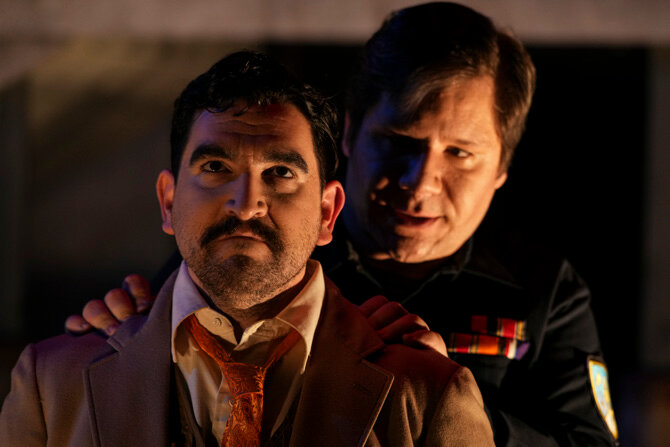
“Othello” is an appropriate choice as part of the Michigan State University Department of Theatre’s season of “Secrets & Spotlights.” Iago (Andrew Keller) is passed over for a promotion by Othello (Chisom Anwunah), who gives the job to Cassio (Hugh Watters). Iago schemes to make Othello believe his wife, Desdemona (Rileigh Belle Wine), is having an affair with Cassio.
Through lies and manipulation, Iago destroys Othello’s psyche, leading to devastating consequences for almost everyone. Not only is the play based on secrets that destroy people’s lives, but it also shines a spotlight on current national issues.
Director Ji Won Jeon investigates societal fear in this production, and her choices show how the delivery of scripted language can highlight particular themes. In Joen’s notes, she explains she was interested in Othello’s downfall as the product of anger and fear. His identity as a Moor — an outsider to Venetian society — is heightened through the delivery of the dialogue.
A successful production of “Othello” relies heavily upon a well-cast Iago, and Keller is outstanding.
He employs subtle changes in his posture and facial expressions, depending on his status. When engaging Othello, he is a wide-eyed supplicant, but in his conspiratorial monologues, he seethes and snakes. Those who sit stage right will get the full force of Keller’s malice as he embraces Othello, eyes seeming to envision the psychic daggers he plunges into his comrade’s back.
While not the strapping warrior one typically pictures as Othello, Anwunah portrays him well. Anwunah handles the intense emotional moments with aplomb, especially when Iago plants his poisonous seeds and in the final standoff in the bedchamber.
As Desdemona, Wine exudes playfulness and affection when their relationship is good, a sparkle in her eye as she looks upon her beloved Othello. It is truly haunting when she sings “The Willow Song,” further enhanced by Brandon McDuff’s sound design.
Ranae Selmeyer’s set is simple and sparse, with a two-story platform over a floor incorporating large, cracked rocks through which magma is emerging. As the deception intensifies, the magma glows brighter. Similarly, the lighting slowly becomes an angry red, and the sound effects become more ominous as the play races toward its tragic ending.
Another detail showing Othello’s mental decay is his uniform. In the beginning, Othello is the picture of military excellence, buttoned down and trimmed up. As he slides toward rage and madness, he loses parts of his uniform and becomes increasingly disheveled.
Ryan Scott Long’s costume designs are an important part of the play. The male characters wear stiff, formal, modern uniforms, juxtaposed with Desdemona and Emilia’s soft, flowing pieces. The women are almost out of place in this hard, dark, militaristic environment.
As with most Shakespearean plays, every production can offer new angles, interpretations and experiences.
This rendition of “Othello” shines a spotlight on how secrets and fear can destroy people.