
New local pharmacies combat worsening shortage
When the Rite Aid across from the University of Michigan Health-Sparrow hospital closed its doors in fall 2024, UM-Sparrow regional pharmacy director Todd Belding wondered where its patients would …
Addressing ‘pharmacy deserts’ an increasing concern after Rite Aid closures
When the Rite Aid across from the University of Michigan Health-Sparrow hospital closed its doors in fall 2024, UM-Sparrow regional pharmacy director Todd Belding wondered where its patients would go.
“I knew the pharmacists over there and talked to them, and it was one of the busier Rite Aids,” he said. “And we were kind of worried about where that script volume was going to go, and how we were going to service those patients.”
The pharmacy had a lot of patients who walked there, he said, making the pharmacy in the UM Health-Sparrow Professional Building nearby inaccessible because it has to be entered through a parking garage. So UM-Sparrow bought the building, renovated it and began running it themselves.
It opened on Oct. 8, and Belding said it has been busy ever since.
When access to medical care is highly inconvenient, Belding said people often skip it. But as pharmacies struggle with decreasing reimbursement rates — how they make a profit — “pharmacy deserts” where access to prescriptions is difficult have been on the rise, particularly in underserved areas.
Jamie Alan is a licensed pharmacist and professor at Michigan State University. Alan said pharmacy deserts are a newer concept and aren’t as well-known as food deserts. People without reliable transportation have struggled to access pharmacies and other healthcare for years, but the pharmacy side has gotten worse in the last decade as lower profit margins lead to closures.
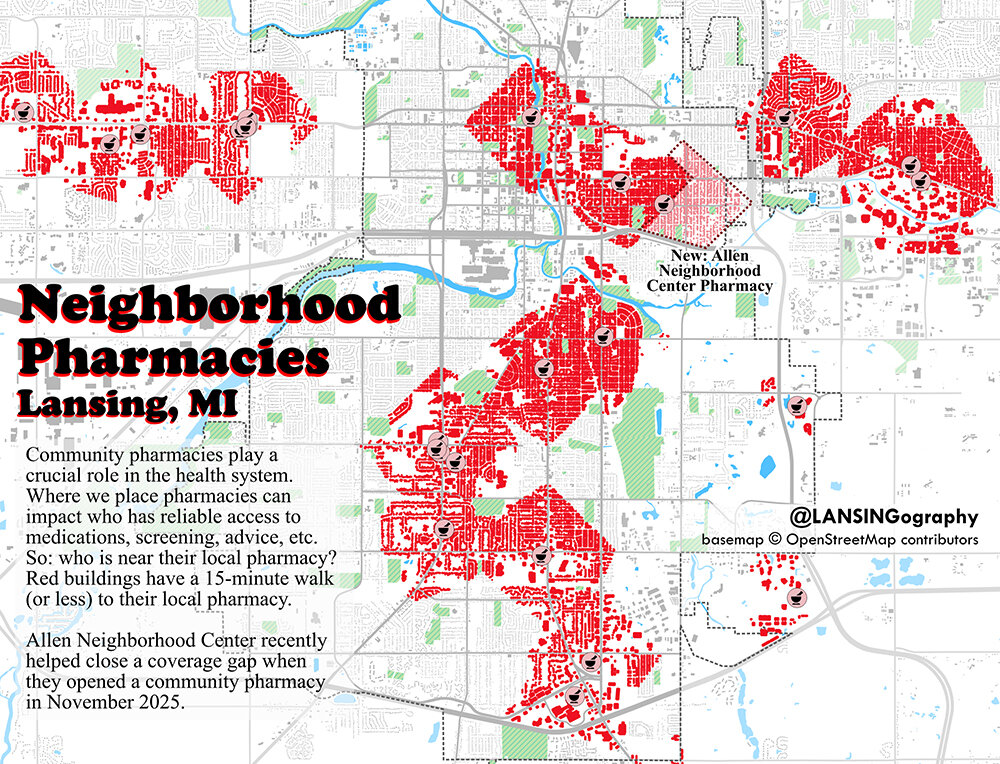
A 15-minute walk from the UM-Sparrow pharmacy, the Allen Community Pharmacy opened for business on Nov. 12. The pharmacy is inside the Allen Neighborhood Center and run by the Ingham County Health Department, a longtime ANC partner.
Both of the new pharmacies are located directly next to clinics. The UM-Sparrow pharmacy is next to a UM-Sparrow urgent care facility and the ANC pharmacy is beside the Allen Community Health Center.
The health department’s chief medical officer, Dr. Nike Shoyinka, said having access to both pharmacies and clinics can improve health outcomes.
“So, I’m a physician, and I have a patient who comes to see me, and I write prescriptions, and this individual takes the bus to come see me,” she said. “And the pharmacy they need to go to is two miles down the road, and it’s snowing, but they’re out of their meds already. And I write a prescription and say, ‘Hey, go fill this.’”
That individual is likely to take longer to fill the prescription or even skip it, Shoyinka said. That can exacerbate whatever is being treated and even lead to further complications or expensive emergency room visits.
“Think about someone who has diabetes, who needs to take either their metformin or insulin,” she said. “If they’re unable to take their medication on time, their blood sugar goes up, they end up not feeling well and they could develop complications like diabetic ketoacidosis and end up in the emergency room.”
An analysis by Christopher Greene-Szmadzinski, who creates visualizations from open-source data on the website Lansingography, shows the ANC pharmacy increased coverage on the east side, some of which overlaps with the UM-Sparrow pharmacy and some of which increases access to those who did not formerly have it. Buildings pictured in red have a maximum 15-minute walk to a pharmacy.
“Not everyone has reliable transportation,” said Allen Neighborhood Center Executive Director Joe Enerson. “We have the bus routes, but that might not fit people’s schedules. They might not be able to spend an hour or two changing buses and waiting, so access has to be really local.”
The new pharmacies help to fill an important gap, Belding said, but they’re not enough to combat the worsening shortage.
“Rite Aid was in a lot of areas that were underserved, and when you close those pharmacies, you really take away from those underserved patients,” he said. “You already have a patient population that struggles with service, and you’re taking away one of their biggest providers of service.”
A pharmacy shortage mapping tool developed by the National Community Pharmacists Association and the University of California shows that pharmacy shortages in the Lansing area were getting better between 2016-2018, when coverage expanded into three areas previously identified as shortages. The map stays consistent through 2022, but in 2023 and 2024, three areas that previously had coverage became areas with shortages.
“I mean, Rite Aid closed because they couldn’t make any money, and that was 5,000 pharmacies,” Belding said. “So if you have a small pharmacy that’s only running three or four pharmacies, it’s even harder to make a profit.
“We’re going to have far fewer pharmacies than we used to.”
— LEO V. KAPLAN