Old Town set to lose another piece of history
“Such a shame to see it go,” said Rick Preuss, gazing up at the dilapidated building that bears his family name. “Such a shame.”
Constructed in 1875, the building, at 308 …
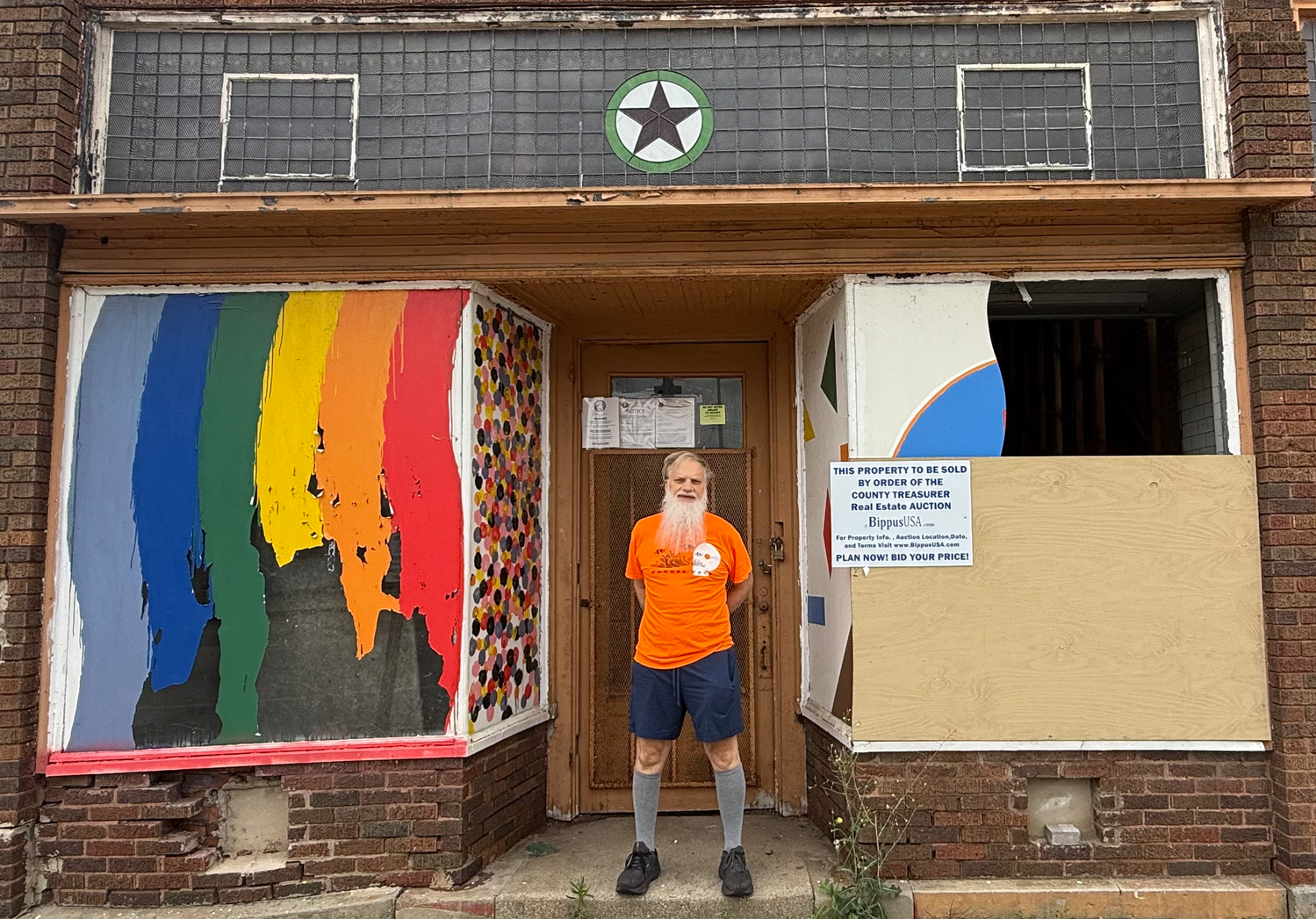
“Such a shame to see it go,” said Rick Preuss, gazing up at the dilapidated building that bears his family name. “Such a shame.”
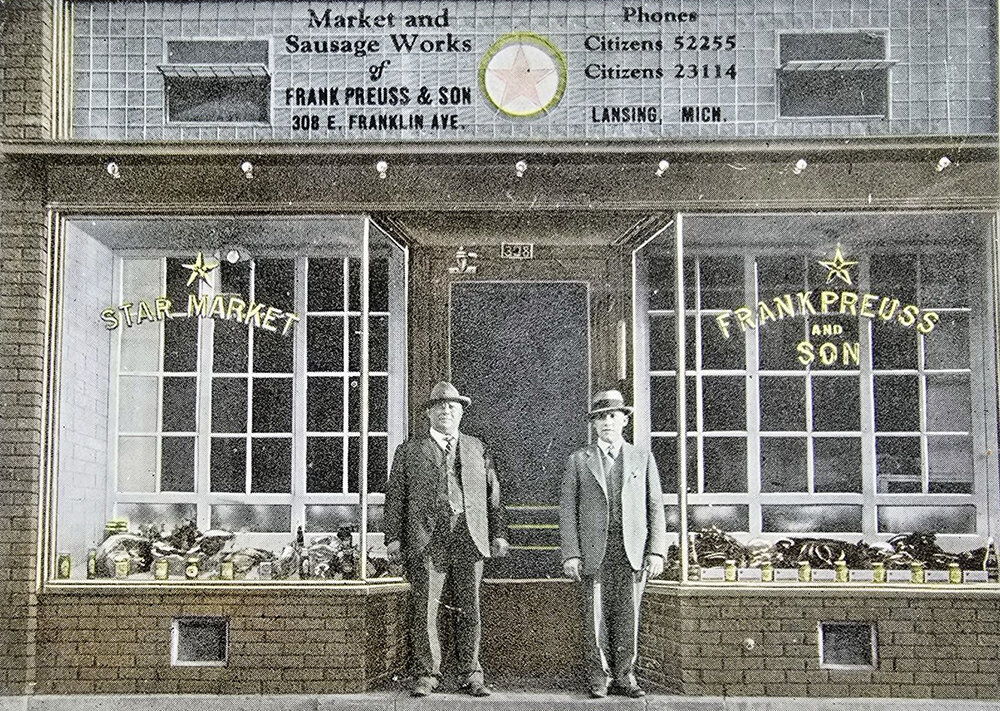
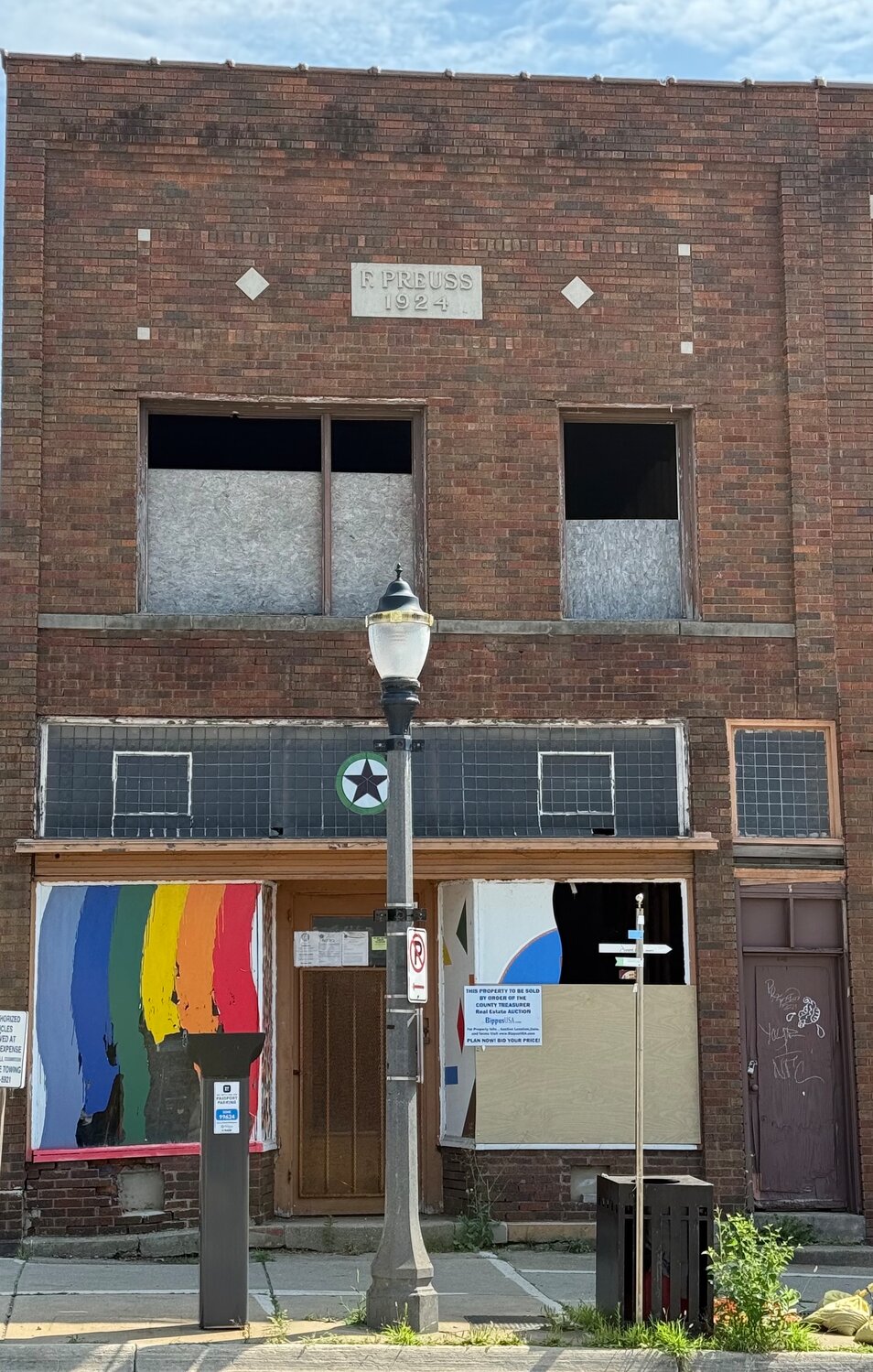
Constructed in 1875, the building, at 308 E. César Chavez Ave. in the heart of Old Town, was extensively remodeled in 1924 by German immigrant Frank Preuss, Rick’s great-grandfather. For years, it housed the Star Market, a meat and sausage market founded by Frank.
“Those front windows, back in the day, were originally used for the display of meats, and the bottom surface was glazed tile that they would put ice on,” said Rodney Preuss, 79, Frank’s grandson.
Now, one of those windows has been painted over, and the other only partially boarded. Below the stained-glass star that once characterized the market are notices declaring the property unsafe and ordering its owners to either fix or demolish it. Like many historic buildings in Lansing, such as the Glaister House at 402 South Walnut St., years of neglect have left the property derelict.
The building appears in the Ingham County Land Bank’s August auction. The land bank acquired it in a tax foreclosure against Cesar Place LLC, whose records list Adam Brewer as the resident agent. Brewer could not be reached for comment.
New owners would have to “immediately” submit construction documents and quickly begin working to make it safe to avoid demolition, mayoral adviser Scott Bean said Tuesday. Otherwise, they have to demolish it quickly, or the city will do so and bill them the costs.
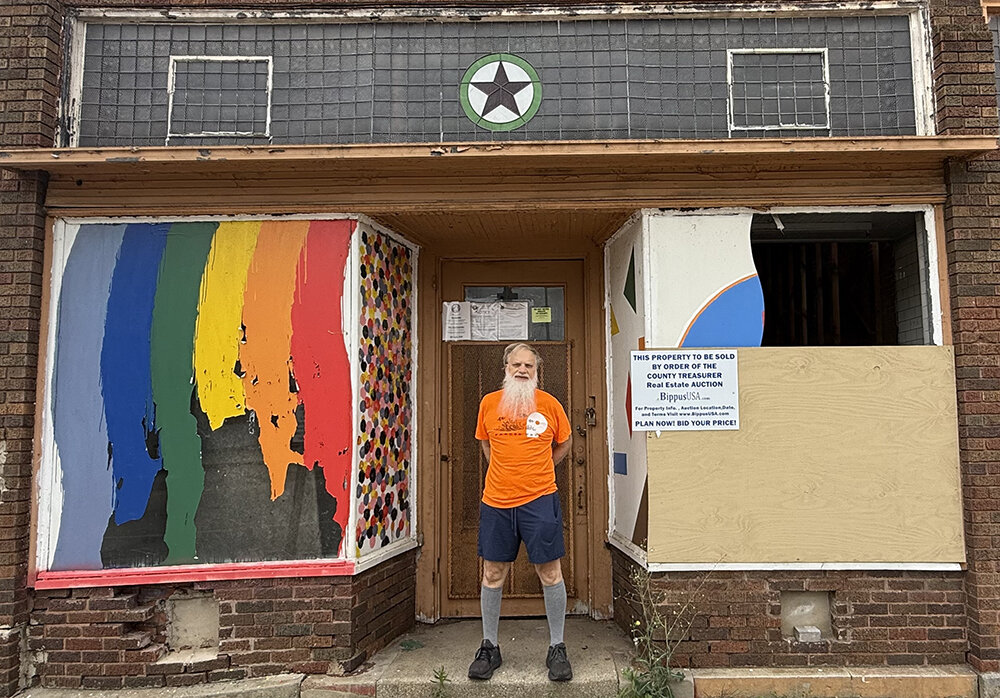
Rick Preuss never owned the building, but he did make a last-ditch effort to save it at the Feb. 24 City Council meeting, where he called it one of the few remaining properties left in Old Town “that looks the way Old Town looks.”
“I mean, we’re the old town. That’s our poster child,” he said in an interview last week. “We are the old town of Lansing, and that’s one more building that we could salvage with financial help.”
The building’s most recent owner, Adam Brewer, did not respond to requests for comment.
Just across the street from the Preuss Building is the Michigan Historic Preservation Network, where former director Nancy Finegood worked for 17 years. She said she has been concerned about the building’s fate for a long time.
“It’s a beautiful building, and its place on the block is critical,” she said.
The block was singled out in the National Register of Historic Places nomination form that led Old Town to be designated a historic district in 1976. It is described as “characteristic of the non-descript American commercial style which prevailed during the building boom that followed World War I.”
But since Old Town is not locally designated as a historic district, she said, its properties are not protected from demolition. That motivated her to ask the preservation network’s board to help save the building, though the board declined to do so.
“Since Old Town is not a local historic district, anyone could build anything there. So, they could have built a house, or something modern or ugly,” she said.
Designating a district or property a local historic district, such as the Cherry Hill neighborhood has been designated, is a difficult process involving the Historic District Commission and the City Council. Most recently, the commission requested in 2024 that the City Council approve a study committee on the former Eastern High School building, according to Mayor Andy Schor. The Council never acted on the request, and the building was demolished.
In 2017, Absolute Gallery owner Kathy Holcomb also tried to save the building.
“I started calling the city in 2017, trying to get them to do something,” she said. “The upstairs windows, in all my time in Old Town, had never been boarded up, so they’d just been open. It was just sitting there, and I never saw anyone in it.”
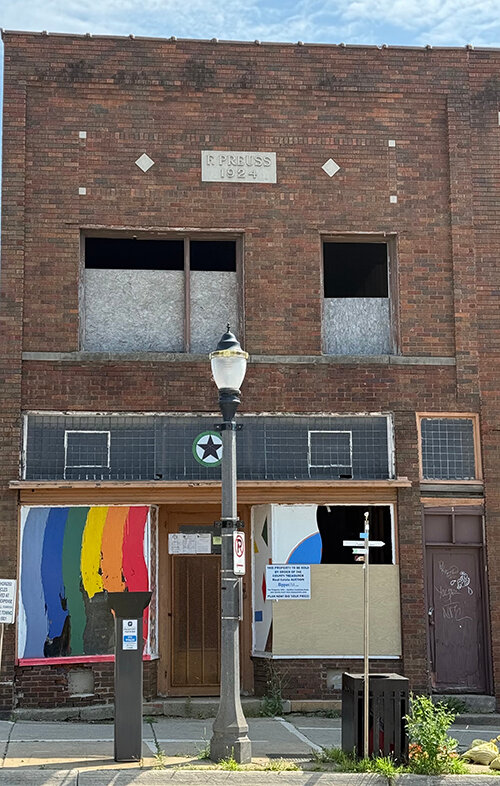
She mentioned the building’s inclusion in the historic district application, saying “we’re going to lose our past” if the building is demolished. But notably, she cited its demolition as characteristic of Lansing’s treatment of historic buildings.
“Historically, Lansing tears anything this cool down,” she said. “You go to big cities all over the world, even small cities, and they preserve the past and work within the architecture of buildings from the past. But you come to Lansing, and you don’t see any cool old buildings.”
While Lansing has had a number of successful historic rehabilitations — including the complete interior remodel of 1221 Turner St. by the late John Sears, which Rick Preuss called “an impeccable, fantastic job” that “proved the point” that historic remodels were possible — it has also lost many historic buildings to the “Make Safe or Demolish” process, by which the owner of a dilapidated and unsafe property is ordered to either bring it up to code or see it destroyed.
In a statement, Mayor Andy Schor said the Preuss Building entered the process after “complaints from near-by property owners, residents, the Old Town Commercial Association, and members of the City Council.” He said the property has “significant structural decay” and has accumulated drug paraphernalia and trash as well.
“Property owners have a duty to keep their buildings in a safe condition,” he said.
Schor said the city’s preference in the Make Safe or Demolish process is “ALWAYS for property owners to make buildings safe, but we need the property owner to want to make it safe.”
But a property owner’s desires aren’t everything. Rehabilitating historic structures can be expensive, especially after years of neglect, and more properties are headed for the same fate. Are there any plans to encourage upkeep — or discourage neglectful ownership?
Apparently not. Schor’s “hope” is that “the historic preservation community create a fund to purchase or restore or maintain historic buildings that are no longer used.”
“The community needs to make sure that the buildings that are no longer used do not fall into disrepair,” he said. “Otherwise we end up waiting many years, the building falls into disrepair because the owner doesn’t maintain it, and we are forced to hope that someone comes in with dollars to rehab and reuse the building so it isn’t torn down.”
“The city can only do so much using tax dollars,” he said.
Schor said funding was the main roadblock toward policy that better protects historic structures. While the city can assist owners in obtaining federal and state historic designations, which can help owners get tax credits, even those credits have diminished, he said. Both Schor and Finegood mentioned a 25% former state historic tax credit as having been a strong incentive for preservation. The credit was phased out by former Gov. Rick Snyder. It was reinstated in 2020 in a very limited capacity, with a $5 million cap.
Schor said the return of the former credit “would make it much easier to secure investments and rehabilitate historic buildings.”
Rick Preuss said tax credits incentivized him to build his own business, Preuss Pets, in Old Town. The building it inhabits required drastic renovations, for which he received tax credits. The building is just a block away from his great-grandfather’s former market.
“I always find it interesting that my relatives were in the same neighborhood,” he said. “When I walk over Busby Bridge, I always think about how they walked over the same bridge, and it brings back this weird deja vu.”
He said he knew saving it would be expensive, but that he wished the community could rally behind saving one of the oldest remaining buildings in a district that values its history.
“How do we collectively look at it and say, ‘Hey, this is Old Town’s precious resource, and how do we keep it from being demolished?’” he asked.