Proposed downtown data center focused on sustainability
Expert: If we are committed to data centers, heat donation is a better way
The heat flowing through 10 miles of pipe underneath downtown Lansing is generated by natural gas.
But come 2027, …
Expert: If we are committed to data centers, heat donation is a better way
The heat flowing through 10 miles of pipe underneath downtown Lansing is generated by natural gas.
But come 2027, Lansing Board of Water and Light customers downtown may be getting their heat from a novel source: Racks of computers lining a new data center in the city’s stadium district.
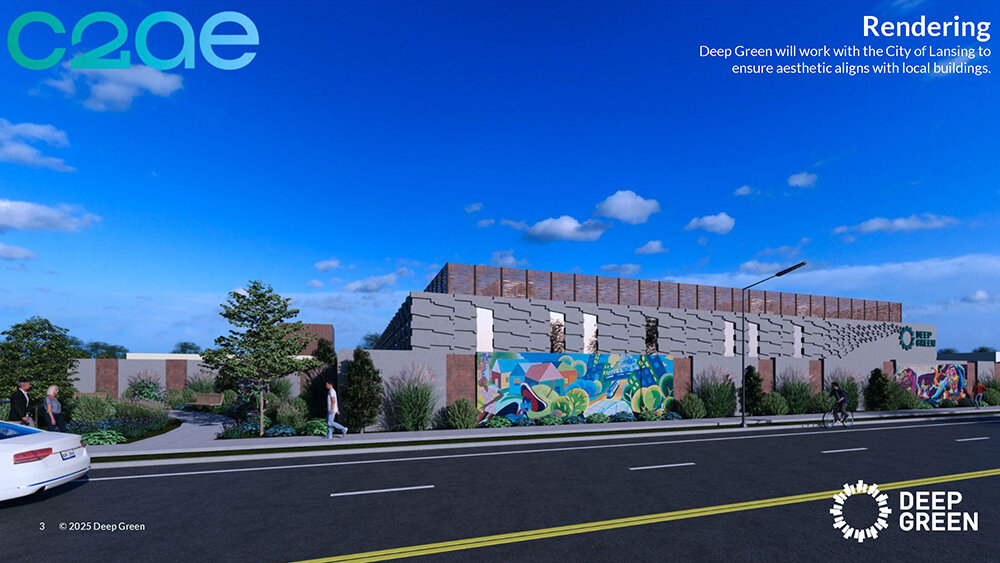
U.K.-based data center builders Deep Green are partnering with Lansing’s BWL and proposing a 24-megawatt data center at the intersection of Kalamazoo and South Cedar streets. The $120 million project, which could begin construction in March 2026 if approved, differs from most other data centers not just because of its smaller size and being deep inside a city, but because the heat it generates would go to the BWL.
That’s a win-win for Lansing, said Deep Green founder and CEO Mark Lee and BWL General Manager Dick Peffley, at a news conference Monday.
“A lot of data centers spend an incredible amount of money cooling their process,” Peffley said. “Well, we need heat — that’s what keeps our downtown heating customers happy — and they want to get rid of it, so this is the perfect marriage.”
Environmental and energy concerns around data centers have been growing along with the buildings themselves as the AI technologies continue to evolve. Consulting firm McKinsey & Company predicted in April that data centers equipped to handle AI processing would require over $5 trillion in investment by 2030. The U.S. Energy Information Administration said in June that data centers would push U.S. energy consumption to record highs.
But despite having by far the most data centers in the world, the U.S. has lagged behind the U.K. and Europe in finding uses for the excess heat that all those AI queries are generating. In Sweden, for instance, Microsoft is building a data center region expected to heat an entire large city. In the US, a Biden-era executive order to expand research into data center heat reuse was overturned this year by President Trump.
It should come as no surprise, then, that a U.K.-based company is leading the charge to bring sustainable data centers to Michigan. And it’s the BWL that made the city a perfect fit.
“We approached a number of sites across the U.S., and in BWL we found a partner that was both willing to be innovative in the way it thinks about power provision, which is extremely important to us, but was also willing to be innovative about putting a data center into its existing key network,” Lee said.
The project could save the BWL around $1.1 million because the center would donate its excess heat generated by the center, and Peffley said it would additionally offset about a quarter of the fuel the BWL burns for its heating customers and could minimize future rate increases by reducing expenses.
He also said Deep Green will pay for all infrastructure upgrades necessary to implement the heat-reuse program, keeping customers off the hook for those costs.
The Lansing project will be Deep Green’s sixth and largest yet, according to its website, but it still pales in comparison to the massive data operations making headlines elsewhere. The footprint will be less than an acre, compared to the 250-acre project causing controversy in Saline Township, and will use 24 megawatts compared to the Saline project’s 1,400 megawatts.
Peffley said that energy usage would have been “considerably higher” if Deep Green had to dispose of the heat itself, making the relationship symbiotic.
Emma Bostwick, vice president of business attraction for the Lansing Economic Area Partnership, said the project was a major win for Lansing on an international scale.
“We are competing internationally, and we’ve won this project as the first flagship for America,” she said.
Lansing Regional Chamber of Commerce President and CEO Tim Daman said he was excited to see “high-tech economic activity” along what is currently a parking lot.
The project will be more efficient than traditional data centers, according to Lee, citing a projected power usage effectiveness (PUE) between 1.03-1.17. A low PUE, a ratio of power used by a data center to energy delivered to computing equipment, signals high efficiency. Data centers average around 1.8, according to the National Renewable Energy Laboratory.
Lee said there would be an estimated 35 or more construction jobs and the new architecture of the building was designed by local firm C2AE.
Doug Bessette is an associate professor in Michigan State University’s department of community sustainability. He studies community support and opposition to large-scale renewable energy projects, and said concerns around data centers have been “a natural extension” of that work.
His feelings on the project are mixed.
“If you’re going to assume that we need to continue to build data centers because we want to pursue AI and cloud computing and cloud storage, this is the way I would recommend we do it,” he said.
He described Deep Green’s perspective toward AI and cloud computing as “fatalistic,” saying the company seems to believe the continued demand for data centers is inevitable. If that’s the case, then recapturing and reusing the heat is the best path forward, Bessette said, but he doesn’t share that view.
Bessette said he is nervous about both the potential risks of AI technologies themselves and their climate and energy impacts, so he doesn’t want to wholeheartedly support advancements in data center technology in any form.
“But if you think this is the way we’re going, then I would rather the data centers be built the way Deep Green has proposed this one,” he said.
He said he likes the project’s smaller scale and integration into an urban area, where it will generate tax revenue and keep the costs and benefits in the eyes of people actually using the center.
But he also said the sustainability focus is somewhat misleading.
“A data center will never be sustainable,” he said. “It will always require more energy to run than it could ever produce. So they’re arguing that it’s sustainable because it’s almost carbon-neutral and they’re producing heat the BWL needs anyway — well, yeah, but you also have to power the data center.”
Peffley said the BWL has the surplus energy to power the center.
Asked why he thought a project more familiar to Europeans will work in the U.S., Lee said, “It’s the right thing to do.”
“It seems entirely logical for us to be reusing the heat that we produce from our servers and our computer capacity to actually decarbonize the heat networks that we operate within,” he said. “So it is the right thing to do, and that is absolutely the starting premise that we work from.”