
Ratatouille season is upon us
“If you are what you eat, I only want to eat the good stuff.” – Remy the rat
If you squint, ratatouille is practically indistinguishable from summer itself. It’s a dish …
“If you are what you eat, I only want to eat the good stuff.” – Remy the rat
If you squint, ratatouille is practically indistinguishable from summer itself. It’s a dish you make when the tomatoes, eggplant and zucchini are accumulating faster than you can use them. Cooked together with olive oil and salt, these earthy treasures add up to something greater than the sum of their parts.
In the film “Ratatouille,” Remy the rat made a similar point when attempting to give a lesson on food theory to his hapless brother: “Each flavor is totally unique. But combine one flavor with another, and something new is created.”
So it is with the dish ratatouille, in which the diverse flavors of the mature garden do amazing things to each other as they meld together in a brine of tomato juice and olive oil. The mushy eggplant and zucchini surrender their forms as garlic and aromatic herbs permeate the whole business. Each ingredient is at its best, thanks to the presence of the others.
That film has an extra-special place in my heart because I have a son named Remy, who, like the film’s star, happens to be a culinary genius. He’s seen the movie enough times to recite many of its scenes from memory and more than enough times to be less than impressed by a recent batch of ratatouille I made, which did not glow like a rainbow as it did in the movie.
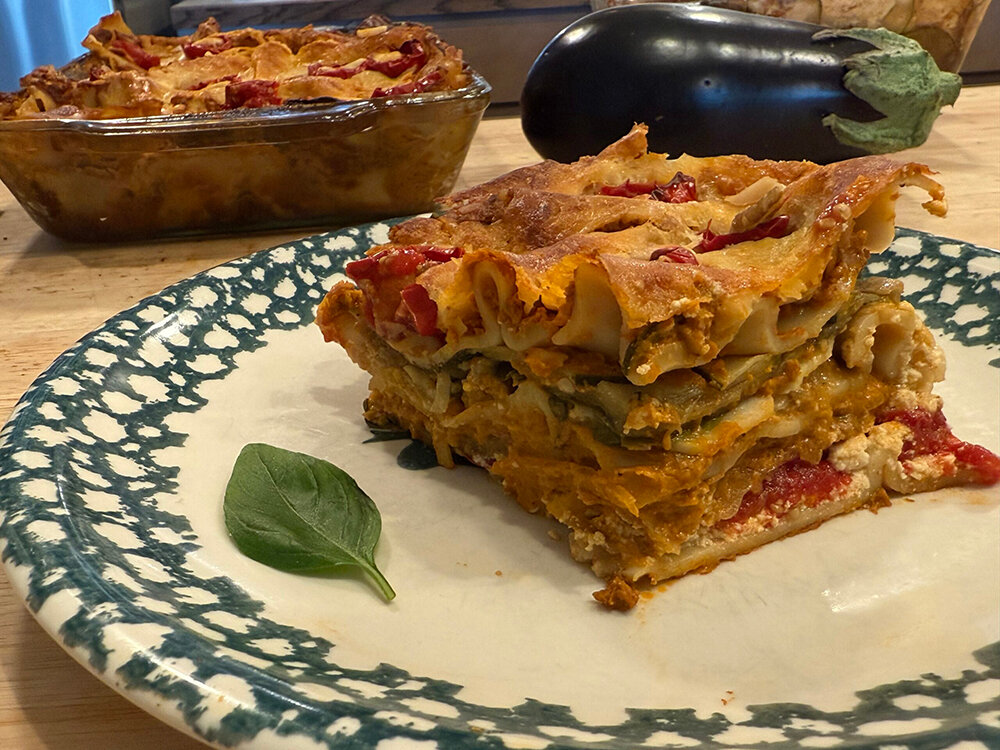
Remy’s criticism was understandable — that batch was pretty chunky. But I had an excuse. It was destined to be a sauce, not built for looks. As soon as it cooled, I planned to liquify it into a pinkish-orange slurry that goes well on pasta, pizza and on its own as a salmorejo-like soup. Liquified ratatouille freezes particularly well and is arguably the most versatile and useful form of ratatouille. I assured Remy that when it came time to construct my masterpiece, a double-ratatouille lasagna, I would use the mandolin to make perfect slices.
I call it double-ratatouille lasagna because it requires making two batches of ratatouille: a sauce batch like I mentioned above, and a batch of thin-sliced ratatouille components to layer in with the noodles, sauce and cheeses.
To my relief, Remy was impressed with my ratatouille lasagna. He marveled at its hybrid nature, representing equal parts French and Italian cuisines. While double-ratatouille lasagna is a way to enjoy the fleeting moments of summer, having ratatouille sauce in the freezer will allow you to make a damn good lasagna all winter long. And if that doesn’t capture the dual nature of summer — a time to enjoy the sunshine and squirrel some away for later — I don’t know what does.
If you are what you eat, then this time of year, I’m ratatouille.
Ratatouille
Here’s a recipe for the most ordinary, average form of ratatouille. Consider it a starting point. I’ve listed the principal ingredients in equal parts, but the reality is that you can use whatever you have, in whatever quantities you have. If you only have one eggplant, don’t put off the recipe or go shopping. Just make it with whatever’s available. That’s the true spirit of ratatouille.
Ingredients
3 cups zucchini slices
3 cups eggplant slices
3 cups tomato, sliced or chopped
1 large onion, minced
1 large bulb of garlic, peeled and
sliced
Fresh herbs like thyme, rosemary
1 cup olive oil
2 teaspoons of salt
Preheat the oven to 350 degrees. Layer the ingredients in a deep-dish pan, alternating so it’s more of a mixture than stratifications. Add the salt and olive oil, cover with foil or a tight-fitting lid and bake for 90 minutes. You can leave it in the oven for hours to keep it warm until it’s time to eat.
Liquid ratatouille
Make a batch of ratatouille, heavy on the tomatoes if possible. Let it cool, then liquify it in the blender.
If you want the smoothest sauce possible, peel the eggplant and zucchini prior to cooking.
Frozen in freezer bags, the sauce will last at least until the following summer.
To serve liquid ratatouille as a salmorejo-like soup, mix it with some heavy cream or serve with a dollop of crème fraîche. Garnish with chives, basil or parsley.
Double-ratatouille lasagna
In the winter, when fresh ratatouille ingredients aren’t available, you can make a simpler version of this lasagna by skipping the raw vegetables and simply layering in sauce, noodles and cheese. It’s still completely amazing.
Ingredients
Liquid ratatouille
Lasagna noodles
Ricotta cheese
Grated mozzarella cheese
Sliced ratatouille ingredients:
zucchini, eggplant, tomato,
onion, garlic, herbs
Preheat the oven to 350 degrees.
Ladle enough sauce into a deep baking dish to cover the bottom. Add a layer of uncooked lasagna noodles, followed by another layer of sauce, a layer of ricotta, layers of ratatouille ingredients, a layer of mozzarella cheese and another layer of sauce. Repeat this as many times as your ingredient quantities and pan depth allow.
Cover and bake for 90 minutes. Remove the cover for the final 15 minutes to melt and slightly brown the cheese on top. Serve while still warm.
Related Articles

Babe’s Corner reels in shrimp and lobster rolls
It’s hard to find a good lobster roll in the area. The few restaurants that serve them only do so for a limited time. One of these places is Babe’s Corner, which recently moved into the downtown …
Sunrise Chinese Food & Sushi replaces Apple Jade in Frandor
Before opening Sunrise Chinese Food & Sushi in Frandor, Feng Yang operated a similar restaurant in New Jersey.
Arana Yang, translating for Feng, said he was interested in bringing his …