Remixing reality
When Lansing artist Chelsea Roberts started the Lansing Collage Club in May, she didn’t know what the response would be. She invited ten close friends, just to avoid embarrassment.
Over 30 …
Lansing Collage Club Art Show
Hooked
3142 E. Michigan Ave., Lansing
Opening reception
6-9 p.m. Wednesday, Dec. 10
Art show at Hooked uncorks Lansing collage culture
When Lansing artist Chelsea Roberts started the Lansing Collage Club in May, she didn’t know what the response would be. She invited ten close friends, just to avoid embarrassment.
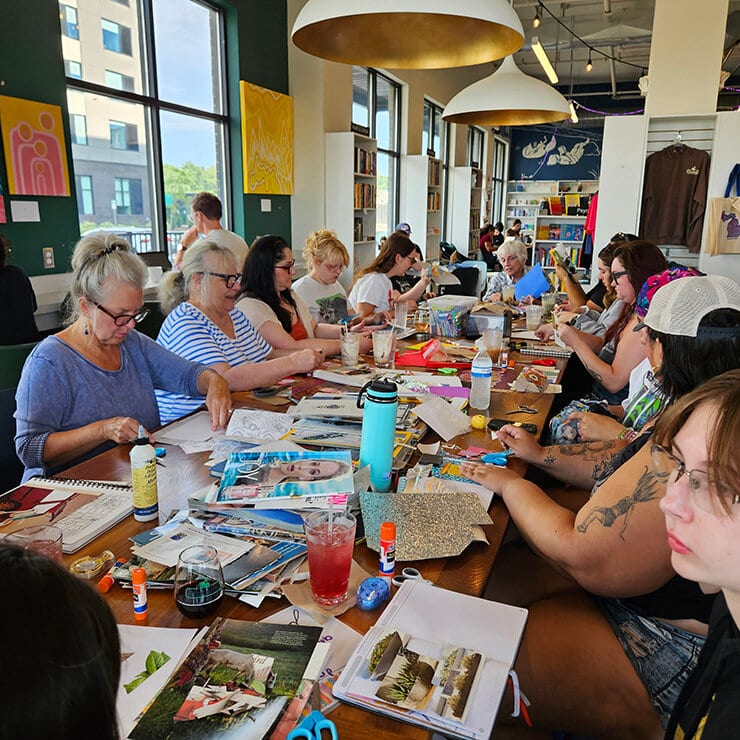
Over 30 people showed up, and they kept on showing up, in ever greater numbers, month after month.
Who can pass up a chance to take the world apart and put it back together again, with no adverse consequences?
The first-ever Collage Club show at the Hooked bookstore/wine shop/coffee shop, with an opening reception tonight, is the result of seven months of feverish activity at an ever-expanding table.
What makes collage different from other art forms?
“You can remix your reality into a whole new story,”
artist Cheyanne Britten said. “I love it that you can create a story or make a statement using items that already exist in this room.”
Dre Cuellar, another contributor to the show at Hooked, expressed it more mad-scientist-ly.
“Collage actually gives you a peek into a person’s brain,” she said. “It’s the perfect way to see how they actually visualize things.”
The show will feature work by 20 artists, working in digital media as well as traditional paper and fabric, and one or two pieces that were collectively created by the whole club.
Roberts is particularly pleased that many of the artists are exhibiting their work for the first time.
The fun of using what’s laying around, instead of painting or drawing from scratch, makes collage less intimidating than painting, drawing or sculpture.
“What makes it special is that a person at any level of artistry can make something so cool,” Britten said. “You can grab scraps from anywhere.”
Roberts makes a point not to guide artists one way or another. “You just show up and you make,” she said. “You have your own point of view. You have to jump in and figure it out — and they do. In the past eight months, I’ve seen several artists go from ‘I don’t know what this is’ to ‘I’m framing this and hanging it up.’”
Roberts has been conducting mad surgery on printed matter since high school. She was both fascinated and repelled by slick fashion magazines like Vogue and Vanity Fair that her mother left lying around the house.
Emaciated “heroin chic” models and their over-the-top accessories were an early target. In an untitled 2010 collage, she draped a bloody vignette of a wolf devouring a lamb (clipped from National Geographic) over a reclining, ultra-chic Dolce & Gabbana model.
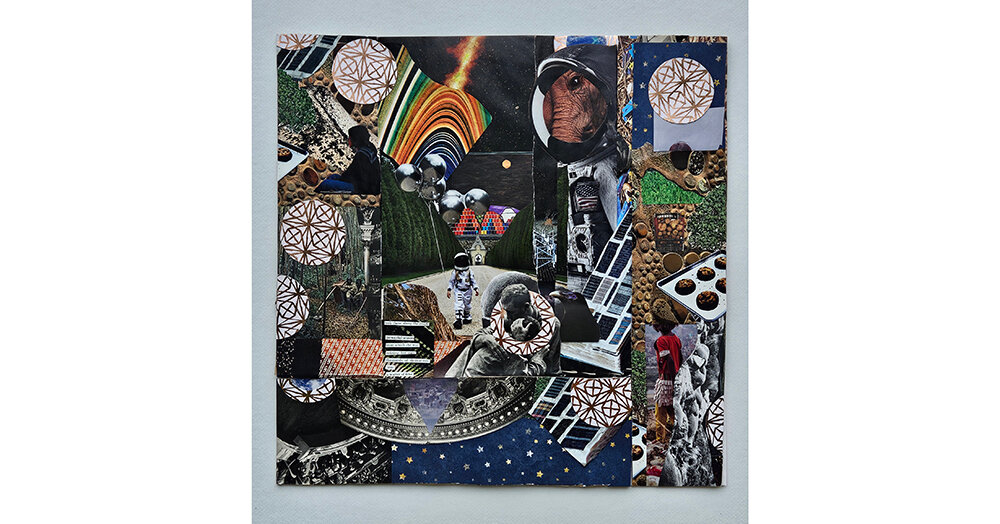
Her more recent work, like “Space Girl” in the Hooked show, aims for rich visual density, rather than jumbling two or three elements together for shock value.
“I want it to feel like you’re looking at worlds within worlds,” she said. “I hope someone would want to get closer to it and look at it again and again because they would find more different things going on.”
Unique among the arts, collage enjoys both wide amateur appeal and high critical prestige. Roberts loves the work of Detroit collage artist Judy Bowman and was blown away by a recent exhibit of Bowman’s work at the Flint Institute of Arts, along with collages by fellow artist Romare Bearden. She was also influenced by the playful, genre-bending work of Ray Johnson, the Detroit-born, New York-based collage artist who helped shape the Pop, Fluxus and conceptual art movements of the 1960s and 70s.
While visiting a friend in Chicago a year ago, Roberts went to a monthly collage meet-up there and got the idea to start a similar club here.
Hooked was the perfect venue.
“I was craving that coffee shop vibe,” Roberts said. “It fits with that 1960s protest art scene we think of with collage — let’s get together, make art at a big table, drink coffee, drink wine, meet interesting people.”
All the sessions at Hooked have been well-attended. The first hour is the busiest, with a bit more breathing room after 7:30 p.m.
Roberts said the age range is “all over the place, from college-aged people in their 20s to people like me in their 30s and 40s to retirees.”
“It makes it very lively when you put two little old ladies down at the end with the 21-year-old punk rocker and you just see what happens,” she said.
“I have such a good time at the club,” Dre Cuellar said. “I try to go early to get a good seat. It reminds me of when I was a kid, making home-made posters for a boy band.” (The band was One Direction, if you’re curious.)
Cuellar doesn’t identify herself as an artist. “I usually express more of myself through makeup,” she said.
Collage is a handy outlet for her admitted habit of “hoarding” her makeup packaging.
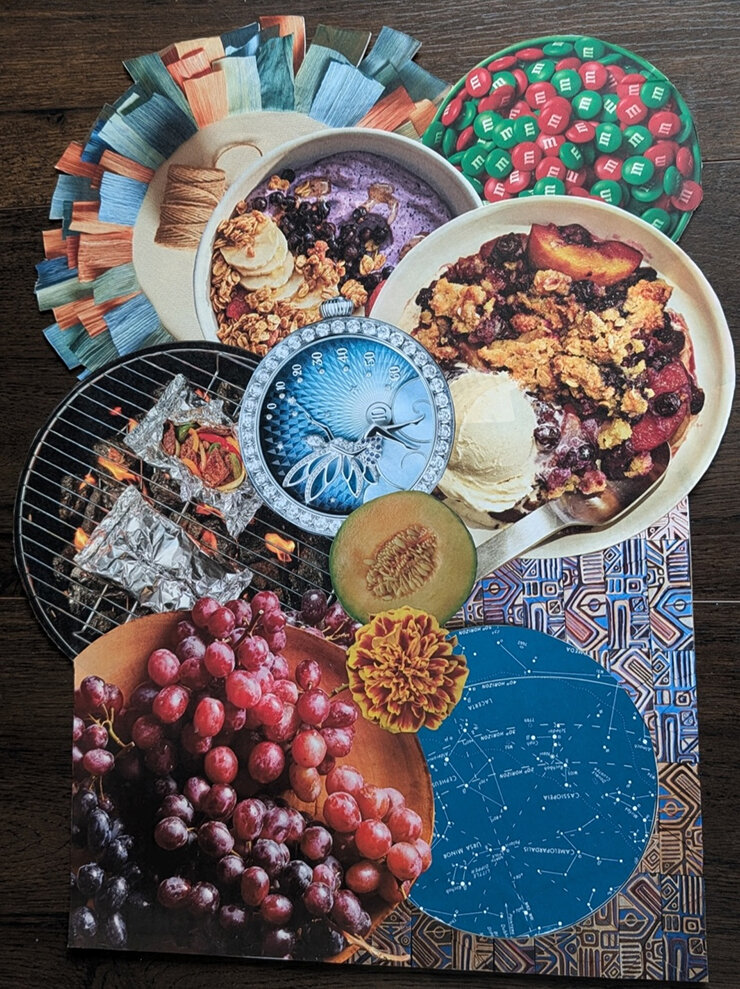
“When it’s too pretty, I have this problem of not wanting to throw it away,” she said.
For her first exhibited collage at Hooked, Cuellar chose something more serious. At the young age of 25, she is a cancer survivor. Her piece is a mélange of quotes, QR codes and graphics highlighting resources for people who have survived cancer.
Cuellar often goes to the Collage Club with Britten, a Lansing-area artist who works in painting, digital art and fabric art as well as collage.
“Keep On Walking,” one of two pieces Britten is showing at the exhibit, features a clunky yet cheerful looking robot.
“At times I felt alone on my path as an artist,” Britten said. “I’ve always been encouraged to keep walking, even in darkness.”
She enjoys the process of collage as much as the result.
“I kind of feel like an animal when I’m collecting pieces for a collage, looking for bits and bobs, shiny things, clippings, random stuff I can remix into a story,” she said.
Cuellar calls herself an artist, while Britten shies from the label. Roberts loves when the Collage Club, and the art show at Hooked, blurs the distinction and draws newcomers into the fold (and cut and glue).
Although she has lived most of her life in Lansing, Roberts spent a few years living in Austin, Texas and Seattle, Washington, where there is a lot more art “infrastructure.”
She was “devastated” by the recent closing of the Lansing Art Gallery (where she was on the board), but she admires the resilience of the local art community.
“We don’t have that much investment, but there are some really talented and creative people in Lansing who are just hiding in plain sight,” Roberts said. “I’m reminded of that every month for three hours, when I get to see people working and doing these interesting things, just from the spirit of wanting to do it. They aren’t professionals, but many of them could be.”