Riverwalk’s ‘Little Women’ mixes feminist themes with coming-of-age tale
Some might say “Little Women” was Louisa May Alcott’s little social rebellion. Alcott grew up in Concord, Massachusetts, with her famously transcendentalist parents, who regularly …
“Little Women”
Nov. 13-16
7 p.m. Thursday
8 p.m. Friday-Saturday
2 p.m. Sunday
Riverwalk Theatre
228 Museum Drive, Lansing
(517) 482-5700
riverwalktheatre.com
Some might say “Little Women” was Louisa May Alcott’s little social rebellion. Alcott grew up in Concord, Massachusetts, with her famously transcendentalist parents, who regularly rubbed elbows with the likes of Henry David Thoreau and Ralph Waldo Emerson. Although the 1868 novel has traditionally been considered “quiet reading” for young women, with its relatable tale of American family life, Alcott provides an alternative to Victorian gender norms through the (semi-autobiographical) character of Jo March and her friend Laurie (Theodore Laurence).
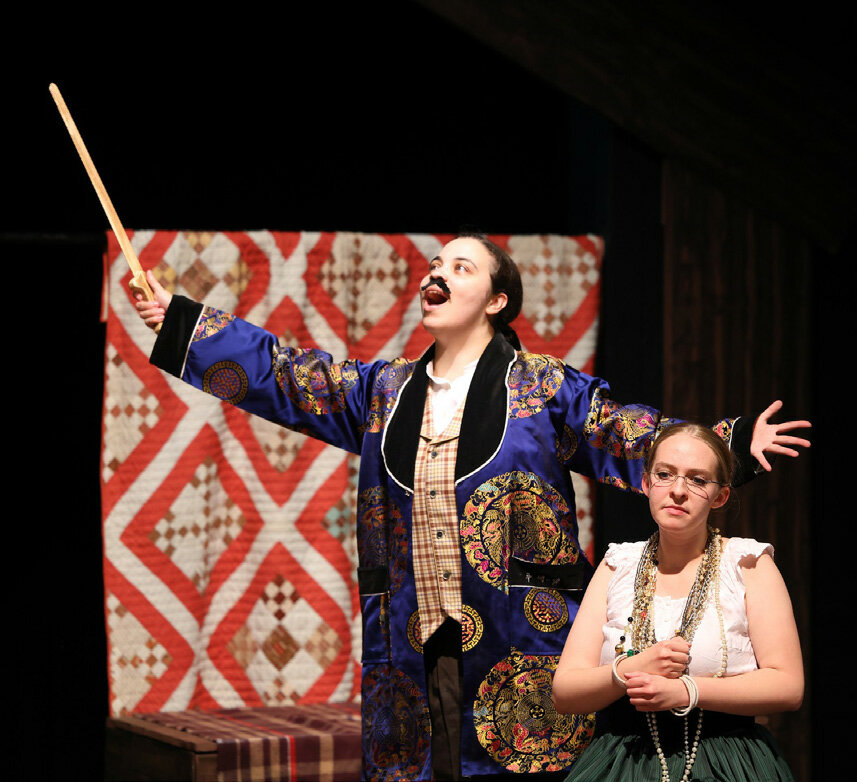
Playwright Kate Hamill’s retelling of this classic story sits squarely in between modern academic discourse — which views the novel through the lens of strong feminist themes with lesbian, non-binary and transgender interpretations — and a well-worn coming-of-age story. This Jo wears pants at home, swears, whistles and swordfights. On the other hand, she’s also portrayed as self-pitying and impatient. As her family life evolves, she’s stubbornly locked in a childlike inertia, throwing petulant glances at the theater lights, stomping her foot and bemoaning how nothing meaningful is happening in her life. She knows she doesn’t want to embody society’s version of a virtuous woman, but she doesn’t know what kind of woman she really wants to be, and she intends to punish everyone until she figures it out.
Fan of the novel and movie adaptations that I am, I was ambivalent about Riverwalk Theatre’s production. While we’re told that Jo is adventurous, fiercely independent and self-guided, actress Anna Hill’s Jo seemed trepidatious and immature. While the homey set and the oval-shaped cameo at the top of the stage gave this production a traditional feel, the overly loud ticking clock audio and Beth’s twirling fever dream/death sequence gave one scene in the play an out-of-place post-modern spin. It was as if this production wasn’t sure what it wanted to be.
Diction was an ever-present issue on opening night, with three notable exceptions: Heath Sartorius’ Laurie, Sandra Thomasson’s Aunt March and Betsy Karinen’s Marmee, who were excellent in their roles. The line delivery improved, however, when actress Rachael Steffens’ Amy March matured into the (dislikeable) adult version of her character.
One has the sense that with another performance or two under their belt, this would all come together nicely. You can always rely on Riverwalk for high production value — its inventive set designs and costuming never disappoint. This production seemed to have an innumerable number of scene changes, but the set adjustments were very quick and seamlessly executed. If you’re in the mood for a relatable and emotionally engaging story about the importance of family and self-knowledge, this one might be for you.