Second ‘No Kings’ protest features local activists, national focus
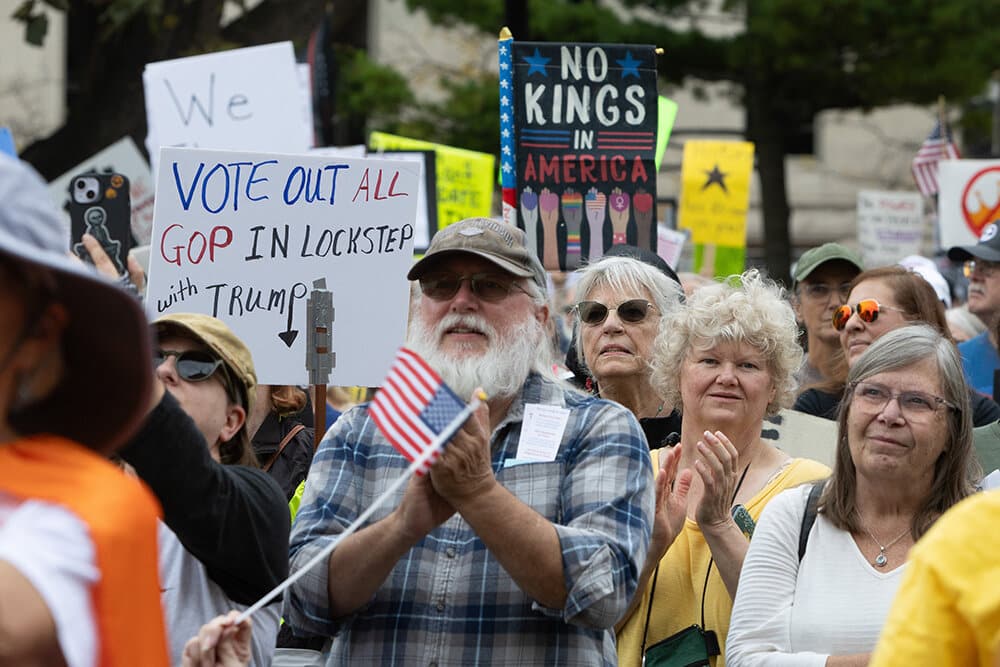
Protesters, some wearing inflatable frog suits, filled the Michigan Capitol grounds on Saturday with one of the largest anti-Trump rallies this year. The Lansing crowd mimicked others around …
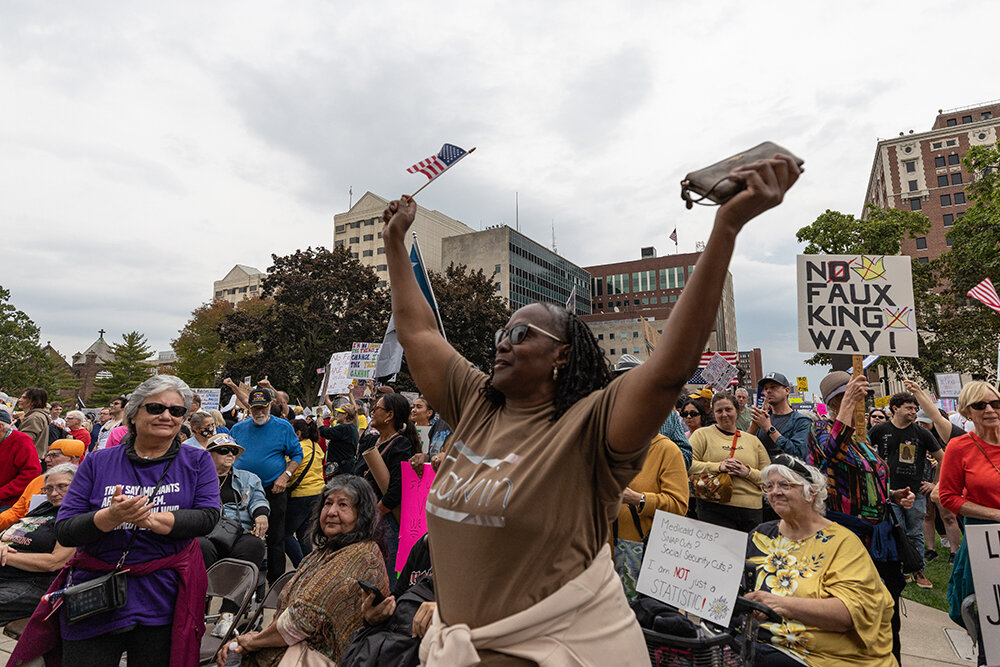
Speakers encourage protesters to get involved with other local activist groups
Protesters, some wearing inflatable frog suits, filled the Michigan Capitol grounds on Saturday with one of the largest anti-Trump rallies this year. The Lansing crowd mimicked others around the nation, with some wearing inflatable frog costumes to add some whimsy to the latest protest.
It was the second “No Kings” protest this year, and it followed a series of decentralized, nationwide protests with a presence in Lansing.
The first, a Feb. 5 protest organized by 50501, originated from a Reddit post suggesting a coordinated protest at every state Capitol on 2/5/2025 to protest Project 2025. That event brought people from all over the state to one hastily put-together rally.
As protests grew, cities across Michigan began organizing their own iterations of the coordinated events. There were over 100 in Michigan on Saturday, organizers said, making the latest Lansing protest more locally focused as others organized in their own areas.

Anyone could see that at Saturday’s afternoon Lansing rally, where a group of mostly local speakers addressed several thousand protesters from the Capitol steps. Local political groups, such as the Greater Lansing Democratic Socialists of America and the Greater Lansing Area Labor Council for Latin American Advancement, set up booths on the Capitol lawn.
Several protesters said they came with a variety of ideas, and said they had one primary goal in mind: Get everyone linked up with a group advocating for an issue important to them.
One speaker, identifying himself only as James O., said he is a state committee member for SPARC, the Solidarity, Progress, Action and Resistance Collective. The organization was formerly known as 50501 Michigan and organized the Lansing rally in collaboration with other local groups. He explained that the roughly hour-and-a-half of speeches, a shorter timeframe than some previous rallies, was because attendees “already know how bad things are.”
James invited people instead to sign ballot petitions, join activist organizations, speak with candidates and attend educational workshops.
A Michigan State Police spokesperson said there were an estimated 3,000 attendees and no incidents were reported to police.
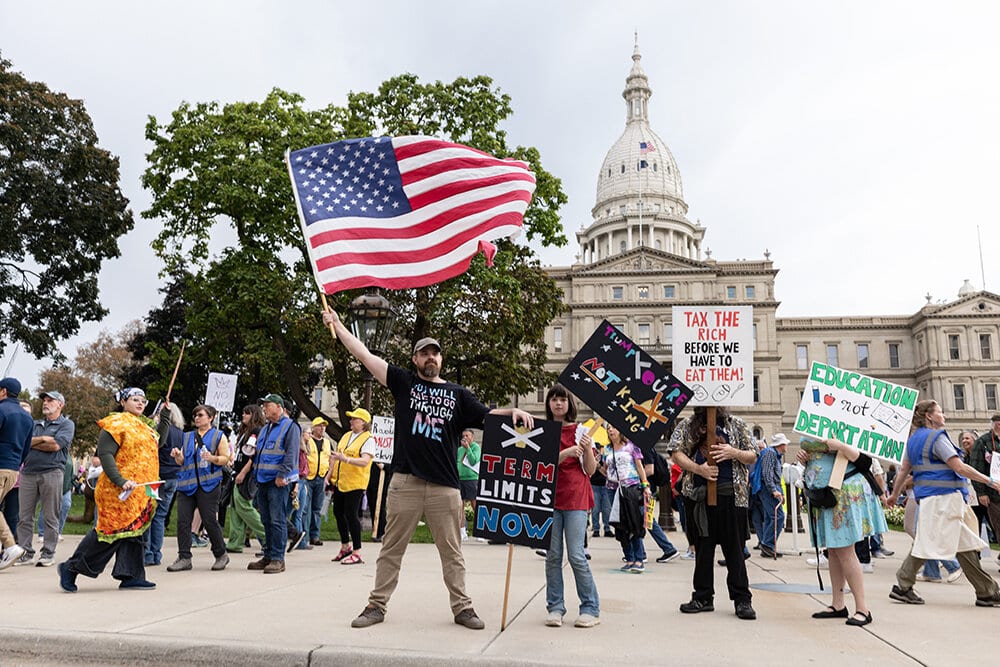
The crowd at Saturday’s Lansing protest was similar in size to one in June. Major news outlets estimated a much higher turnout overall nationally for the October protest compared to the June event. Nationally, around 7 million people protested across over 2,500 locations, according to media reports. The June rallies, which coincided with a military parade hosted by the president, brought around 5 million people.
James asked Lansing attendees to have a “productive, face-to-face conversation” with a candidate for local office, encouraging greater collaboration between citizens and politicians. One candidate, Will Lawrence, is running to represent Michigan’s 7th district in Congress a seat held by Tom Barrett, R-Charlotte.
“I’m here because this is where the people are,” Lawrence said.
Barrett said in a statement that he supported the protesters’ right to express their opinions.
Another SPARC state committee member, Jay Gibbs, said in an interview that the number of protests across Michigan “does present logistical challenges,” but that he “loves to see local communities taking up the mantle.”

Across the state, people were reporting much higher turnout than last time, he said.
“We’re really surprised by how many people came out,” Gibbs said. “And I really do think having something that is local to you that will likely be tailored to the specific issues in your community probably resonates a lot more with your average person that’s just trying to break into getting involved.”
One first-time protester was Linda Bader, of DeWitt. She said her daughter told her when Donald Trump took office that she was worried about a crackdown on LGBTQ+ rights, but she had initially been skeptical it would materialize so quickly.
“My daughter and her wife are more in tune with everything, so they let me know, and probably I doubted, that it would get as bad as it is,” she said. “But everything they’ve been worried about has pretty much happened.”
Bader added her daughter lives in Chicago, where she has seen Immigration and Customs Enforcement officers in her neighborhood.
Speakers addressed a variety of topics and emphasized the intersectionality among groups targeted by the Trump administration.
Nichole Keway Biber, an Indigenous climate activist based in East Lansing, gave a land acknowledgment and encouraged attendees to plant literal seeds.
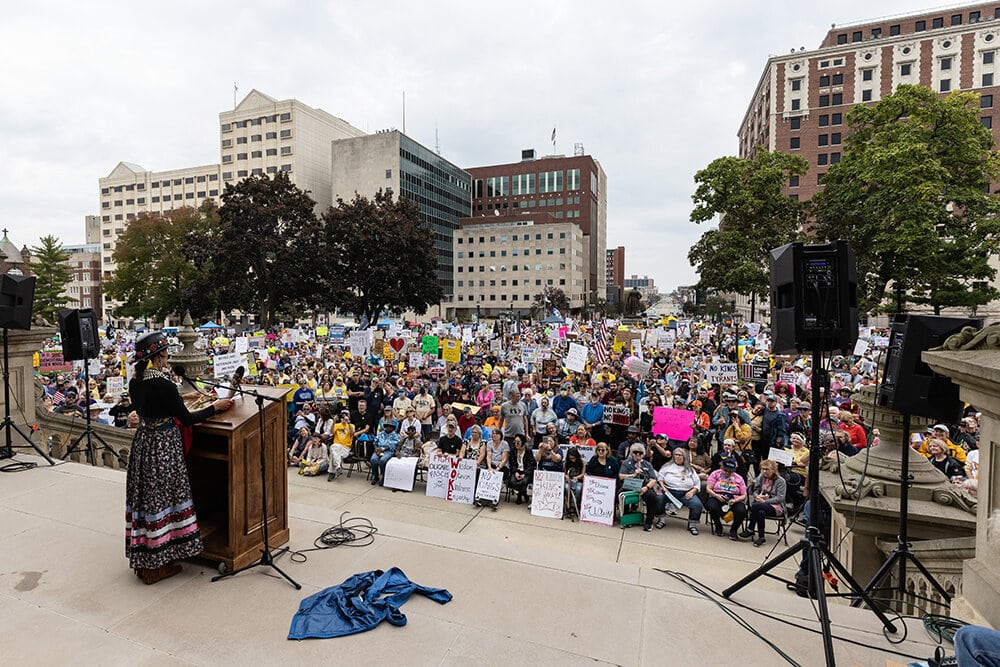
Disability rights advocates Keith and Cynthia Burton spoke about threats to social security.
Gaia Herrick encouraged civil disobedience and cooperation among activists, evoking the food and supplies brought by members of the Black Panther Party to participants during a 1977 sit-in for disability rights protesters.
“This makes an excellent example of how different communities can come together in the fight for justice for all,” Herrick said. “Eventually, the government relented, and now we all reap the benefits that civil disobedience enacted all those years ago.”
A member of Lansing for Palestine, who did not provide a name when speaking at the rally, urged attendees to be skeptical of the Trump-brokered Israel-Hamas ceasefire, which had already begun breaking down over the weekend.
Lorenzo Lopez, a local advocate for LGBTQ+ and Latino rights, called on attendees to “demand immigration reform and stop the criminalization of our own citizens and the undocumented.” He called Trump “the real criminal” and critiqued Trump’s executive order making English the country’s official language.
“I am a native-born Michiganian from Lansing, Michigan, and I am here to tell you that I come from parents who were Texans, who spoke English and Spanish,” he said. “That is who we are as American people.”
“Silence is not an option,” Lopez shouted. Then, he repeated himself as he walked down the Capitol steps, his voice becoming inaudible as he moved away from the microphone. But the symbolism was evident as thousands repeated his inaudible call.
Sam Nelson, Greater Lansing Democratic Socialists of America co-chair, has been involved since the first 50501 protest and has watched the movement grow. He said organizers are beginning to see rallies “as one component of resistance.
“This event’s about mobilizing,” he said. “It’s about getting thousands of people out on the same day.” He said smaller groups dedicated to a variety of issues are mobilizing and, “in Michigan especially, we are seeing folks step up and realize that we all have a different role to play.”
Like other “No Kings” protests across the country, many protesters wore inflatable animal costumes and other whimsical outfits, as Gibbs said. The costumes reference those worn by protesters in Portland, who donned them to ridicule Trump’s deployment of the National Guard to the city, which he called “war-ravaged.” After Portland protester Seth Todd, clad in a frog costume, was pepper-sprayed by an ICE agent while protesting outside an ICE facility, the inflatable costumes gained traction as a symbol of peaceful protest.
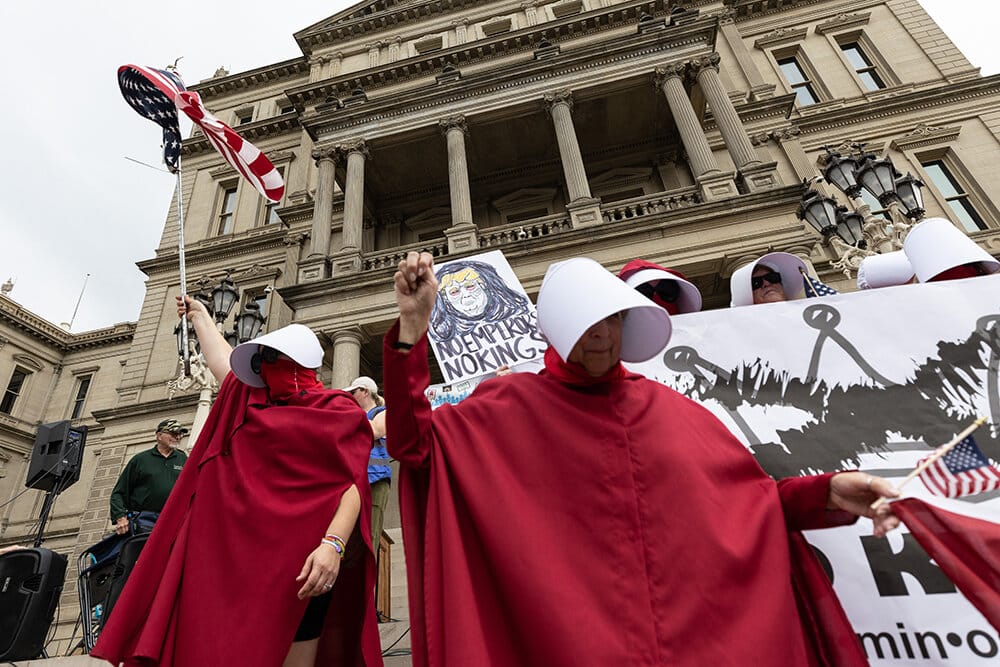
The inflatable costumes were new, but joyful protesting was familiar to Lansing residents, who organized the June “No Kings” rally as a protest carnival with circus games, stilt walkers and a drag show on the Capitol steps.
Gibbs said the aesthetic “does actively push against that rhetoric coming from the Trump administration, saying that these are unsafe events or that they’re fomenting some sort of violent rhetoric.”
“Some people may look at it and think people aren’t serious, but what it really does is disarm a lot of that rhetoric,” Gibbs said.
Aric Nesbitt, R-Porter Township, the Michigan Senate minority leader, posted photos from the protest on the social media website X that showed Lansing protesters holding signs reading “DIE NAZI SCUM” and “Do the right thing TRUMP, EAT SHIT AND DIE.”
“As expected, Lansing “No Kings” protesters brought lots signs calling for more death and violence,” he wrote. “Republicans are NOT the problem.”
Barrett said in a statement that “There is no king of the United States of America, which is exactly why people are free to protest peacefully and make their voices heard,” he said. “I defended that freedom in the Army, and I’m eternally grateful for it, even when it means the same protestors show up at cookie-cutter rallies that are funded and organized by far-left groups whose only goal is to sow division in our country.”
There were scattered arrests at protests across the country, but with a turnout of millions the event was overwhelmingly nonviolent. There were no incidents reported at the Lansing protest, according to Michigan State Police Public Information Officer Rene Gonzalez.
The White House responded to protesters’ irony with its own sarcasm.
Trump posted an AI-generated video to his social network Truth Social depicting himself wearing a crown, in a fighter jet emblazoned “KING TRUMP,” dumping sewage on protesters. Vice President JD Vance posted an AI-generated video of prominent Democratic lawmakers kneeling to Trump, clad in a king’s regalia.
The posts make light of protesters’ claims that Trump is acting as a king by concentrating power into his office.
Some protesters flew the flag of left-wing anti-fascist movement Antifa, which the Trump administration has branded a domestic terrorist organization. Others flew the American flag, the yellow rattlesnake Gadsden flag and even the Straw Hat Pirate flag from anime series One Piece, which has become a symbol of youth resistance in Generation Z-led protests in Indonesia and Nepal.
The administration’s crackdown on far-left ideology did lead to an atmosphere of fear among protesters, several of whom declined to be interviewed by City Pulse. Some cited fears of government retaliation, and one referenced the federal government’s call for organizations to fire employees who insulted the late conservative activist Charlie Kirk after he was assassinated last month. Some photos from the protest on Reddit blur out the faces of protesters.
Organizers of the June rally worked closely with local police, even coordinating protesters’ marching route with the Lansing Police Department in advance.
No march was planned this time, but thousands still took to the streets after speeches were done, marching east of the Capitol building and over the Michigan Avenue bridge. While the march was less orderly, with many marching in the streets, it went off without incident. Cars stuck behind the protesters generally honked their support through the inconvenience.
“Whose streets?” protesters shouted. “Our streets,” others responded.
Gibbs said Monday there was a relatively small police presence at the event.
“I really think that the police did a great job of keeping people safe, or maintaining the optics of safety and security, without being heavy-handed or overreaching,” he said.
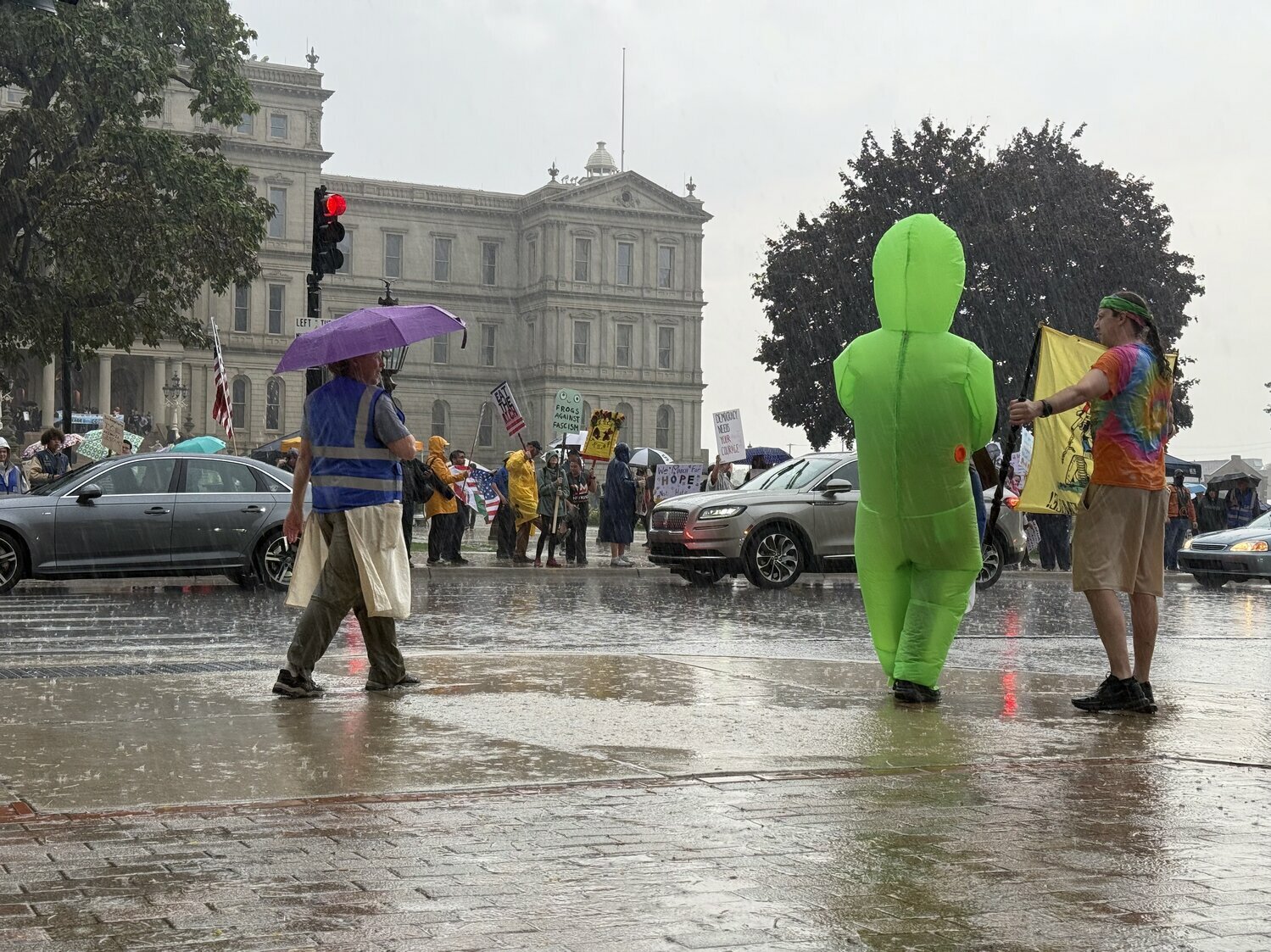
Before 5 p.m. Saturday, when some marchers had turned around at Cedar Street, rain suddenly began pouring down, defying weather reports that had indicated the weekend storms would not begin until around 6 p.m.
Protest signs became impromptu umbrellas, the marker ink bleeding down.
For some time the marchers continued, but as the rain intensified, they mostly gathered underneath overhangs and continued protesting in smaller groups.
Taking shelter with a few dozen other rain-drenched protesters, 14-year-old Finley and his mother held signs painted with the transgender pride flag high.
Despite being a transgender minor, a group that has been targeted by Trump’s executive orders since the first day of his presidency, the Lansing teen said he was protesting out of solidarity with many groups under attack.
“It’s pretty scary” to be a trans minor, he said, “but I’m mostly angry because I’m around other trans people, and I’m angry for them and for other people. I have disabled friends, and friends who are women, and I’m angry about all of it.”
“Donald Trump is doing so many things, and when you attack one group of people, you attack everyone,” he said. “When one group of people loses their rights, then they can come for any of us.”
Even as most took shelter or ran for their cars, a contingent of marchers continued to walk back to the Capitol, joined by a person in an inflatable T. rex costume, as whimsical as wet.
“Trump, Trump, go away, don’t come back another day,” they chanted.
Those with raincoats and umbrellas, and some who simply let themselves become drenched, lined up on the east side of the Capitol grounds and continued chanting to drivers — long after some of their signs were no longer legible.