Song of the stars
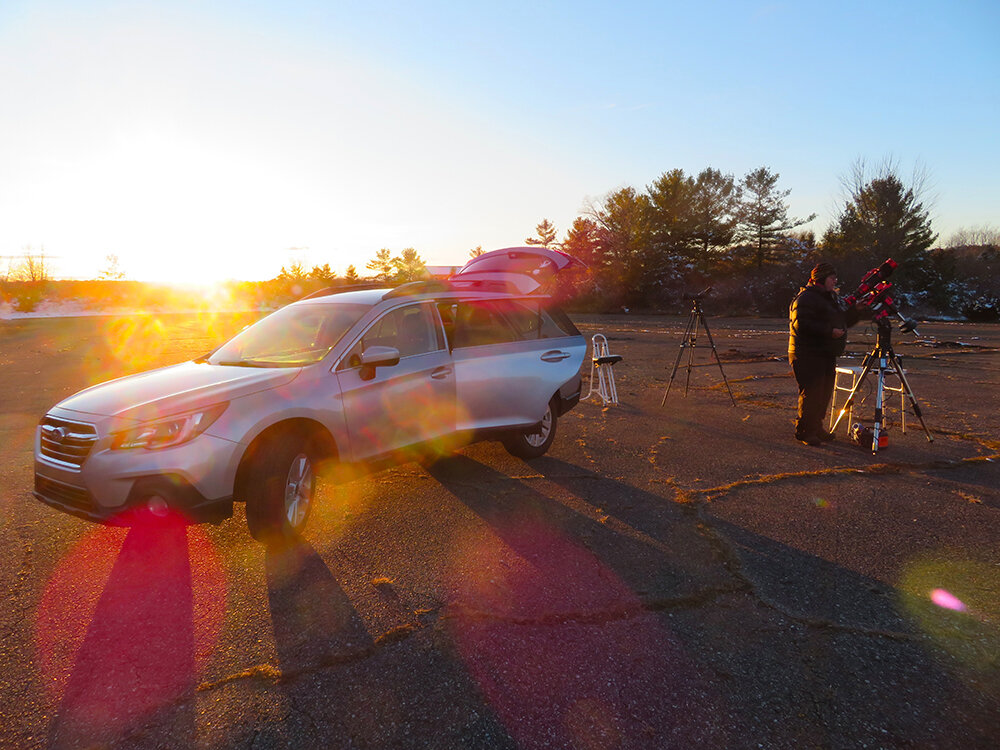
On a cold, clear Monday evening in early November, two Subarus rendezvoused in an otherwise empty parking lot at Sleepy Hollow State Park, about 20 minutes’ drive north of Lansing.
The sun …
Interstellar photography by Barb Barton
Earth photos by Lawrence Cosentino
Biologist and folk musician Barb Barton takes the ultimate voyage
On a cold, clear Monday evening in early November, two Subarus rendezvoused in an otherwise empty parking lot at Sleepy Hollow State Park, about 20 minutes’ drive north of Lansing.
The sun was doing a slow swan dive into Lake Ovid.
Shrugging off the 26-degree chill, Barb Barton dispensed with the pleasantries and started unloading her camera gear from the hatch.
“There’s something I can’t wait to show you,” she said.
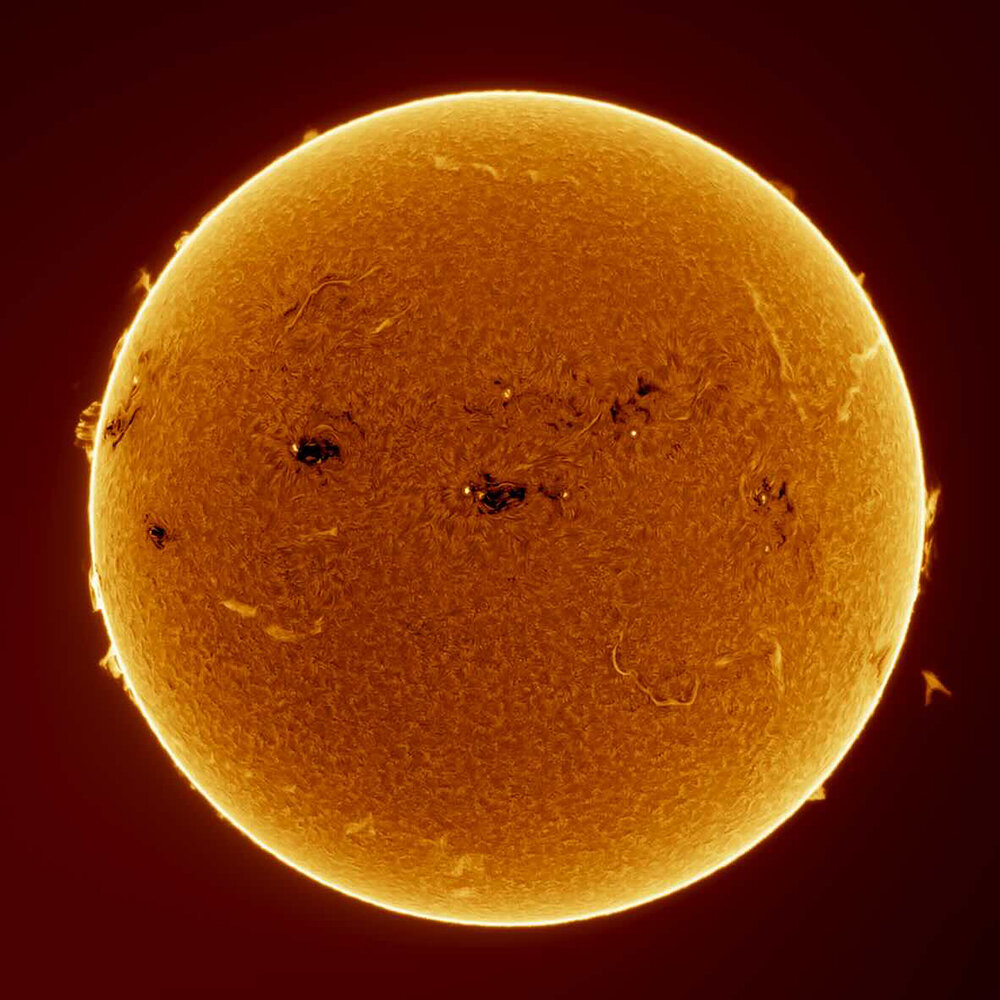
For the past two years, Barton has haunted Sleepy Hollow, from sunset to midnight or later, all year round, to capture stunning images of the sun, the planets and points far beyond.
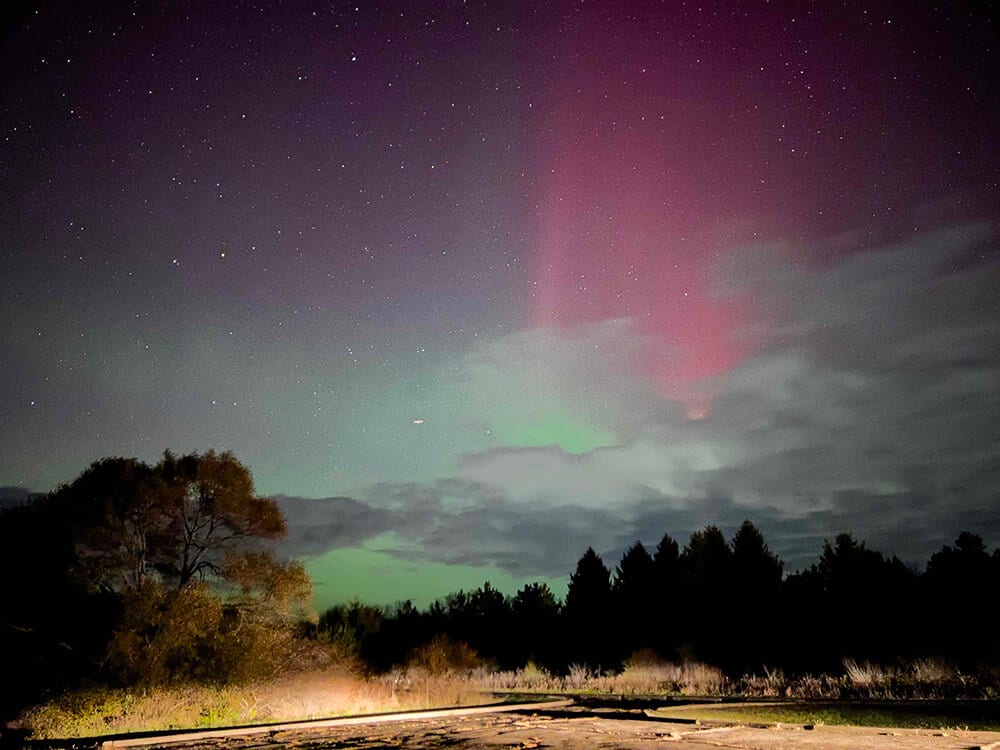
Two weeks ago, she captured graceful images of the comet Lemmon, a surprise visitor that made its closest approach to Earth on Oct. 21 and only buzzes by every 1,350 years or so. Last week, she captured a dramatic surge in the aurora borealis as it billowed over Lake Ovid.
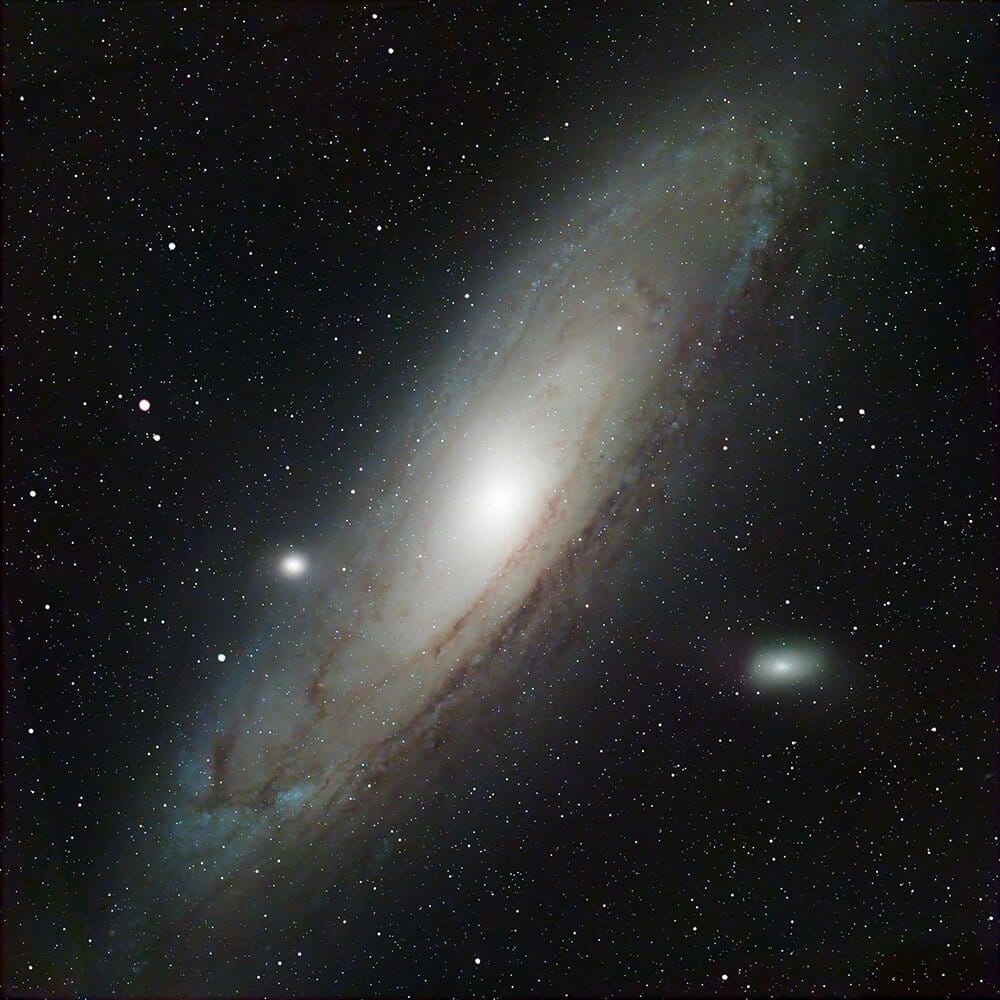
Recently, she has turned her gaze to deep-sky objects like nebulae and galaxies millions of light-years away.
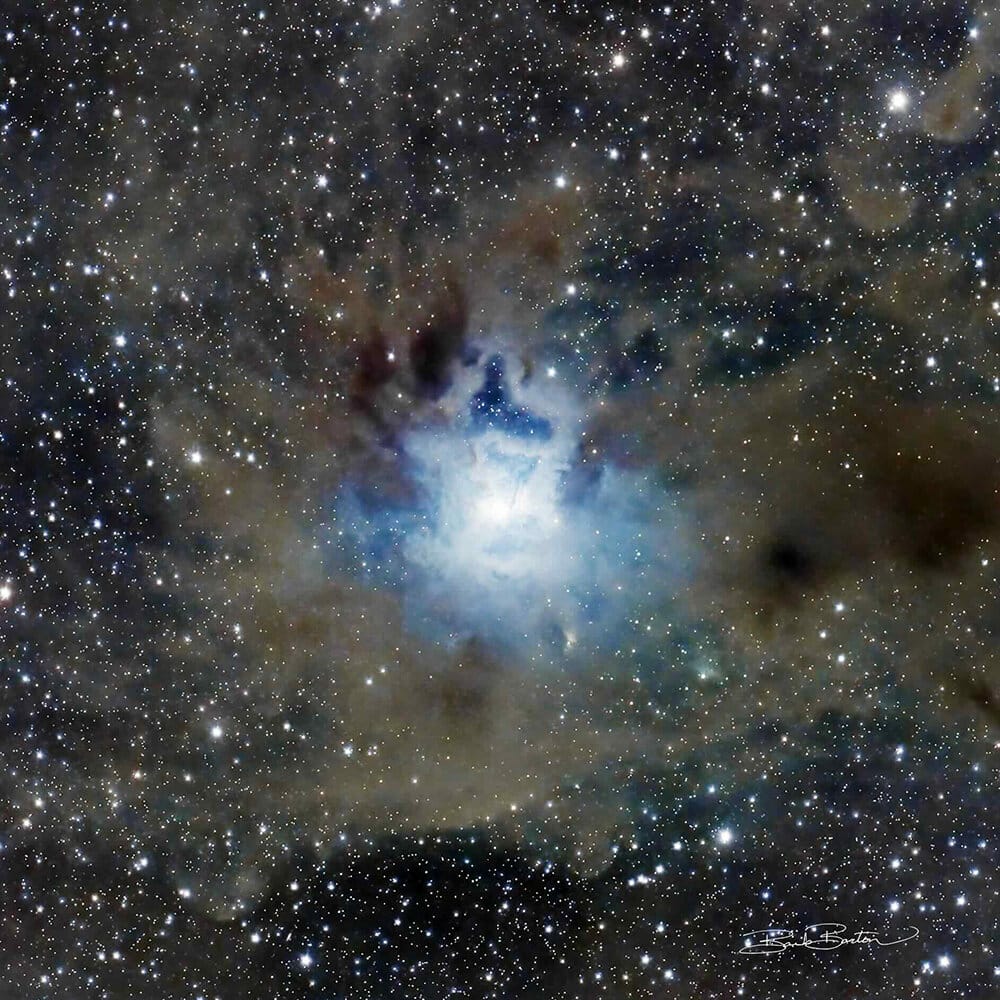
“When people see these pictures, they say, ‘Holy shit, you can take pictures like that from here?’” Barton said, with a smile.
After a lifetime of terrestrial adventures – studying wildlife and cataloguing endangered species in the wilds of Alaska, the mountains and caves of Pennsylvania, the swamps of Florida and many other wild places – she has moved to the next frontier.
“In my retirement, I’m on a quest to experience things I have never experienced before,” she said. “And also to find the wild, because there’s so little wild left.”
She pointed up.
“And what’s more wild than the vastness of space — galaxies, nebulas, the most beautiful things?”
Shooting the Dragon
Before setting up her complex camera rig, Barton set up a simple but powerful spotting scope on a tripod. She usually sets up a second telescope several feet from her camera, just to see what’s going on in the universe during the long exposure time.
A week earlier, Barton and a fellow observer noticed a light in the northern sky over the Sleepy Hollow parking lot, flashing from green to red to yellow. At first, they thought it was an airplane.
Using a telescope, they pinpointed it as Capella, the third-brightest star in the Northern Hemisphere (actually a quadruple star system), about 40 light-years from Earth, often called “the Christmas star.”
This was the object Barton couldn’t wait to show me. We took a few minutes to watch Capella twinkle over the Sleepy Hollow parking lot.
We weren’t the first to watch this dance of light. The star is believed to be mentioned in an Akkadian inscription from more than 4,000 years ago.
Once I knew where it was, I could take my eye off the scope and spot it with my naked eye.
Most stars twinkle when they get close to the horizon, but Capella really scintillates. Recently, Barton filmed Capella through her big telescope. It looked like a CD spinning under a disco light — “that, or you’re on Quaaludes,” she quipped.
“When they get below 30 degrees up, all of the turbulence in the atmosphere causes them to twinkle, but excessively so,” she said.
She pointed to the spotting scope.
“That’s how all of this started,” she said. For years, she used the scope for birding, but it was also her first window into a wider universe.
Three years ago, on a fall day, she went out birding after work, but wasn’t having much luck. She idly looked at the moon as it rose after dusk and wondered how it would look through the scope.
Her reaction was a profound “Wow.”
It’s a shock to see the craters and valleys of the moon, the rings of Saturn or the moons of Jupiter, not as they look on a computer screen or in a slick coffee-table book, but as they are now, hanging over your head, sharing space with you. You suddenly realize your shoes are barely hanging onto a small rock in a vast infinitude.
Barton tried to capture what she saw with her iPhone, but the results were unsatisfying. She started researching photographic hardware, assembled her current setup the following summer and hasn’t stopped exploring the universe since.
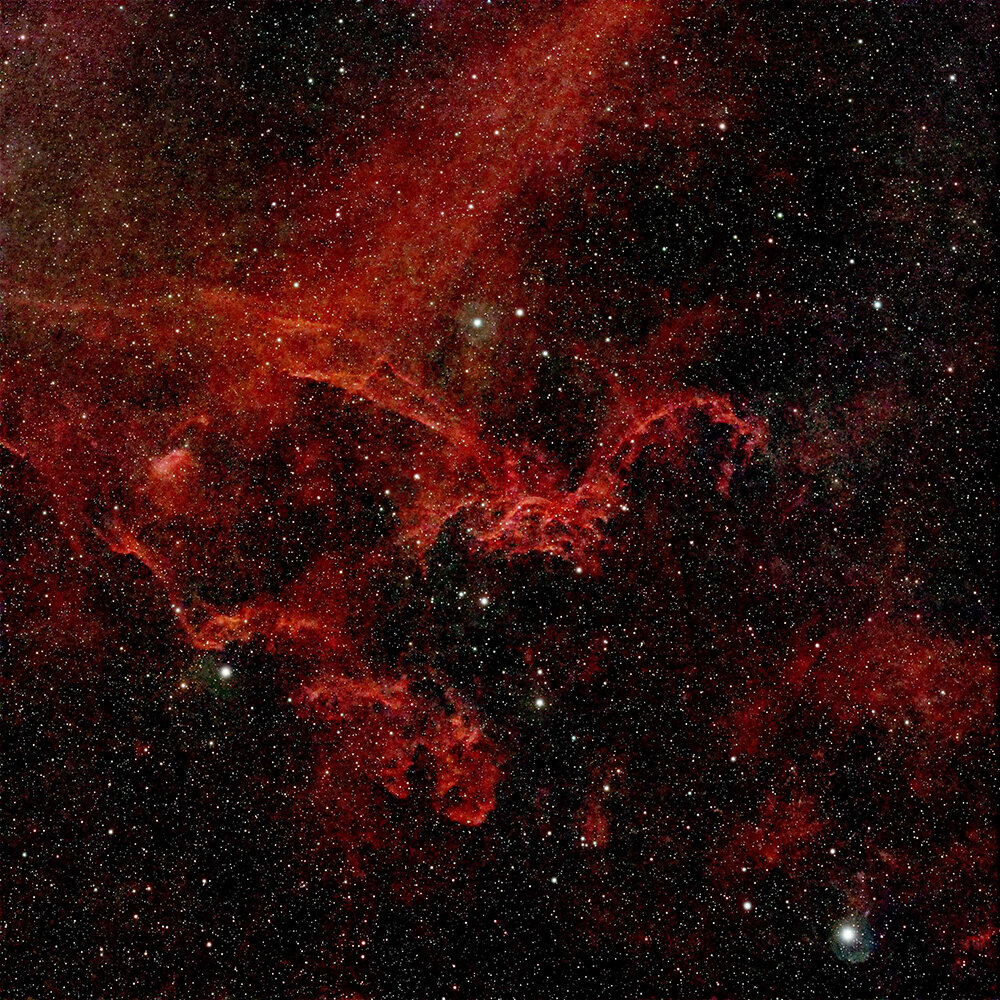
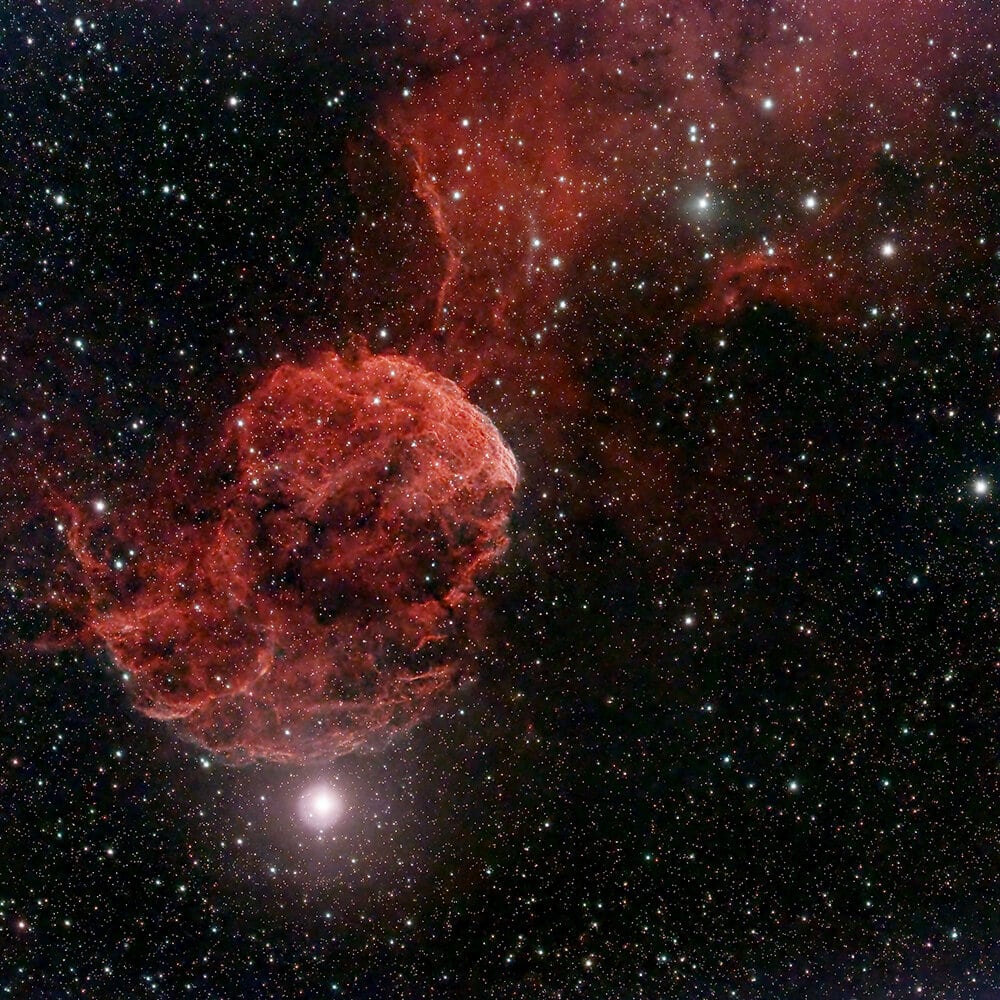
On the night of Nov. 10, she turned her attention to her “project” for the week: SH2-114, or the Flying Dragon nebula, a stunning red apparition of interstellar gas and dust too faint to see with the naked eye.
Some astronomical objects don’t live up to their names, but this one really looks like a dragon, with two flapping wings and a tail. The curvy, long filaments could be the result of gravity and magnetic forces — there are some massive stars nearby — or it could be the drifting remains of a supernova.
Taking sharp images of deep-sky objects takes superhuman patience and a lot of tech savvy. Even casual photographers know it takes a long exposure time to capture dark scenes, like a child blowing out candles in a dark room. It’s hard to hold still for even half a second to keep Billy’s face from coming out as a smudge.
Now try capturing deep-sky objects like the Flying Dragon.
“These things are thousands of light-years away,” Barton said.
It takes a long time to gather every bit of light, every delicate detail. Barton’s goal tonight was to shoot the Dragon for three or four hours, from dusk to midnight, to go toward a goal of 20 light-sucking hours total.
To keep a celestial object in focus, Barton uses a German-made equatorial mount that tracks across the sky in sync with the rotation of the Earth. Without such a mount, the stars would trace circles on the image as the Earth rotates.
“If you’re shooting deep-sky objects like galaxies and nebulae, you don’t want trails,” she said.
She has to carefully align the camera rig to the North Star, wrestling a heavyweight tripod into perfect balance.
The sweet spot is 7 degrees northeast, between the geographic North Pole (“True North”) and the north magnetic pole, which moves over time.
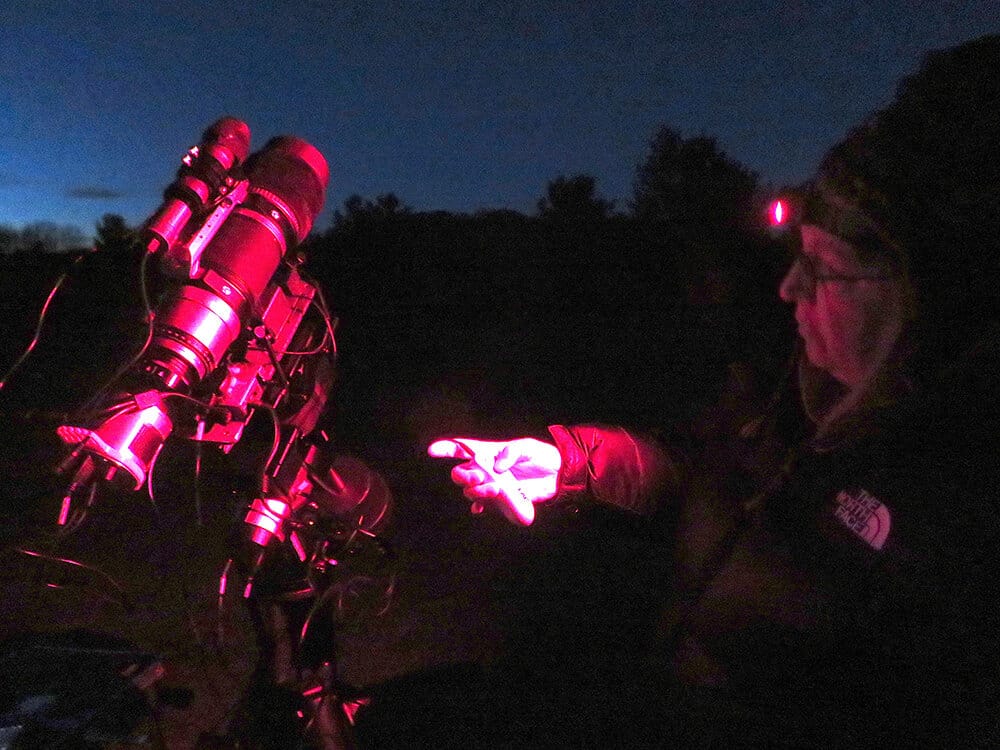
Her hands were already red in the 26-degree cold, but she calmly screwed the rig together, adding the needed filters. She fluffed out a growing tangle of wires so they wouldn’t touch one another.
“It’s called cable management,” she said.
If the sky is clear, Barton is probably out there taking pictures, no matter what time of year. In winter, by the time she packs up and leaves, around midnight or so, her puffy coat is white with frost.
The focus on her task seems to keep her warm.
“I’m never cold out here,” she said. “But as soon as I get home, get my pajamas on and go to bed, I’m freezing.”
The Curse of Sleepy Hollow
There seemed to be no end to the arcane gear Barton pulled out of her Subaru. The only thing I could identify without her help was a bag of pretzels.
Some parts of the rig have to be heated; other parts have to be cooled. Long, continuous exposures heat up the camera, so Barton cradles it in a small gadget that keeps it cooled to -10 degrees Celsius.
A special filter blocks intrusive light that would obscure the nebula’s delicate red filaments. Amateur astronomers use these H-alpha filters to observe solar flare-ups that would otherwise be invisible.
Next, she attached a guide scope, equipped with a tiny camera, that locks onto the target and makes sure the mount is on track as it slowly rotates. Then she added tiny heating pads that keep dew from condensing on the lens.
Every piece of equipment, including the cables, was carefully labeled.
Finally, she fitted two donut-shaped weights onto the central rod to counterbalance the weight of the rig and keep the whole shebang from tipping over.
Sometimes it takes an hour just to put the rig together and plug it all in, splitting the power drain between two batteries.
By the time our long shadows merged into one dark parking lot, everything was in place. But when Barton checked the image on her iPad, a crease appeared on her forehead. It was too bright.
“It should be completely dark,” she said.
Few setups go without a quick round of troubleshooting.
“Is there fog on the lens? Is this thing on? It’s the curse of Sleepy Hollow,” she said.
She added a device that minimizes the effects of dust that always gets into the works, no matter how carefully you store and clean the gear.
The fix was quick, but that’s not always the case.
“When I started out, some nights, I just wanted to throw this whole thing in the lake,” she said. “But I kept at it.”
The sun dwindled to a weak yellow band of light over the lake.
All was quiet until the call of a distant coyote drifted through the trees.
“Springtime is so fun, when the little pups start yipping too, trying to yip like the big ones,” Barton said. “It’s so cute.”
Her other nighttime companions are owls: screech owls, barn owls, barred owls and even great horned owls.
On other nights, she enjoys the company of the Headless Astronomers of Sleepy Hollow, an informal group of a half-dozen core members and assorted newcomers. The night passes quickly as they call out to each other, “Hey, look at this!” and eagerly peer into each other’s telescopes.
“It’s a way for us to introduce people to stargazing and photography,” she said. “Some are really good photographers and some just do observing.”
It doesn’t take long to get away from the lights of Lansing and see the stars against a velvet-black backdrop.
The Bortle dark-sky scale rates locations by the level of light pollution. The lower the number, the darker the sky.
“Detroit’s a 9, Lansing’s a 7 and Sleepy Hollow is 4,” Barton said.
Michigan has three International Dark Sky parks where the number dips to 2 or lower: T.K. Lawless Park near Vandalia in southwest Michigan, Headlands Dark Sky Park in Mackinac City, and Keweenaw Dark Sky Park in the Upper Peninsula. There are several other dark sky preserves in the state.
The best viewing Barton ever experienced was at a Dark Sky & Stargazers’ camping event Sept. 25 at Ocqueoc Outdoor Center near Millersburg in northeast Michigan, where the Bortle number was 1.9.
“Oh my gosh, the Milky Way was incredible, so wide and bright,” she said. “You can see the Milky Way here at Sleepy Hollow by 12:30 or 1 o’clock, but not like that.”
Fragile life
While going through some personal memorabilia a few weeks ago, Barton came across a map she drew at age 12, locating a fort she made in the woods near her family home in Edwardsburg, Cass County, northeast of South Bend, Indiana.
The annotated map lists, by season, all the wild foods available nearby.
Barton is still an avid wild food gatherer and scholar of wild food biology and culture.
In 2018, she published “Manoomin: The Story of Wild Rice in Michigan,” about the biology, history and cultural significance of rice to the Anishanaabek people. The book was named a Michigan Notable book and won two national awards.
Her earliest memories are of exploring the woods wherever she lived. She was born in Angola, Indiana, and later lived in northern Ohio, but has spent most of her life in Michigan. Her parents were avid morel mushroom hunters and her grandmother taught her to fish with a cane pole and hunt for hickory nuts.
She went to Glen Oaks Community College in Centreville, Michigan, intending to major in electrical engineering, but was quickly diverted back to the woods.
While taking a basic biology course, she learned that her professor’s wife was working on a Ph.D. in wildlife biology, putting radio collars on flying squirrels and tracking their movements.
“I was so surprised,” Barton said. “You mean there’s a job where you can study wildlife?”
Electrical engineering went out the window.
She finished her two-year degree and transferred to MSU to get a degree in fisheries and wildlife.
While studying otters in Alaska, she joined a search party for a missing backpacker in the wilds of Denali. Searchers found the body of the 20-year-old woman, the same age as Barton, wedged into the rocks of a rushing river. Barton describes the logistical and emotional rigors of the search in her memoir, “Amazing Adventures of a Midwestern Girl.”
“It’s just a collection of autobiographical stories, two or three pages each, good for reading in the bathroom,” she shrugged.
In charming and readable prose, Barton recounts hair-raising incidents like pulling an accident victim from a burning car, getting stuck in the vertical passageway to a subterranean cave in Pennsylvania and waking up to the smell of moose breath while camping under a bare tarp in Isle Royale.
It took time, and a few detours, to find her dream job as a wildlife biologist. She worked at Fenner and Woldumar Nature Centers in Lansing and did a stint as a disc jockey at WMMQ radio.
She hoped that working on wetland permitting would be a stepping stone to her cherished goal of studying endangered species, so she joined the Michigan Department of Transportation.
“And it was,” she said.
She was over the moon when the Nature Conservancy hired her as a conservation research scientist in Pennsylvania.
“That job was my absolute favorite, a real adventure,” she said.
She spent several summers surveying all kinds of wildlife, including a rare butterfly, the regal fritillary, in Pennsylvania’s Fort Indiantown Gap Military Reservation. (An adventure with unexploded ordnance is a highlight of her book.) “I spent a lot of time in the mountains, looking for Allegheny wood rats, rattlesnakes, moths, and everything,” she said.
Her favorite part of the job was exploring wild caves. She made over 100 caving trips, studying subterranean aquatic invertebrates, bats and other dwellers of the dark.
“The exciting part was if you found one, this was probably the only part of the world where it lived,” she said.
She returned to Michigan, got a master’s degree in ecology at Eastern Michigan University and a job with the MSU Extension’s Michigan Natural Features Inventory, tracking endangered species in the state.
It was biological bliss for Barton to conduct bird and animal studies and track another endangered butterfly, Mitchell’s satyr.
“Being in the wildest, rarest places, and to hold an endangered species in your hand, is such an honor,” she said. “That fragile life — there are no words to describe it.”
The job was cut in 2009, and Barton returned to MDOT for a few years before retiring two years ago.
A lifelong love of wildlife is not the only constant for Barton. She has also braided the golden thread of music into her entire life, chiefly as a singer-songwriter.
She first picked up a guitar at age 5 and wrote lyrics with a No. 2 pencil. In elementary school, she led a garage band that played rock nuggets like The Nightcrawlers’ “Little Black Egg.”
In 1979, while living in Three Rivers, Michigan, she played in a rock and roll band named Mahana.
“We played bars mostly, and I was a big rock and roller,” Barton said.
She discovered folk music after coming to MSU and attending a concert by local folk stalwarts Kitty Donohoe and Lady of the Lake.
“I completely changed, started writing contemporary folk music, and took off from there,” she said.
All of Barton’s creative and scientific explorations harmonize with her personality — curious, caring, witty, honest. Her voice is like a warm autumn wind, with a November bite when the subject calls for it; her songs, gentle yet strong.
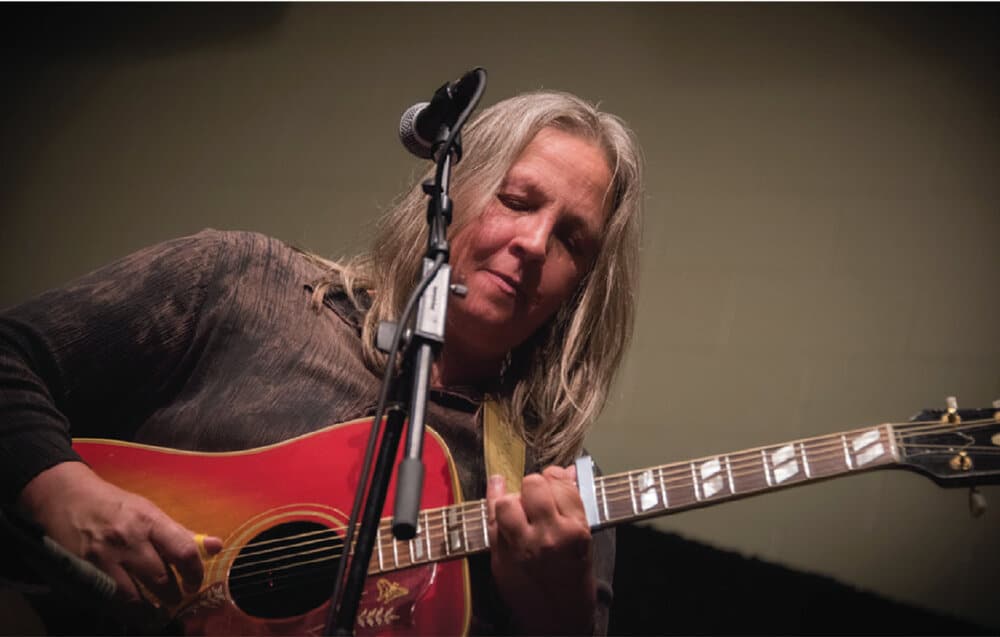
She has recorded six CDs and established a strong presence in Michigan’s folk scene. In 1992, she won the Metro Times award for best folk vocalist and was named songwriter of the year by the Metro Area Artists and Songwriters Association.
After the move to Pennsylvania, she started all over again, playing along the East Coast, from Washington, D.C. and Cape Cod.
She was thrilled to play and sing on the same coffee shop stage with Bill Danoff, co-writer of the John Denver hit “Take Me Home, Country Roads.”
In 2019, she injured her right wrist in a car accident, only a week after having a joint replacement in the same hand. It took more than two years for her to play guitar again and she has never resumed public performing.
We are stardust
After all of Barb Barton’s terrestrial adventures, it seems like a big leap to the distant universe, but it’s not a leap at all. The human connection to the night sky goes much deeper than aesthetic appreciation or even spiritual wonderment.
As Barton says in her documentary short, “We Are Stardust,” every atom in our bodies, and the Earth beneath our feet, was forged in the heart of supernovae and other cosmic events.
The film is enjoying a successful first life on the festival circuit, with a screening set for the Great Waters Short Film Festival in Rogers City on April 22, 2026 (Earth Day), and has earned 13 awards so far.
It wasn’t enough for Barton to take beautiful images of the night sky. Her stunning photography, with narration by Lansing poet laureate Ruelaine Stokes, explains how celestial events forged the heavy elements that coalesced into our planet, our water and ourselves.
“Everything here came from up there,” Barton said, pointing up. “Once I made that connection, it just hit me on a really deep level, and it made the world a smaller place. I had that ‘I get it’ moment.”
By 6:45 p.m., it was dark enough at Sleepy Hollow for Barton to start shooting. She planned to stay until midnight, “or until the clouds come.”
“Oh, that’s going to be a nice sky,” she said. “The moon’s not up. That’s a good sign. Want a pretzel?”