Supreme Court decision hangs over Lansing Township special election
After East Lansing settled for $7.8 million over a 5% fee on Lansing Board of Water & Light bills deemed to be an illegal tax, Lansing Township is trying a different approach to keep a similar …
Proposal asks residents to confirm current fee that is likely illegal
After East Lansing settled for $7.8 million over a 5% fee on Lansing Board of Water & Light bills deemed to be an illegal tax, Lansing Township is trying a different approach to keep a similar fee in force.
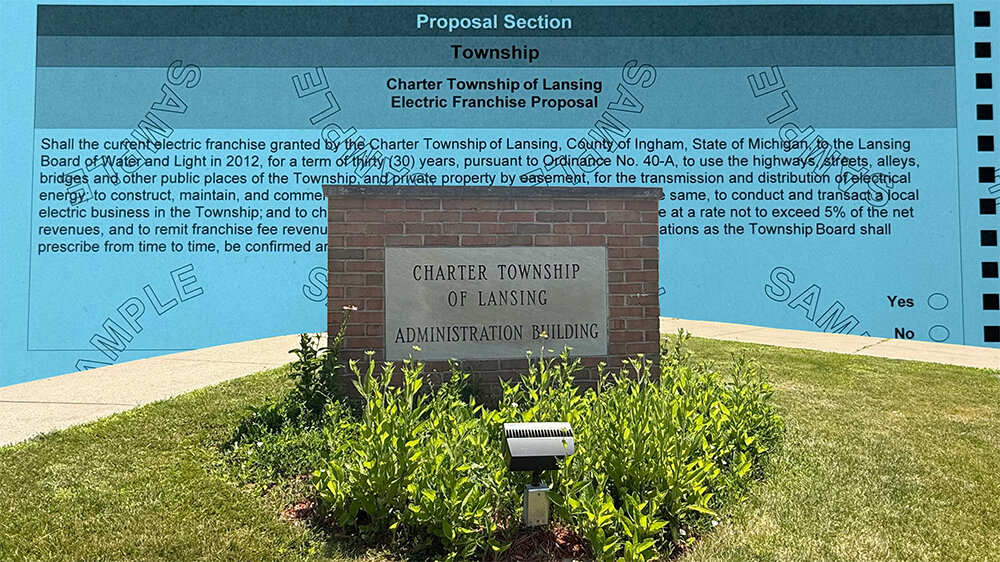
An Aug.5 special election has only one proposal, which asks voters to confirm a franchise agreement with the BWL for the next 30 years. The agreement includes a 5% franchise fee on customers’ electric bills, which BWL pays to the city. It has been active since 2012, though without voter approval — a practice forbidden by Michigan’s 1978 Headlee Amendment, which requires voters to approve municipal taxes.
In an interview, township Supervisor Maggie Sanders said the proposal “is not a request to legitimize” the fee. Instead, it seeks an “irrevocable” franchise agreement, which would make the agreement more difficult to terminate. State law mandates that voters must approve irrevocable franchise agreements. But some are worried a “yes” vote would legitimize an illegal tax and make a lawsuit more difficult.
“It seems the basic thrust of this entire thing is to cover them, even retroactively,” said Lansing Township resident Jane Dailey. “East Lansing and Delta Township were able to sue for it and get reimbursed millions of dollars, as it was declared an illegal tax in the Michigan Supreme Court.”
Erika Rosebrook, the director of MSU’s Extension Center for Local Government Finance and Policy, said there was nothing in the proposal’s language to indicate a retroactive effect. But Dailey and other residents said avoiding a lawsuit was the obvious intention.
The BWL serves 5,179 customers in Lansing Township. The public utility has participated in franchise agreements since 1986, when it entered them with DeWitt and Windsor townships. Franchise fees, which BWL collects and pays to the municipalities, are active in DeWitt, Meridian, Watertown and Lansing townships, BWL spokesperson Amy Adamy said.
A particular gripe for Dailey is that the fee, which is meant to cover expenses the BWL incurs for operations in the township’s public right-of-way, seems too high considering how few services she gets from the township.
“We get almost no services from the township,” the Groesbeck neighborhood resident said. “The Ingham County Road Department plows my roads and takes care of the trees, and then we have to pay Granger to pick up our trash. We don’t get any recycling or any of that stuff.”
She added she struggles to trust the township after multiple financial mishaps in her 30 years as a resident. A settlement last year got the township out of $250 million in financial liabilities over The Heights at Eastwood, a residential and commercial development built using public bonds — but Dailey is not convinced township leadership has learned its lessons. Sanders, who was elected supervisor in 2022, is the daughter of Kathy Rodgers, who was treasurer during the development and oversaw some of the fallout during her 2012-2016 tenure as supervisor. Sanders also sued the township over debt she owed in 2018, and her mother remains treasurer.
“These are the same players,” Dailey said. “I don’t know why anyone would think we should trust them to manage our money.”
But another Lansing Township resident, Joel R. Brouwer, said the township’s financial situation was his reason for voting “yes” on the proposal.
“I don’t want the township to be sued and have to give all that money back, because the township is broke,” he said. “And as a Lansing Township resident and taxpayer, one way or another, I am responsible for that debt.”
While he is unhappy about the township’s financial woes, he said, the township needs all the money it can get, including the franchise fee. Beside that, the cost litigation and paying back the fees collected since 2012 would probably fall on taxpayers anyway, he said.
“I don’t know how else the township is going to raise that money.”
Sanders called the primary motivation of the ordinance to “maintain the franchise fee,” but she said it was not a reaction to the East Lansing decision. In its current state, she said, the franchise can be revoked by a petition or lawsuit. With an irrevocable franchise agreement approved by electors, the township would gain peace of mind in knowing that funding was secure.
While money collected from the fee goes into the township’s general fund, Sanders said it is directed toward areas affected by BWL’s operations.
“When utility companies use our public streets, our highways, our alleys, our right-of-ways, our public places within the township, they do damage they’re not necessarily fixing,” she said.
“It goes into the general fund, then those funds are spread out within different cost centers,” she continued. “So, some of it goes into sidewalks and roads, and some of it goes into police and fire because they are also responding to these utility company areas. So, it assists with the purchase of equipment for response for our police and fire departments.”
She said the township made around $600,000 from the fee in 2024.
Complicating the issue is the general lack of information around the ballot proposal. Dailey and Brower both said they had heard nothing from township officials about why the proposal was on the ballot and what it entailed. Dailey said the wording was confusing.
“I think it was written by a package of lawyers, and it’s designed to be slightly confusing, frankly,” Dailey said. “It’s kind of hard to figure out.”
Rosebrook said researching the proposal had been difficult because information about township meetings is sparse.
“I haven’t run into a government of that size with as little information about their meetings and things like that online,” she said. “I was surprised.”
“There’s so little explanation in the minutes and no agenda packet with additional details, it’s hard to react to anything other than hypotheticals.”