
Ten touchstones in local LGBTQ+ history
In 1971, gay activists in East Lansing demanded protections in the city government’s hiring process from their City Council. They came, they fought, and they won: East Lansing’s early 1992 civil rights ordinance was the first of its kind in the country.

In 1971, gay activists in East Lansing demanded protections in the city government’s hiring process from their City Council. They came, they fought, and they won: East Lansing’s early 1992 civil rights ordinance was the first of its kind in the country.
In the Greater Lansing area, that story has repeated again and again. It repeated in 1980, when the Lansing Association for Human Rights alleged patrons of local gay bars were unfairly targeted by undercover police operations. It repeated in 1996, when a Lansing civil rights ordinance was passed by the City Council before being repealed by voters, and then again in 2006, when a similar ordinance was passed that remains today.
Last year, when two trans women were threatened at The Avenue, a new group formed to demand recognition and protection from the City Council. Within a month, the city was formally declared an “LGBTQ+ welcoming city,” with the council recommending additional measures.
The following 10 touchstones in local queer and trans history include these efforts and many more, showcasing just some of the ways LGBTQ+ people have made history in Greater Lansing. But while it provides a window into several moments in queer and trans individuals’ ever-evolving legacy in Lansing, it is far from comprehensive. This list does not include the 2023 election of Lansing resident Emily Dievendorf, the state’s first openly nonbinary representative, or the 2005 election of Lansing City Clerk Chris Swope, the city’s first openly gay elected official. It does not include coverage of the AIDS crisis in Lansing. It does not include the histories of Lansing’s gay and lesbian bars, such as Club 505, which closed in 2017, nor does it include coverage of Terri Jewell, a poet and Black lesbian activist who died tragically in 1995.
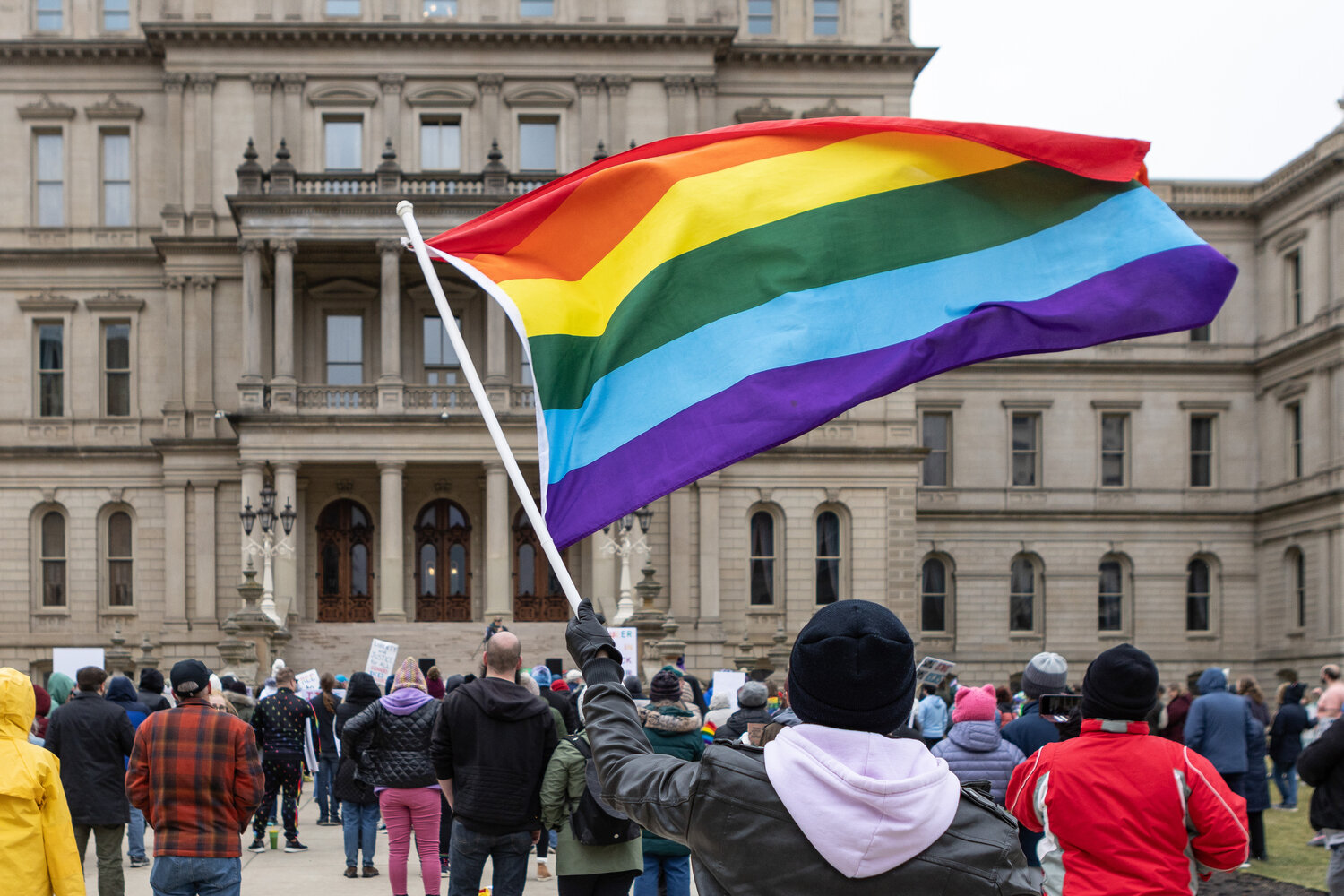
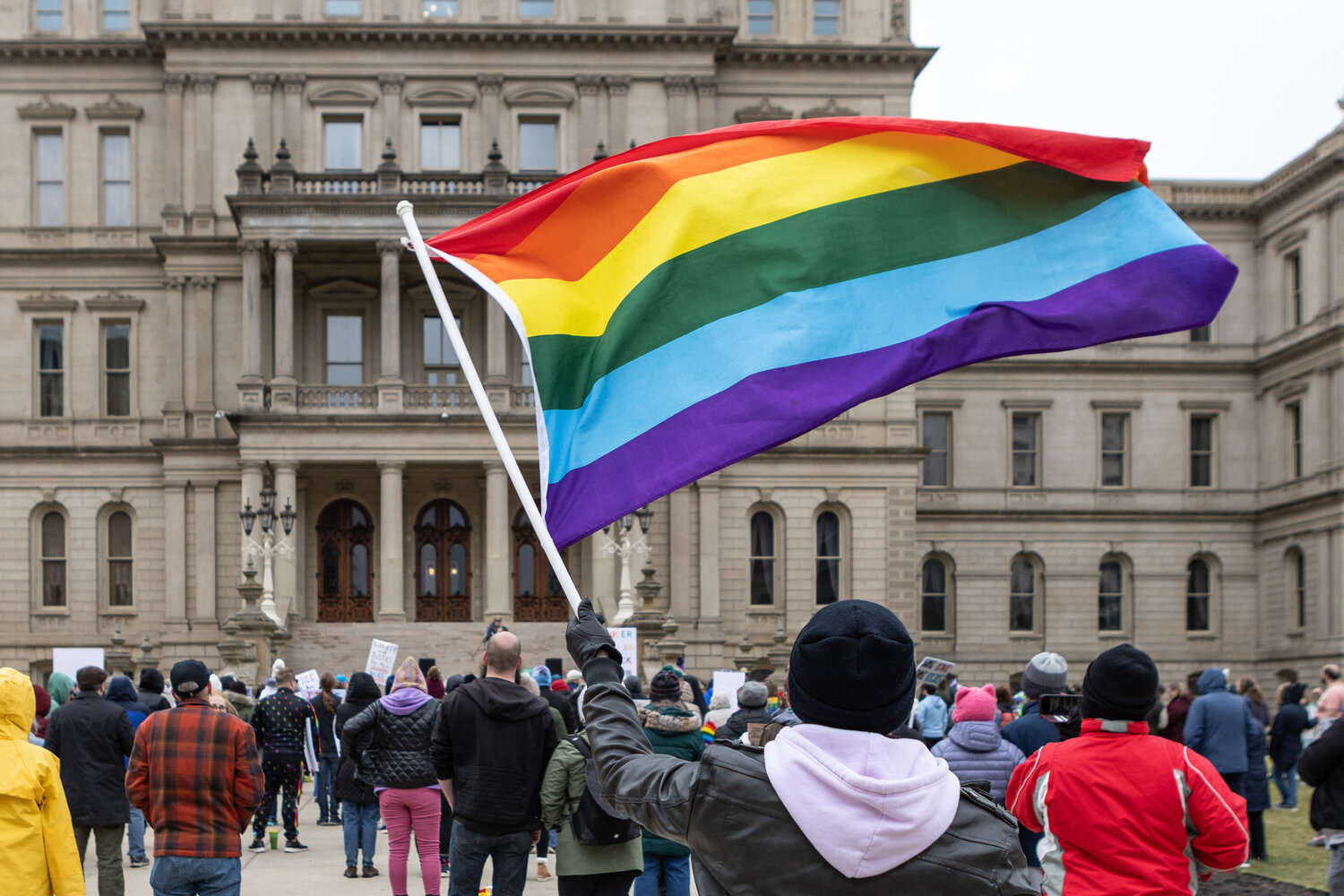
What it does provide, or at least aims to, is a sense of lineage, something to tie together the 150 gay activists who marched on the state Capitol in 1971 and the 200 who turned up to do the same in 2025.
(Leo V. Kaplan wrote this story. Tim Retzloff, who teaches history and LGBTQ+ studies at Michigan State University, selected many of the topics and provided substantial research assistance, including providing some primary source materials.)
First gay march on the state Capitol (1971)
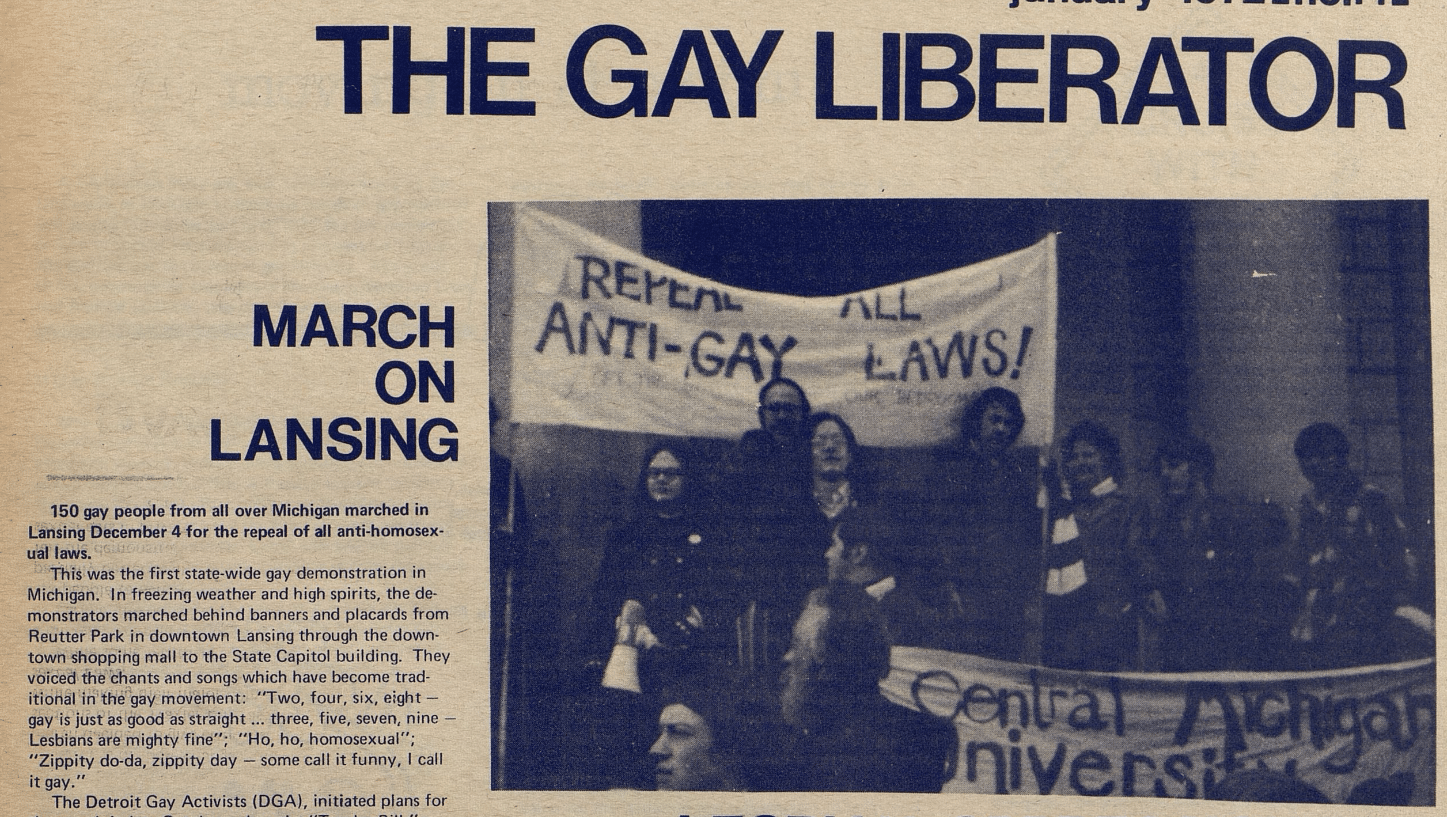
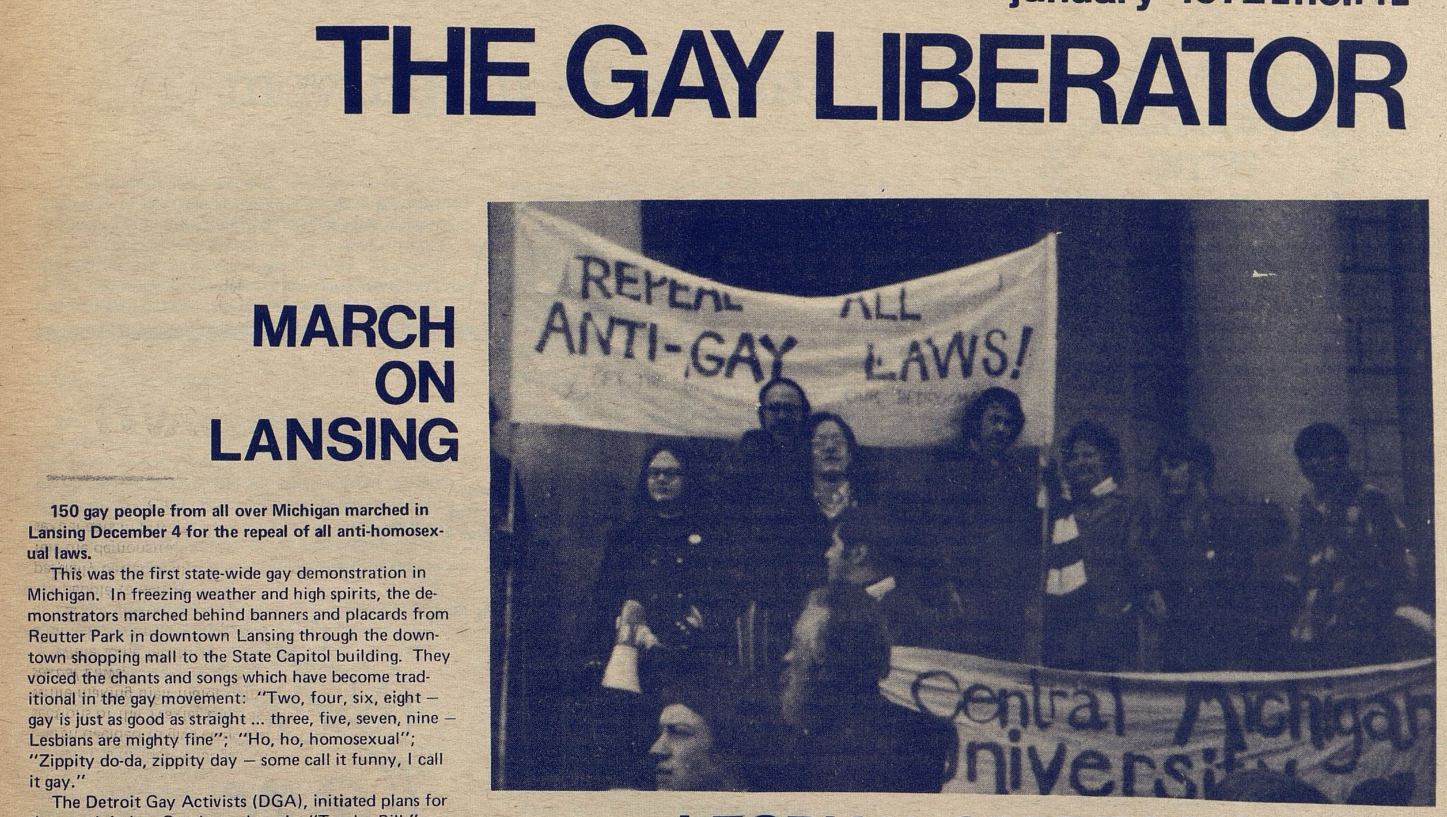
The Stonewall riots in June 1969 kicked off a wave of organizing in local communities, with small, grassroots groups cropping up across the country. Several of those organizations in Michigan came together in January 1971 to march on the Capitol in opposition to a proposed revision to the state’s penal code, the first statewide action of its kind.
The revised penal code, spearheaded by then-state Rep. Bob Traxler, would actually have legalized “sodomy” and reduced crossdressing and “loitering to solicit” for deviant sex — that is to say, “cruising” — from misdemeanors to civil infractions.
But on Dec. 4, 1971, about “150 gay people from all over Michigan,” according to coverage in the Detroit-based Gay Liberator, marched from Reutter Park to the Capitol to oppose the bill, which they felt was a step forward for gay and lesbian rights but a step back in other ways: According to the January 1972 Liberator, the bill would have illegalized abortion in all cases except to save the mother’s life, tightened restrictions on public gatherings and given increased power to the state Parole Board in determining prison sentences. Leaving cross-dressing and cruising illegal, some argued, did not constitute enough of a victory to earn gay rights groups’ support.
The groups “recognized that to give tacit or outright support to these changes would mean fighting for gay rights at the expense of the rights of others,” according to The Liberator, choosing instead to oppose the bill and demand all the rights it did not include, such as employment protections.
East Lansing civil rights ordinance (1972)
On March 7, 1972, East Lansing made history as the first municipality in the country to pass an ordinance banning the city from discriminating on the basis of homosexuality in its hiring process.
The ordinance was spearheaded by the East Lansing Gay Liberation Movement, a Michigan State University student organization that began in 1970 amid the formation of similar “Gay Liberation Front” groups across the country. Coverage in The Gay Liberator explains that the GLM first presented East Lansing City Council with the proposed changes in October 1971, but after four months of radio silence, the group began protesting the Council’s inaction.
The Gay Liberator reports that then-City Manager John Patriarche said he had been directed to study the matter but had not been specifically directed to report his findings. When pressed, he recommended against the changes, but after six gay residents spoke in favor, the council voted 3-1 that the changes be drawn up.
Before the ordinance passed, however, an addition was made to ban homosexual “solicitation” while on the job, which advocates successfully opposed. Then-Mayor Wilbur Brookover, the sole vote in favor of keeping the amendment, was reported by The Liberator as having said the measure would have prevented gay hires from turning other city employees gay.
“No person is a homosexual by nature,” Brookover said, according to The Liberator. “Their pattern of behavior is to try and get recruits by telling people homosexuality is natural. I don’t feel the employees of the city should be left open to this possibility.”
The ordinance came on the heels of a similar policy in New York, though that was an administrative policy rather than an ordinance, and it was quickly followed by similar ordinances in Ann Arbor and San Francisco. The latter claimed a historical first, leading to a May 10 headline in gay newspaper The Advocate that read “Oops, E. Lansing first with hiring law.”
The policy has been expanded several times, now protecting gay and transgender residents from housing discrimination, employment discrimination and more.
The Lansing State Journal reported that, following the amendment’s passage, MSU senior Chuck Will laid a sprig of marijuana on the table in front of Patriarche, spoke in favor of reducing the penalty for marijuana possession, and described himself as “so high I can hardly stand up.”
It was very much the early ‘70s.
Lesbian Connection (1994)
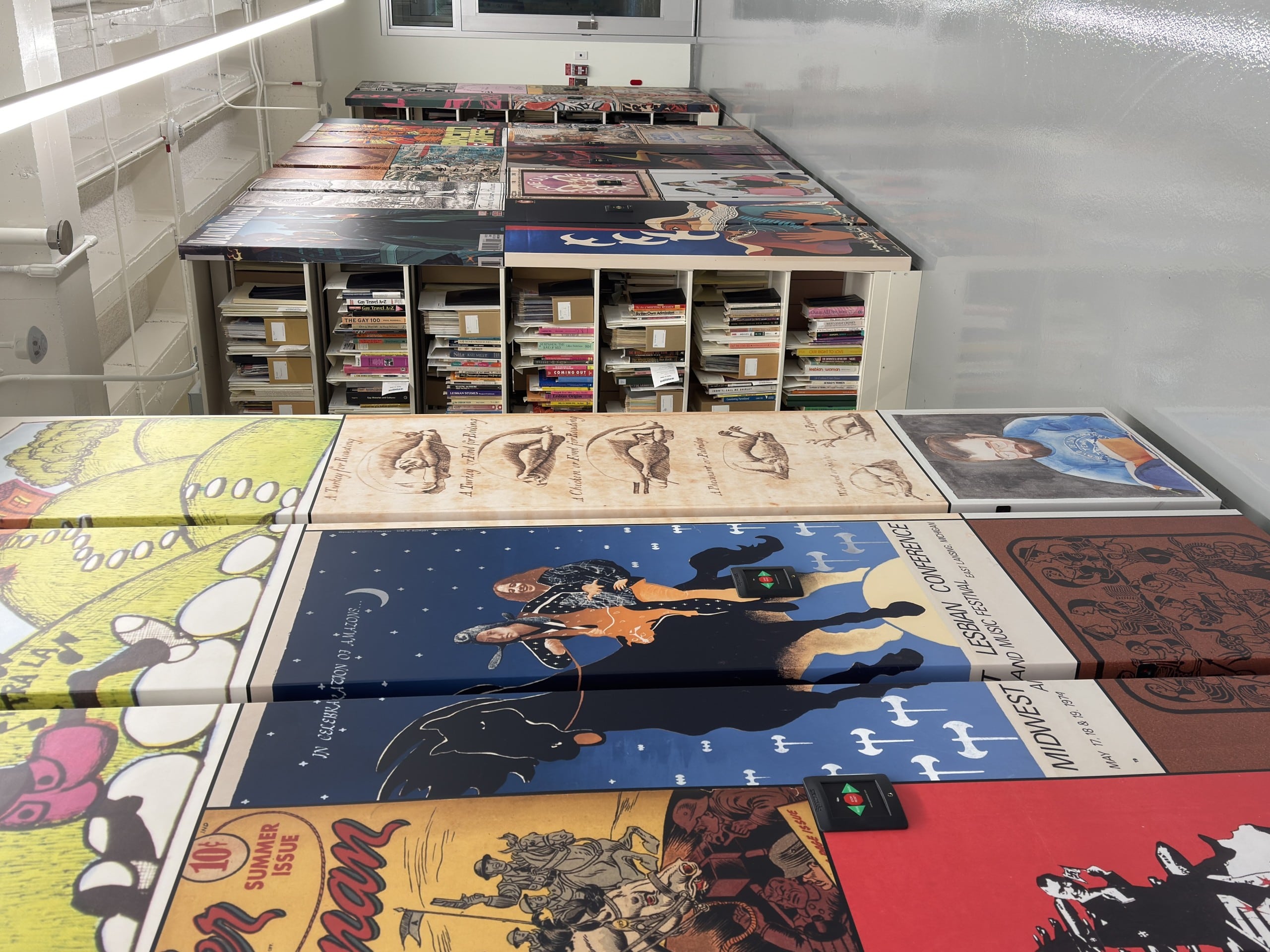
Lesbian Connection, a bimonthly, internationally distributed periodical by and for lesbians, was founded in 1974 on the heels of the Midwest Lesbian Conference and Music Festival.
The conference followed a cross-country road trip that founders Margy Lesher and her then-girlfriend, Goldie, took the previous year to connect with lesbians across the country. A 1974 story in radical feminist publication Off Our Backs describes the event as having been inspired by the West Coast Lesbian Conference in 1973.
The Midwest Lesbian Conference was held from May 17 through 19, 1974, in East Lansing. Sessions included workshops on “self-help” (then a term referring to self-healthcare), a panel on legal issues led by a lesbian lawyer, lectures on lesbian mothership and a panel on how to improve and find alternative social spots to gay and lesbian bars, according to Off Our Backs. Two Black lesbians from Tennessee came to lead a workshop about the Black lesbian community, and National Black Feminist Organization co-founder Margaret Sloan-Hunter gave an address.
Lesbian Connection “was one of the groups that came to be after that conference,” according to an interview with Lesher in the MSU Libraries’ Stephen O. Murray and Keelung Hong Special Collections.
“One of the hard things with the conference was trying to figure out how to publicize it, because there were very few, maybe a handful of lesbian publications that were even existent at the time,” Lesher said, adding that a few big cities had dedicated women’s or feminist publications, but smaller cities like Lansing did not.
“So, that was how the idea for Lesbian Connection came about. It was a way to get the word out about these things that lesbians were trying to put together and create,” Lesher said.
Cheryl VanDeKerkhove is a local lesbian activist who owned the former LGBTQ+ bookstore Real World Emporium in Old Town and was instrumental in the 1996 push for an LGBTQ+ civil rights ordinance in Lansing. She worked at Lesbian Connection for seven years and said it provided an invaluable service in connecting a pre-internet lesbian community.
“It was the original chatroom,” VanDeKerkhove said. “The readers wrote everything that went in it, and then everybody would write back and respond to what someone else wrote.”
LC, or “Elsie,” continues to publish today and still operates on a pay-what-you-can model.
Rachel Crandall-Crocker founds Transgender Michigan (1997) and Transgender Day of Visibility (2009)
When Lansing local Rachel Crandall-Crocker came out as transgender in 1997, she was fired from her job on top of losing her marriage.
“I kind of lost everything,” she said. “And I decided what I would do was that I would try to create an organization to make sure it didn’t have to happen to anyone else, and I called that organization Transgender Michigan.”
Transgender Michigan held early meetings at Potter Park in 1997. It was a time when “hardly anyone knew what trans was,” Crandall-Crocker said, and resources for trans individuals were few and far between.
Transgender Michigan hosts events such as transgender health and job fairs alongside providing information about trans healthcare and other resources on its website.
Today, Crandall-Crocker is primarily known for founding International Transgender Day of Visibility, created in 2009 to supplement the Transgender Day of Remembrance. The latter, observed annually since its inception on Nov. 20, 1999, honors transgender individuals who have been murdered because of their identity. The day of visibility, meanwhile, held on March 31, celebrates trans lives and contributions.
“Every year, on the day of remembrance, I would get so depressed,” Crandall-Crocker said. “After a while, I couldn’t even go to the ceremonies because I would get so depressed, and it would last for weeks. And that’s one reason why I started the day of visibility: I wanted a day that I could feel happy about. I wanted a day where people could be proud to be trans.”
Former President Joe Biden recognized Trans Day of Remembrance in 2020.
Lansing LGBTQ+ civil rights ordinances (1996; 2006)
Firings like Rachel Crandall-Crocker experienced would have been illegal, at least in Lansing, under the comprehensive civil rights ordinance that included protections based on sexuality and gender identity that City Council passed in 1996.
VanDeKerkhove, who was on then-Mayor David Hollister’s LGBT advisory board and served various roles in the Lansing Association for Human Rights, said LAHR and other organizations had worked collaboratively with the city government to craft the ordinance, which passed.
But opposition to the ordinance, led by a group called Majority Opposed to Special Treatment, petitioned to put it to a vote.
VanDeKerkhove said MOST intentionally misled petition signers about their intentions, telling supporters of the ordinance that the petition would help ensure it remained in effect and opponents that the petition was intended to do away with the ordinance.
A space that VanDeKerkhove had been intending to use for an LGBTQ+ coffee shop became an impromptu campaign headquarters as local activists fought in favor of the ordinance. When exit polls predicted the ordinance would survive, supporters held a victory party.
But the exit polls turned out to be wrong. Voters had overturned the ordinance, and it did not go into effect.
“It was heartbreaking,” VanDeKerkhove said. “But if you look back at it in context, we were just a couple of years out from Clinton instituting ‘don’t ask, don’t tell’ when we were voting on this. The environment for gay people and lesbians was still pretty rough.”
In that context, she thinks, a narrow 2% loss was a kind of success, too.
The ordinance, during its brief tenure in effect, was the second of its kind in Michigan to include protections for transgender people as well as gay, lesbian and bisexual people. It was a controversial decision internally, VanDeKerkhove said, for prescient reasons.
“They were worried that if we included gender orientation, we were going to get into the bathroom wars, and childcare-by-a-man-who-is-a-woman, and all these things we’re seeing today,” she said.
Ten years later, a nearly identical ordinance was passed by City Council with less fanfare. Some of the MOST organizers turned up again with the same playbook, but it didn’t work out, and the ordinance remains in effect today.
Murder of Bob Gross (1996)
Few knew that Bob Gross was gay — at least not until after his death. Then everybody knew.
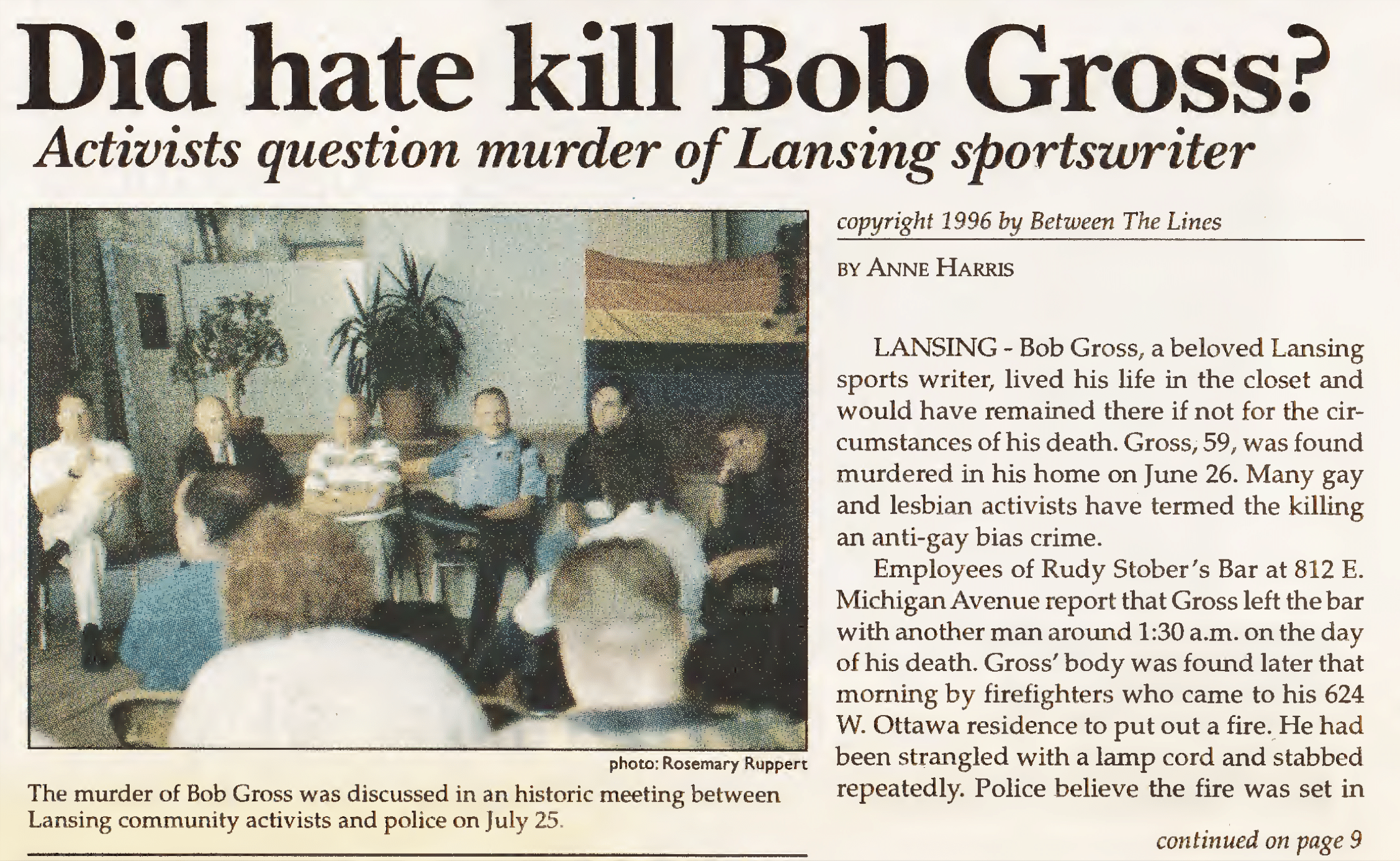
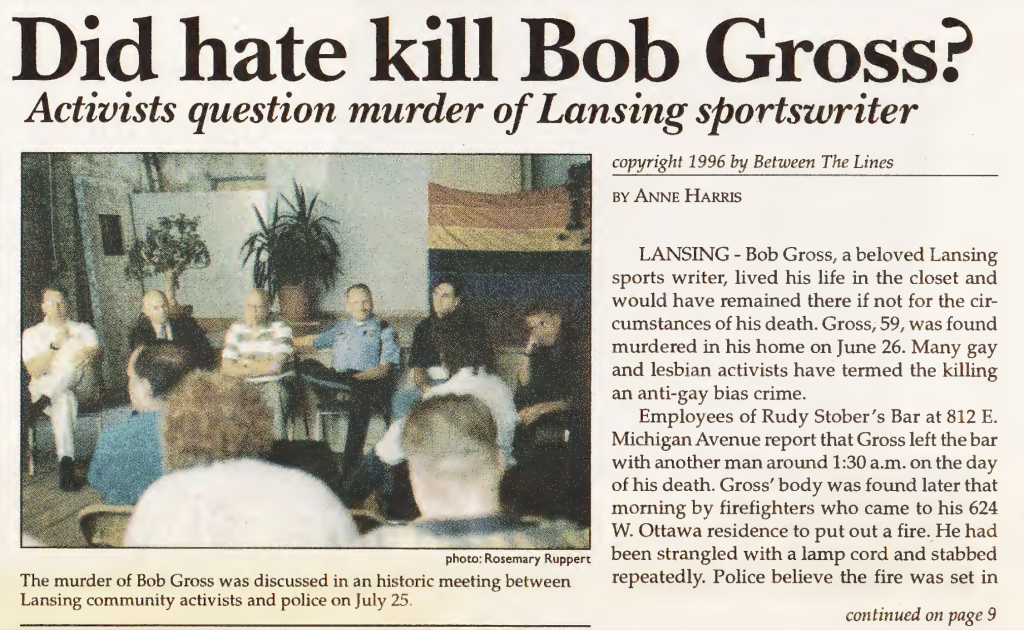
The Lansing State Journal sportswriter was murdered in 1996 after leaving Rudy Stober’s Bar with another man, who later killed him. He had been with the Journal for 34 years and was a well-known figure publicly, but he was not “out” publicly, at least outside of the gay scene.
Gross’ murder was a “pick-up crime,” in which a criminal, usually a robber, makes their way to a victim’s home under a sexual pretext. Gay people, especially those in the closet, are often targeted because they are less likely to out themselves. That puts them in a murky area under hate crime designations.
The Journal’s coverage did not acknowledge Gross’ sexuality, but he was posthumously “outed” by the Detroit-based Triangle Foundation, according to a 1996 story in the Michigan LGBTQ+ newspaper Between The Lines.
The debate around whether to discuss Gross’ sexuality situates Lansing in a long lineage of debates around the politics of “outing.” When Oliver Sipple foiled an attempt on then-President Gerald Ford’s life in 1975, for instance, Harvey Milk outed him as gay in an attempt to portray a gay man as a heroic figure, a controversial decision due to the stress it brought Sipple and his family. In 2016, the late Whitney Houston’s husband caused controversy by posthumously outing her as bisexual.
Gay men continued to be targeted by pick-up crimes in Lansing, such as the 2016 targeting of local reporter Todd Heywood, who wrote about his experience for City Pulse.
Dyke Heights
Folk singer and lesbian feminist activist Alix Dobkin memorialized Lansing’s most sapphic community in a 1992 recording of her song Lesbian Code: “In Lansing 48912 / She lives in Dyke Heights.”
It’s not clear when 48912 became Dyke Heights, but by the mid-‘90s, the neighborhood had its own newsletter (the Dyke Heights Dispatch), the highest concentration worldwide of Lesbian Connection subscribers and, according to VanDeKerkhove, the highest lesbian homeownership per capita in the country.
“I honestly don’t know how it organically became Dyke Heights, but it’s definitely where the women were, on the east side, 48912,” she said. “It was known that if you wanted to be in the lesbian community, rent or buy in this area.”
The Dispatch, which followed the local newsletter Lesbian Alliance, was edited by philosopher and influential radical feminist Marilyn Frye, a Michigan State University professor.
The Dispatch contained community announcements, essays, some news and a skill-swap section called the Lesbian Energy Network, in which locals traded skilled services with each other in a sort of mutual aid network.
The September 1996 issue highlights MSU’s Special Collections, describing MSU librarian Anne Tracy — and the collection she built — as “undiscovered treasures for mid-Michigan lesbians.”
The issue is now in that collection itself, alongside many other issues of the Dispatch.
Layne Ingram comes out as trans (2017)
So far, most local coverage of transgender people in sports in the 2020s has focused on the role of trans women — that is, people born male who transition to female — in sports. The topic has ignited fierce debate across the country — a debate far outsized to the very small number of trans women who actually participate in school sports.
In 2017, though, the Lansing State Journal ran a front-page story about Layne Ingram, the women’s basketball coach at Lansing Community College. Layne’s story is the inverse: Born female, he began his transition to male that year.
A front-page Journal story featuring positive coverage of a transgender Black man was, admittedly, a refreshing read after the far less positive coverage from the ‘70s and ‘80s reviewed for this story. The piece was also informative regarding the process of gender transition, including a photo of Ingram taking a testosterone shot.
Ingram appeared on “Dr. Phil” in 2022 to discuss trans inclusion in sports.
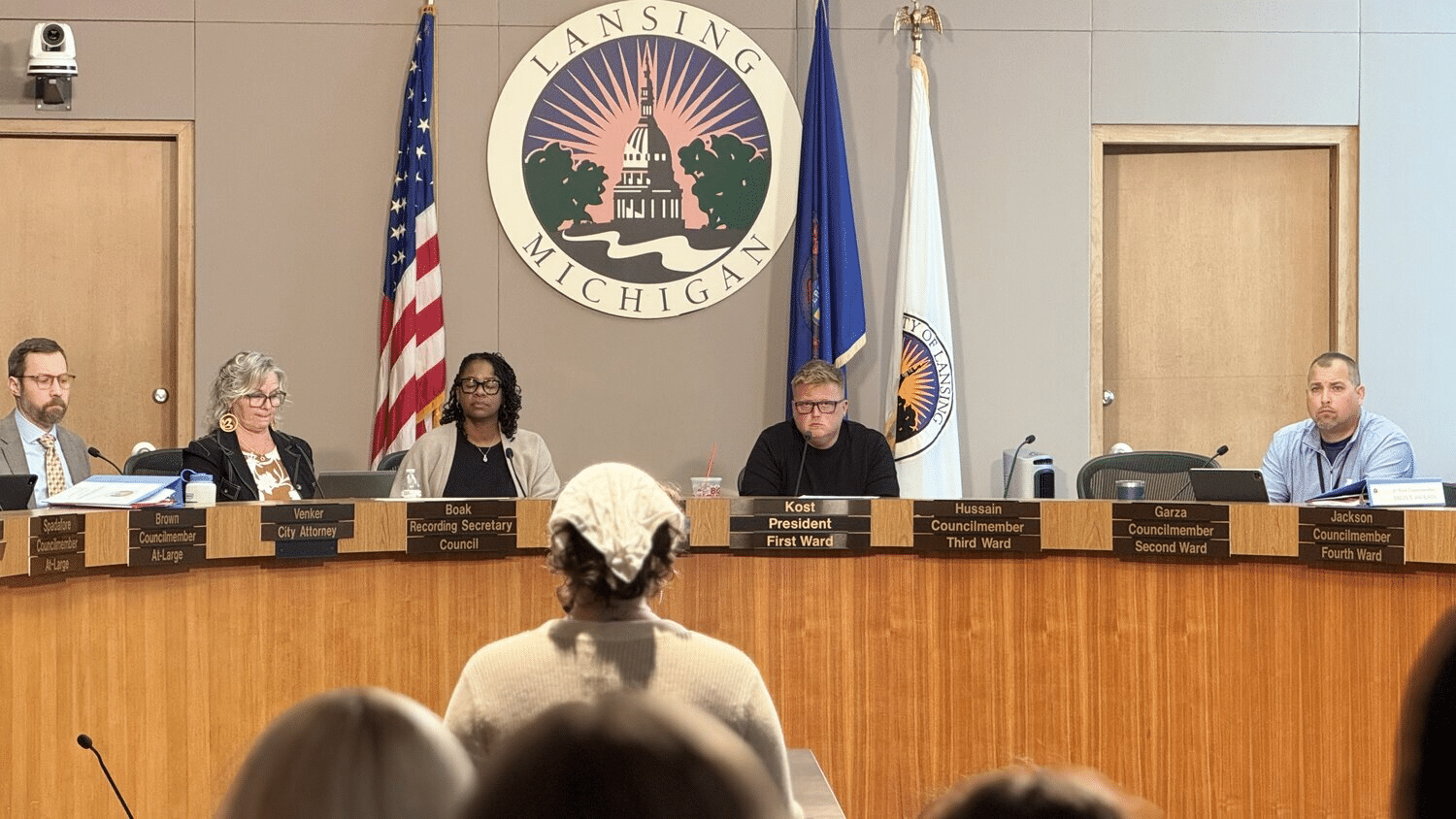
Lansing declared an ‘LGBTQ+ welcoming city’ (2025)
After a self-proclaimed Charlie Kirk supporter made violent threats against two trans women at The Avenue Cafe in Lansing last year, the community came together to demand change.
On Sept. 29, more than a dozen people asked for support from City Council members amid an uptick in anti-trans rhetoric fueled by the federal government. Brian T. Jackson, then head of the City Council’s equity, diversity and inclusion task force, called an open meeting in response, which drew about 75 attendees, including 30 speakers.
Organizers with the Lansing Advocates for Trans Safety, a grassroots organization that formed in response to the threats, made three demands: a statement affirming the city’s commitment to LGBTQ+ inclusion, an LGBTQ+ advisory board, and funding and support for queer or trans-owned businesses.
The next week, the council unanimously passed an ordinance that declared Lansing an “LGBTQ+ welcoming city.” The ordinance met the group’s first demand. The group asked the city to implement the other two, but the council did not have the power to do so.
Organizer Lyra Opalikhin, speaking at the meeting, called the ordinance “a signal that the city will dedicate itself to protecting and uplifting its LGBTQ+ residents, not merely because it’s convenient, but because it’s necessary.”
Related Articles
A roundup of recent Lansing-area music news
From Big Sur’s new album, Starfarm’s Whitney Who has a new group and Displaced Manor finds a new home
“Midwest is Best”: World-Class Roller Derby Came to Lansing and Delivered
Sometime around 1 pm on Sunday, with about 100 fans gathered inside the Lansing Center, a chant broke out from the Ohio Roller Derby cheering section. “I say ‘Rat’! You say ‘Chet’!” …