Trudging the depths on Deep Green proposal
When Lansing City Council members went into closed session the night of Monday, Feb. 9, the packed city chambers were abuzz with conversation — specifically, to the tune of about 55-65 decibels.
…
Photos by
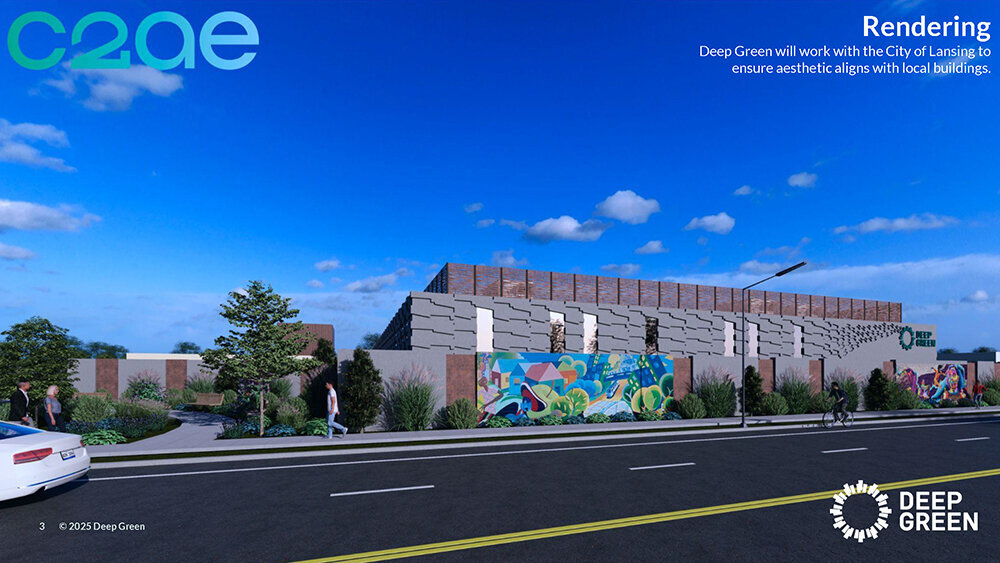
Leo V. Kaplan, rendering by Deep Green
Four months into controversial project, data center builders altering their rezoning request
When Lansing City Council members went into closed session the night of Monday, Feb. 9, the packed city chambers were abuzz with conversation — specifically, to the tune of about 55-65 decibels.
That meant the noise in that room was comparable to the promised maximum noise levels of the project that many of those present were there to oppose: a data center, pitched by British company Deep Green for Lansing’s stadium district.
The phrase “a different kind of data center” has appeared on posters and PowerPoint presentations at several community engagement meetings as Deep Green seeks to sell a skeptical public on building a 24 megawatt, one-acre data center on top of parking lots at Kalamazoo, Cedar and Larch streets. Keeping noise levels low is one of many promises the company has made, alongside donating waste heat to the Lansing Board of Water and Light, donating $120,000 to the BWL’s Pennies for Power fund and using no more water than a small restaurant.
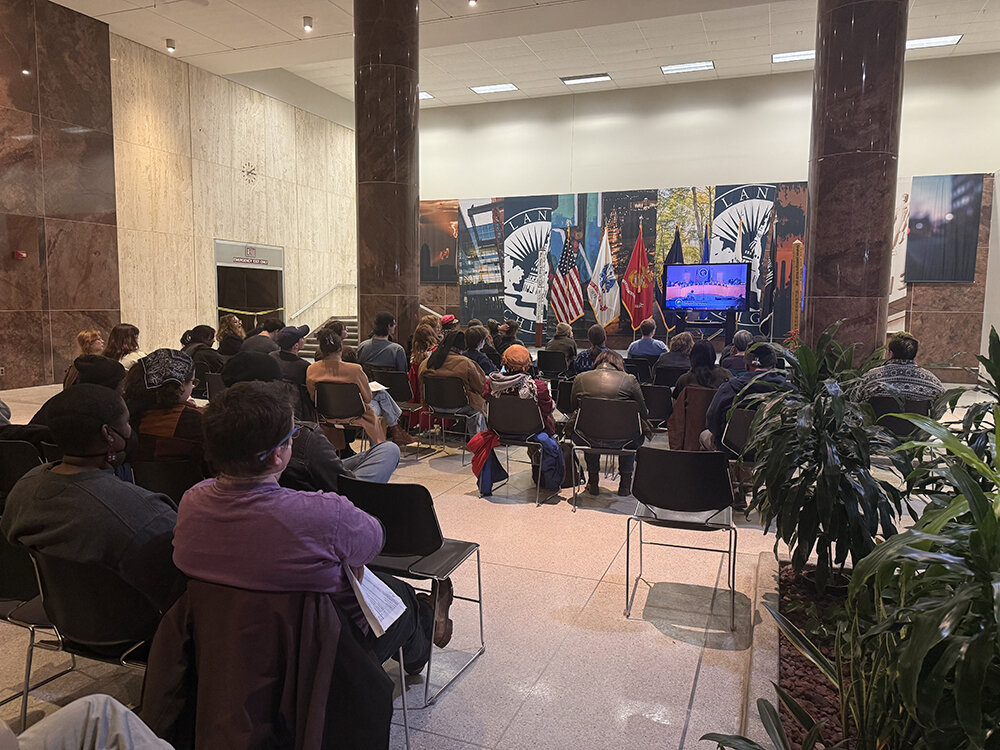
But there were so many people objecting that a second viewing space needed to be set up on the first floor of City Hall. And many said they simply didn’t believe those promises. The meeting ran past midnight.
Council members also raised concerns that Deep Green’s promises were not contractual. Second Ward Council Member Deyanira Nevarez Martinez said Deep Green prematurely made the rezoning request, since the city owns the property.
First Ward Council Member Ryan Kost has declared himself a firm “no” vote after listening to constituents.
That’s a problem for Deep Green because it needs the Council’s approval to build the data center. The company’s modus operandi is to donate waste heat to local utilities, but that means setting up shop in the urban core rather than more traditional outskirts or rural areas. The city owns the land, and Council members need to approve both the sale and a rezoning request that could make the land industrial, conditioned on being a data center.
At the meeting, residents still expected that City Council would approve or deny the sale on Monday, Feb. 23. But on Friday, Feb. 13, Deep Green announced that it would be starting the process over, resubmitting the rezoning request in conjunction with the city and making some of its promises contractual.
The planning commission, which initially recommended against the rezoning condition after a packed meeting the same day the project was announced, will reconsider on March 3, effectively starting the process from scratch again.
City spokesperson Scott Bean said Mayor Andy Schor could have rectified the rezoning issue by simply offering the condition himself, but that Deep Green wanted to start over.
Council President Peter Spadafore said this course of action was the “clearest and most transparent” amid a highly scrutinized proposal.
The project is popular with city officials and union leaders. Schor has supported it alongside the Lansing Regional Chamber of Commerce, the BWL and the Lansing Economic Area Partnership. Representatives from several trade unions have also spoken in favor of the project.
Opposition has been fierce amid a national debate about the future of data centers, which have proliferated alongside the AI technologies they power.
Now with Lansing’s data center debate poised to last several more months, here’s how the project started and what we currently know.
How did we get here?
At 4428 Creyts Rd, not far from where I-69 and I-96 meet, is a nondescript building labeled “liquidweb.” It’s one of two small-scale data centers that the web hosting company has run in the area since 1997. The servers lining the 24-hour facilities have hosted websites big and small for nearly 30 years, and have done so without generating much controversy or much attention at all.
It’s a very different story from the massive backlash to the Deep Green project. But it’s also a different kind of data center from a very different time.
A data center, at its most basic level, is a building for computer server farms, which in turn are just clusters of computers that are better together than separate. A data center can house anything from websites, to video game servers to the Google Doc this article was written in.
In recent years, as AI technologies like large language models and image generators have taken hold, the demand for data centers has sharply increased. AI companies like OpenAI, which operates ChatGPT, have funded enormous data centers to train and run their models, such as a 250-acre project currently causing controversy in Saline Township.
Those massive data centers require massive amounts of energy. Consulting firm McKinsey & Company predicted in April that data centers equipped to handle AI processing would require over $5 trillion in investment by 2030. The U.S. Energy Information Administration said in June that data centers would push U.S. energy consumption to record highs.
But despite having by far the most data centers in the world, the U.S. has lagged behind the U.K. and Europe in finding uses for the excess heat that all those AI queries are generating. In Sweden, for instance, Microsoft is building a data center region that is expected to heat an entire large city. In the US, a Biden-era executive order to expand research into data center heat reuse was overturned in 2025 by President Trump.
It’s in that environment that Deep Green announced this project in November. A U.K. company seeking to expand into the U.S. after a £200 million investment from Octopus Energy Generation, the renewable energy wing of the U.K.’s largest energy utility, Deep Green found a partner in the BWL to debut its heat-reuse technology in the U.S. (and build its largest data center yet).
The BWL, currently transitioning its downtown heating loop from steam to hot water, wants the free heat. At no cost to them except setting up the pipe to take the heat, from the edge of Deep Green’s property line, the utility could offer water to downtown residents at a lower cost. Deep Green doesn’t have to worry about getting rid of all their heat, which is a major nuisance for data center operators.
When the project was announced to the media in November, BWL General Manager Dick Peffley called the project “the perfect marriage.”
Residents quickly disagreed. About 40 people showed up to a city planning and development committee meeting to oppose the project, the same day it was announced.
Weeks later, the Ingham County Environmental Affairs Commission passed a resolution urging the BWL to create more long-term regulations on proposed data centers, which the County Board of Commissioners later adopted with modifications.
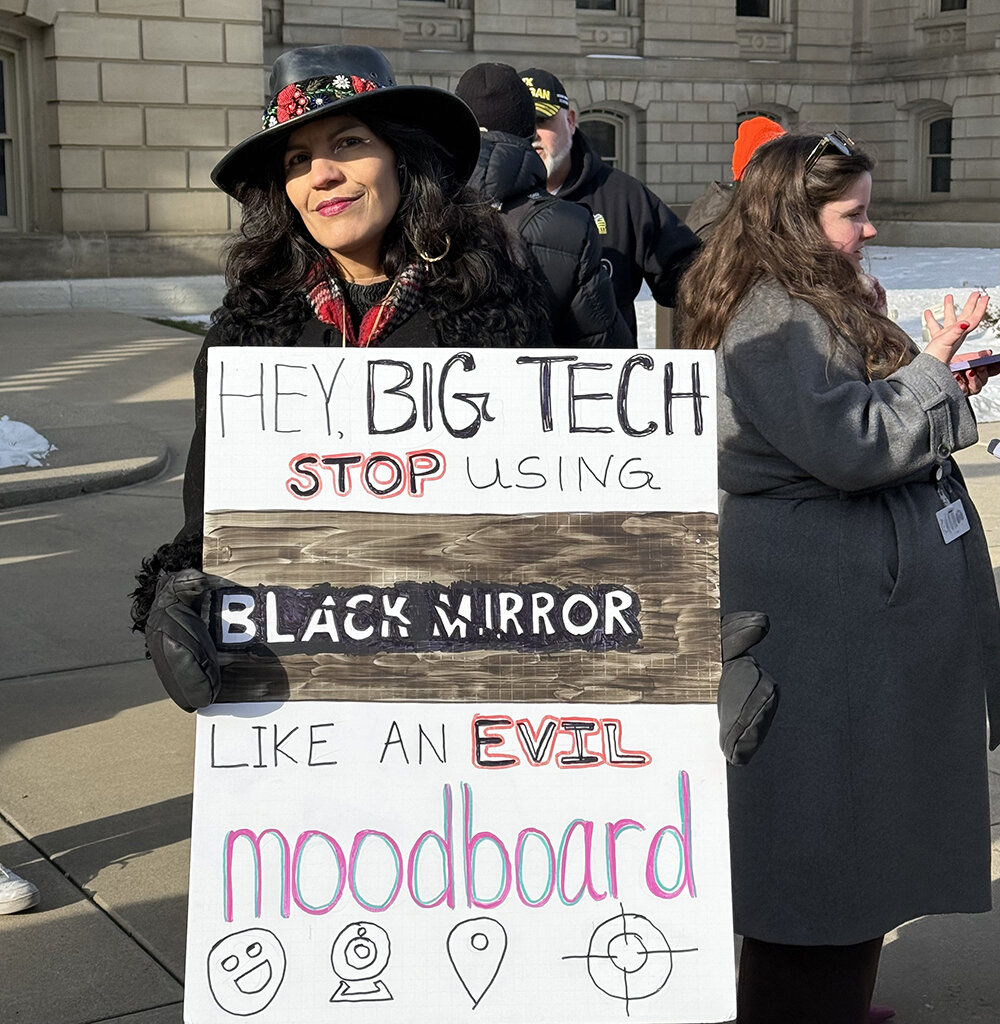
The project has been opposed by local activists at multiple protests, including one in December at the Capitol that brought hundreds together from across the state to oppose several data center developments.
At a community meeting about a month ago, Deep Green and the BWL revealed that the facility would have a 16MW fuel cell power plant onsite, which would be built by Deep Green and owned by the BWL. It would help avoid congesting the power grid, and be more climate-friendly than burning gas for all of the energy, but the fuel cell plant being a better-than-a-worse-option hasn’t made climate activists feel happy.
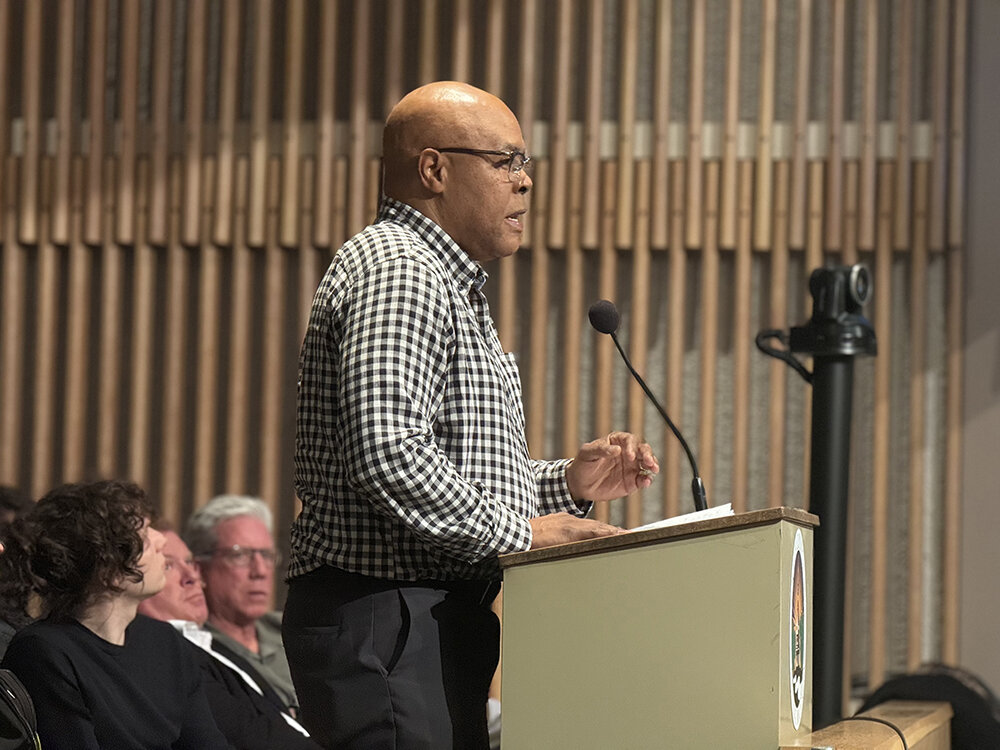
Nichole Keway Biber, an organizer with Clean Water Action, was at that protest and the Feb. 9 City Council meeting. She told City Pulse last week that she opposed the project, arguing that the parking lot should be used for something other than a data center.
That lot has sat empty for decades. One development was proposed for it around 2008, a mixed-use development called “Lansing Gateway” that would have included home and office spaces and a green roof. It quietly disappeared.
City Pulse was unable to get in contact with anyone directly involved with that project, but LEAP CEO Bob Trezise said it would have been difficult. The site is “very tough,” he wrote in an email, with loud traffic, car exhaust and a “quasi-rundown industrial/commercial feel to the area,”
It fell victim, like so much, to lack of financing due to the Great Recession,” he said. “But even then, I don’t know whether it really could have come to fruition.
Trezise said Deep Green offers the chance to turn “a useless city parking lot” into “a cash cow for important city services,” with Deep Green’s property taxes and return on equity payment, via BWL, to the city expected to be well over a million dollars a year.
Keway Biber said if she were offered a choice between the data center and an eternal parking lot, she’d choose the parking lot over having “a power plant, increased emissions and a foreign company without a lot of experience, that we really have no idea what the data will be used for.”
A power plant in the stadium district?
When Deep Green first started scouting out Lansing, a realtor offered the former Cooley Law School campus as a potential location. That proposal didn’t last long, Bean said, with the city telling Deep Green a location right in the middle of downtown wouldn’t get approved.
Deep Green CEO Mark Lee said last week that concerns from the local community and knowing that the building could have a better use downtown led Deep Green to step away from the location, working with the city to find the current spot.
The location is still close to residential areas, like the Cherry Hill neighborhood just across the river. Cherry Hill Park is fewer than a thousand feet away.
Peffley has said multiple times he hopes to see the fuel cell plant designated as “clean energy,” something he’s in talks with some state officials about. It’s not an unprecedented designation, but it is a controversial one, since fuel cell plants still use fuel and generate carbon dioxide.
Should Cherry Hill residents be concerned about a 16MW fuel
cell power plant being built just across the street?
Douglas Jester is managing partner at 5 Lakes Energy, a former senior policy advisor of the Michigan Department of Energy, Labor, and Economic Growth, and a former BWL commissioner. He said a fuel cell plant operating correctly would only be so “clean,” since it still generates about 60-70% of the carbon dioxide that burning the fuel would. But in terms of conventional air pollution, it’s night and day.
“The reduced pollution of conventional pollution, sulfur and nitrogen oxides and particulates, is important,” he said. “Those are significant public health concerns. And I don’t want to dismiss that, but in terms of greenhouse gas emissions, the fuel cells are only a partial solution.”
A Cherry Hill resident, though, shouldn’t be any more concerned by that CO2 than a resident of any other neighborhood in any other part of the world, because the CO2 will spread into the atmosphere globally within a matter of days.
That’s if everything works correctly. Doug Bessette is worried it won’t.
An associate professor in Michigan State University’s department of community sustainability, he studies community support and opposition to large-scale renewable energy projects, and said concerns around data centers have been “a natural extension” of that work.
“Regarding the methane fuel cells, there’s the plan and then what actually occurs,” he said. “When it comes to data centers, the two often aren’t aligned.
“I have concerns about the likelihood of Deep Green and BWL actually installing methane fuel cells, when we know that these technologies are in huge demand and face significant backlogs. And the backup power generation could end up being diesel generators if there are extenuating circumstances, which there nearly always are.”
Bessette is also concerned about the increased greenhouse gas emissions.
“BWL simply can’t be the ones leading our climate initiatives,” he said. It’s not in their interest. It has to be City Council and the mayor. They need to lead.”
Who benefits?
Assuming data centers are critical infrastructure for the future — an assertion Deep Green made at the Council meeting — the Deep Green project has clear advantages over other plans.
Its power usage effectiveness (PUE) would likely be 1.03-1.17, Lee said, with data centers averaging around 1.8, according to the National Renewable Energy Laboratory.
As a small, multi-tenant facility, it won’t be housing the workloads used to power controversial, large AI technologies, instead being used for local and regional use cases like research. That also makes it less likely to go belly-up in the event of a theorized “AI bubble.”
Then there’s the heat donation, the relatively small size, the closed-loop water-glycol cooling system that would minimize water usage, the fuel cell plant for the BWL, the Pennies for Power donation and the $1 million in additional revenue to the city, 10% of which could go to a new city housing fund if an ordinance proposed by Council President Peter Spadafore goes through.
But why?
Deep Green’s leaders market themselves as enterprising do-gooders, happy to put in the extra time, money and effort to mitigate their climate impact and help communities.
On the business side, though, they argue that heat reuse helps counteract an inherent problem with data centers: Once built, they’re basically just a big box that guzzles power and makes money.
In a Q&A on Deep Green’s own blog, Lee said local opposition to data centers in the U.S. necessitates clear, local value in proposals.
“People believe that data centres put strain on the grid without benefiting them, and in some cases, this is true,” he said. “So, if new data center builds can integrate with communities and offer clear local value, this is a game-changer. Heat reuse models embed data centres within local ecosystems; this is a clear advantage in terms of securing approvals and ensuring long-term viability.”
Asked about this quote in person, Lee said Deep Green remains active in the communities it operates in beyond continuing to donate heat. In Manchester, for example, it does not just heat a swimming pool with one of its smaller data centers, but offers free lessons to an underserved population in the community. It has committed to a carbon reduction program by helping to reforest an area of the community. It partners with the school for several educational programs.
These were not part of the approval process in Manchester, Lee said.
There are substantial differences between the U.K. projects and the Lansing one, though. Alongside being much larger and in a different country, the Lansing project is the first of a planned “pipeline” Deep Green wants to build in the U.S., with seven sites currently being considered.
It’s not possible to know whether Deep Green will continue coming up with more community benefit projects. But the new obligations it has agreed to in contracts does necessitate some things, at risk of being taken to court: It will make a $1 million yearly return on equity payment to the city via the BWL; its closed-loop cooling system will minimize water use to that of roughly 15 homes or a small restaurant; it will pay all required energy infrastructure costs upfront; it will pay standard published rates for energy and water; it will comply with downtown zoning noise limits and its building aesthetics will conform to the surrounding community.
The promised 15 long-term jobs are not contractual but are a conservative estimate, Lee said, essentially the bare minimum to run the place.
Cutting-edge or on the edge of obsolescence?
Not far from the planned site, Jerry Norris operates The Fledge, a local community center, on the east side.
Norris knows a thing or two about tech and data centers: He’s started three globally operated tech companies. He’s not against AI and other similar tech, and uses those tools to do coding and previously heated The Fledge in part by mining Litecoin, until last year.
Norris is a proponent of edge computing — distributed computing that essentially brings smaller, computing closer to the person using it, rather than sending it across the country to the whirring computers in, say, Virginia’s Data Center Alley.
On a small computer called a Raspberry Pi and Google’s Coral processor, which cost him less than a combined $200, Norris can run open-source large language models similar to closed-source models like ChatGPT. He can power the whole operation with solar panels, and he can do it all without his data ever leaving the building.
It’s a vision that’s strikingly similar to a vision of Deep Green founder and CIO Mark Bjornsgaard expressed to the BBC last month, in an article titled “Honey, I shrunk the data centres: Is small the new big?”
Bjornsgaard foresees a future where every public building houses a small data center, connected in a large network, and generating heat.
“London is just one giant data centre that hasn’t been built yet,” Bjornsgaard said.
Norris sees a similar future.
“The way I see us using AI would be to help us improve how we distribute our food, to help us improve how we manage our farm,” he said, “and I don’t think I need a big data center for that.”
His $200 setup powers those needs just fine.
“So if I have that for my AI, and you have that for your AI, and we let other people share in that through a federated internet, then data centers become a thing of the past, not the future.”
Asked about the incongruence between Bjornsgaard’s vision and the acre-sized data centers Deep Green is proposing, Lee said “the world isn’t ready for that yet.”
“The reality is that edge computing will come, and there are certain use applications where edge computing will come to the fore and be a more prevalent sort of way of building data centers,” he said. “You can see a world where data centers will be very small and devolved in the context of this situation, but I don’t think those use cases are prevalent yet, from a commercial perspective.”
He added the proposed Lansing location is very small compared to the large-scale data centers the industry is known for.
After hearing Bjornsgaard’s comments, Norris said that was a technology he could get behind.
“When they’re there, then come back to Lansing,” Norris said, “because that would be a lot better than what they’re proposing right now.”