Turkey bone soup for the holiday soul
Thanksgiving marks the start of the holiday season, and a parallel season of enhanced leftovers consumption. It can be a freewheeling, chaotic time, when pieces of feasts and roast beasts are …
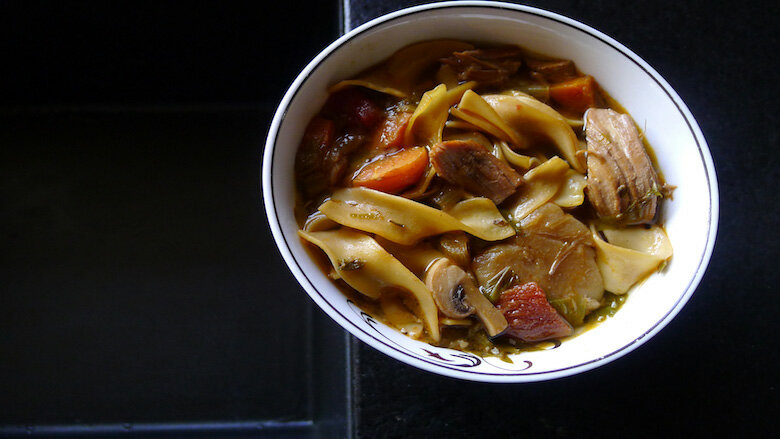
Thanksgiving marks the start of the holiday season, and a parallel season of enhanced leftovers consumption. It can be a freewheeling, chaotic time, when pieces of feasts and roast beasts are combined and reheated. But amid improvisations like refried mashed potatoes and microwaved kale salad, the most sacred act of leftovers season remains constant: bird-bone soup.
The process begins when the table is cleared. As the uneaten sides and desserts are wrapped for the fridge, the motivated host will cut the remaining meat off the carcass, pluck leftover bones from the returned plates, and add the bones and sinew to a stock pot. If you get started before the dust settles, that’s one less large object to cram into the fridge.
The first step in cooking a bird-bone soup is to prepare a stock from the carcass, herbs and aromatic vegetables. What you do with that stock is up to you. I recommend turkey noodle soup.
For me, bone-broth soup isn’t just a holiday ritual. It’s a literal way of life. Whether it’s from a deer, cow, pig, fish or rotisserie chicken in a plastic bag from the supermarket, I’m loath to throw away a bone without simmering it first to extract its goodness.
If you have a pasta pot with a removable insert drainer, I recommend using it. That way, you can keep simmering your bones in the soup for as long as possible, even after you’ve added the rest of the ingredients. If you don’t have a pasta pot, use a colander to strain the finished stock before making soup.
When I make bone stock, I try to cut, break, smash and otherwise reduce the size of the bone pieces as much as possible. This facilitates the release of marrow and other beneficial bone particles.
But going to such lengths, admittedly, is not necessary. If you aren’t up to bone breaking, don’t sweat it. There is, in fact, a decent argument against breaking the bones: Leaving them intact creates a clearer and more delicate stock.
But we’re making leftover turkey noodle soup, which, like leftovers season itself, is a raucous affair. It may be clouded by dissolved potatoes. There may be little bits of stuffing. Everything suspended in a glorious, semi-solid matrix of bird-broth-bloated egg noodles.
Turkey bone soup, with noodles
If you can make this recipe without a single trip to the store, do so, even if it means skipping the parsnips, mushrooms or hoisin sauce. If you don’t have wine, use a little vinegar for the acid. But if you don’t have onion, carrot or celery, then you’re going shopping. Ditto the noodles.
- One turkey (or other bird) carcass
- Six sticks celery: three chopped finely (about 2 cups), three cut in half
- Six medium carrots: three chopped (about 2 cups), three cut in half
- Two onions: one chopped finely (about 2 cups), one sliced in half
Four sprigs fresh thyme- Four sage leaves
- One 14-ounce can diced tomatoes
- 2 cups mushrooms, cut into quarters
- One parsnip, chopped
- Leftover veggies and pan drippings, if available
- 1 cup wine
- 1/2 cup soy sauce
- Salt
- Pepper
- Egg noodles
- 1 tablespoon hoisin sauce
- Three cloves garlic, minced
Fill a pasta or stock pot three-quarters full of water and place it on high heat.
Pull apart the carcass, bones and everything in between, yanking off the bits of cartilage and connective tissue and stripping the good pieces of meat. Keep the meat in the fridge.
Cut up the bones and connective tissue as small as you can with a pair of kitchen scissors, including the soft ends of the long bones. Smash what you can’t cut if you’re up to it, but don’t hurt yourself.
Broken or not, add the bones, along with the cartilage, skin, onion halves, large sections of celery and carrot, thyme and sage to the pasta insert or stock pot. Simmer for as long as time permits, up to 10 hours.
When it’s time to make the soup, remove the bones. If using a pasta pot, do so slowly so the bones drain into the pot, and set the insert in a container to catch further drainage. If not using a pasta cooker, strain the bones in a colander.
Add the chopped celery, carrot, onion, tomato, mushrooms, parsnip, wine, soy sauce, pan drippings, leftover veggies and meat to the pot and cook over medium heat. If using a pasta boiler, and if space permits, put the bones back in the soup while it cooks. Sip the broth every half hour or so to check the seasoning; adjust the salt, pepper and wine as necessary.
About 30 minutes before serving time, add the celery leaves, hoisin sauce and garlic.
Now it’s time for the noodles. You can either add them directly to the soup or cook them separately and add them. Neither is a perfect solution: Cooking the noodles in the soup means leftovers will be soggy, while cooking them in water deprives them of the opportunity to get bloated by bone broth.
If using a pasta boiler, you don’t have to choose — you can dump the bones and use the insert to cook the noodles in the soup, adding them to each bowl as needed at serving time.