We could debate … or make it as difficult as possible
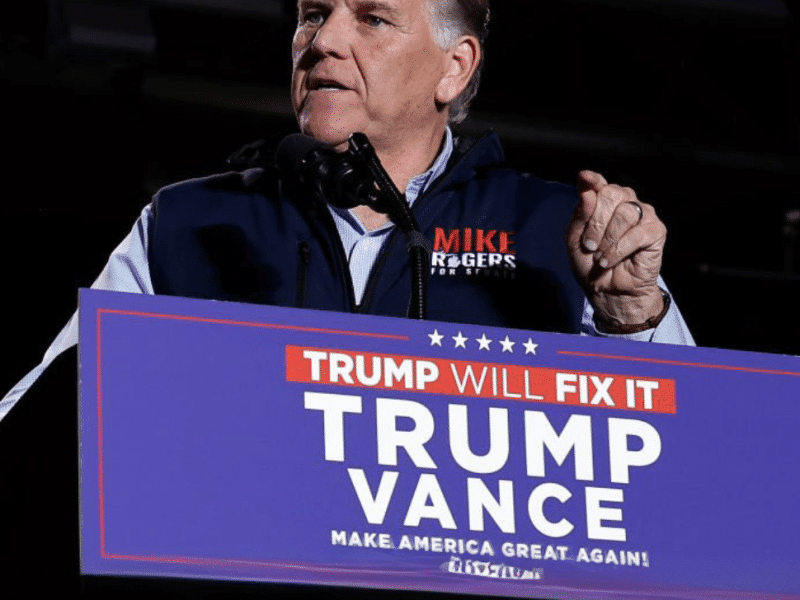
Mike Rogers this week narrowly avoided having an empty chair representing himself on a public stage for the second time in seven days.
The Republican nominee — unable to attend a U.S. Senate forum planned by a large coalition of Northern Michigan businesses this past Monday — hastily agreed to meet with the group on Oct. 23 instead, after the campaign gave the group the runaround for six weeks.
To recap, the Northern Michigan Chamber Alliance invited Rogers and Democratic U.S. Senate nominee Abdul El-Sayed, shortly after the primary election, to attend a Sept. 21 forum in front of their members.
If not, would a different time and date work instead?
El-Sayed confirmed almost immediately for Sept. 21. Rogers’ team didn’t respond. For weeks, it was radio silence. Not a yes. Not a no. Just nothing.
Eventually, as Sept. 21 approached, the Northern Michigan Chamber Alliance — hardly a Democratic pressure group — was forced to advertise Rogers as merely “invited.”
Finally, the Chamber was told Rogers had another engagement on Sept. 21. Team Rogers suggested that Rogers could do something separately later, but didn’t offer a date that would work.
Frustrated that their members might not get an opportunity to hear from Rogers at all, Chamber officials told his team they would move forward with the Sept. 21 event and that he was welcome to attend.
There would be a chair on stage for him.
Remember, Rogers said no to a FOX 2 debate in Detroit the week prior with host Roop Raj. The station did the debate without Rogers anyway, basically giving El-Sayed an hour to share his thoughts in primetime to the state’s largest media market.
The Rogers campaign proceeded, behind the scenes, to accuse the Northern Michigan Chamber Alliance of running a partisan attack against Rogers.
If they were going to stick an empty chair on stage, they’d hold their own event in Northern Michigan, to spite the Chamber, and see “whose megaphone is louder.”
Ultimately, an intermediary from a different campaign came in and, less than 48 hours before the event, brokered a deal in which Rogers would meet with the Northern Michigan businesses on Oct. 23 in exchange for no empty chair.
Who would think that a Republican candidate for any office would go to the brink of war with a coalition of northern Michigan business groups?
And, yet, that’s where we are in 2026. Community forums and debates — in which voters can size up candidates side by side — have become the exception, not the norm.
Campaigns have made the calculation that it’s better to avoid any direct interaction with their political opponent unless there is a clear advantage for doing it. Helping voters make their own decisions is not part of the calculus.
Abdul El-Sayed is doing nearly any and every public appearance because he’s very engaging on the stump and he’s meeting as many people as possible one-on-one to show that he’s not a scary, dangerous guy.
Gubernatorial candidate Jocelyn Benson, during the primary, stiff-armed Roop Raj and FOX-2. She let her primary opponent Chris Swanson debate an empty chair for an hour. Why not? She was the frontrunner. Why give her opponents any oxygen?
Likewise, John James blew off nearly every Republican forum during the primary. Why not? He was the frontrunner. Why give his opponents any oxygen?
Moments after both won their primary, James now the underdog, called for five debates. Benson agreed to two … both in October, after absentee ballots had already gone out.
Dodging isn’t limited to big races, either. Tom Barrett and Will Lawrence are debating Oct. 6 … the same day as the first Benson-James debate.
In the Secretary of State race, frontrunner Garlin Gilchrist agreed to debate opponent Tony Forlini … at the same time as one of the two U.S. Senate debates.
Frontrunners avoid debates because they have little to gain. Underdogs demand them because they have little to lose. If a debate does occur, campaigns increasingly prefer that it happen after absentee ballots have arrived or opposite another major political event.
Why make it easy for voters to do their due diligence?