Clarity out of chaos
A muscular whack of a bass drum jolted the Wharton Center audience to attention Friday night (Nov. 7) in the first second of Michigan State University composition Professor Zhou Tian’s “A …
Lansing Symphony, Ray Chen dive into big-time Bruch and Bartók
A muscular whack of a bass drum jolted the Wharton Center audience to attention Friday night (Nov. 7) in the first second of Michigan State University composition Professor Zhou Tian’s “A Thousand Years of Good Prayers.” Tortured roars from the brass section unleashed a sonic dragon into the hall.
You were expecting maybe the overture from “The Magic Flute”?
A Chinese proverb says it takes a thousand years of prayer to bring about a good relationship, but who has that kind of time? Tian compressed this ancient idea, the basis for the piece, into about eight-and-a-half absorbing minutes.
The music’s initial turbulence gradually gave way to harmonious tranquility, but it took some heavy lifting to carve out that serene space. A torrent of thoughts, dreams and fears ebbed and flowed, with the dragon of chaos always lurking at the margins. The buffeting was intense, but it didn’t take long for the music to reveal its tender heart. By and by, a thick and lush string section poured out a gorgeous, yearning melody that dimmed to dusky hues and ended in stillness.
It’s great to have locally based talents like Tian, whose music is appreciated around the world, to put a fresh perspective on the older masterworks that make up most of the Lansing Symphony Orchestra’s repertoire. Gradually distilling clarity from chaos, Tian’s music proved to be a microcosm of the whole evening.
It was a classic demonstration of outgoing music director Timothy Muffitt’s stealth teaching mode. You could hear the logic, follow the moving parts, and still be swept up in the storm. The more complicated the music became, the harder they worked to pull the focus and polish the lens.
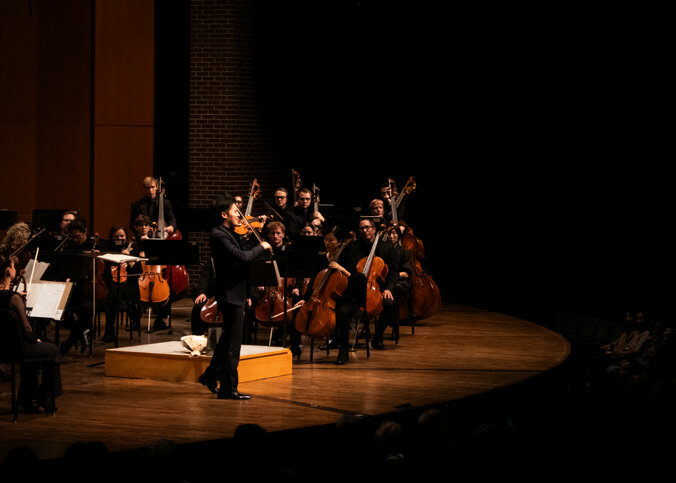
To bring Max Bruch’s First Violin Concerto to full blast, the orchestra brought a formidable gun, internationally celebrated violinist Ray Chen.
Even with 70-odd musicians crowding around him, Chen connected with the audience on an individual level. You knew he was giving a performance, but he didn’t let you sit back and regard him from afar. He used everything, including body language and facial expressions, to lock you into the moment. Emotionally, Chen was all over the place, now grimacing, now smiling, now relishing the orchestral riots he incited, like a kid dropping a water balloon and watching it smack passers-by. It was almost unsettling to watch him shift from light frolicking to rock-style shredding.
His fiddling, however, was as centered as it could be. Every note, however fleeting, hit the bullseye. The high register was honey, the low register was chocolate, and everything in between was red, red wine.
Chen got a rare triple standing ovation for his exertions. To ice the cake, he played an excerpt from a remarkable sonata by Belgian composer Eugène Ysaÿe that seized upon Baroque bits of Bach and tore them open like settee cushions. Ysaÿe’s bifurcated, bipolar oscillations, embodied by Chen’s “Obsession” (his name for the piece), played right into the chaos-and-clarity theme of the evening.
Without said clarity and precision, Béla Bartók’s mosaic-like Concerto for Orchestra can come off as a mess, a series of seemingly arbitrary gestures. 20th-century orchestral music moved into strange new realms of self-parody, sarcasm and bitter tragedy, side by side with the triumphal and optimistic material the orchestra was expected to produce.
Muffitt and the orchestra etched it all in glass and steel, laying out Bartók’s musical mosaic in all its rich ambivalence.
Ominous soundings from the double basses and mysterious flutterings from the woodwinds quickly escalated into tense, angular outcries from the violins.
The music coalesced into sharply etched counterpoint, setting the stage for an epic tug of war between chaos and order, between violence and tranquility.
In the second movement, a muted fanfare in the brass section floated on a razor’s edge between seriousness and mockery, followed by a completely earnest and noble horn benediction.
The third movement gradually materialized in a mysterious mist of harps and woodwinds, only to collapse in a massive outcry from all corners. The violin section corkscrewed higher and higher, like Icarus futilely trying to fly.
Muffitt and the musicians didn’t try to smooth over the music’s strange contradictions and non sequiturs. They seemed to delight in lulling you into relaxation in the fourth movement with playful, searching noodling and a luscious melody cushioned by two harps, knowing full well the idyll wouldn’t last long.
In a musical landscape where sarcasm and parody jostle with earnest expressiveness, it’s not so strange that Bartók took a minute to parody a fellow 20th-century composer, Dmitri Shostakovich. But this may be my only chance to go on record about this, so here goes: Bartók’s ham-handed, cartoony parody of Shostakovich’s Seventh Symphony, complete with gratuitous trombone fart, is utterly lacking in class and crudely written to boot.
It wasn’t the Lansing Symphony’s fault. It’s in the score, so they had to perpetuate this atrocity, and they did it with panache.
Unlike Bruch, Bartók’s heart is not on his sleeve, although passages like that Shostakovich bit give you a good look at his spleen. Figuring out what he’s up to is just part of the game. The last movement of the concerto is a stunning example of how to whip a stupendous, shuddering paroxysm out of absolutely nothing. The orchestra coursed like an All-American running back through this furious cavalcade of seesaw musical episodes, leaving questions of interpretation to the flattened and dazed listener.