
A conversation about artificial intelligence
It’s a simple question, asked in a small room in the basement of the Lansing Community College library.
“So,” adjunct sociology professor Elizabeth Robison said, “how do you see AI …
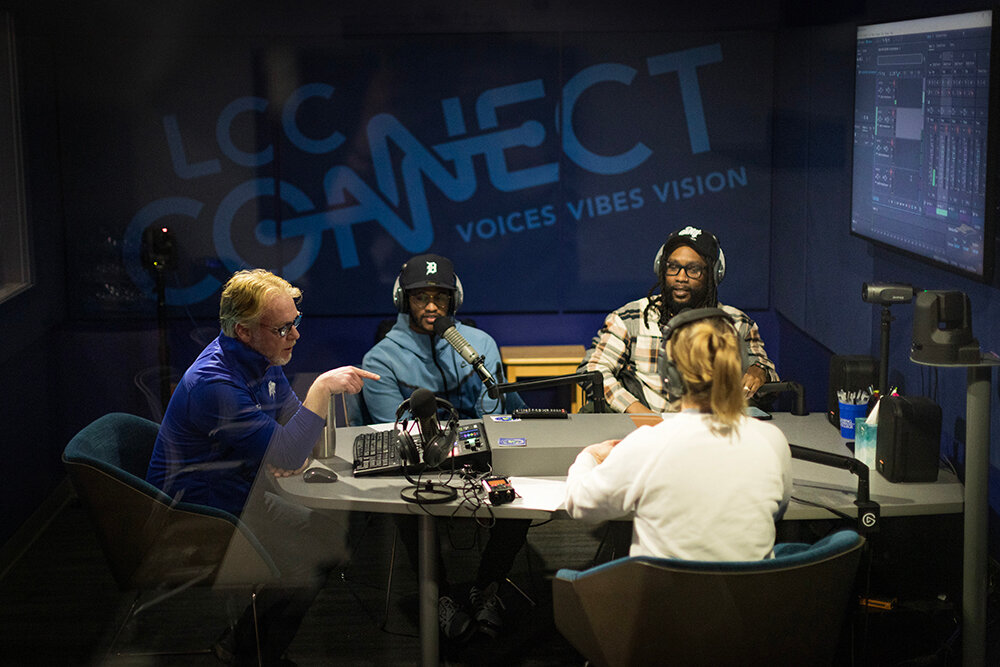
It’s a simple question, asked in a small room in the basement of the Lansing Community College library.
“So,” adjunct sociology professor Elizabeth Robison said, “how do you see AI affecting our society right now?”
On Sociological POV, a podcast moderated by Robison where students and community members discuss social and educational topics, Robinson waded into the ethical use and social impact of artificial intelligence.
“I think it’s going to affect the way we interact with each other, the way we think, and even how we arrive at the conclusions we form,” said Guutama, 32, an LCC student who uses a first name. “It’s going to be such an integral part of our lives that I don’t see any other way around it, honestly.”
Guutama was joined by Patrick Rogers, 37, a Central Michigan University student in social work.
“I’m pro-AI,” Rogers said. “I’m pro all of this tech stuff. But I think what’s going to give it the biggest bump, a real boost, is how it teaches us to learn better.”
It has become impossible to avoid hearing about or debating AI, which summarizes people’s morning emails, sparing them the bother of reading their own messages.
For Rogers, AI “will meet the individual where they are.” It will revolutionize methods of teaching and learning, while its social impact is something we will be unable to resist, he said.
AI and education
“So, you mentioned education,” Robison said to Rogers. “Do you think it’s destructive at all in education?”
Several recent studies show that a large percentage of students around the world are relying on AI for brainstorming ideas, asking it questions like a tutor or using it to study for exams or quizzes.
For teachers, AI makes it tricky to know when students are using ChatGPT on assignments, tests or in class.
In an opinion piece for the Spanish newspaper El País, Professor Santiago Schnell, provost of Dartmouth College, argues that generative artificial intelligence has not created a new problem in education but exposed existing ones. The fact that a student can complete an assignment in a matter of minutes using ChatGPT is not a new but , it surfaced an existing problem: homework assignments do not measure learning.
“This is what AI is forcing us to see clearly: there is a fundamental difference between producing a result and forming a judgment,” Schnell wrote.
Guutama sees AI as destructive to education. An AI chatbot could essentially replace a student’s coursework and even attendance in online classes.
“I’ve seen it even in my personal work,” he said. “And some of the things that I do, if you don’t challenge the AI to help you think or come to different conclusions, then you will just rely on it as a tool to arrive at your own conclusions, leaving you pretty much mentally handicapped.”
For Rogers, AI is about the proper handling of information. While he shares Guutama’s concerns, he believes we are still at the beginning, and AI, with its capacity to learn over time, will find a way to teach.
Drawing on an experience where his son asked him knowledge-based questions, Rogers commented on how ChatGPT helps to provide answers in a way a 7-year-old would understand. “It proceeded to give the concept in a way that they understood,” he said.
“So, what’s the point of going to school?” Robison asked.
Adapting to AI
Sally Welch, LCC’s provost, said that there is no perfect way to know if a student uses AI. However, she hopes students will use it as a learning tool.
“The AI checkers are not reliable,” she said, “We ask faculty who believe a student used AI to have a conversation with the student about their assignment. This has been an effective, but not perfect, way to determine if a student has used AI.”
On occasions, Robison has caught students using AI for assignments because of specific prompts they had fed into ChatGPT, such as “make this text more casual,” “make it not sound like AI,” “give it a casual university tone,” or “make it sound more human.” Were it not for these small slip-ups, she would have no way of knowing who was using AI and who wasn’t.
Although AI is prone to error, Robison notes that many students place their trust in it as an authoritative source of knowledge, failing to consider that AI makes mistakes and can introduce errors into their assignments.
According to a study by Inside Higher Ed, the most common reason college students to use AI to get good grades, followed by saving time and by not caring about academic integrity policies.
Robison said there is a tremendous expectation to get top grades. “It’s not good for society to have everyone at the high end flooded, where you don’t know who is doing a good job, who is doing the best job with their work.” However, with AI, it is no longer possible to know with certainty whether students are doing the job well or not.
“We have to change what the job of the teacher is,” she said. “It’s not necessarily about what I know anymore because AI can look up more information than I know.”
Redesign and reconsider
Both participants, Rogers and Guutama, said they’re uneasy about the future of the education system as we know it.
Education as we know it could become obsolete, but it is too premature to say, Rogers said. Guutama is concerned about the poor state of the education system, including the dismantling of the federal Department of Education.
“How am I supposed to know that the career I’m in right now, or the degree I’m pursuing, is even going to be available in the future?” he said.
The answer could lie in redesign.
Before starting the podcast, Robison said she had been a fan of an artist and felt cheated when she discovered the artist was highly likely to be artificial intelligence.
She describes a growing sense of frustration among students, families and teachers, along with a perception that communities do not fully support the education system. At the same time, schools are often blamed for broader social problems.
“We need to change how we’re doing things if we want an equitable society. You know that’s what public education was for,” Robison said.
Welch said LCC is adapting. Professors and faculty can choose one of three options. Option 1 does not allow students to use AI at all on any homework or assignments. Option 2 allows the use of AI on certain assignments but students must cite their work. Option 3 allows students to fully use AI in the course, while also requiring them to cite their AI use. This past fall, she said, the majority of instructors chose options 1 and 2.
“On the professional development side, we have had keynote speakers and panel discussions on campus regarding AI and using AI in teaching,” she adds. “This spring term, our Academic Senate had each division present how they are using AI in their work. The presenters were faculty and staff. We also had a faculty fellow in the Center for Teaching Excellence assigned to help faculty with AI.”
“Most of the national conversation has focused on helping students be prepared to use AI in the workforce, developing AI skills, and finding ways to use AI to teach critical thinking and problem-solving, she said. “For me, I want to think of AI as another tool in our toolbox for teaching and learning.”