
In Lansing, activists are solidifying actions to fight ICE:
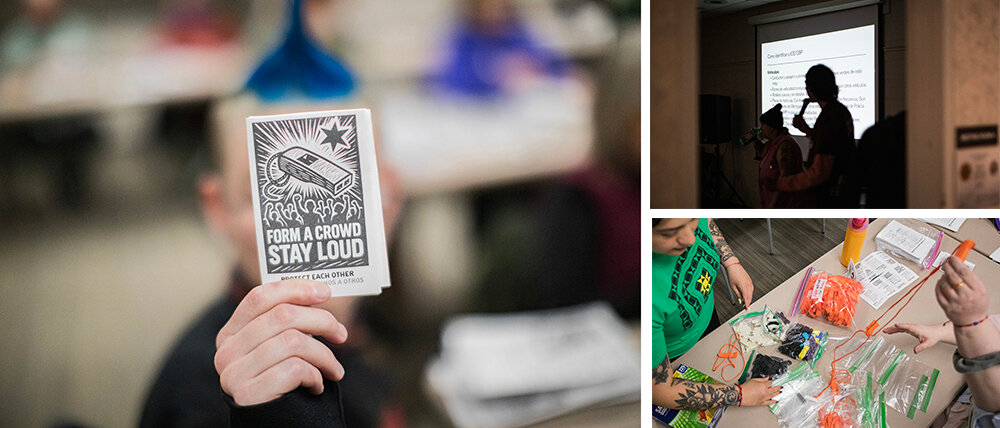
Lansing residents filled a basement room at the city’s downtown library on a Saturday afternoon in March for an orientation on how to identify ICE and CBP vehicles and agents.
The orientation …
‘Only the community will save the community’
Lansing residents filled a basement room at the city’s downtown library on a Saturday afternoon in March for an orientation on how to identify ICE and CBP vehicles and agents.
The orientation was conducted in both Spanish and English by local mutual aid and ICE watch activist groups. The main activity — assembling bagged whistle kits containing small leaflets and a zine with the slogan “Form a Crowd, Stay Loud” on the cover — kept everyone working side by side.
The session also provided information and contact details for rapid-response groups, offered instruction on the use of whistles and urged attendees to join their actions.
“It is a way to educate people so they can report the presence of ICE — and their abductions,” Diego Morales, a 26-year-old local activist, told City Pulse. “Because we aren’t entirely sure about ICE’s presence here. We don’t know. We haven’t fully tallied it. If there is no one watching or reporting, we will never know if they are here.”
The blast of a whistle is a shrill melody that echoes through streets where immigration agents are spotted. Masked agents have been whistled at, and seen going after immigrant families, in cities including Grand Rapids, Dearborn, Pontiac and Detroit. Residents have gradually trained themselves to confront the potential violence of ICE arrests and the presence of the Border Patrol, engaging in daily “Migra Watch” routines, weekly distributions of whistle kits, the provision of delivery and transportation networks for immigrant families and financial support for families affected by arrests and deportations.
In Lansing, however, little activity has been observed. Any alleged instances can be counted on one hand. Activists and residents cite various theories, ranging from the potentially relatively low number of undocumented immigrants compared to other cities to political factors.
One of the most recent cases reported by the media involved CBP agents. On Oct. 9 of last year, agents were spotted conducting operations by residents in Meridian Township.
ICE has acquired a new detention center in Romulus and new offices in Southfield. In February, Michigan Attorney General Dana Nessel launched an online reporting form for residents to report evidence of illegal activity by federal immigration agents, citing concerns by Michiganders, from whom she had received more than 5,000 emails regarding immigration activity.
For Jonas, a 28-year-old local activist who didn’t feel safe using a full name, what’s happening in the country is an escalation of fear approaching Lansing, and that’s why activists are trying to organize more public events and reach more neighbors.
“We’re trying to do more outreach to spread the word about the hotline number and get people joining the rapid response chat if there’s a confirmed sighting,” he said. “Some of us have been going door to door at least once a week as a group, handing out flyers. We also hand out ‘Know Your Rights’ flyers.
“We get a call on the hotline or a report sometimes, and some of us will go and take a look. But we haven’t been doing daily patrolling. So far, it seems like there’s not enough ICE activity, and there’s not enough of us to make the patrols.”
Just as the orientation concluded, and everyone was ready to begin assembling the kits, a 28-year-old woman wearing a face mask, who goes by TH, raised her hand to address the group.
“We’ve all been taught to not really get to know the people around us,” she said. “Those people, our neighbors, are scared, and they need safety. And it’s really important to get to know each other. I can’t stress enough right now on how important it is to get to know the people around you.”
For TH, a Lansing resident, an isolated community makes it easier for the government to act violently against the people. If immigration agents take someone away from an apartment complex or neighborhood, there will be no outcry or reporting of the abuse if there is no connection among the neighbors, she said.
“We very much live in an isolated society where, because there aren’t third spaces, because you have to pay for things to go outside, and because we don’t have public infrastructure where people have natural places to commune with each other, we’re not talking to each other, and it creates this very isolated society,” she told City Pulse.
Nearly 3,000 federal agents were deployed to Minnesota earlier this year — sometimes indiscriminately firing tear gas and arresting anyone who stood in their path — which escalated into the deaths of two American citizens and the detention of thousands of immigrants.
Activists and neighbors have begun using new ways of communication and surveillance to stand more united than ever. The spirit of mutual defense is contagious, they said.
For Janet Nuñez, 30, a librarian at Michigan State University, only the community will save the community.
“At the end of the day, they will look after each other and take care of each other,” she told City Pulse. She was born and raised in Santa Cruz, California, in an immigrant household and community where it was common for neighbors to take care of her or ask for groceries when needed.
“It was almost kind of a shock to not see people talking to each other here in Michigan,” she said. “It has made it so that we’re scared of each other instead of our common enemy, which is those in power. I think this is one of the first events here in Lansing, and it is the start of something that will become stronger.”