
Joshua Gersen brings disciplined emotion to Lansing Symphony
It would have been fun to report that the Lansing Symphony Orchestra, guest conductor Joshua Gersen and violinist Will Hagen crushed it Saturday night (Nov. 21).
But they didn’t crush it. They cupped it, in their steady and strong hands, and gently breathed on it, as if it were a wayward warbler from the Arctic in search of warmth.
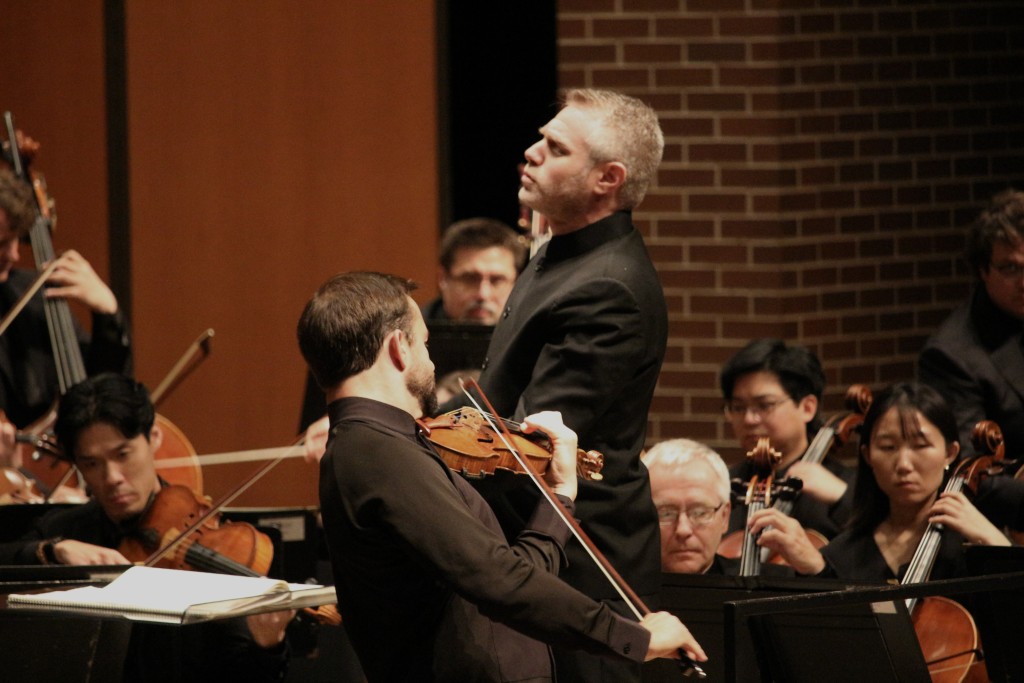
“It” was indeed a visitor from the north, the fragile, sincere, nakedly confessional violin concerto of Finnish composer Jean Sibelius.
Looking at Gersen, a no-nonsense conductor with an almost military bearing, and the youthful, bearded Hagen, raring to go and coiled with energy, you’d think a bit of a rumble was in the offing, but these two badass dudes and the orchestral home team weren’t here to flex their musical muscles. They gave the concerto a tender, committed performance of breathtaking delicacy.
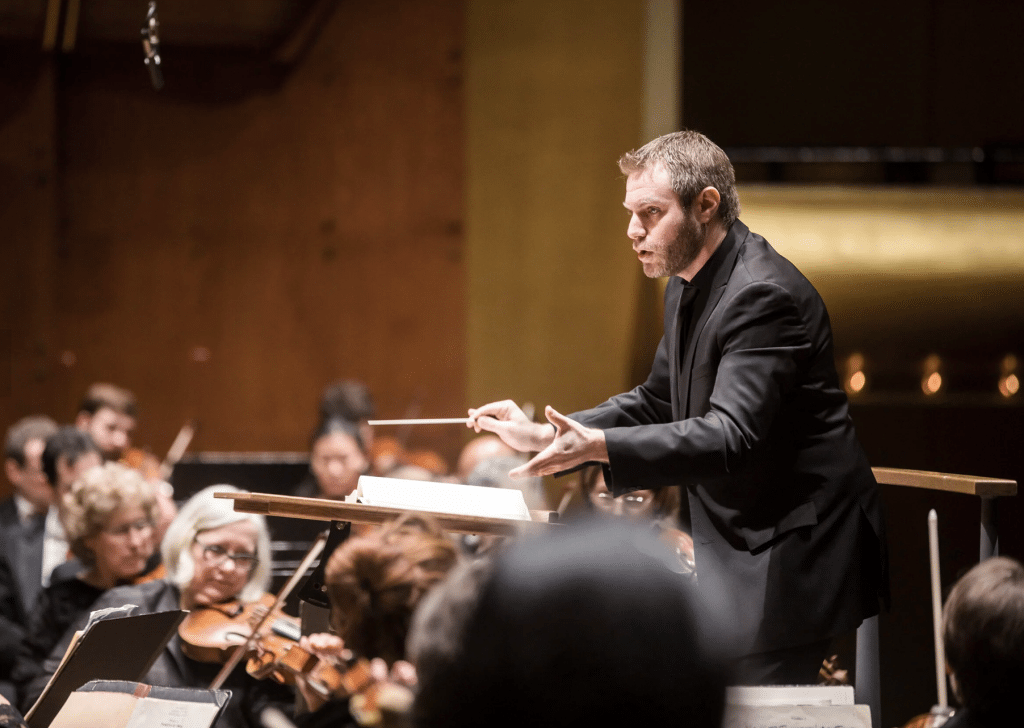
Gersen, the third of five guest conductors vying for the post of LSO music director, is not a charisma-driven maestro, but on Saturday night, he was the embodiment of musical precision and disciplined emotion.
At every moment, from the most hushed to the most boisterous, he and the orchestra were saying something meaningful — to each other and to the audience.
Everything Hagen did had an emotional underpinning, a reason for being there. If he stretched out a note, it wasn’t just to exhibit his velvety tone, but to penetrate the mystery of that note. If he double stopped, playing two notes at once, it wasn’t because he was showing off, but because two notes were needed to convey a mixed emotion or complex thought. After an ecstatic run up the scale, he would back off just a hair on the last note, as if to invite the orchestra to respond, making it clear that this concerto is a deep dialogue.
Gersen discreetly managed the mercurial back and forth between soloist and orchestra with transparency and clarity. That dialogue took many forms, from full-on call and response between Hagen and the entire orchestra to tasty little exchanges with individual voices like principal bassoonist Michael Kroth.
Hagen’s warm tone got about 15 degrees warmer in the slow movement, when every note carried an almost desperate emotional weight. It was almost a letdown when the finale rolled in, with its bouncy dum-ditty-dums. But after such a prolonged, heartfelt penetration into realms words can’t reach, there seemed little more to be said.
Another sensitive, delicate performance opened Saturday’s concert. As a purely musical experience, Chris Rogerson’s “Noble Pond” is an absorbing tone poem, propelled by crosscurrents of bleak tragedy and lyrical beauty.
Gersen and the orchestra took their time and gave the music a grand, even cosmic, sweep while letting each granular detail twinkle on the horizon. A backstory, provided in the concert notes and alluded to by Gersen in brief remarks before the concert, tells us that Rogerson wrote the music in response to a real-life news account of a 5-year-old boy who was killed by a stray bullet while fishing with his grandfather.
You can’t un-know what you know. Music wrestles with tragedy all the time, but the specificity of this information made it hard to relax and accept whatever message the music could have conveyed. The boy’s death was a cruelly random and horrible accident. However earnest the intent, it made me queasy to see it co-opted as musical material for my comfortable contemplation. Gersen’s pre-concert comments on “overcoming adversity” didn’t connect the dots, either.
The last work on Saturday’s slate, Beethoven’s famous Fifth Symphony, carried no such baggage. This music is about Beethoven’s struggles — with fate, with love, with deafness, with Napoleon, you name it. It’s his party, and he can rage if he wants to.
As the da-da-da-doms of the famous first movement tumbled forth, things got slightly out of sync a couple of times, and there was a bit of juddering in the violins, but Gersen made sure the momentum never let up. After the prodigious energy of those four notes underwent fission into two notes, fusion into four again and was finally spent (at least in its purest form), a spacious sense of grandeur settled in for the rest of the ride.
After the triumphant finale, Gersen did something I’ve never seen a conductor do. Instead of dispersing individual acknowledgments from the podium like a bride tossing out a bouquet, he waded deep into the wilds of the orchestra like a pith-helmeted ranger in the veldt and hunted down each contributing soloist and section, beginning with principal oboist Stephanie Shapiro, whom he practically lifted by the collar for public celebration. (Shapiro nailed that famous bit where a big orchestral buildup suddenly comes to a stop and the oboe is left to drip dry for about 45 seconds.)
There was a lot to acknowledge, from the subsonic elephant rumbles of principal bassist Ed Fedewa and his crew to the defiant, elk-like blasts of the horns, who appear to be asking for the LSO to do a Wagner “Ring” cycle just so they can strut their stuff.