Lawrence hosts office hours, defends protest involvement and pushes for moratorium on data centers
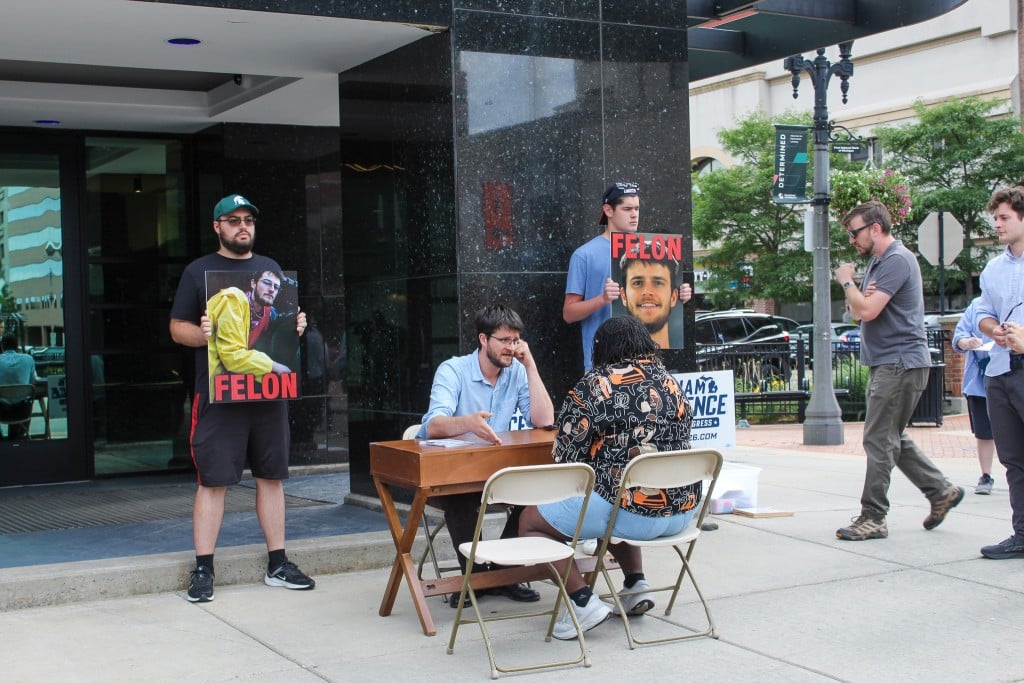
A few dozen constituents gathered outside of Rep. Tom Barrett’s (R-MI) office at 101 S. Washington Square Monday evening for an open question and answer session.
The session wasn’t hosted by Barrett’s team, but by his opponent in the Congressional race to represent the 7th district, William Lawrence.
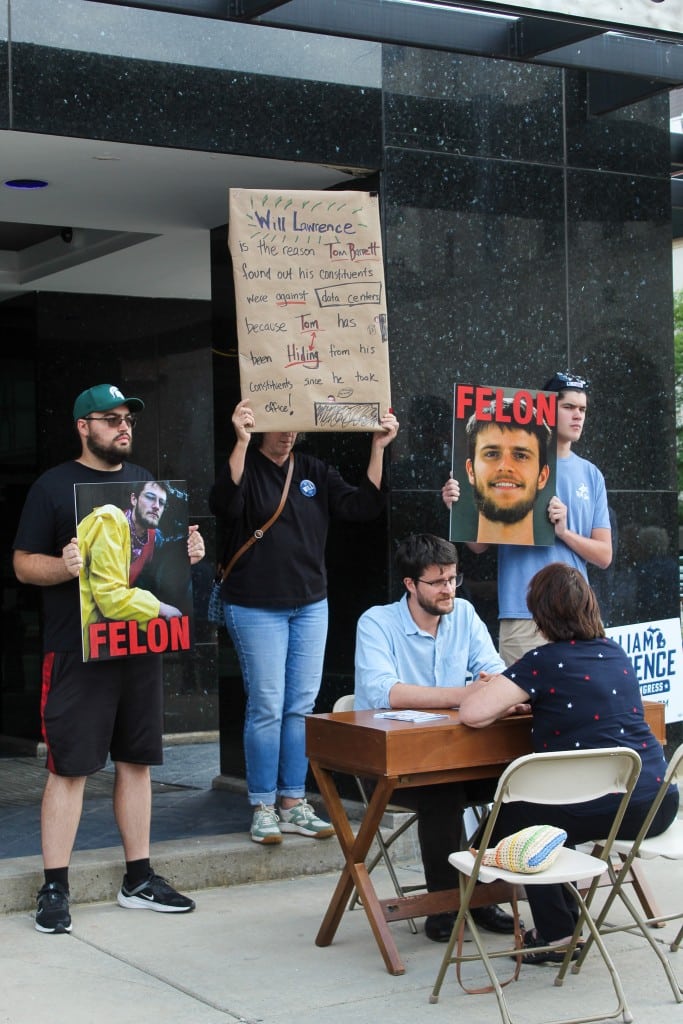
One attendee told City Pulse she appreciated the time Lawrence dedicates to meeting voters. “He doesn’t avoid any of the questions,” she said. “He tells his point of view.”
Lawrence, flanked by two counter demonstrators, answered questions from voters for about two hours before speaking to the press.
The demonstrators silently held up signs with images from Lawrence’s 2013 arrest.
Lawrence was arrested in 2013 for involvement with a protest at an Enbridge Energy pipeline work site. He was charged with the misdemeanor of trespassing and resisting and obstructing police, which is a felony. Lawrence ultimately pleaded guilty to the felony and the misdemeanor was dismissed. The conviction was expunged from his record.
Some demonstrators, who abstained from identifying themselves or any group they were with, said Lawrence “suppressed” his files.
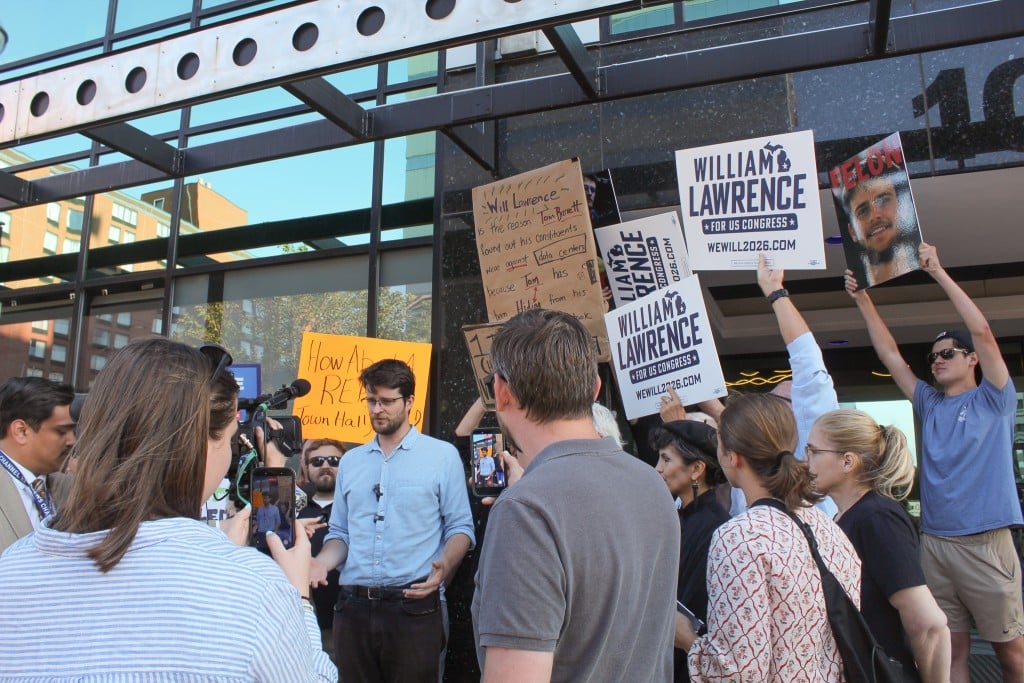
It wasn’t clear if all demonstrators present were part of the same group or there of their own accord.
Responding to other demonstrators’ questions about his arrest, Lawrence said he petitioned to have his records expunged “through the criminal justice proceedings along with thousands of other Michiganders through the opportunity to get a second chance at a clean slate.”
“It was something passionate,” Lawrence said to reporters, “but maybe not the most wise.”
When asked about the presence of demonstrators, Mya Legel, a campaign spokesperson, said “it comes with the territory.”
“Tom Barrett doesn’t show up,” she said. “We want people to show up.”
Lawrence criticized the congressman, calling the references to his arrest a distraction from “the criminality and lawlessness of this administration.”
“They want to distract from the fact that Tom Barrett voted to kick hundreds of thousands of Michiganders off of health care,” he said. “He voted for the disastrous war in Iran, which has caused all our gas and groceries to go through the roof.”
Barrett was one of only a handful of Republicans to have voted to curb the war in Iran, he voted three times in favor of a resolution to limit and wind down further military action in Iran without congressional approval.
Barrett introduced an Authorization for Use of Military Force in May that “would have given President Trump congressional authority for a limited time to successfully demolish, degrade, or defeat Iran’s nuclear weapons program without putting Americans boots on the ground or engaging in nation-building.”
However, Barrett was one of 209 House Republicans to vote in favor of passing H.R. 8800, an annual military policy bill called the National Defense Authorization Act. The bill includes $1.1 trillion in funding for the military, and received criticism from Senate Democrats because of a lack of concessions for reining in President Trump’s war effort in Iran.
The bill is still sitting in the Senate. It’s unclear whether the bill will be passed in time for the start of the new fiscal year.
“Tom Barrett is against the war only when it’s symbolic and will score him political points,” Legel said in a statement. “But when it counted, he voted to fund this war, driving up our costs on gas and groceries.”
If elected, Lawrence said his top priority would be connecting constituents with government services. “That’s something I can deliver, regardless of what the power balance is,” he said.
He described Barrett’s constituent services as “notoriously absent.”
Lawrence’s platform also calls for the passage of a 12-month federal moratorium on new data centers. Corporations are bullying local communities that don’t support the presence of data centers, and regulations “level the playing field,” the candidate said.
“[Regulations] will ensure that we’re not allowing artificial intelligence to put tens of millions of Americans out of work,” Lawrence said, “which is what the AI CEOs themselves say is the point of these data centers.”
When asked about his position on concerns surrounding the usage of Flock cameras, Lawrence called it “the most un-American thing I can imagine.”
“We have a strong history in this country of mistrust, of arbitrary surveillance by big government and big business,” he said. “But now we’re allowing this to happen for the sake of profitability of a few companies.”
“I think it’s time to get back in touch with an old American mantra, which is, ‘Don’t tread on me,’” he said, “and don’t spy on me either.”
Following the Monday session, Lawrence and his supporters headed to the Lansing City Council meeting, less than a block away, where Lawrence was one of dozens to speak in opposition to Flock cameras.
During that meeting, Lansing City Council members voted 7-1 on a resolution urging the city to cancel its contracts with Flock licence plate cameras.