
Never out of date
There’s been a lot of off-script crying at recent Michigan State University Opera Theatre rehearsals
Ricky Ian Gordon, one of America’s most celebrated theater and opera composers, …
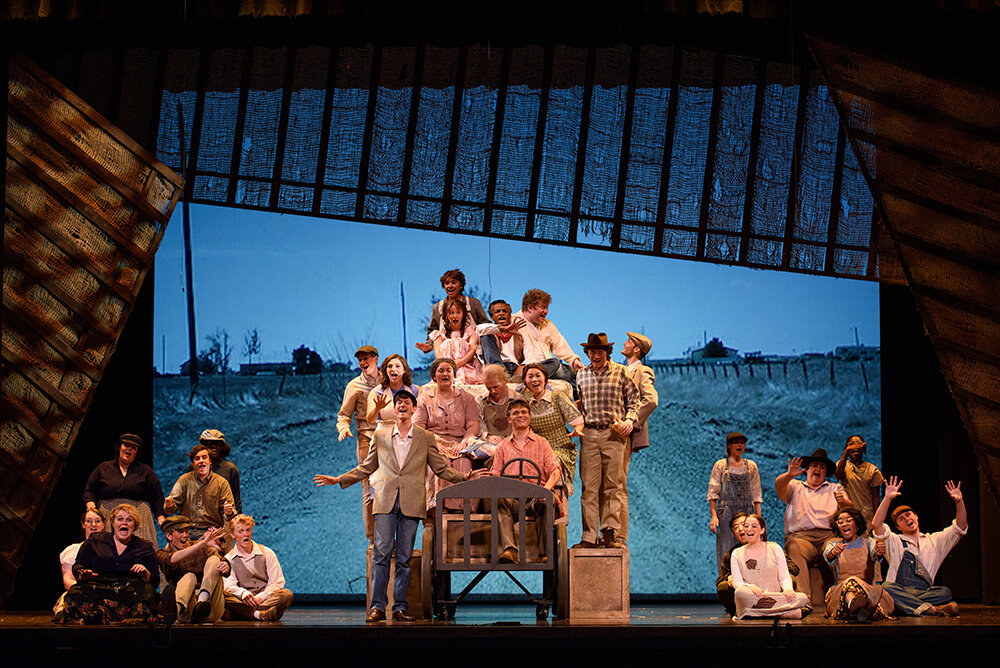
“The Grapes of Wrath”
7 p.m. Wednesday, Nov. 19; Friday, Nov. 21; Saturday, Nov. 22
3 p.m. Sunday, Nov. 23
Fairchild Theatre
542 Auditorium Road, East Lansing
(517) 353-5340
music.msu.edu
‘Grapes of Wrath’ composer guides students through dust storm of emotions
There’s been a lot of off-script crying at recent Michigan State University Opera Theatre rehearsals
Ricky Ian Gordon, one of America’s most celebrated theater and opera composers, is the culprit. Gordon is in town for 10 days to mentor this weekend’s student production of “The Grapes of Wrath,” his epic opera based on John Steinbeck’s novel.
It’s not that Gordon is treating the students harshly. He’s tough to please, but he’s no sadist.
It’s just that his heartbreaking, lyrical music, yoked to the tragic saga of the Depression-era Joad family, has moved many of the students to tears and will no doubt do the same for audiences this weekend.
“We haven’t gotten through a rehearsal without somebody crying,” director Melanie Helton said. Two casts will alternate performances. “Both of our poor Rosasharns have just now calmed down enough to do the scene where they feed a starving man without bawling.”
“The Grapes of Wrath” may be a period piece with jalopies and fedoras, but its relevance to American life has only sharpened since the opera was born amid the foreclosures and financial collapses of the late aughts.
Steinbeck’s migrant “Okies” are heckled by locals complaining of “shit-heel hicks” who “mess up the restrooms” and “clog up the highway.”
“Retards got more common sense/Government should build a fence,” they jeer.
“When you think about what we’re doing right now with immigrants in this country, it couldn’t be more resonant,” Gordon said during a break in rehearsals last week. “Let’s starve people, get them off their health insurance. It’s a mean-spirited country right now, and that’s what ‘The Grapes of Wrath’ addresses.”
The opera’s musical language ranges from the stern prairie melancholy of Aaron Copland to the high drama of Puccini and Verdi, with arias and set pieces that dip brashly into popular idioms and roadside Americana. A trio of waitresses breaks out in a Broadway-style showstopper, and a chorus line of used car salesmen ooze sleazy commercial patter.
Helton considers Gordon’s opus the “great American opera” that eluded composers like Copland, Leonard Bernstein and George Gershwin.
“Ricky’s ability for melody is just so overwhelming,” she said. “His knowledge of styles is encyclopedic.”
Helton worked with Bernstein and sang in the premiere of his only full-length opera, “A Quiet Place,” but the opera never clicked with audiences, and she admits that it now feels dated.
With Steinbeck, Helton said, Gordon struck source material that is, sadly, timeless.
Gordon spent two weeks at MSU in September, going through the score with students and conductor Octavio Más-Arocas. Last week, he returned to a warm round of hugs from students. Gordon and Helton will give preview talks before each performance.
“It’s a very deep experience,” Gordon said. “There’s been a lot of crying in the room. I think they feel really engaged in its ramifications, and they feel resonance in being an artist in a world that needs art.”
The work was commissioned by the Minnesota Opera and premiered in 2007 at the Ordway Center in St. Paul. That production, which also aired on Minnesota Public Radio, was a critical and box-office success (a Minnesota reviewer called it “overwhelming”). Successful performances in Salt Lake City, Pittsburgh and Houston followed, but the opera, like its characters, fell upon hard times when the Great Recession hit. Two years after it was born, the full-scale, three-and-a-half-hour version was beyond the means of most opera companies and universities.
“A piece of music about poor people was too expensive to produce,” Gordon said, emphasizing the irony.
But the heart of the opera never stopped beating. Gordon’s soaring, heartfelt music and the slangy, gut-punching lyrics of librettist Michael Korie distilled the spirit of the novel so well that it lived on, in limited or truncated versions, in dozens of varied venues from New York to Alaska.
(Korie will also be on hand at Friday’s performance.)
The first of these scaled-down versions was produced at Carnegie Hall in 2010 with the American Symphony Orchestra and narrator Jane Fonda.
“It’s been done in so many forms,” Gordon said. “People do it in whatever form they can.” In February, Gordon is going to Minnesota to develop a shorter “suite” version.
At MSU, Gordon and Helton are using a condensed, two-act version written for the Opera Theatre of St. Louis in 2017, reducing the original 60-piece orchestra to about 40 musicians.
The opera could hardly be staged in a more appropriate venue. The MSU Auditorium and its Fairchild Theatre were funded, in part, by a grant from the Depression-era Public Works Administration in 1938. (Viewed from Farm Lane, the building even looks like a giant 1930s radio.)
“We’ve been teaching the students a lot of history, including this building,” Helton said. “Eleanor Roosevelt opened it in 1938.”
Inside the theater, social realist murals by Charles Pollock, elder brother of Jackson Pollock, feature sinewy figures, idealized workers, toiling farmers and populist themes that harmonize perfectly with Steinbeck’s literary canvas.
Helton called it a “blessing” for the students to have Gordon in the house, not only for inspiration, but also to “read them the riot act about learning the music.”
Her friendship with Gordon goes back to the halcyon New York theater scene of the 1960s and ‘70s, when Bernstein was maestro of the New York Philharmonic and Broadway was rolling out blockbusters like “Funny Girl,” “Fiddler on the Roof” and “Hello, Dolly!” Helton loved to hang out in Gordon’s apartment, soaking up the energy. Since then, Gordon has walked a distinctive musical path, choosing non-commercial, humanist and literate material to adapt to the stage. His 2015 opera, “Morning Star,” follows a Russian Jewish family’s émigré journey to New York in 2010. His opera version of director Vittorio De Sica’s classic film “The Garden of the Finzi-Continis” premiered in 2022, a collaboration between the National Yiddish Theatre Folksbiene and the New York City Opera. He has composed and performed his own songs and written music inspired by poet Langston Hughes and novelist Marcel Proust.
MSU Opera Theatre staged “The Grapes of Wrath” in 2011, but Gordon’s involvement was limited, and he couldn’t attend the performances.
“I’m retiring sooner than later,” Helton said. “One of my top priorities has been to get him back in a residency like this.”
Gordon rushed back into the hall.
“I haven’t heard the orchestra yet,” he said. “I can’t wait.”