Orchestra of his dreams
At the tender age of 102, the “Pines of Rome,” the stars of the Lansing Symphony Orchestra’s season finale, are mere sprouts when compared to the hoary sequoias of the standard repertoire.
…
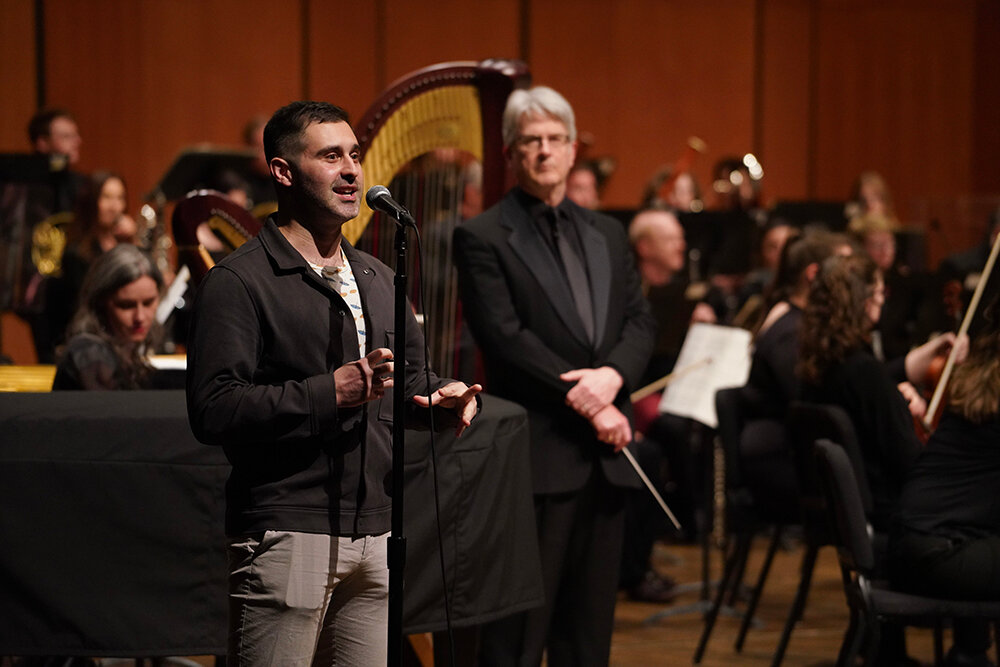
Lansing Symphony Orchestra season finale
7:30 p.m. Friday, May 15
Wharton Center
750 E. Shaw Lane, East Lansing
(517) 487-5001
lansingsymphony.org
Jared Miller, LSO go big with world premiere in season finale
At the tender age of 102, the “Pines of Rome,” the stars of the Lansing Symphony Orchestra’s season finale, are mere sprouts when compared to the hoary sequoias of the standard repertoire.
But on the same botanical time scale, Jared Miller’s latest opus, “House of Dreams,” is barely a zygote.
“I just finished it Thursday,” Miller said in an April 20 phone interview, laughing at the disparity.
Miller knows Friday’s concert will be chiefly remembered as the last to be conducted by 20-year maestro Timothy Muffitt. (For a full retrospective of Muffitt’s tenure, see last week’s cover story.)
But Friday also marks the end of Miller’s stint as the LSO’s second composer in residence, and he’s making the most of a rare opportunity. It so happens that an extra-large orchestra will be on hand to help the Roman legions (and Muffitt) clank into the sunset.
“I haven’t worked with an orchestra of this size before,” Miller said. “There are five percussionists. There’s both a harp and a piano. The string section is quite large. It was really fun to explore all of that.”
Miller is more used to writing his music on the lean side, to increase the odds it will be played multiple times.
“The bigger the orchestra, the more expensive it is, so it becomes harder to put on a big piece like this,” he said. “But I really wanted to take full advantage of this opportunity.”
The violins in “House of Dreams” are divided into fluid subgroups that coalesce, merge and separate as the music unfolds. The constant, granular micro-shifts generate a shimmering fabric approximating the parallel world of dreams.
To capture that elusive feeling, Miller drew upon an experimental style developed in the 1970s called “spectral music,” which uses the physics of sonic vibrations to generate sounds that glimmer and glow in the ear the same way a prism generates the colors of the rainbow.
“You get these really cool chords that slowly transform into one another,” Miller said. “It was really fun to write, and I can’t wait to hear them play it.”
It took a month for the complicated individual parts to be finalized, corrected, printed and distributed to the musicians, with 14 separate documents just for the violins.
“It was a long, drawn-out task, but I had a lot of support from the orchestra, and I’m very grateful for that,” Miller said.
The spectral style is not a stunt, but a way to convey a common yet fugitive human experience.
“I was trying to capture the feeling you get when you’re experiencing an episodic dream, with multiple stories that intersect with one another,” Miller said.
Once he tapped into that feeling, he found that “the music started to write itself.”
“The music goes through a lot of different emotions,” he said. A slow, funereal passage evokes the mysterious process of falling asleep.
“It builds and becomes majestic and magical,” he said. “Then you’re off on a rocket, flying through space.” There’s a devilish scherzo, a serene nature idyll and several other emotional phases, held together by the illogical logic peculiar to dreams — and, sometimes, to music.
That’s a new challenge for a composer who’s usually a meticulous planner. Of all Miller’s works, “House of Dreams” comes closest to stream-of-consciousness writing.
“Of course, you can’t really improvise an orchestral piece,” he said. “But I was finding the journey of the music as I was composing it. It’s more of a long, drawn-out improvisation that took place over a couple of months.”
Miller said that while writing a new piece for the LSO, he gave no thought to its limitations, because “in working with them for two and a half years, I haven’t really experienced that many limits.”
“They’ve played five of my pieces, and whenever any challenges came along, they rose to the occasion,” he said. “I was thinking about them the way I would think about any high-level professional orchestra.”
Miller is also grateful to Muffitt and the LSO for giving him the chance to revise and revisit some of his favorite works for a second time.
“Surge and Swell,” a complicated piece that uses subtle delay effects and polyrhythms to evoke electronic dance music, struck Muffitt as the perfect opener for a September 2023 concert, even though Miller had his doubts. The LSO gave the piece its U.S. premiere.
“He really believed in the piece,” Miller said. “I was very apprehensive, but the LSO did a great job, and it’s been performed a few more times since then.”
One of the personal high points of Miller’s tenure was a committed January 2026 performance by pianist Han Chen and the LSO of “Shattered Night,” a deeply personal piece about the rise of fascism in 1930s Germany.
“It was sort of a nerve-wracking decision to have it performed, but an important one for me personally,” Miller said. “I got to almost workshop the piece with the orchestra and refine it so it’s in good order to be performed again.”
Since January, “Shattered Night” has taken on a life of its own. A performance is scheduled with North Carolina’s Winston-Salem Symphony in November. The work will be played on reclaimed and refurbished string instruments that belonged to Jewish musicians before and during the Holocaust as part of the Violins of Hope project.
“I don’t know if that would even be happening if Lansing hadn’t performed it first,” Miller said.
He will continue to mentor composition students in his thriving studio and plans to return to composing after taking a breather this summer. After Friday’s premiere of “House of Dreams,” he’ll have time to reflect on his rich experience in Lansing.
“I’ve lived in larger cities most of my life and worked with a lot of different orchestras, and I think it’s amazing what this organization does, considering its size,” Miller said. “If so much vitality and variety is possible in Lansing, ideas are being incubated here that could serve as a model for larger orchestras. It gives me hope.”
Like the rest of the Lansing community, Miller is grateful for the musical passion of departing maestro Timothy Muffitt.
Many times, when Miller was in the torturous throes of second-guessing a newly completed piece of music, with a concert looming in a week or two, he came home to a reassuring voicemail from Muffitt in the following vein: “Jared, I’m so enjoying working on your piece, and it’s so phenomenal.”
Composing is often a solitary pursuit, so Miller appreciated the encouragement. But he was more impressed by the attention Muffitt gave to his music.
“I’ve worked with a lot of incredible conductors,” Miller said. “They’re all busy people, but Tim puts so much work into learning my music inside and out, on a high level. The fluency with which he talks about my own music to me when he’s working on one of my pieces is beguiling. It’s like he’s written the piece himself.”