Ovation Center retrenches on its Albert Kahn redesign
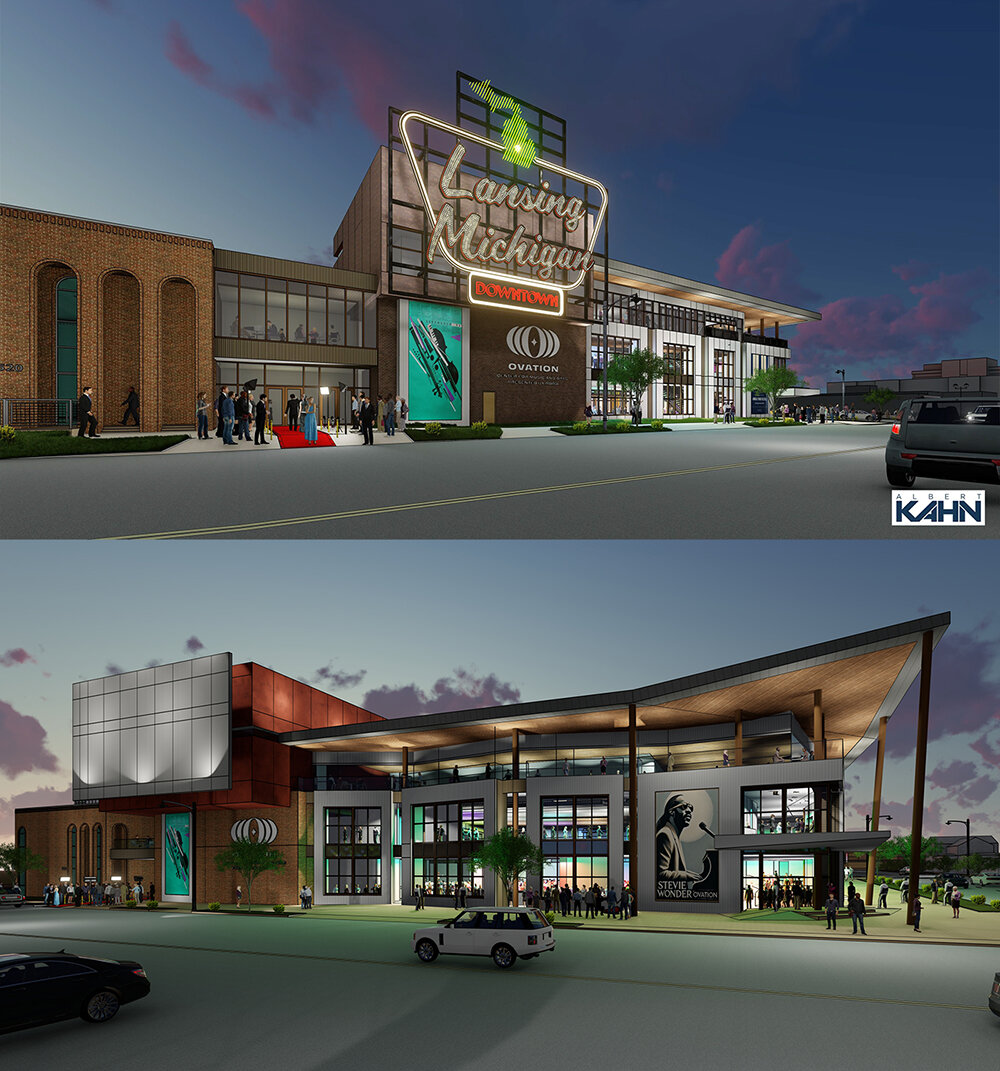
A year ago, the city of Lansing unveiled a major redesign of the Ovation Center of Music and Arts by nationally known Detroit architect Albert Kahn Associates with an undulating glass façade …
Bids ran $4-5M over; tariffs took another bite
A year ago, the city of Lansing unveiled a major redesign of the Ovation Center of Music and Arts by nationally known Detroit architect Albert Kahn Associates with an undulating glass façade to make the building more approachable.
The design had just one problem: It was too expensive.
Bids were “significantly” over the project’s $28 million budget, Ovation founding director Dominic Cochran said, to the tune of $4 million to $5 million. That necessitated a redesign by Albert Kahn’s architects.
Then President Trump’s tariffs hit, further increasing projected costs around 5% to 10%.
The Ovation Center is a public-private partnership featuring a performance venue with standing room for 2,000 concertgoers on the main floor and black-box space for 150 to 200 upstairs. Cochran said roll-out seating from beneath the stage was on his wish list.
Cochran insisted that the project “hasn’t been jeopardized,” with promising fundraising leads and contingencies already built into the budget.
However, the redesign meant straightening out the glass walls and removing the distinct cantilever roof, both major elements that Kahn introduced after it took over from Lansing-based Studio Intrigue Architects.
Cochran said he was OK with the changes.
“It’s always a calculus, right?” he said. “We’re lacking some part of the budget, and preserving the audience experience is our highest priority, followed very closely by the architectural aesthetic.”
With the cantilever roof and diagonal walls costing over $2 million, Cochran said it was a preferable change to anything that would impact the audience experience. The unique design would have required steel to be cut to custom lengths onsite, a major expense.
Tariffs necessitated further pivots. While Cochran always intended to use domestic steel, the domestic market shot up amid market uncertainty and market readjustment from Trump’s 50% tariff on steel and aluminum in June.
Jason Miller is the Eli Broad Endowed Professor of Supply Chain Management at Michigan State University. He said that’s a natural impact from tariffs.
“When you put tariffs on products like steel, it allows the domestic producers that are now being essentially protected from foreign competition to raise their prices,” he explained. “So the domestic price of that good goes up because the domestic producers now face less competition.”
The producer price index for hot rolled steel bars, plates and structural shapes has increased 11% since January.
In response to those costs, the Ovation Center switched its construction to the design-build method, in which a single entity oversees design and construction.
That means Kahn’s work is done. Freund & Associates of Royal Oak has become the project’s construction architects.
“The architect’s job is not done after they design the building and you get your construction documents,” Cochran explained. “They’re usually shoulder-to-shoulder with you during construction, making sure everything is done the way they specified. And then there’s the architect’s ‘stamp,’ to approve and take on the liability to make sure it’s done correctly.”
With that “stamp” now belonging to Freund & Associates, Cochran said the process would be more efficient not just because communication is streamlined, but because the people working directly with the project are best educated on how to “save money and do it efficiently.”
A steel-and-neon “Lansing, Michigan” sign sponsored by Choose Lansing will now adorn the building.
“When we first saw that surface in the original drawings, we thought it would be a good place to put the Ovation signage,” he said. “But it’s huge. It’s like 40×40 feet.”
The surface was too big to put upcoming shows on, too. Cochran called it “Las Vegas-size.” So, with the state as a major partner, he set out to make a “truly great Lansing placemaking sign.”
“The whole district is going to have kind of an entertainment feel,” he said. “So having a sign like that is going to be a beacon.”
The changes were the latest in a series of pivots and roadblocks dating back to Former Mayor David Hollister’s original study for a 6,500-seat performing arts center in the 1990s.
Despite the cuts, former Mayor Virg Bernero thinks it will be fine.
Bernero successfully lobbied the state legislature to let the city capture $8.5 million in cable television fees, which ended up helping fund the Ovation. The city’s media center will be housed in the Ovation complex.
He said the original project lost its wind because of the 2007-’08 Great Recession. In comparison, he believes the current roadblocks are navigable.
“When I was mayor during the Great Recession, we had to pass a fire and public safety millage just to keep police and firemen at work, so a performing arts center just fell further and further down in terms of priority,” he said. “So yes, the price is increasing, Trump’s a disaster and his tariffs are idiotic, but there are still building projects happening. I believe the city is going to be able to keep this in focus.”