Rediscovering night
Complete darkness, like complete silence, is a rare thing.
In the modern world, you have to go to great lengths to go totally dark.
Last week, workers were pushing the envelope of …
Jan Tichy: “Darkness”
Jan. 31- July 26
10 a.m.-6 p.m. Wednesday-Sunday
MSU Broad Art Museum
547 E. Circle Drive, East Lansing
broadmuseum.msu.edu
‘Darkness’ brings enlightenment to Broad Art Museum
Complete darkness, like complete silence, is a rare thing.
In the modern world, you have to go to great lengths to go totally dark.
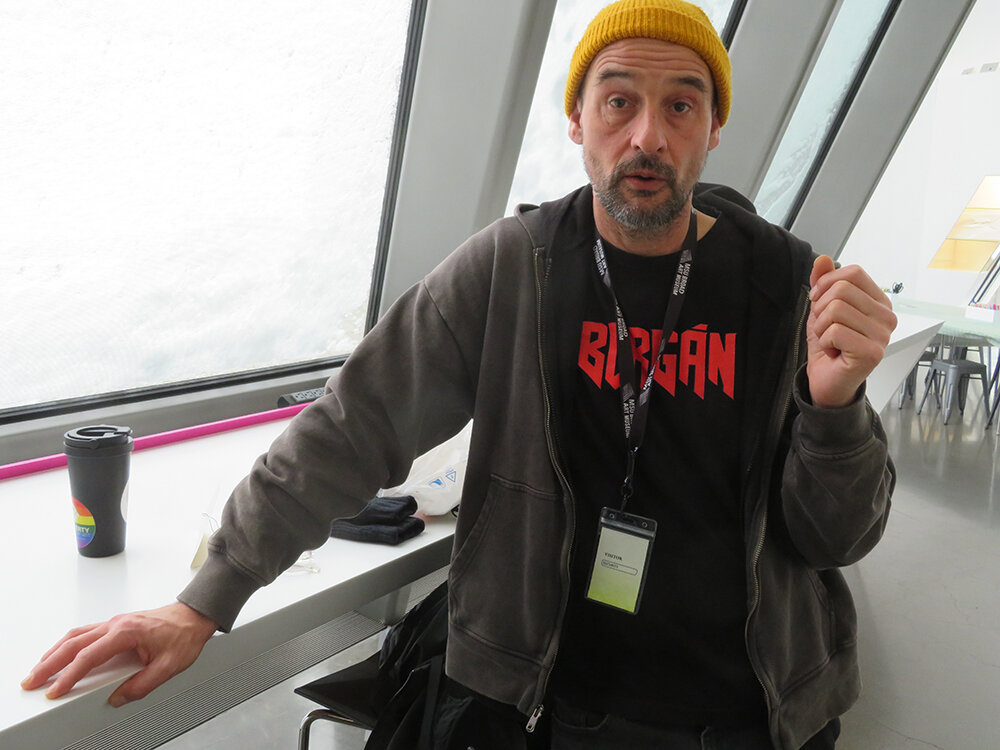
Last week, workers were pushing the envelope of possibility to seal off the Michigan State University Broad Art Museum’s first-floor Minskoff Gallery in preparation for “Darkness,” an immersive installation by Czech-born, Chicago-based artist Jan Tichy.
As a 13-year-old high school student in Prague, Tichy printed his own photographs and loved working in the darkroom.
Soon he’ll have the coolest darkroom on Earth.
Darkness is a precious resource in a world beset by light. Today, one of the most popular classes Tichy teaches at the School of the Art Institute of Chicago is black-and-white darkroom photography.
“Everybody has this,” Tichy said, holding up his phone. “Nobody has a darkroom.”
Tichy is still a photographer, but his experiments with light go far beyond to take in architecture, sound and science.
We couldn’t take a picture of “Darkness” last week, and not just because it wasn’t finished. Even when the gallery is ready for visitors of the Broad’s Jan. 30 Winter Opening Party, photographs won’t do it justice.
“What I’m trying to do is materialize light and make it an experience for my audiences,” Tichy said.
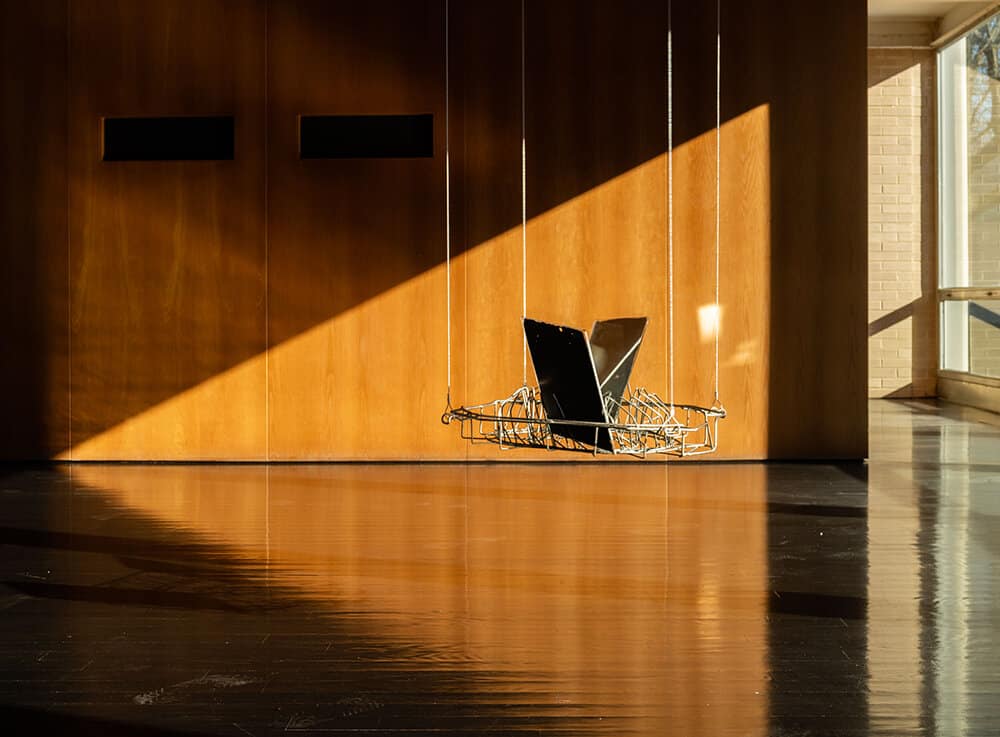
You can’t be dipped into the well of darkness by proxy. You have to take the plunge.
“I’m using all of these natural and man-made rhythms of light that are around us, from the dawn to the sunset, from the light in your home to the lights of city traffic or Spartan Stadium,” Tichy said. “It will put you into a dark space and let you focus just on the changes of light. It might seem abstract, but you know it from your own experience.”
But we don’t know darkness as our ancestors knew it.
Through tackling the challenge of going dark, exhibit curator Steven Bridges is finding enlightenment.
“I’ve learned so much about our circadian rhythms, the internal clocks in our bodies,” he said. “We have about 30 trillion cells in our bodies, and each one has a little clock programmed to the one constant since our planet began, that the sun rises and sets every day.”
A second gallery will draw the visitor into a series of increasingly dark chambers, flickering with Tichy’s neon sculptures, photography and video art. The exhibit has a strong scientific streak, drawing on research from four MSU laboratories looking at human-caused disruption of the cycle of darkness and light and how that disconnect affects human physiology and moods, plant growth and insect life.
“As we often do in our lives, humans have attempted to control nature for our own needs and demands, to the detriment of nature, but also to the detriment of our own health and well-being,” Bridges said. “With all of this artificial lighting, we’re losing our relationship with darkness.”
To make Tichy’s vision a reality, Bridges and Broad staff had to almost reinvent the spacious Minskoff Gallery, devising new and innovative hardware that will expand the museum’s possibilities long after “Darkness” lifts in July.
‘Artists push us’
Last Friday afternoon, Tichy was constantly on the move, monitoring light panels, inspecting corners, pacing in and out of the gallery. His morning coffee sat untouched. The pressure was on to bend the gallery to his vision in time for the opening, initially scheduled for Jan. 24 but moved to Jan. 31.
Bridges has been discussing the project with Tichy for over a year, but in the runup to the opening, he mostly kept out of the artist’s way.
“In Jan’s art, there’s only so much you can do in advance,” Bridges said. “He’s literally drawing and writing with light, and it’s so precise that you can’t do it until you’re here, the projectors are in place, and you’re connected to them.”
Since 2017, when Tichy worked with Bridges on an installation at the Broad pertaining to the Flint water crisis, the two have stayed in touch and kept up an informal “book club.”
About a year ago, Tichy sent Bridges a copy of Swedish bat scientist Johan Eklöf’s “Darkness Manifesto,” about the harmful effects of light pollution on humans and nature alike.
Flooding the world with artificial light has led to a myriad of harmful effects — from massive die-offs of insects to disruption of the natural 24-hour rhythms built into every cell of our bodies — with a range of health consequences, from impaired sleep to diabetes, heart disease and depression.
Bridges thought a darkness-themed project would make an ideal second installment for the Broad’s Signature Commission Series, established in 2024 to bring internationally recognized artists into “deep collaborations” with the museum by designing work specifically for its unique, Zaha Hadid-designed spaces.
The Broad’s first “signature” installation, Esmaa Mohamoud’s “Complex Dreams,” reveled in the gallery’s natural light, suspending a cloud of 5,999 steel Monarch butterflies in the air.
Now Tichy would take the gallery in the opposite direction, plunging the space into darkness.
Tichy has worked with “very iconic and very challenging architectural spaces” around the world, in Bridges’ words, from Chicago’s Hancock Center to a Gothic cathedral in Osterberg, Germany.
“I knew he would be up to the task,” Bridges said.
In Tichy’s 2022 exhibit “Reflectance,” he applied his palette of light and shadow to famed architect Ludwig Mies van der Rohe’s 1952 McCormick House at the Elmhurst Art Museum, using mirrors, glass and light to animate and transform a classic modernist home.
Michigan art lovers might recall “All Monsters,” Tichy’s site-specific installation at the Museum of Contemporary Art Detroit from October 2021 to January 2022. The title was a reference to the late Mike Kelley’s influential Detroit band, Destroy All Monsters.
“All Monsters” was Tichy’s light-and-shadow riff on Kelley’s “Mobile Homestead,” a full-scale replica of the 1950s ranch home in Westland, Michigan, where Kelley grew up.
After working with small-scale houses like the McCormick House and the “Mobile Homestead,” Tichy loved the idea of applying his unique vision to a larger architectural canvas.
But he told Bridges that in order to reach the necessary level of control over the light in the main gallery, it would have to be completely “light locked.”
“None of us ever thought to even attempt that,” Bridges said. “That’s why artists are so incredible. They push us to do things we never knew we could do.”
“Darkness” brings a 13-year tug-of-war between the ideas of artists and curators and the domineering designs of world-renowned architect Zaha Hadid to a head. Tichy wasn’t interested in working with the gallery’s natural light. He wanted total control.
Taking a break from adjusting the light console, Tichy nodded toward the Minskoff Gallery’s enormous corner window.
“This window doesn’t make sense as a museum window,” he said. “You cannot show any light-sensitive work. If you want to pull from this amazing collection the museum has, it just cannot be here.”
His critique of the space went further.
“It’s hard for the artwork to compete with these windows,” he said. “It’s like the window in a Gothic cathedral. It is the window and its relationship to light that makes us go ‘wow.’ We should be going ‘wow’ from art rather than from the architecture.”
Will Hadid roll over in her grave when she finds out that her glassy jewel box of a museum has been “light locked?”
Bridges doesn’t think so. In 2023, when the Broad installed its lower-level gallery, the CORE, he spoke with members of Hadid’s architectural firm to make sure the CORE would fit in with Hadid’s vision.
“They understood that after 10 years of living in a building, you look at things a little bit differently,” Bridges said. “It’s like a house. After living in it for a while, you make alterations based on your needs or comfort.”
Bridges never expected to see the Broad go dark, but he’s excited about the opportunities the project opens up.
“Speaking for myself, I needed an artist to come in and push us in this way,” Bridges said. “Now that we can light lock the gallery, it’s building out our toolkit. We can do this in the future.”
He was quick to point out that everything the designers and builders are doing is reversible. The sun will shine again in the Minskoff Gallery.
Museum inside a museum
The Broad team has done many strange and wonderful things to indulge the whims of artists over the years, from hanging an ersatz elephant from the ceiling to lugging three tons of Vietnamese sea salt to the second floor.
“Light locking” a sunny gallery with open balconies on two sides, a glassy entranceway and a huge, angular array of windows in one corner was a challenge chief preparator Brian Kirschensteiner couldn’t resist.
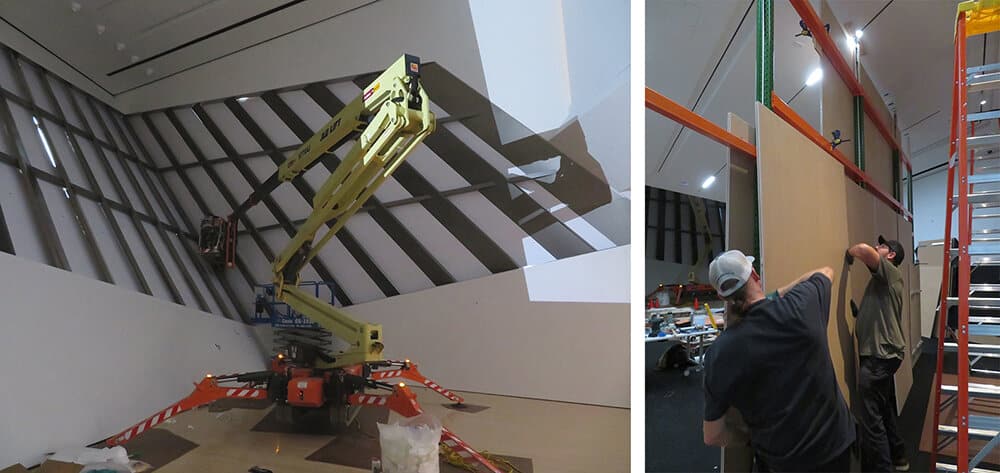
Last Friday, two workers were huddled in the gondola of an aerial lift so large it barely fit into the gallery. One by one, they fitted custom-cut, twin-wall polycarbonate panels into each section of the window. Needless to say, no two sections of the window are the same size or proportion.
“I think of it as a big tiling exercise,” Kirschensteiner said. “We’re tiling the windows, we’re tiling the balcony openings, and we’re tiling the floor.”
Most of the “tiles” are enormous panels that weigh up to 80 pounds each.
Another crew was installing a modular wall system designed to seal the gallery off from any light sneaking through the entryway.
Kirschensteiner designed the wall system 10 years ago. A pilot section was installed in the former Kresge Art Museum space way back then and is still there, gathering dust.
“I had to keep it literally under wraps,” Kirschensteiner said. The system was finally granted a provisional patent in December 2025.
“Now I can talk about it,” he said. “Not only that, we want to share it with the world. We’re very excited about it.”
Huge, custom-made panels akin to hollow doors lock snugly together, blocking the light that pours from the balconies and entryway.
The panels are designed so light can be tinted, reduced or, in this case, totally blacked out, opening up a new world of possibilities for exhibiting art.
All the panels and wall sections, together with their fixtures and fittings, are reusable. When the exhibit closes in July, the whole system will be put into storage until the gallery hosts another artist or exhibition that requires strict light control.
“We’ll be able to exhibit light-sensitive artworks, which has been a hindrance for us in the past,” Kirschensteiner said.
As workers bustled and power-tool noise blasted from all directions, it looked like they were building a second museum inside the first. The wall system runs from floor to ceiling and adapts to changing ceiling height, unlevel floors and other variables.
Tichy and Bridges stepped back in awe (and slight amusement) as Kirschensteiner exuded engineering ecstasy. “The horizontal joints are held together by gravity,” Kirschensteiner said. “For the vertical joints, we use a Swiss ‘inviz.’”
“Inviz” is short for “invisible magnetic hardware system.”
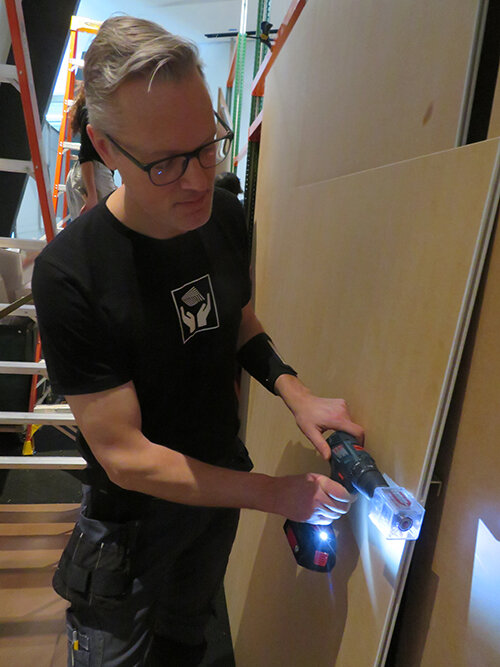
He grabbed a portable electric drill fitted with the “inviz,” placed it next to the threaded rod — next to it, not on it — and the rod began to turn by itself, without anything else touching it.
The result was a perfect join, with no holes, no seams, no visible sign of human effort. The finished wall will look as if it just materialized out of thin air, a Platonic ideal of a partition. Even Hadid would have to approve.
A faraway look came over Kirschensteiner’s face. The “inviz” lit up in his hand.
“I first saw an early version of this when I was a child, at a home trade show in Chicago,” he recalled. “I remember thinking, ‘One day, who knows when, I might use it.’”
As Kirschensteiner enthused, Tichy wandered off to work on his lights, but Bridges stood and listened respectfully.
“It’s easy to come up with a visionary concept,” Bridges said. “Brian and the staff are the ones who make it possible.”
Resuming work, Tichy glanced with approval at each new panel as the gallery gradually went dark.
“For Brian to figure out a way to close the gallery for the first time in its 13-year history — it’s not an easy thing to do,” Tichy said. “But I hope that all these panels can be used in the future to make this gallery into a place where you can view work that is light sensitive, either historical or contemporary.”
“This is an environment that begs for innovation,” Kirschensteiner said. “And it’s fun.”
Bugs and bats
There’s more to “Darkness” than the dark doings inside the Minskoff Gallery.
Tichy’s work in photography and related media is displayed in a neighboring gallery, nestled in a series of chambers that grow increasingly dark as the visitor explores further.
It’s a quiet world of pale grubs, darting bats, wraith-like bugs and luminescent threads of neon.
Tichy based this part of the exhibit on an influential book by groundbreaking American photographer and inventor Berenice Abbott, “Documenting Science.” (One of Abbott’s photographs, from a 1930s study of the rapidly changing urban landscape of New York, is in the Broad’s historic collection and will be on display at the gallery entrance.)
“She did this amazing book showing the basic forces of nature and physics around us, like a prism of light,” Tichy said. “I was always fascinated by this, and I look at it as an inspiration.”
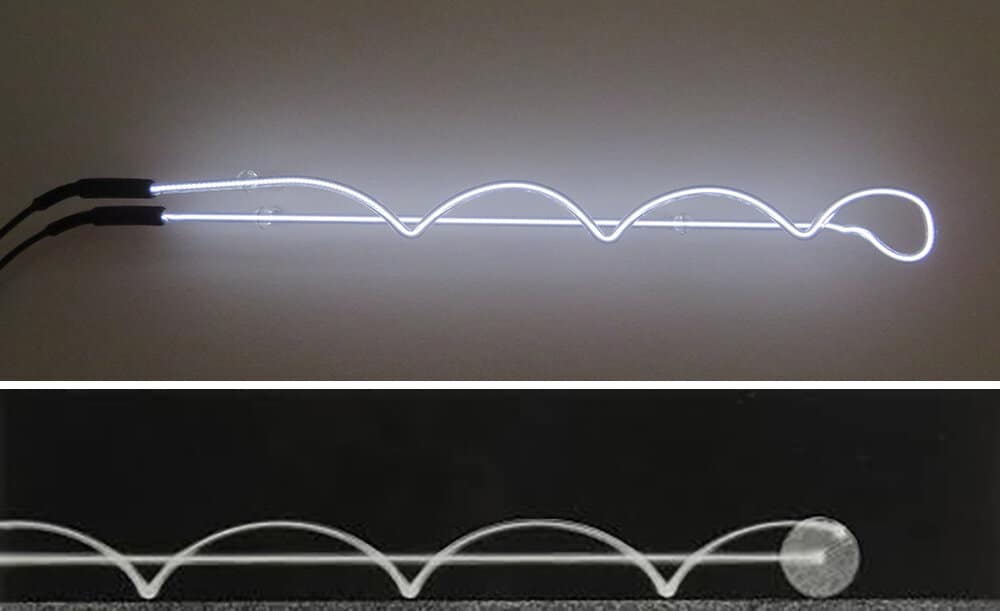
In a neon sculpture called “Cycloid,” Abbott’s famous time-exposure photograph capturing the path of a point on a rolling ball is materialized in pure light. Another neon sculpture evokes Abbott’s images of light flowing through a prism.
One of the “Darkness” collaborators is the MSU Entomology Department and its visitor-friendly mini-menagerie, the Bug House.
As part of the exhibit’s investigation into the cycle of light and darkness, entomologists conducted a study of insects that live around the museum last year.
“We found out that in this tiny plot of land around the museum, there is an amazing amount of variety of insects and bugs — more than they expected to find,” Tichy said.
“A year later, we have hundreds of dead bugs. What do we do with that?”
He decided to document the bugs, and, in a sense, “bring them back to life.”
Instead of using a camera, he placed the specimens directly on an old black-and-white photo enlarger, using darkroom processes to bring out the texture and shading.
Opposite the bugs, a haunting video flashes quick images of insects in the ghostly, camera-less format called “Rayograph,” invented by artist Man Ray, who placed subjects directly on photosensitive paper and exposed them to light.
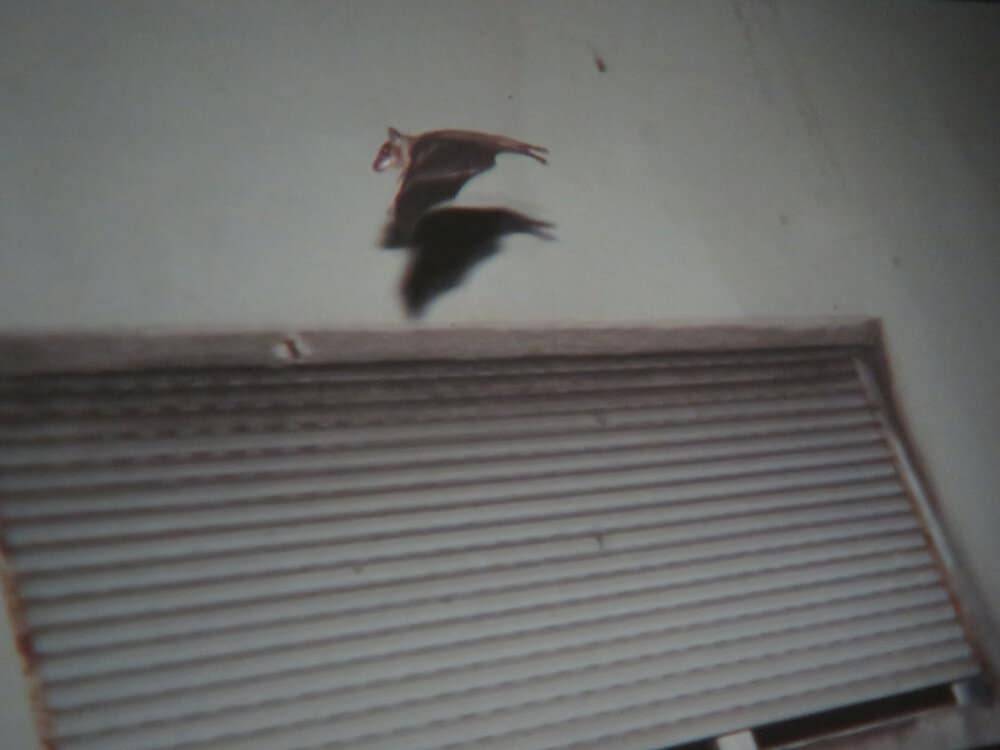
Deeper in the gallery, beyond a labyrinthine partition, Tichy set up two old-school slide projectors that continuously display images from a 2007 set of photographs, “Bats.”
Captured by Tichy on midnight walks through Tel Aviv, Israel, using a “very powerful flashlight,” the bats are glimpsed on the fly, darting from a generic ledge or shrub. They’re neither romanticized nor demonized — just doing their thing.
“We, as humans, have a strange relationship to bats,” Tichy said. “For half of us, they’re these scary flying rats, culturally marked as Draculas. But they’re flying mammals, related to us — amazing possibilities of us.”
The two slide projectors are pointed in opposite directions, so there’s always an unseen bat about to swoop from behind the viewer’s back.
The galleries are divided into a sneaky maze of walls and chambers.
“It’s like there’s multiple layers, from a place that’s slightly more luminous, deeper into the darkness, back into the deepest recesses,” Bridges said. “And the bats live in the deepest recesses of the cave.”
After basking in Tichy’s chamber of darkness and viewing the art in the neighboring gallery, visitors will find more food for thought in the museum’s education wing, where interactive displays will introduce the work of three more MSU collaborators.
The displays drive home the lesson that we lose touch with darkness at our peril.
Hanne Hoffmann, a faculty member in the reproductive and developmental sciences program, is researching “uncoordinated hormone release” among shift workers and people who sit in front of bright screens at night. Nocturnal light disrupts circadian rhythms, leading to increased risk of diabetes, obesity and heart disease and harming mental health.
Lily Yan, a neuroscience faculty member, is concerned about the effects of light on mood, especially the familiar form of winter depression known as Seasonal Affective Disorder.
Erik Runkle, a professor in the Department of Horticulture, leads the Controlled-Environment Lighting Laboratory, a “vertical farming” facility researching indoor production of high-value crops.
As a professor at the School of the Art Institute of Chicago, Tichy considers his art to be deeply connected to his role as an educator. He found that all the students, researchers and educators jumped at the chance to bring their scientific findings to an art museum.
“They were eager to talk to us, as a place of exposure to an audience they don’t have but are in need of, because the things they research are related to us, to human beings,” he said.
Tichy’s MSU residency won’t stop with “Darkness.” In March, he’ll launch another project at the “largest dark space on campus,” Abrams Planetarium.
Using a 360-degree camera, he documented the quality and quantity of light at various indoor and outdoor places across MSU’s campus. The results will be projected on the planetarium dome.
“That wasn’t the plan when we started,” Tichy said. “But when a museum is serving a university with so many audiences and partners and ideas, that’s how it can snowball.”