Escape from New York: Joshua Gersen brings metropolitan mojo to Lansing Symphony
In February 2017, Joshua Gersen made an unexpected and dramatic subscription concert debut with the New York Philharmonic. In the middle of a time-crunched rehearsal that was pushed to late afternoon by a snowstorm, music director Semyon Bychkov fell ill and was taken to the hospital. Gersen finished the rehearsal and mounted the podium a couple of hours later to conduct Tchaikovsky’s epic “Pathétique” symphony, which he’d never conducted before, and two other works.
When it was all over, the orchestra stood and applauded his last-minute heroics. The New York Times called the performance “passionate and incisive.”
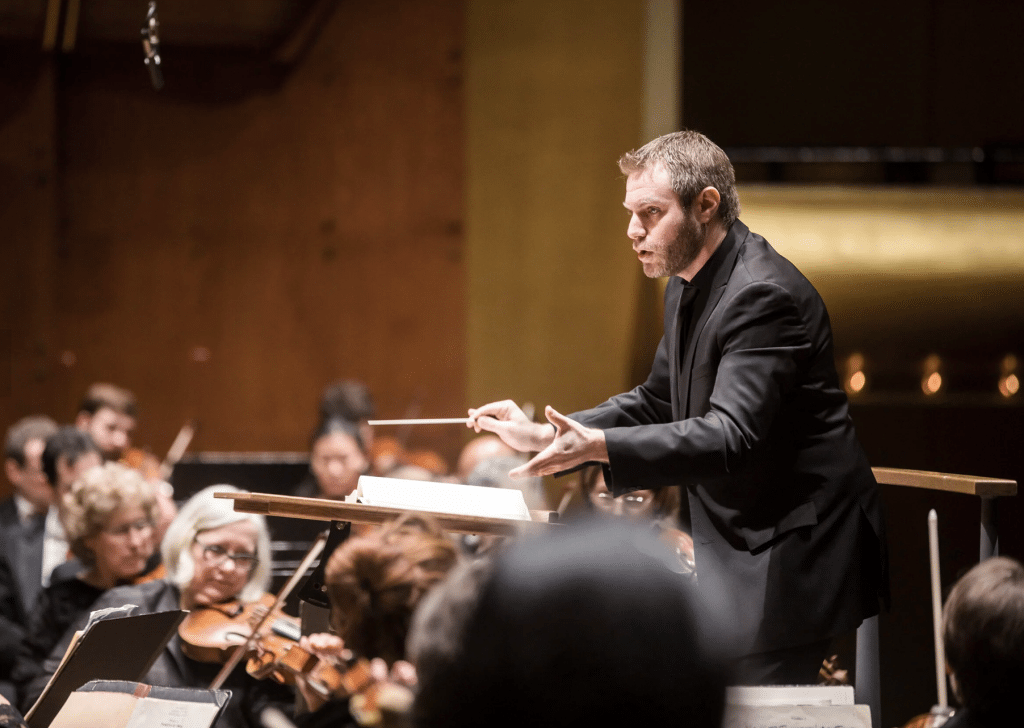
Gersen faces a slightly less nerve-wracking challenge Saturday, as the third of five guest conductors leading the Lansing Symphony Orchestra this season to determine who will fill the shoes of departing music director Timothy Muffitt.
“Working together for the first time is a bit like a first date,” Gersen said. “Sometimes you lock in, and sometimes it takes a bit of time to get on the same page. It’s the unknown. All you can do is go in there and do your thing, do what you do the best you can.”
Gersen’s tenure as assistant conductor in New York ended in 2018. He has enjoyed being the music director of the New York Youth Symphony, taking the group on its first international tour in 50 seasons, and guest conducting with the San Francisco Symphony, the Chicago Symphony and many other ensembles, but he’s ready for new horizons.
“I’m from (New York), and I’ve been here for quite a while, but I’m looking for the next chapter, hoping to find an orchestra to work with regularly,” Gersen said.
He has worked several times with the Detroit Symphony, including a 2019 screening of “Jaws” with John Williams’ famous score performed live, and done conducting workshops in Ann Arbor, but he’s never been to Lansing.
“Talking to the administration and the committee in Lansing, I was really impressed with how organized, how stable everything seems to be there,” he said. “They’re in good shape in many ways and looking to grow the ensemble, and that’s exactly the kind of situation I’m looking for.”
In the wider world, conducting is a rare life choice, but for Gersen, it was inevitable. He started conducting — and reading scores — when he was 3 years old. An early hero was the charismatic New York Philharmonic maestro Leonard Bernstein.
“For me and my family, a Jewish family in New York City, he was incredibly important, our champion in many ways,” Gersen said. “At the centennial of his birthday, I actually got to conduct ‘West Side Story’ with the New York Philharmonic, and that was really special for me.”
Another early influence was Gustav Meier, music director of the Lansing Symphony from 1978 to 2006.
“I was very, very lucky that he happened to be conducting the Bridgeport Symphony in Connecticut when I was growing up right around there,” Gersen said. “I got in touch with him and got to study with him all through high school, and he was a really important person in my life growing up.”
On the podium, Gersen is muscular, grounded and precise.
“There are a lot of conductors out there who are a little more flamboyant in their gestures than I tend to be,” he said. “But for me, it’s about studying the music and, when I’m up there, trying to recreate the music as the composer wanted to hear it and helping the musicians on stage play the best they can. It’s not about me at all.”
Gersen is impressed by the innovative programs the Lansing Symphony established during Muffitt’s tenure, such as the composer-in-residence program and the new music series LSO at The Robin. He hopes to extend the orchestra’s reach further with concerts and casual events in non-traditional venues around the community.
“The biggest problem we run into, as far as attracting a broader audience, is that many people still feel like it’s some kind of elitist club they don’t belong to,” he said. “Anything we can do to make everybody feel welcome, make it an enjoyable experience, is important.”
He’s happy to talk from the stage about the music on the program, and he likes the idea of turning pre-concert talks into podcasts people can listen to in the car on the way to the concert hall.
“There are so many interesting things about the music we’re performing,” he said, and he’d like to make people aware of that “any way we can.”
For Saturday’s concert, Gersen picked three works that, in his view, “deliver a universal message.”
Chris Rogerson wrote the evening’s opener, “Noble Pond,” after the tragic death in 2007 of 5-year-old Austin Haley, who was fishing with his grandfather in an Oklahoma pond when a police officer fired at a snake nearby and a bullet struck him.
The simple lyricism and beauty of “Noble Pond” often reduces audiences to a reverent silence.
“Chris is a very good friend of mine. We went to school together,” Gersen said. “He’s a wonderful composer whose music should be played more often.”
Gersen said the other works on the program, Sibelius’ violin concerto and Beethoven’s Fifth Symphony, “are obviously kind of iconic and don’t need much introduction” but build on the same emotional arc.
“It’s a program about overcoming adversity,” Gersen said. “Chris’ piece is about a specific tragic event. Sibelius’ concerto was written when he was going through a lot of things personally, and he was wistfully lamenting the fact that he could never play violin himself. And, of course, the Beethoven Fifth is the quintessential example of humans facing the greatest adversity and triumphing over it. It’s a very heavy but uplifting program.”