Speed dash with racing heart
You’re above the clouds. Your heart is pounding. Your guts twist up, down and sideways as you swoop, dive and accelerate.
Are you falling in love or flying a small, open-cockpit airplane?
…
“Love Is in the Air” exhibit opening & program
6:30 p.m. Thursday, Feb. 12
Historical Society of Greater Lansing
528 N. Capitol Ave., Lansing
lansinghistory.org
To launch the Historical Society of Greater Lansing’s latest exhibit, “Love Is in the Air,” President Bill Castanier promises a “different kind of event than you would expect from a historical society” — a crazy-quilt celebration of love, with readings of love letters, poetry, “funnier than hell” lonely hearts ads from the 1990s and many surprises, including roman-tic correspondences between R.E. Olds and his wife, Metta, and a romantic recording of “In My Merry Oldsmobile” by Judy Garland and Bing Crosby.
“People don’t know it’s a love song,” Castanier said.
Castanier himself will read a mysterious, recently discovered letter from an unknown wom-an to his grandfather, asking, “When are we going to tell your family?”
“He was married at the time,” Castanier said. “We don’t know what that means, but we have a suspicion.”
Historical Society’s ‘Love Is in the Air’ exhibit mixes aviation and romance
You’re above the clouds. Your heart is pounding. Your guts twist up, down and sideways as you swoop, dive and accelerate.
Are you falling in love or flying a small, open-cockpit airplane?
Both, in a new Historical Society of Greater Lansing exhibit opening this weekend.
The Historical Society has delved into many meaty subjects over the years, but this Valentine’s Day, it’s serving up a box of candy to make the history lesson go down easier.
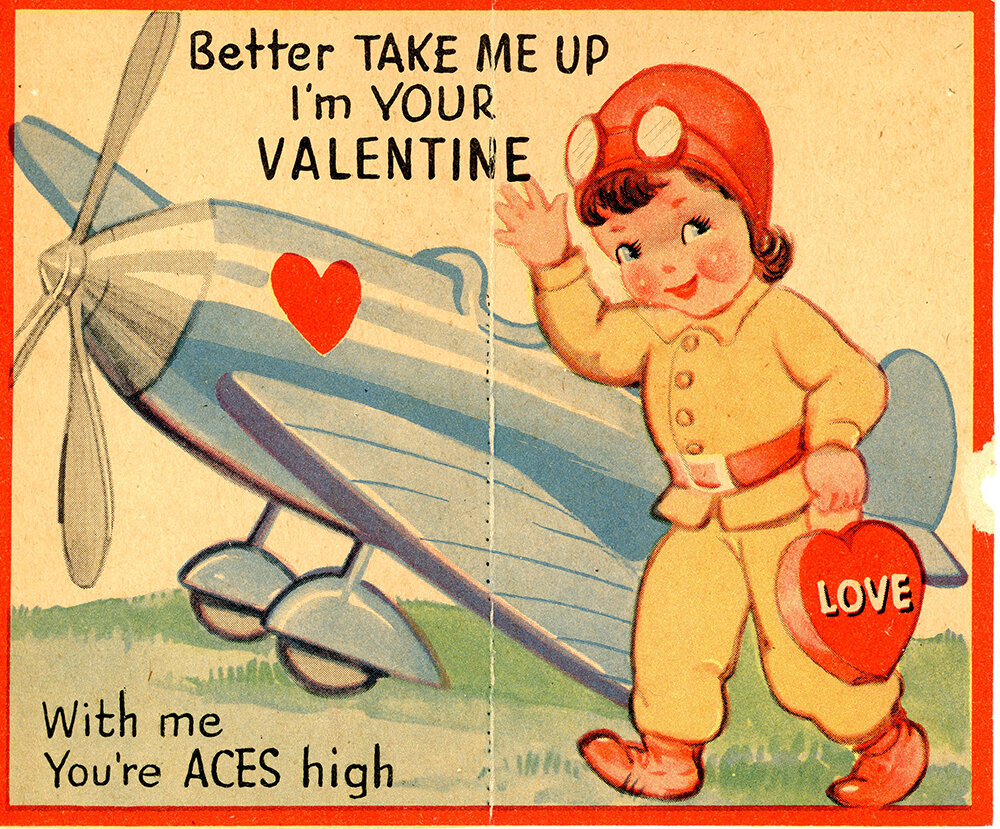
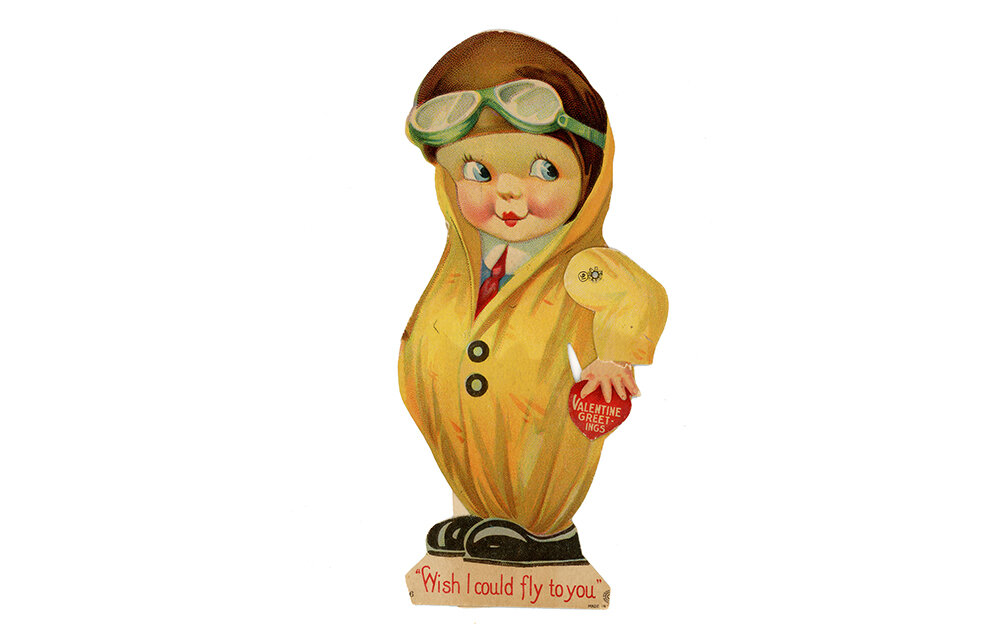
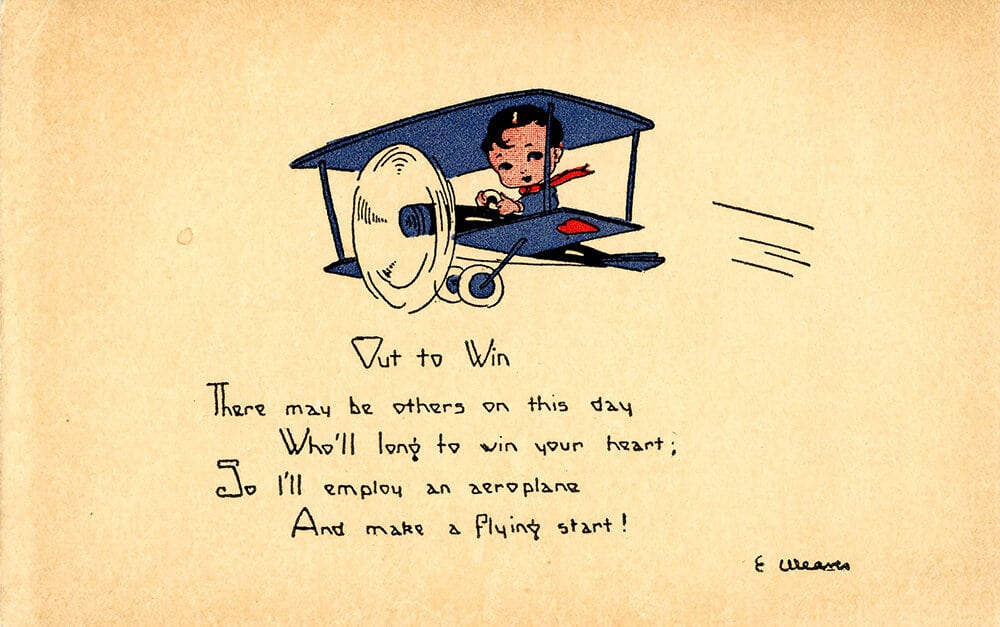
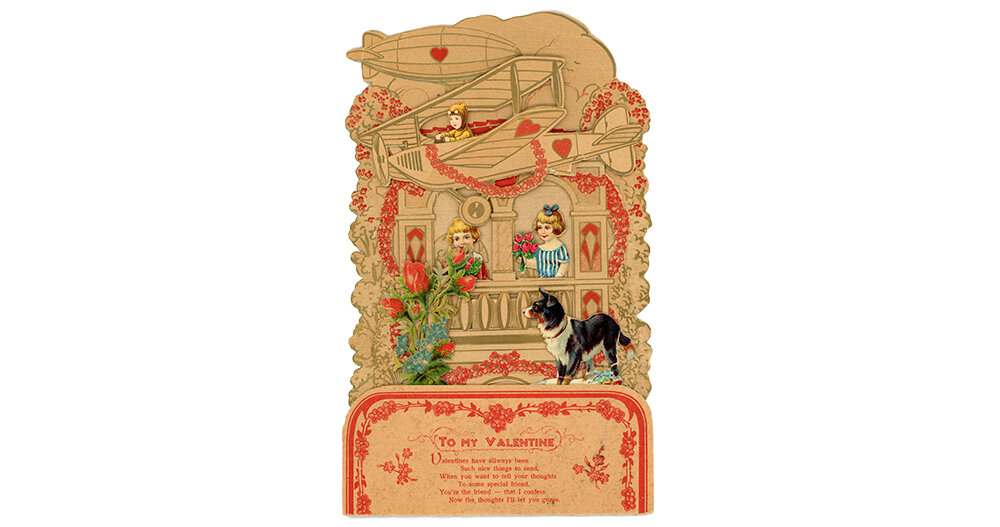
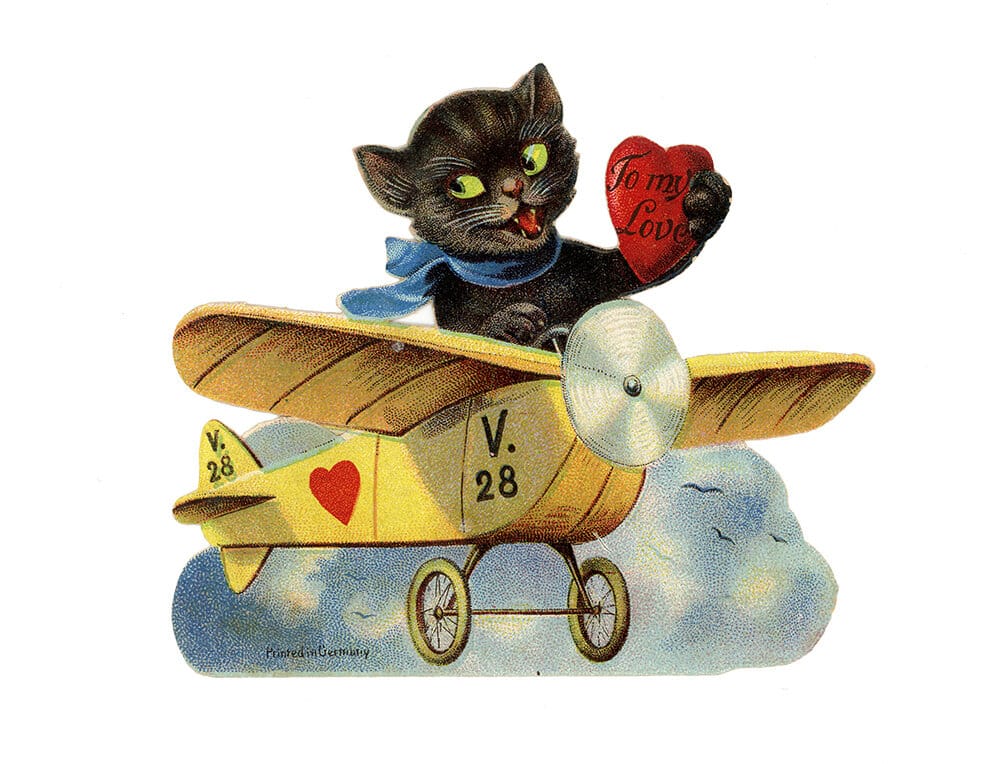
“Love Is in the Air” grabs your attention with 50 cherry-red, aviation-themed valentines from the golden era of aviation — and the golden age of postcards — in the early 20th century.
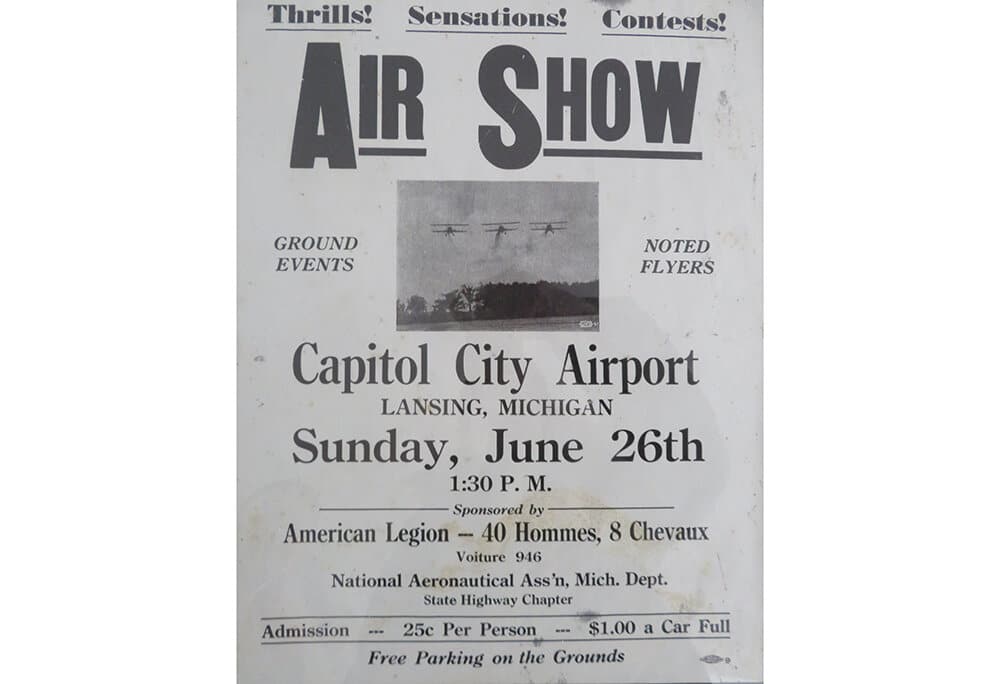
The curators hope these bonbons will draw the visitor into a deeper collection of memorabilia from a nearly forgotten time when aviation was a revelation and spectacular air shows, daredevil pilots and hair-raising stunts were a wildly popular and frequent sight across the nation, including at Lansing’s own Capital City Airport and other local airfields.
Kiss of death
About 100 years ago, in the heyday of air shows, people did strange, spectacular and dangerous things to get other people to look up.
“Lansing was part of that whole culture of daredevils,” Historical Society President Bill Castanier said. “It was a really big deal.”
Michigan’s own “bat man,” Clem Sohn, jumped out of planes wearing a winged suit of his own design, 5 feet wide and made of steel tubing and canvas. Defying gravity, he steered himself as he floated down to Earth from as high as 10,000 feet. He waited until he was 1,000 feet from the ground, or even lower, before deploying his chute.
Sohn grew up in Fowler, just north of Lansing, and graduated from Eastern High School.
He once dove 18,500 feet before pulling the cord, a world record in the 1930s.
“I don’t know how these guys did it,” Castanier said. “They had to be massively strong, and massively…”
He deleted the word on his lips and found a substitute.
“… brave.”
On April 25, 1937, at the age of 26, Sohn plunged to his death in front of a crowd of 1,000 people at an air show in France when his parachute failed to open.
Lansing, an obscure Midwestern city with a muddy, underdeveloped airport, has produced more than its share of aviation pioneers.
The name Art Davis, a titan of Lansing aviation, comes up a dozen times in an air show schedule from Somerville, Tennessee, on display in the Historical Society exhibit.
At 11 a.m., Davis was already up in the air, “smokewriting over [the] city,” a stunt he performed many times across the nation. At 1:45, he put on a display of “balloon strafing.” At 2:20, he was the first leg of a “trio in smoke.” At 4:35, he reenacted a “wartime dog fight.” At 5:45, he flew through the “wall of smoke.” At 3:10, he performed “the kiss of death.”
“They called it ‘deadstick,’” Castanier said. “They’d just drop the plane and see how close they could get to a mark on the field.”
The same afternoon, between doses of Davis’ derring-do, other daredevils landed planes on automobiles, started a stalled plane in midair and did upside-down acrobatics on the wing. Of course, there was a bat man — two bat men, in fact — performing the “double-bat-wing parachute jump” from 10,000 feet.
Air shows at Capital City Airport involved up to 70 planes and drew up to 8,000 spectators on a weekend afternoon, Castanier said.
A budding aviator in his youth, Castanier flew over the Lansing area as a student and was keen to find a way to bring the city’s lively aviation history to the Historical Society’s new digs on the Lansing Community College campus.
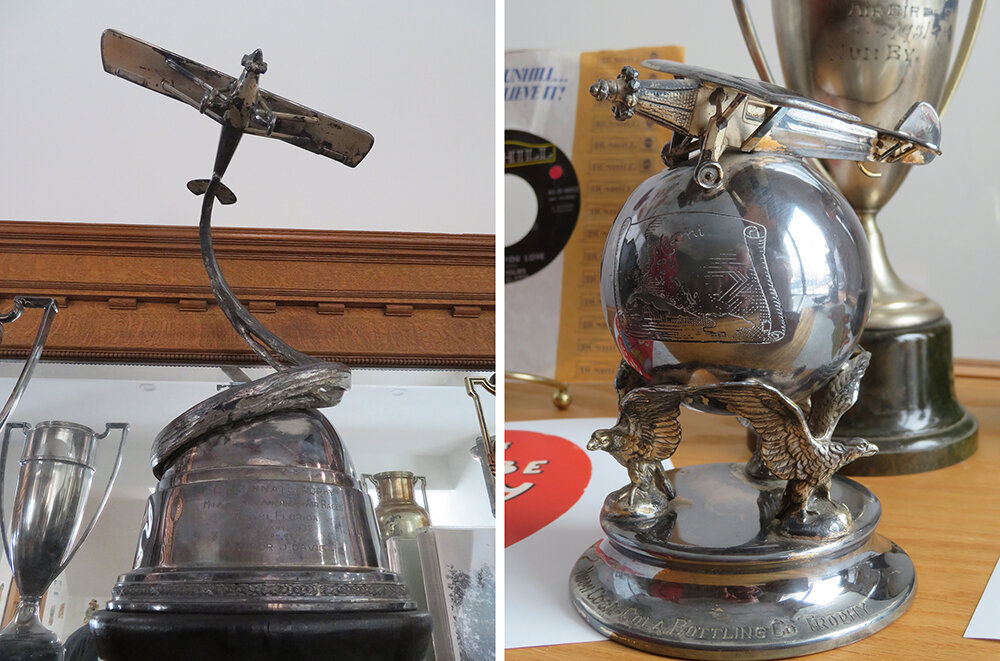
About a year ago, he got an exciting call from MSU. While clearing out some historical objects accumulated over the decades, historians ran across a set of trophies from Davis’ collection and offered to donate them to the Historical Society.
Yes, trophies are boring, but not Davis’ aviation trophies. This guy wasn’t exactly bowling for a living.
On display as part of “Love Is in the Air,” these babies are swooping art deco masterpieces — just what you’d expect from a unique and rarefied arena of competition, and from a man who thrilled airfield crowds thousands of times.
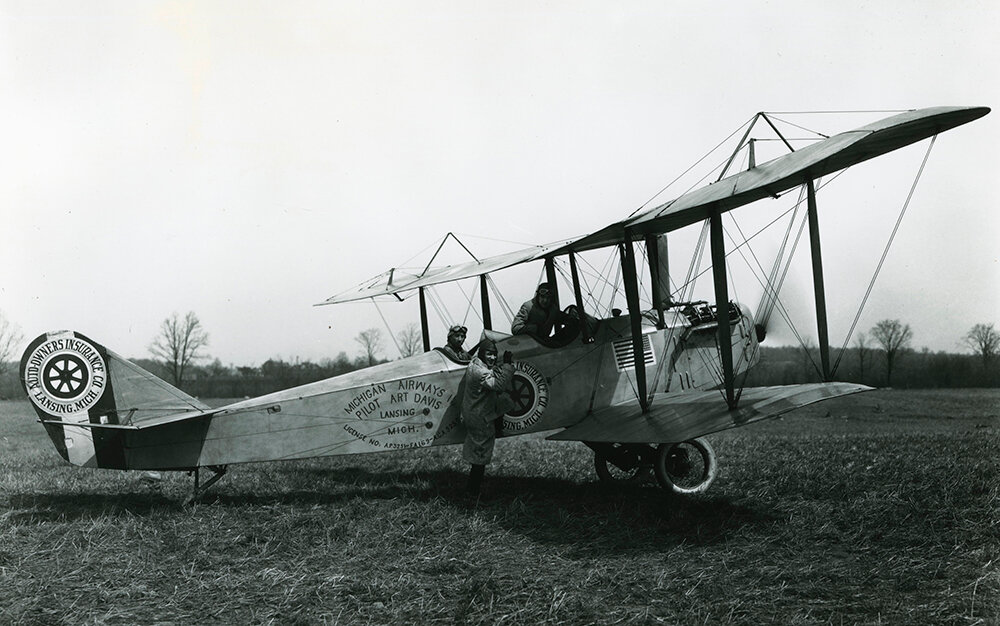
Davis trained as an aviator with the U.S. Army in 1918 and bought an open-cockpit biplane as soon as World War I was over. Using a dairy farm south of Lansing as an airfield, he barnstormed about the state, doing exhibitions and taking passengers.
“Those air circuses were hugely popular from about 1920,” Castanier said. “After the war, a lot of planes were available, and pilots bought them cheap and started barnstorming all over the country and Canada.”
In 1922, Davis teamed with another Lansing aviation pioneer, Talbert “Ted” Abrams, to start Michigan Airways, a scrappy outfit that mixed passenger service with exhibitions, selling airplanes and parts on the side.
Abrams, a daredevil wing walker, went on to become a pioneer of aerial photography and the namesake benefactor of the MSU planetarium. In an era when airplane rides were considered risky, Abrams drummed up passenger business by taking dramatic aerial photos and exhibiting them at air shows.
“He gave rides from Capital City Airport for $5 a pop,” Castanier said.
Davis flew nearly every aircraft in existence during World War II and went on to lead an aviation school at Capital City Airport that trained many pilots to work for major airlines.
Shot down by an arrow
Davis’ spiffy trophies made a perfect anchor for a broader collection of aviation memorabilia, but the show needed a colorful hook.
Castanier had a sudden inspiration. While going through the aviation memorabilia, he discovered that it was common at air shows for intrepid couples to get married on a plane.
The catchphrase “love is in the air” popped into his head and wouldn’t leave it.
He knew a local collector who had a cache of aviation-themed cards. He gave her a call and asked if any of them were valentines.
“Over 100 of them,” she replied.
Lark (our name for the anonymous collector) isn’t a pilot, but she has been fascinated with aviation all her life. She found her first vintage aviation valentine at a second-hand shop.
“Shortly after, I found the second one, and then by the time you have the third one, it’s a collection,” she said.
It so happens that the golden age of postcards, from about 1905 to 1915, coincided with the beginnings of aviation.
According to a September 2022 Ephemera Journal article by retired Michigan archaeologist Mary L. Kwas, aviation-themed valentines crisscrossed the nation by the millions, in a “mind-boggling” variety of formats — not just postcards and bi-fold cards, but also “cutouts, mechanicals and cards with embellishments of honeycomb paper, lace and ribbons.”
The craze tapered off in the 1930s but never completely went away.
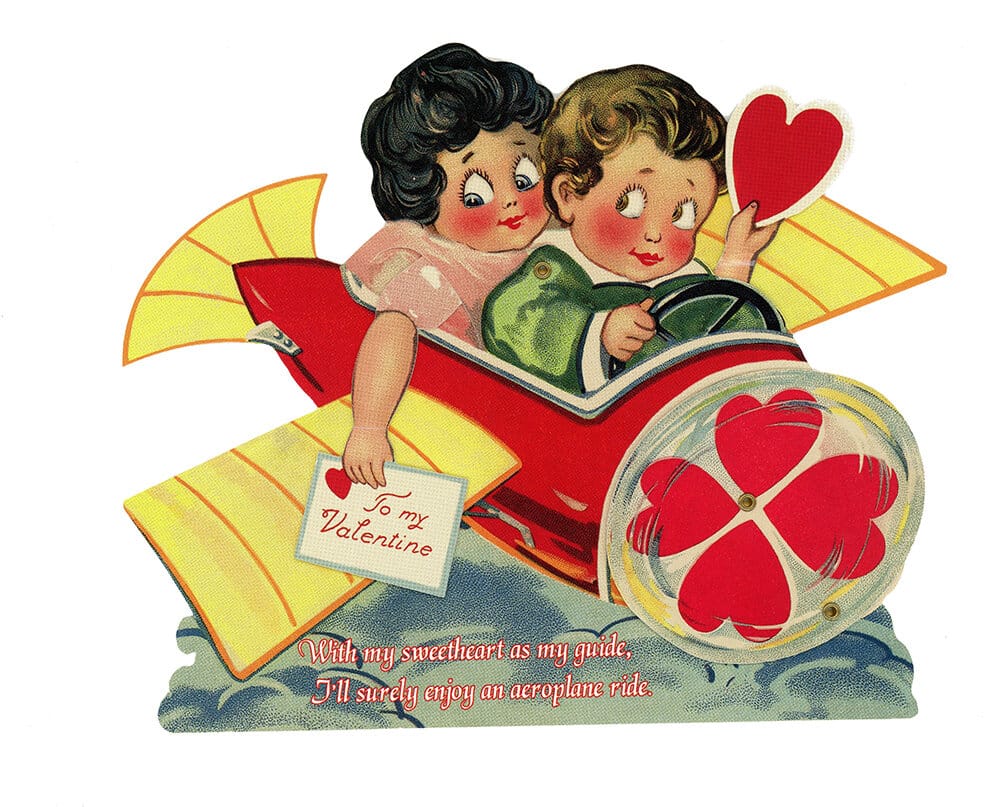
As an admirer of Amelia Earhart and other women aviators, Lark found it interesting that many, if not most, of the valentines showed women at the controls.
The Historical Society exhibit includes memorabilia relating to the life and career of pioneering Lansing aviator Marion “Babe” Weyant Ruth, who soloed for the first time in 1936, at age 18. Ruth lived next to Capital City Airport, where her mother ran a restaurant. She was fascinated with planes, hanging around the airport and getting frequent rides from obliging pilots in her early teens.
In 1933, she got a letter of encouragement from Earhart herself: “I believe that if you are not afraid to work very hard, and you really wish to enter aviation, you will be able to do so someday.” She met her idol in person when Earhart visited Eastern High School later that year.
At age 19, Ruth became the youngest licensed pilot in the nation, male or female. She went on to win a slew of awards at air shows, became one of the first woman flying instructors in the nation and taught in the aviation department at LCC in the 1970s.
She died in 2004, leaving behind a huge collection of aviation memorabilia. Castanier knew her and recalled her as “an adventurer.”
“She’d go off to Alaska and shoot elk, probably from a plane,” Castanier said. “She was that kind of lady.”
In between sundry stunts by Davis, the air show schedule in the Historical Society exhibit lists a “speed dash with racing turns” by celebrated racing pilot (and friend of Earhart) Jacqueline Cochran.
“Miss Cochran will fly the Beechcraft with which she won the New York to Miami race in January,” the flyer announces.
“Jackie Cochran was the greatest woman pilot, the first woman to break the sound barrier,” Lark said.
In Lansing, Leota Pearl Abrams (wife of Ted Abrams) also climbed into the cockpit, to the delight of the public.
“She flew competitions in the first aerial shows here in Lansing,” Lark said. “The women flyers were particularly exciting to the public. They were breaking records all the time in the 1920s and 1930s — distance, speed, time in the air — and they got a lot of press.”
By the early 1930s, Castanier said, women-only air races were common.
In their own naïve way, the valentines collected in “Love Is in the Air” reflect the public fascination with women flyers, and with aviation in general.
Not for the first time, Castanier found that fleeting, lighthearted cultural artifacts come with invisible strings that lead in many meaningful directions.
“I didn’t realize how deeply this was embedded in our culture,” Castanier said. “Women were dressing like Amelia Earhart. These people were glamorous. I don’t know what would excite everyone the same way now. It was a very special time.”