Lansing’s ‘Windlord’ sculpture waits for its new nest
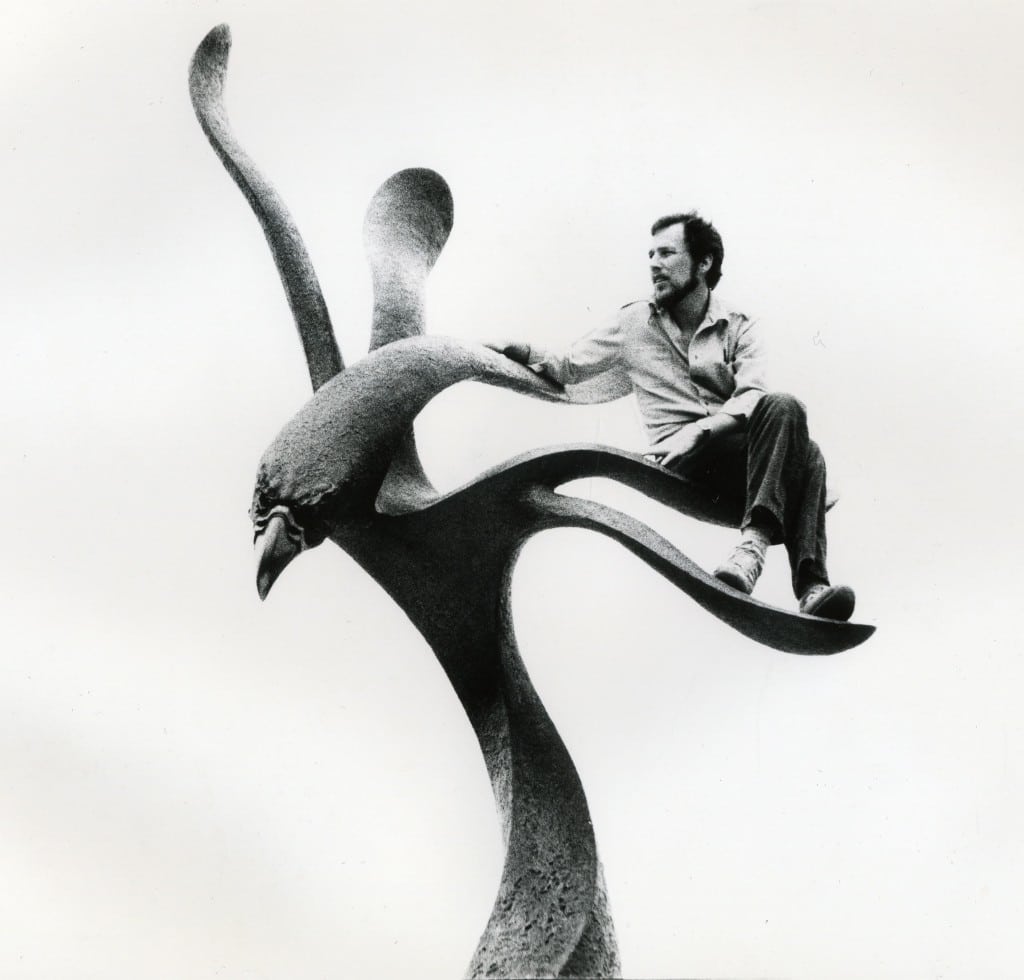
Perched on a bluff overlooking the Grand River at Adado Riverfront Park near downtown Lansing is a wine-dark eagle with a rumpled, wise face and feathers that surge into the sky.
Conceived and cast to celebrate the 1976 United States Bicentennial, “Windlord” is a deft fusion of realistic and abstract forms, fabricated over a grueling nine months using labor-intensive methods that go back millennia.
The sculptor, Martin Eichinger, has gone on to have a long and successful career, but “Windlord” was his first major work — a piece of Lansing history cast in near-indestructible bronze that may outlast the city itself.
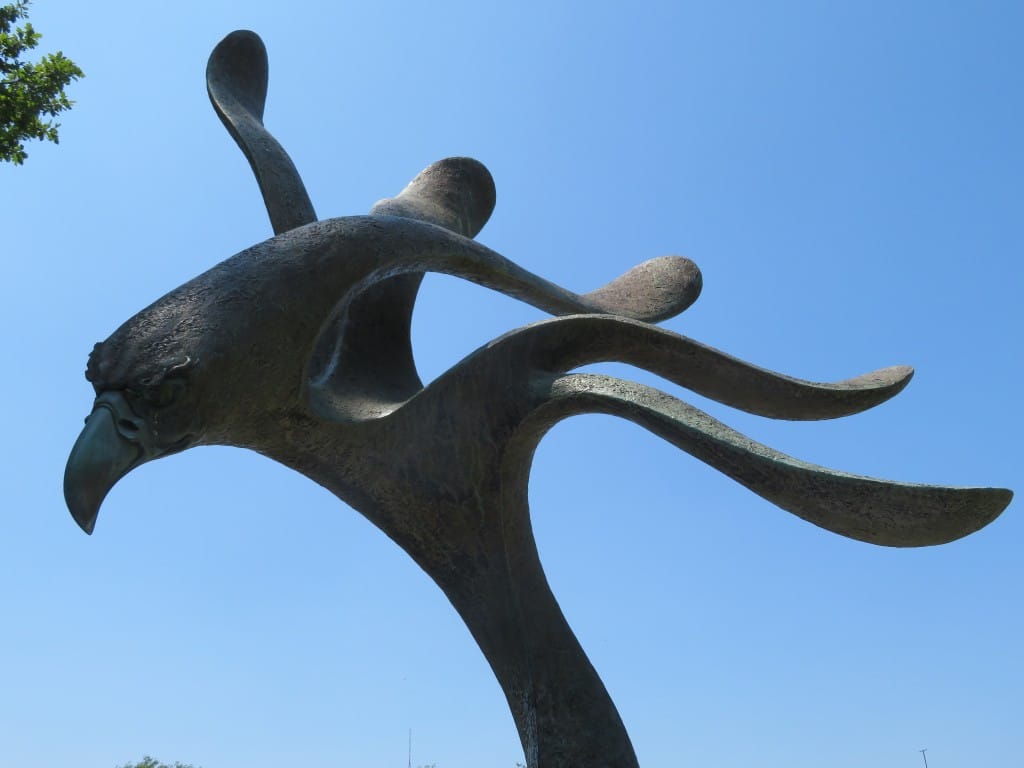
Photo by Lawrence Cosentino for City Pulse
As its 50th birthday nears, “Windlord” has reason to flex its wings with more urgency than usual. The sculpture is owned by the city and managed by the Parks Department.
Ingham County Drain Commissioner Pat Lindemann is planning to move the eagle to a new perch in a more visible location as part of the Montgomery Drain stormwater management project on the city’s far east side. An empty pedestal is ready, complete with a fountain, in the busy Michigan Avenue meridian, where thousands of motorists, bikers, shoppers and nearby residents would see it every day.
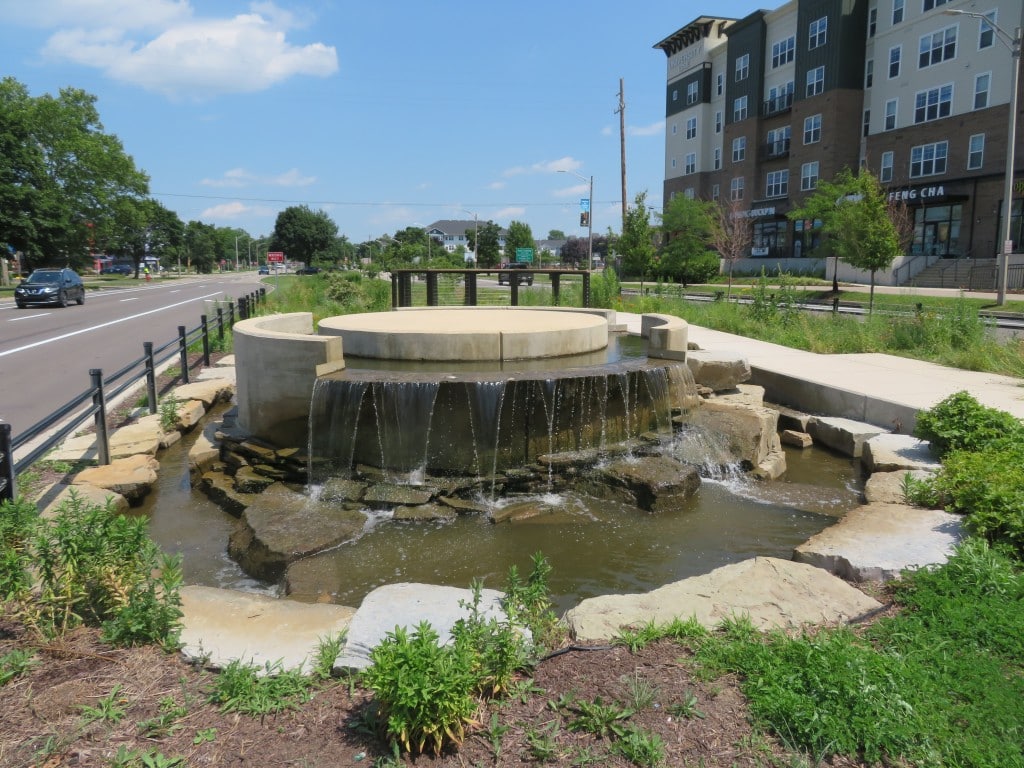
Photo by Lawrence Cosentino for City Pulse
Eichinger, now based in Portland, Oregon, endorses the change of location, and so does former Lansing City Councilman Richard Baker, who set the project going in 1976.
But there is uncertainty about the cost of moving the sculpture and fixing its lower section, a 6.5-ton raft of undulating concrete that has begun to crack and crumble.
Eichinger and Baker want the sculpture to be restored with long-term fixes that range in cost from $168,000 to $258,000, according to a 2021 engineering study.
Lindemann says he can do the job for $40,000 and that he’s only $10,000 shy of that goal, using private donations.
Courtesy photo
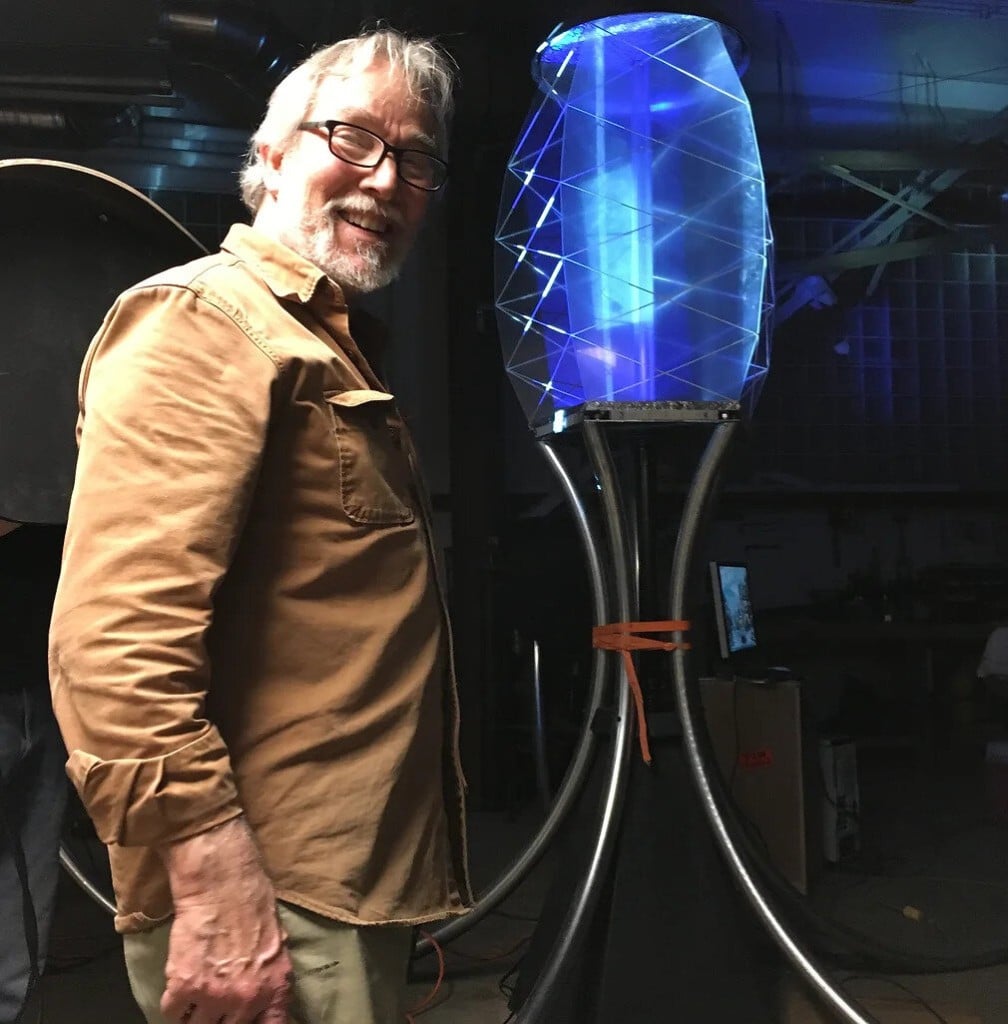
Half a century on, Eichinger called himself a “bystander, but a passionately interested bystander” in the sculpture’s ongoing saga.
‘Maybe I’ll be the artist’
In 1976, Eichinger didn’t consider himself a sculptor. When the city was planning its Bicentennial celebrations, he was an exhibit maker and graphic designer working for the city’s Parks Department.
One of Eichinger’s most durable and well-loved creations is the giant ceramic mouth full of teeth at Lansing’s Impression 5 Science Center, built in the early 1970s and still scrubbed daily by hygiene-conscious kids with baseball-bat-sized toothbrushes.
“Impression 5 has done a wonderful job of keeping it maintained with fresh paint every decade or so,” Eichinger said. “It’s amazing, considering how many kids clamor all over it every day.”
Eichinger married the founder and first director of Impression 5, Marilynne Katzen. (He jokingly called it his “last project” at the museum.) They moved to Portland in 1985 when Katzen became president of the Oregon Museum of Science and Industry.
Monumental bronze work was an unexpected career choice for Eichinger, but “Windlord” was a classic case study in the adage, “If you want something done, do it yourself.”
“I was interested in civics, what Lansing was all about, and I knew that it needed more art,” Eichinger said. He proposed that the city put together a selection committee to find an artist.
“I couldn’t get any headway with that,” he recalled. “So, I started making drawings, and all of a sudden, it was like, ‘Maybe I’ll be the artist.’ It ended up being my career for the rest of my life.”
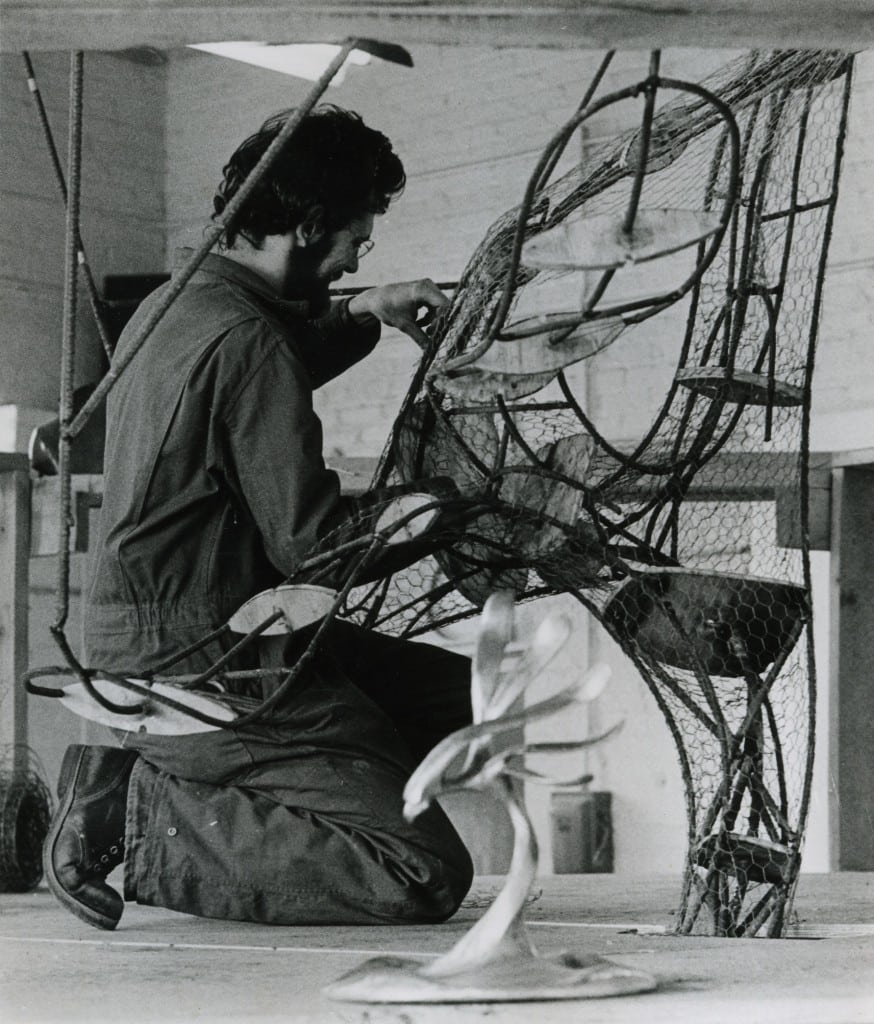
Photo by Joan Steiber
Eichinger retired from heavy-duty bronze work a few years ago, but he’s made a big mark in that strenuous medium over the past 50 years, fulfilling commissions around the world. He recently contributed to a monumental 90-sculpture extravaganza depicting the Passion of Christ at a religious retreat in Omaha, Nebraska.
His work is mostly figurative, inspired by mythological stories or stages in the human life cycle. About 1,000 Eichinger bronzes are either housed in corporate and private collections across the country or displayed in public places, like his bust of former Lebanese Prime Minister Rafic Hariri at Georgetown University in Washington, D.C.
His website features conservative, corporate-friendly bronzes — ballerinas, circus performers and such — but he’s also done some wild things, such as a 3,500-square-foot installation at Nevada’s Burning Man festival that included a bar, a dance floor, a chandelier that misted the crowd and a representation of the Tree of the Knowledge of Good and Evil, complete with a talking snake that flirted lasciviously with viewers.
Lansing was lucky to get Eichinger at a youthful peak of brashness, boldness and ambition.
“I was doing things for fun, and frequently it was very abstract,” he said.
When it came to the Bicentennial, the choice of subject was obvious.
“Our country’s symbol is the eagle,” he said. “But I wanted the eagle to be something different than you find on the back of a half dollar. I wanted it to be something a bit more fanciful, so I combined abstract elements and literal elements.”
As a “kind of last-moment thing,” he thought of identifying the eagle with Gwaihir the Windlord, the swiftest of a race of mighty eagles featured in J.R.R. Tolkien’s “The Lord of the Rings” series.
It was 1976, after all, and Tolkien’s epic saga was tucked into every student’s backpack, dog-eared and loved to death.
“He kind of saved the day, the hero that swooped in and saved everybody,” Eichinger said.
In nature, bald eagles are opportunistic, scrappy scavengers, but the benevolent Windlord gave Eichinger the opportunity to endow the bird with an uncanny human expression that still penetrates the soul.
“Now that I’m 70-something rather than 20-something, I see that a lot of more serious, art-focused people might consider that frivolous,” he said. “But I don’t apologize. It was what I made at the time, and I stand by it.”
In early 1976, Eichinger drew up some “admittedly terribly sketched” ideas and sent them to newly elected City Councilman Richard Baker.
Baker was sympathetic. He didn’t like “the hokey stuff the city was doing” to mark the Bicentennial.
“They were painting fire hydrants, and they really didn’t have anything other than that,” Baker said. “I just thought this was a great idea.”
Eichinger described Baker as “a bit of a long-haired rabble rouser,” on the opposite end of the spectrum from conservative Mayor Jerry Graves.
“Figure out how to do it and give us a real proposal,” Baker told Eichinger.
Now Eichinger was really on the spot. To learn the arcane art of bronze casting, he enrolled in the master’s degree program at Michigan State University.
“It took me a whole year to get my gumption, I guess, and skill set to the point where I could actually accomplish the thing,” Eichinger said.
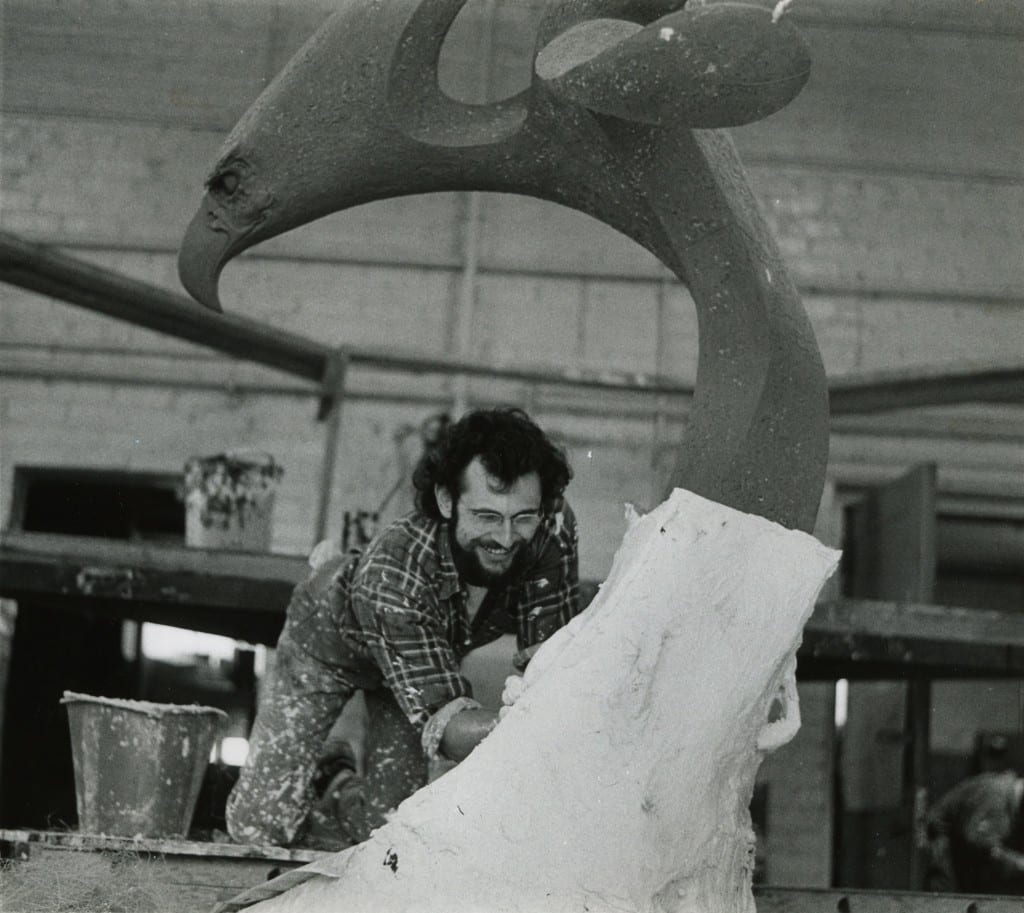
Photo by Joan Steiber
He refined “Windlord” through a series of small-scale models, or maquettes. (One of them still sits on Baker’s desk.) It started out as a realistic bird on a gnarled tree stump, but it evolved into a long-necked idealization everyone dubbed the “pterodactyl.” In the sleek and graceful final form, the tree stump was gone, and the eagle curled into the air on its own twisting column of energy.
Eichinger said he was inspired chiefly by his two favorite artists. The realistic head and beak evoke the closely observed linework of Leonardo da Vinci, while the body and wings embody the abstracted, rounded forms of monumental British sculptor Henry Moore.
“I was trapped between those two worlds and liked them both,” he said. “So, the sculpture became a little bit of both.”
At the same time, with the energy of youth, Eichinger intrepidly plunged into another arcane art: advocating for a public art project.
“It was very fun, understanding how politics works and how cities get things done,” Eichinger said. “I was in the Parks Department, with a group of people supervising me who knew nothing about sculpture. It became my job to kind of inform the department what it takes to actually make sculpture.”
He pitched the project to Gregory Deliyanne, publisher of the Lansing State Journal. Deliyanne loved the idea and got a $3,500 grant from the Gannett Foundation.
Now Eichinger could approach the City Council with a strong hand. With the support of Baker and another sympathetic young councilmember, Bob Hall, he figured the city would be reluctant to say, “No thanks, we don’t want your money.”
The council approved $16,500 for the project. George Lokken, Lansing’s federal fund coordinator, agreed that the city needed public art. Lokken helped secure another $15,000 from the Comprehensive Employment and Training Act, a federal program signed into law in 1973 by President Richard Nixon to offer job training and employment to disadvantaged and long-term unemployed people.
“When I made it, I was working for a CETA position that paid me $7.50 an hour for 40 hours a week,” Eichinger said. “I was actually working 80 hours a week.”
Tales from the bronze age
From the days pharaohs cast bronze idols in ancient Egypt until Eichinger and his assistant, Jack Bergeron, set up shop in their rented warehouse along the Grand River (now part of Impression 5 Science Center), the “lost wax” method of casting bronze sculptures has remained much the same — a long grind of inspiration and tedium, brute strength and painstaking detail work.
To get to the final, enduring monument, artisans have to work their way up the temperature gradient, all the way to molten bronze, by creating a series of “positive” sculptures (the bird itself) and “negative” molds (a shell hugging the bird).
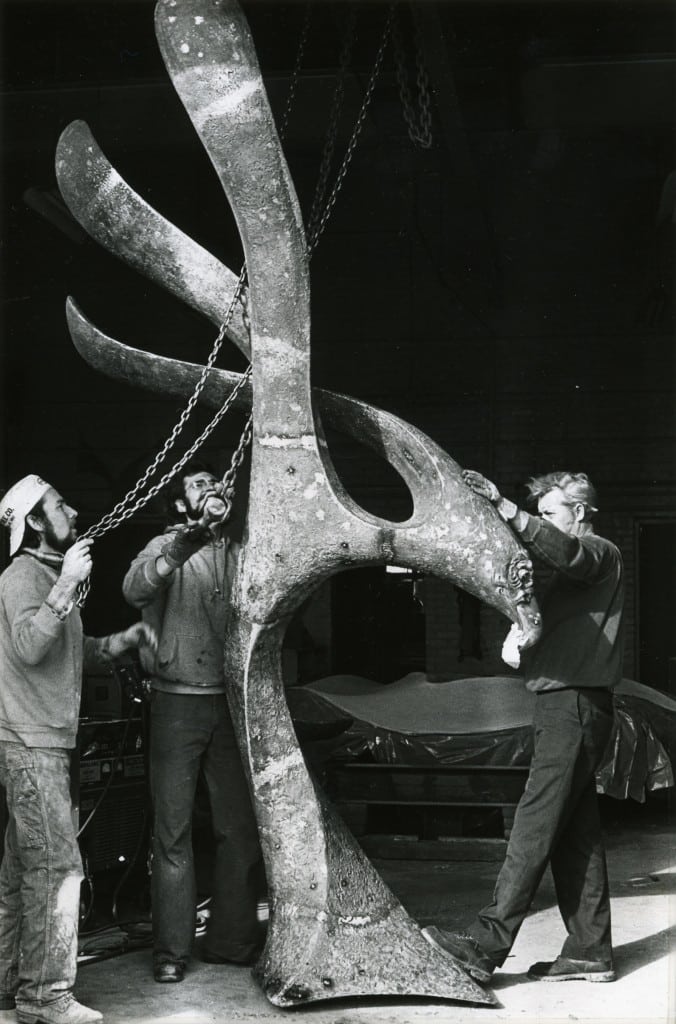
Photo by Joan Steiber
It was clear from the outset that Eichinger couldn’t get the massive job done by himself, so he on called Bergeron, an experienced sculptor and art instructor at Lansing Community College. The two had known each other for many years and even went to Boy Scout camp together.
For the first few months, Eichinger and Bergeron clambered and crawled around a full-sized, Tinkertoy-like array of steel rods and wood spacers, making sure everything was positioned to match the small model.
“Marty built the steel framework,” Bergeron recalled. “Then we put plaster and plasticine on top.” Plasticine is a synthetic, oil-based modeling clay. Bergeron and Eichinger made their own custom blend.
To create the first negative mold, the artists painted the plasticine bird with a black, spongy rubber compound.
The rubber mold is workable and captures a lot of detail, but it can’t handle molten bronze, which is heated to over 2,200 degrees.
However, it can hold liquid wax, which is only about 200 degrees.
That’s where the centuries-old “lost wax” process gets its name. Wax was brushed into the rubber molds, layer by layer, to slowly form another positive sculpture. The two-piece molds were joined together to make a detailed wax duplicate of the bird.
The bird was sleek and smooth — too smooth for Eichinger, who wanted more texture on the surface to hold the viewer’s eye.
Bergeron came up with an ultra-low-tech solution.
“I took a pebble and rolled it around the whole thing,” he said. The pebble channels are clearly visible in the finished bronze sculpture.
Next, the sculptors created a second negative mold, one that could withstand tremendous heat. They slathered the wax bird with a heavy-duty coating of plaster and fire-resistant bricks.
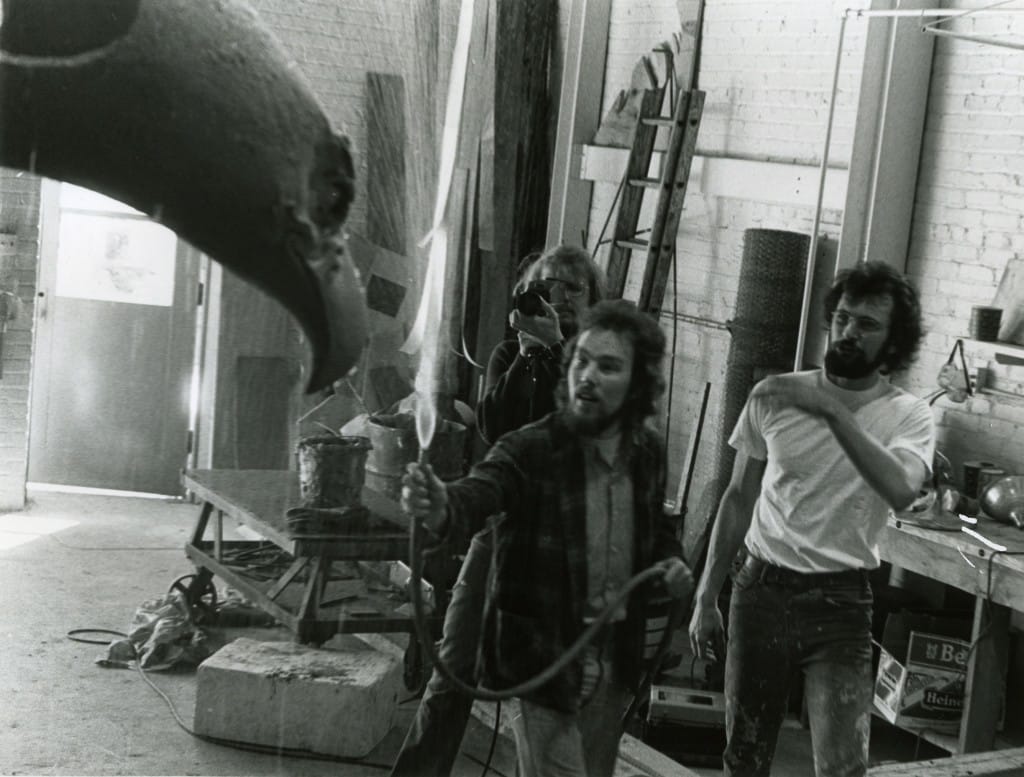
Photo by Joan Steiber
The molds, cut into pieces, were loaded onto a flatbed truck and moved to the Ypsilanti foundry of sculptor John Pappas, an art professor at Eastern Michigan University.
A documentary film on the making of “Windlord” shows all three sculptors hefting the molds into place with the aid of heavy block and tackle and an industrial hoist.
“Windlord” was much too big to cast in one piece, so Eichinger and Bergeron determined where the most logical seams should be. They created 29 separate molds — 12 around the bottom ring and 17 for the bird.
Finally, molten bronze was poured into the molds, letting air and wax escape through “sprues,” straw-like channels that fed the molten metal into different parts of the sculpture.
“It feeds from the bottom up, so as the metal comes in, the air goes out,” Bergeron said. “You keep pouring until bronze comes out the top.”
Once the bronze hardened, it took weeks for Bergeron to cut and grind off dozens of protruding spines of metal, the reverse image of the sprues, where the bronze replaced the escaping wax.
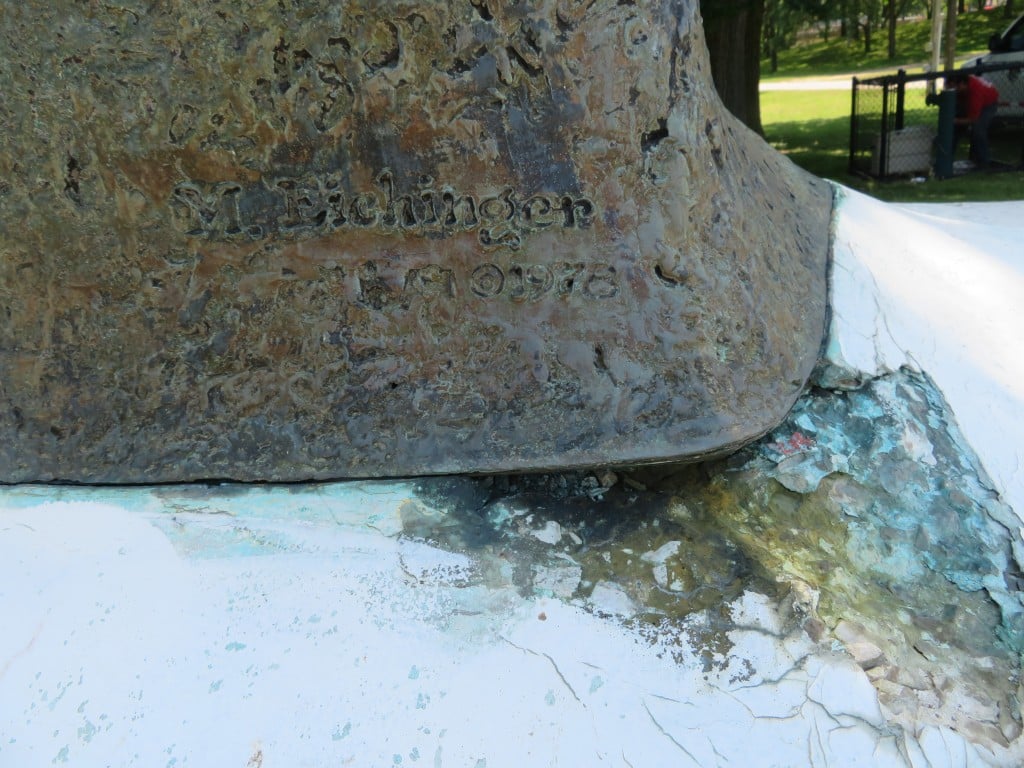
Photo by Lawrence Cosentino for City Pulse
That number of molds rose from 29 to 30 when the most critical piece of the sculpture ran into trouble.
“The inner core shifted on the most critical piece, the one that holds up the rest of the bird,” Bergeron said. “It was too thick on one spot and too thin on the other.”
Unflappable structural engineer Don Emery, assigned to the project by the city, came up with a solution. An extra piece was cast in bronze and set within the outer shell, balancing and stabilizing the bird for all time.
Despite the elaborate sculpture’s potential to fracture, tip over or otherwise fail unexpectedly, Emery wore his responsibility lightly.
“If it takes off and starts flying, we’re in trouble,” he quips in the film.
The separate pieces required 400 hot and sweaty inches of welding to fit together.
It fell to long-suffering Bergeron to make the weld marks disappear and blend into the overall skin of the sculpture. It took him another grueling month, wrangling a grinder amid showers of sparks, duplicating the texture that was there before the welds.
When work was done, the team discovered that the diameter of the sculpture exceeded that of the warehouse door by 5 inches.
Eichinger chalked it up to “the old build a boat in the basement syndrome.”
They tilted the massive bird, taking care to give it extra support, and it squeaked through the door on the diagonal.
‘It stirs you a little’
On one day each year, the Fourth of July, “Windlord” gets a bit of attention as people gather in Adado Riverfront Park to watch the downtown fireworks. Agile kids clamber up the central pillar and perch on the sculpture’s stylized wing feathers for a better view.
Otherwise, the bird has led a “sleepy life,” in Eichinger’s words.
A close look at the undulating concrete base reveals four artfully inscribed directional markers. The letters “N,” “W,” “E” and “S” were keyed to the original location planned for the sculpture, a highly visible traffic circle one block east of the state Capitol.
Eichinger envisioned the sculpture poised not only at a literal intersection, but a figurative one between state and city government.
But when the sculpture was ready, work on the traffic circle hadn’t even started, and the lease on the warehouse was running out, according to Eichinger.
The sculpture ended up in Adado Park, in a secluded spot suitable for a real eagle’s nest, but not for a grand public statement. It can hardly be seen from the nearest street (Grand Avenue), and few park visitors even notice it.
“I was never comfortable with where it was placed, on the front edge of the river in Adado Park,” Eichinger said. “I thought it disappeared there.”
“It’s kind of obscure,” Baker said. “It’s difficult to see it unless you’re looking for it.”
Eichinger likes the idea of moving the bronze bird to a high-traffic spot where Lansing, East Lansing and MSU converge. He also agrees with County Drain Commissioner Pat Lindemann that placing the sculpture in the middle of a state-of-the-art stormwater management project, amid oxygenating cascades, fountains and natural filters, will make a dramatic public statement on the link between clean water and a healthy environment for living things. Eagles are rarely seen far from water.
“I’m glad to still be around to see its new resting place,” Eichinger said. “Rather than representing the intersection between city and state governments, it will represent the intersection between humans and nature.”
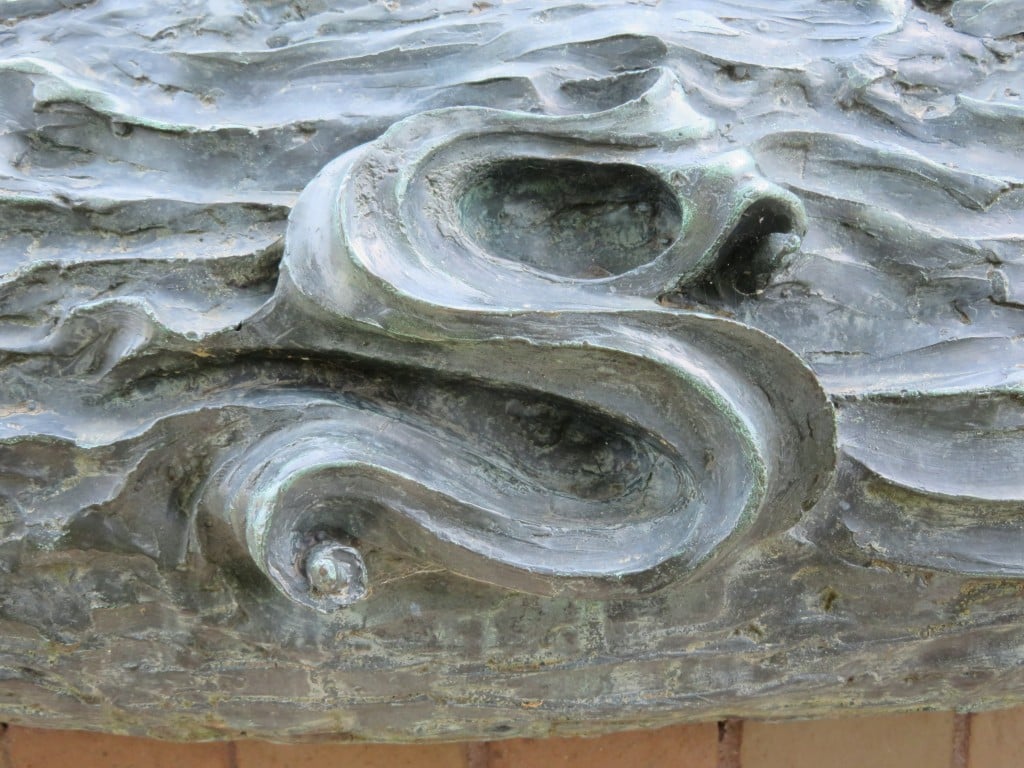
Photo by Lawrence Cosentino for City Pulse
Baker and Eichinger hoped the sculpture would settle in its new perch by July 4 of this year, in keeping with its Bicentennial origins.
The bird itself is good to go, having shrugged off nearly 50 Michigan winters and summers. Bronze, an alloy of copper and tin, doesn’t rust. On the contrary, instead of corroding, it has formed its own protective layer, or patina, over time. With a good cleaning and a fresh coat of protective wax, it will be ready to roost for another 150 years, at least.
But the decaying concrete base of the sculpture shows clear signs of wear, having endured half a century of northern freeze-and-thaw cycles. The wavy, artfully textured, 6.5-ton “potato chip,” as Bergeron lovingly called it, needs some love, and the money for the job isn’t there yet.
In August 2021, the city of Lansing hired the C2AE engineering firm to assess the state of the sculpture and suggest a plan for stabilizing and moving it to the new Michigan Avenue perch.
The engineer came up with two options. The cheaper option, pegged at $168,000, involved chipping off the compromised concrete in the base, applying a new epoxy-filled concrete surface coating and resurfacing the sculpture with a bronze-filled epoxy surface.
The more expensive option, pegged at $258,000, was to remove the bad concrete at the base and replace it with a cast bronze coating, bringing the work full circle to the sculptor’s first vision.
“That was the original plan, but the city didn’t have the money for it 50 years ago,” Eichinger said. “That got replaced with concrete instead.”
Doing it the expensive way would be cost effective over the life of the sculpture, according to civil engineer Bill Kimble, government market leader at C2AE, because a concrete base will need repair every 50 years, but a bronze base will last 200 years.
Good luck finding a municipality or county willing to budget on a 200-year timescale.
Lindemann said he has contractors lined up who will move and fix the sculpture for far less than the 2021 estimates, using cold-applied coatings of liquid bronze instead of expensive cast bronze.
“It’s about $45,000 to $50,000 to have the artist work on the base, and the city of Lansing is offering $25,000 of that,” Lindemann said. “We’re going to put liquid bronze on it. It’s going to be thick enough, and it should hold it for another 50 to 100 years, at least.”
Eichinger said he would be satisfied with either of the two methods proposed in the 2021 study, but he called Lindemann’s $40,000 an “impossible number.”
“My concern is that this sculpture that’s lasted miraculously for 50 years is going to be patched in a way that’s not sustainable, that in another 10 years it’s going to have more cracks and get ugly again,” Eichinger said.
With the city of Lansing only willing to contribute $25,000 to the project, Baker would like to see Ingham County take it on.
“The idea of the county Parks Department running it is not far-fetched,” Baker said. “It sits right on the Lansing-East Lansing line.”
It so happens that last week, Ingham County Commissioner Robert Peña was in the midst of the Fourth of July riverfront crowd, admiring “Windlord” along with the fireworks.
“It stirs you a little,” he said. “The spirit soars. Art like this is appreciated by people beyond the life of the artist.”
But a soaring spirit is about all he could promise.
“These are truly trying times,” Pena said, citing recent cuts in a range of federal programs. “I can’t commit to the responsibility of stewardship of the sculpture in perpetuity. We just don’t have the money.”
Undaunted, Baker said he’s ready “to go into fundraising mode.” Now in his 70s, he considers “Windlord” to be a crucial part of his legacy as a councilmember. He thinks potential donors are out there to raise enough money to restore the sculpture in cast bronze, as was originally intended.
“I’m ready to write letters, talk to people, do fundraisers and things like that,” he said.
Lindemann counseled patience.
“I love the sculpture, but he wants to put a bronze base on there that will last forever, and I can’t afford that,” Lindemann said. “I have a place to put it. I just need another $10,000.” After that, he said, it would take “three or four months” to complete restoration work and hoist the eagle onto its new perch.
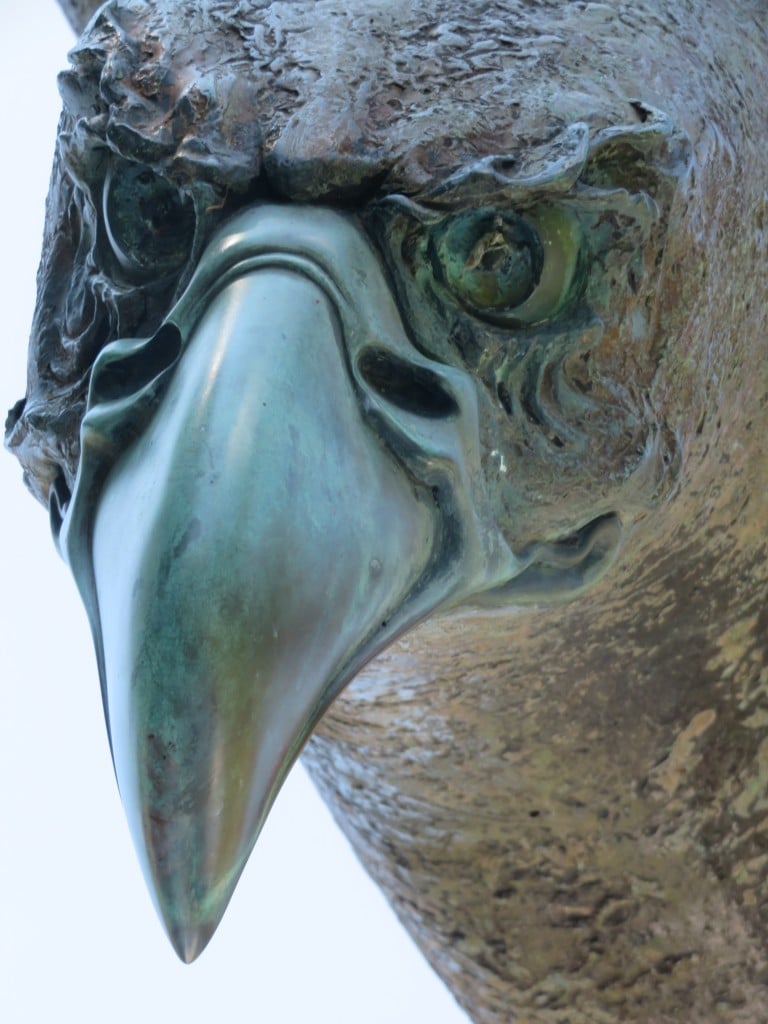
Photo by Lawrence Cosentino for City Pulse
“Windlord” was dedicated on the chilly morning of Jan. 28, 1979. After months of being covered in plaster dust, metal shards and sweat, Eichinger switched to a formal suit and top hat.
“Here you go, it’s yours,” he said to City Councilman Louis Adado.
“It was Marty’s first metal project, and I to this day, I can’t believe they pulled it off,” Baker mused.
For the second time in 50 years, “Windlord” has become a test of a city’s willingness to invest in public art, whether it’s done through public, private or mixed means.
“If people like the sculpture, I hope they’ll be proud of the fact that it happened here in Lansing, not brought in from Nevada or California,” Eichinger said in 1979. “You import artwork and you don’t really have culture, but when a city can make a decision or engender an atmosphere where it allows artwork to happen, that’s really culture.”